
Introduction
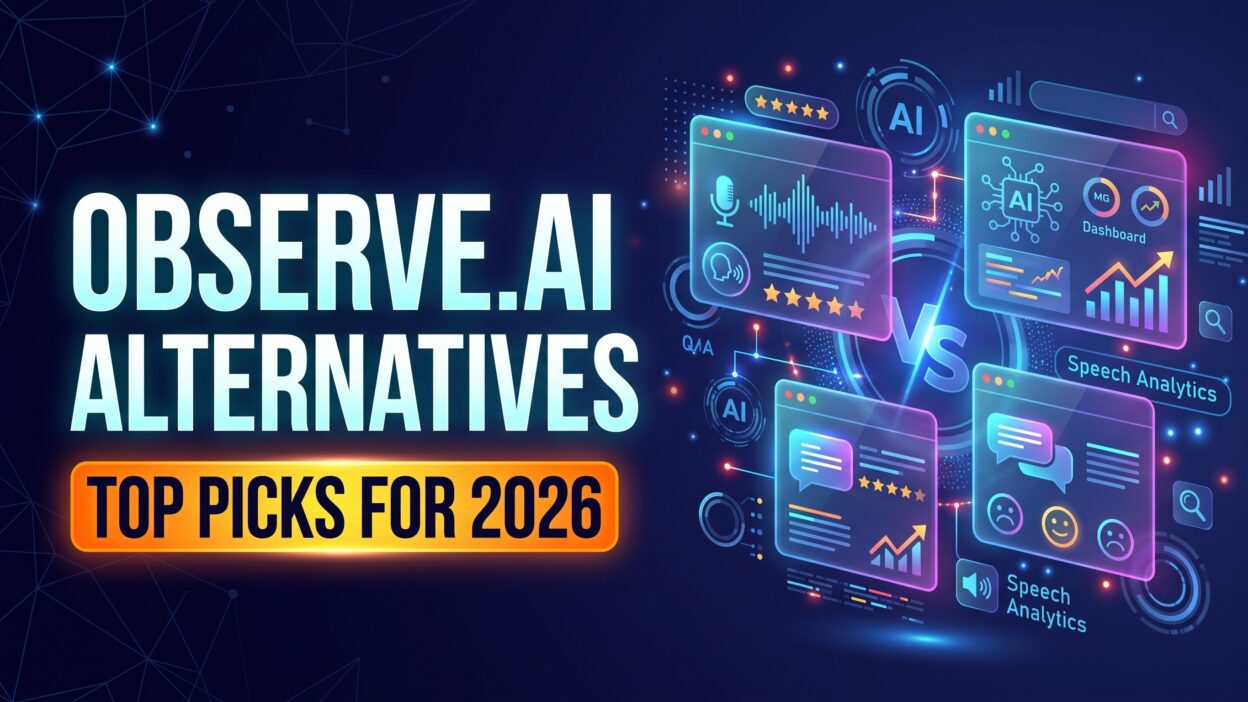
TL;DR Contact centers want faster coaching and cleaner quality scores. Observe.AI helps many teams reach those goals. It does not fit every team. Pricing, features, and workflow needs push buyers to explore other options.
This guide covers seven Observe.AI alternatives for 2026. You will see what each platform does best. You will see where each one falls short. Details come from public vendor pages and review sites. Confirm every claim with a live demo.
The right tool improves agent performance and customer satisfaction. The wrong tool adds dashboards nobody reads. Read each section with your own contact center in mind.
Table of Contents
What Is Observe.AI?
Observe.AI is a conversation intelligence platform for contact centers. It uses speech analytics and AI to analyze customer interactions. It scores calls, supports coaching, and flags compliance gaps. Public sources describe coverage across voice, chat, and email.
Core Capabilities
The platform automates quality management. It transcribes calls and evaluates them against scorecards. Supervisors review results and coach agents. Real-time agent assist features guide reps during conversations. The vendor offers AI agents for automated interactions.
Who Uses It
Mid-sized and large contact centers use it most. QA managers replace manual call audits with automation. Coaches get data to guide one-on-one sessions. Operations leaders track trends across teams.
Why Teams Look for Observe.AI Alternatives
Happy customers compare vendors. Markets shift fast. Good teams check the field before every renewal.
Scorecard and Reporting Limits
Some QA teams report that scoring templates are hard to customize. Complex or industry-specific rubrics need flexibility. Rigid reporting frustrates analysts. They want custom views without vendor tickets.
Real-Time Needs
Observe.AI built its name on post-call analytics. Teams that need live guidance during conversations may want deeper tools. Compliance-heavy sales calls fall in this group. Supervisors want prompts at the exact moment an agent speaks.
Accuracy and Usability
Review sites mention transcription errors in AI summaries. Accuracy varies by accent, audio quality, and industry terms. Some users cite a steep learning curve. Clean interfaces drive adoption.
Pricing and Packaging
Observe.AI uses custom enterprise pricing. You must talk to sales for a quote. Some buyers want published prices. Others want a bundle that covers QA, agent assist, and automation under one contract.
How to Choose Among Observe.AI Alternatives
Good decisions start with clear goals. Write them down before you watch a demo.
Criteria That Matter
Start with accuracy. Test transcription on your own calls. Check scorecard flexibility. Build one of your hardest rubrics. Review real-time features. Measure delay and relevance. Verify integrations with your phone system, CRM, and ticketing tools. Confirm security items such as SOC 2 and single sign-on. Compare reporting depth.
Questions to Ask Vendors
Ask how the platform handles accents and noisy audio. Ask how long onboarding takes. Ask what data you can export. Request customer references at your size. Ask how often the vendor ships updates. Demand a pilot on live data. A pilot reveals more than a slide deck.
Key Features to Compare
Speech Analytics and Transcription
Everything starts with the transcript. Poor text ruins scoring, search, and coaching. Test each vendor on noisy calls. Test accents. Test product names and jargon. Ask for accuracy numbers on your audio. Request a side-by-side test.
Automated Quality Management
Automation should score every call, not a small sample. Check how the tool handles subjective questions. Look at how you edit criteria. Confirm calibration tools exist. Supervisors need to challenge scores and fix them fast.
Agent Assist and Coaching
Real-time prompts help during live calls. Post-call coaching helps agents grow. Some platforms do one well. A few do both. Match the mix to your goals. Watch for prompt overload. Agents ignore noisy suggestions.
Integrations and Security
Your tool must connect to telephony, CRM, and ticketing systems. Check native connectors. Check API depth. Confirm SOC 2 reports, single sign-on, and role-based access. Ask about data retention and redaction of card numbers.
Top Observe.AI Alternatives for 2026
The seven platforms below take different approaches. Some layer on top of your phone system. One replaces it. Descriptions reflect public information and change often.
1. Level AI
Level AI unifies several jobs in one platform. It covers AI-powered QA, agent assist, voice of the customer, and automation. The vendor stresses accuracy and a multimodal approach. Contact centers that want fewer vendors fit well here.
Level AI suits enterprise teams that want QA and insights together. Compare scorecard flexibility against your current setup. Pricing uses custom quotes.
2. Cresta
Cresta focuses on live coaching and agent assist. It offers prompts during calls. Its materials stress behavioral best practices and outcome data. It extends into AI agents for autonomous work.
Cresta suits sales-heavy and compliance-heavy teams. Live intervention matters most there. Expect a sizable investment. Pricing uses custom quotes.
3. Balto
Balto delivers prompts and coaching during live conversations. Agents see suggestions as the call unfolds. Supervisors shape guidance around scripts and compliance steps. The platform targets moments where deals and rules hang in the balance.
Balto fits teams with strict call flows. Third-party reviews flag a higher price point than many rivals. Test it against your scripts.
4. CallMiner
CallMiner is a long-standing speech analytics vendor. It analyzes calls, chats, and emails at scale. Analysts build categories and track trends. Compliance and risk teams rely on its search tools.
CallMiner fits analytics-driven organizations. The platform rewards skilled analysts. Plan for training time. Pricing uses custom quotes.
5. NICE
NICE replaces your contact center infrastructure rather than layering on top. Its CXone platform combines routing, workforce tools, and analytics. Buyers who want one stack choose it.
NICE fits large enterprises ready for a platform shift. Migration takes serious planning. Contract size reflects the scope. Pricing uses custom quotes.
6. Verint
Verint offers workforce engagement tools. They cover quality management, scheduling, and analytics. Large contact centers use it to link performance to staffing. Leaders view agent quality and capacity together.
Verint fits enterprises that want workforce and quality data in one place. Rollouts need dedicated admins. Pricing uses custom quotes.
7. MaestroQA
MaestroQA focuses on quality assurance and coaching. Support teams build detailed scorecards. Graders review conversations and score them fast. Reporting highlights trends by agent and topic.
MaestroQA fits customer support teams that value scorecard control. Real-time features are lighter than Cresta or Balto. Pricing uses custom quotes.
Observe.AI Alternatives Pricing Compared
Almost every vendor here sells through custom quotes. Published numbers rarely exist. Expect enterprise contracts. Treat any public figure as a rough guide.
What Drives the Final Price
Seat count drives cost. Interaction volume drives cost. Modules such as QA, agent assist, and automation add fees. Languages and channels add more. Multi-year terms lower unit rates. Implementation and training add one-time charges.
How to Compare Fairly
Write one scope document. Include agent count, monthly call volume, channels, and modules. Send the same document to every vendor. Ask for itemized quotes. Compare three-year totals. Add internal staff time. Ask about renewal caps.
Which of These Observe.AI Alternatives Fits Your Team?
Match the tool to your biggest pain. Team type usually points to the right answer.
QA-Focused Support Teams
Choose MaestroQA, Level AI, or CallMiner. All three put quality scoring and analysis at the center. MaestroQA gives scorecard control. Level AI bundles QA with agent assist and voice of the customer. CallMiner offers deep search and categories. Build your toughest rubric in each demo.
Real-Time Coaching Teams
Choose Cresta or Balto. Both guide agents during live calls. Cresta ties guidance to outcome data. Balto ties prompts to scripts and compliance steps. Listen to live demos. Judge how relevant each prompt feels.
Teams That Want One Platform
Choose NICE, Verint, or Level AI. NICE replaces infrastructure. Verint joins workforce and quality data. Level AI joins QA, assist, and automation. Count the vendors you want to retire.
Compliance and Risk Teams
Choose CallMiner or Verint. Both support large-scale search and monitoring. Ask about redaction, audit logs, and retention controls. Involve your legal team early.
Real-World Scenarios
Picture a support team of eighty agents. QA staff grade five percent of calls. They want full coverage and flexible rubrics. MaestroQA or Level AI fits.
Picture a sales floor with strict disclosure rules. Missed phrases create legal risk. Live prompts matter. Cresta or Balto fits.
Picture a bank with a large compliance team. Analysts search millions of interactions for risk terms. CallMiner or Verint fits.
Picture a company ready to replace its phone platform. Leaders want one vendor for routing, workforce tools, and analytics. NICE fits.
Migration Tips
Moving to one of the Observe.AI alternatives takes planning. Start with a data audit. List the scorecards, reports, and integrations you use today. Export call data and QA results. Tell supervisors and agents about the change early.
Run both tools in parallel for a short period. Compare transcripts and scores. Calibrate graders on the new system. Train coaches on new dashboards. Review contract dates and notice periods. Cancel on time. Auto-renewals catch many teams.
Observe.AI Alternatives FAQs
What are the best Observe.AI alternatives for contact centers?
Level AI, Cresta, Balto, CallMiner, NICE, Verint, and MaestroQA lead the list. Level AI fits unified needs. Cresta and Balto fit live coaching. CallMiner and Verint fit compliance. NICE fits platform replacement. MaestroQA fits scorecard control.
Why do teams leave Observe.AI?
Reasons vary. Some teams want more scorecard flexibility. Some want stronger live guidance. Some report transcription errors. Others want different pricing or packaging.
Which tool offers the best real-time guidance?
Cresta and Balto focus most on live prompts. Test both on your scripts. Measure how often agents follow the suggestions.
Which tool has the most flexible scorecards?
MaestroQA builds its pitch around scorecard control. Level AI and CallMiner also offer deep configuration. Build your hardest rubric in each trial.
Is there a free alternative?
Few enterprise tools are free. Some vendors offer trials or limited pilots. Ask each sales team for terms in writing.
Can I switch without losing call data?
Yes, with planning. Export recordings, transcripts, and QA scores before you cancel. Ask the new vendor about data import. Confirm retention rules.
How long does implementation take?
Light deployments take weeks. Platform replacements take months. Clean integrations and clear scorecards speed every project.
Do these tools integrate with Salesforce and Zendesk?
Most enterprise vendors support major CRM and ticketing systems. Depth varies. Confirm native connectors and API access before you commit.
Read More:-IQVIA Review 2026: Is This Life Sciences Platform Right for You?
Conclusion

Observe.AI serves many contact centers well. Your needs may outgrow it. Seven strong options exist. Level AI unifies QA, assist, and insights. Cresta and Balto guide agents live. CallMiner and Verint serve compliance and analytics. NICE replaces the whole stack. MaestroQA gives support teams scorecard control.
The right pick among Observe.AI alternatives depends on your biggest gap. Name that gap. Set your criteria. Request itemized quotes. Pilot two finalists on real calls. Measure transcript accuracy, scoring quality, and agent adoption.
Prices and features change often. Verify every detail with each vendor. Trust your own pilot data over any review. Choose the platform your agents and supervisors will use every day.