
Introduction
TL;DR A customer signs up on Monday. By Friday that person has forgotten your name. This happens every day in every industry. People buy with excitement. Life pulls their attention away. Your product sits unused. Weeks later they cancel.
You can close that gap with an onboarding drip campaign. A drip series sends planned messages over time. Each message helps the new customer take one small step. Small steps build confidence. Confidence builds loyalty.
Table of Contents
What Is an Onboarding Drip Campaign?
An onboarding drip campaign is a series of automated messages that welcome and guide a new customer. The series starts when someone signs up or buys. Each message arrives on a set schedule or after a specific action. The goal is simple. The customer reaches real value fast.
Think of the series as a friendly guide. The guide walks beside your customer through the early days. It never shouts. It shares one useful idea at a time. It answers questions before the customer asks them.
The word “drip” matters. Messages arrive in small doses. A flood of information overwhelms people. A steady trickle lets them absorb each lesson and act on it.
Drip Series Versus a Single Welcome Email
A welcome email says hello once. A drip series keeps the conversation alive. It teaches, nudges, and checks in. One email cannot carry that load. Most customers skim a welcome message and forget it by lunch.
A drip series builds a habit. Customers learn to expect helpful notes from you. They open them. They trust your brand a little more with each useful message.
Time-Based and Behavior-Based Drips
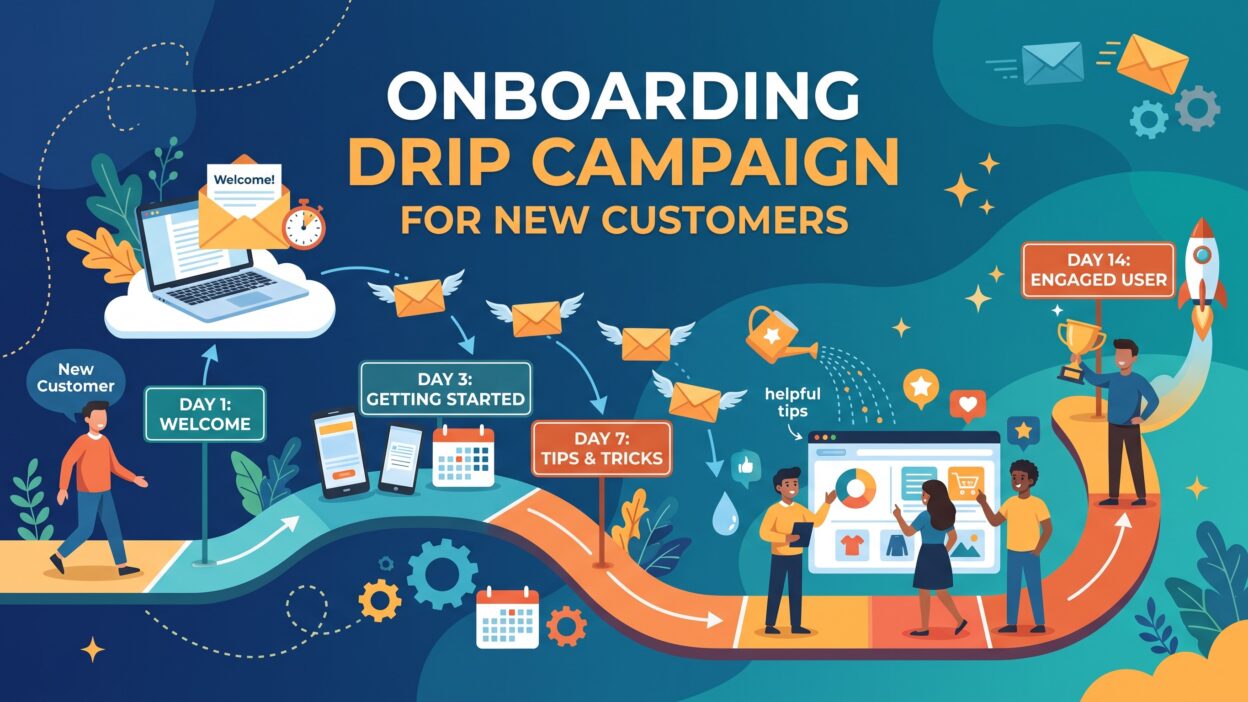
Time-based drips follow a calendar. Day one sends the welcome. Day three sends a tip. Day seven sends a story. Behavior-based drips react to what the customer does. A customer who finishes setup gets a congratulations note. A customer who stalls gets a helpful nudge.
The best plans mix both styles. Time-based messages give structure. Behavior-based messages feel personal because they match real actions. Start with time-based drips if you are new. Add behavior triggers as your data grows.
Why New Customers Need Guided Onboarding
The first days decide the relationship. Customers feel the most excitement right after they buy. That excitement fades fast. A clear path keeps it alive. A confusing start kills it.
Many customers never reach the moment that proves your value. They get stuck on setup. They cannot find a key feature. They feel lost and quit. Support teams hear the same questions all week. A guided series answers those questions in advance.
The Cost of Doing Nothing
Early churn hurts the most. You paid to win that customer. You lose the whole investment if they leave in month one. Refund requests rise. Reviews turn negative. Word of mouth turns sour.
Silence sends a message too. A customer who hears nothing assumes you do not care. Competitors fill that silence with offers and ads.
What a Well-Built Series Delivers
A good onboarding drip campaign lifts activation rates. More customers finish setup. More customers use your best features. Support tickets drop. Customer lifetime value grows because people who succeed early stay longer and buy more.
Your team saves time. Automation handles routine education. Success managers focus on high-value accounts. Marketers gain a steady stream of data about what customers read and what they ignore.
Set Clear Goals Before You Write a Word
Every plan needs a target. Decide what success looks like before you open your email tool. Vague goals produce vague messages.
Start with the activation moment. This is the action that proves a customer gets value. A project tool might pick “created a first project.” A fitness app might pick “completed a first workout.” A store might pick “made a second purchase.” Study your best customers. Find the action they all took early.
Pick one main goal for the series. Pick one or two support goals. The main goal might be activation. Support goals might be profile completion or feature adoption. Too many goals dilute every message.
Set a deadline. Decide how many days customers have to reach the goal. Seven to thirty days works for many products. Complex software may need longer.
Write the goal in one sentence. Share it with your team. Every onboarding drip campaign you build will test that sentence. If a message does not move customers toward the goal, cut it.
How to Build an Onboarding Drip Campaign
Building the series takes planning more than technical skill. Follow these stages in order and you will avoid most headaches.
Map the Customer Journey
Sketch what happens from sign-up to success. List every screen and decision. Mark the moments of confusion. Ask support staff where customers struggle. Read old tickets. Watch session recordings if you have them.
Each trouble spot becomes a message. A customer who struggles to connect an account needs a short guide. A customer who ignores a key feature needs a reason to try it.
Choose Your Triggers
A trigger starts the series. Common triggers include account creation, first purchase, and free trial start. Pick the event that signals real intent. A newsletter sign-up differs from a paid purchase. Each one deserves its own path.
Add smaller triggers inside the series. A missed login for three days can fire a nudge. A completed task can fire praise. These triggers keep the series relevant.
Plan the Message Sequence
Decide how many messages you need. Five to eight emails cover most products. Space them closely at the start. Customers pay the most attention in the first 48 hours. Stretch the gaps as the weeks pass.
Give each message one job. One message teaches one skill. One message shares one story. One message asks for one action. Messages with many asks confuse readers.
Write Each Message
Start with the subject line. Keep it under 50 characters. Say what the reader gains. Skip tricks and all caps. Write the body in plain language. Use short paragraphs. Use the customer’s name once. Place a single button near the top for the main action.
Write like a helpful colleague. Avoid jargon. Avoid long brand speeches. Say what to do and why it helps. End with a way to reach a human.
Design for Mobile and Speed
Most people read email on phones. Test every message on a small screen. Use large buttons and readable fonts. Keep images light. Make the main action visible without scrolling.
Set Exit Rules
Remove customers from the series when they reach the goal. Nobody wants a “get started” email after they already started. Remove customers who open a support ticket. Let a human take over. Remove customers who unsubscribe the same day.
A Sample Seven-Message Onboarding Drip Campaign
Here is a template you can adapt. Change the timing to match your product. Keep the purpose of each message.
The Welcome (Day 0)
Send this within minutes of sign-up. Thank the customer. Confirm what they bought or joined. Tell them the one step to take now. Include a login link. Give a support contact. Keep it short. Welcome emails earn high open rates, so make every line count.
The Quick Win (Day 1)
Show the fastest route to a first result. Use a short video or a three-line guide. A quick win gives a taste of value. Customers who win early keep going.
The Key Feature (Day 3)
Pick the one feature that drives retention. Explain why it matters. Show how to turn it on. Link to a help page. Skip minor features. Save them for later.
The Success Story (Day 5)
Share a short customer story. Pick someone similar to your new customer. Show the result that person achieved and the steps they took. Stories build belief. A reader thinks, “I can do that.”
The Nudge (Day 7)
Check progress. Customers who finished setup get praise and a new tip. Customers who stalled get a friendly offer of help. Offer a short call or a chat link. Keep the tone warm. Never scold.
The Deeper Value (Day 14)
Introduce an advanced tip or a community resource. Invite the customer to a webinar or office hours. This message moves people from learning to mastering.
The Feedback Request (Day 30)
Ask how things are going. Use a one-question survey. Thank them for their time. Offer help to anyone who reports trouble. Feedback shows you what to fix in your series.
Segment Your Audience for Better Results
One onboarding drip campaign rarely fits every customer. A solo freelancer and a fifty-person team need different guidance. A beginner needs basics. An expert wants shortcuts. Send each group the lesson that fits.
Start with simple segments. Split by plan type, company size, or job role. Add use case when you can. Ask one or two questions during sign-up. The answers route people to the right path.
Use behavior to refine your groups. Customers who log in daily need different messages than customers who vanish. Track which features each person touches. Send tips about the features they ignore.
Keep the number of paths manageable. Three to five paths beat twenty. Each path needs writing, testing, and upkeep. Build more only when data proves the need.
Go Beyond Email
Email carries most of the load. Other channels add power. In-app messages reach customers while they use the product. A tooltip beats an email when someone stands at the exact screen that confuses them.
SMS works for time-sensitive nudges. Use it with care. Get permission first. Send only short, useful texts. Push notifications suit mobile apps. Keep them rare.
Human touches matter. A personal note from a success manager lifts trust. A quick call to a high-value account can seal the relationship. Automation handles scale. People handle warmth. Combine both.
Tools That Run the Series
Most email platforms support simple automation builders. HubSpot, Mailchimp, Customer.io, ActiveCampaign, and Braze all offer them. Product-focused tools such as Intercom and Userpilot handle in-app messages and behavior triggers.
Choose a tool that connects to your product data. Behavior triggers need events from your app. Check CRM integration. Check reporting depth. Check pricing as your list grows.
Start small. A basic tool with five working messages beats an advanced platform with none. Upgrade when your needs outgrow your setup.
Metrics That Prove the Series Works
Leaders fund what they can measure. Pick a few numbers and track them from launch day.
Open rate tells you whether your subject lines work. Click rate tells you whether your content drives action. Neither number proves success alone. They point you toward problems.
Activation rate matters most. Count the share of new customers who reach your key moment within your target window. Compare that number before and after the series. A rise proves the series earns its keep.
Time to value shows speed. Measure the days between sign-up and the first win. Shorter times predict stronger retention.
Support volume reveals hidden gaps. Track tickets from new customers in their first month. A good series cuts repeat questions. A spike in one topic tells you which message needs work.
Retention closes the loop. Check churn at 30, 60, and 90 days. Compare customers who completed the series against those who did not. Watch unsubscribe rates too. A high rate signals that your messages feel off.
Test and Improve Your Series
Your first draft will not be your best draft. Treat launch as the starting line.
Test one change at a time. Try two subject lines on the same message. Send each to half your audience. Pick the winner after enough people respond. Run the next test the following week. Small gains stack up over months.
Test timing. Some audiences open emails at breakfast. Others open them late at night. Test send times and days. Test the gap between messages.
Test length and format. Compare a short text email against a designed email. Compare one button against two links. Let the numbers settle debates in your team.
Listen to customers. Read replies. Read survey answers. Talk to a few new users each month. One conversation can reveal a problem that no dashboard shows.
Review the full series every quarter. Products change. Customers change. Update screenshots, links, and claims. An outdated message hurts trust faster than silence.
Common Mistakes to Avoid
Many teams stumble in the same places. Avoid these traps and you will beat most competitors.
Some teams send too many messages. Customers feel buried and tune out. Respect their attention. Send only what helps.
Some teams sell too hard. A new customer already paid. Pushing upgrades in week one feels greedy. Earn trust first. Ask for more later.
Some teams write for themselves. They share company news and feature lists. Customers care about their own goals. Frame every message around what the customer wants to achieve.
Some teams skip exit rules. A customer finishes setup and still gets beginner emails. That looks careless. Build exit rules before launch.
Some teams ignore mobile. A broken layout on a phone loses the reader in two seconds. Test on real devices.
Some teams launch and walk away. Links break. Features change. Results slide. Assign an owner who reviews the series every quarter.
Some teams hide the human. Every email comes from a no-reply address. Customers feel they talk to a wall. Send from a real name. Invite replies. Answer them.
Frequently Asked Questions
How long should an onboarding drip campaign last?
Most series run seven to thirty days. Simple products need less time. Complex software may need sixty or ninety days. Match the length to the time customers need to reach their first win.
How many emails should the series include?
Five to eight emails suit most products. Each message needs one clear job. Add more only when data shows customers need more help.
When should I send the first message?
Send it within minutes of sign-up or purchase. Excitement peaks right then. A fast welcome sets a professional tone.
What is a good open rate?
Rates vary by industry and audience. Compare your results to your own baseline. Welcome emails usually beat later messages. Aim to improve each number over time.
Can small businesses run this kind of series?
Yes. A small shop can send three well-written emails with a basic tool. Start simple. Grow the series as your customer base grows.
Does it work for ecommerce?
Yes. Ecommerce series teach customers how to use a product, care for it, and reorder. They also invite reviews and share related items after trust builds.
Should I automate everything?
No. Automation handles routine education. Humans handle sensitive moments. Let customer success reach out to large accounts and stalled users.
How often should I update the series?
Review it every quarter. Update it after any major product change. Fix broken links and outdated screenshots right away.
Read More:-InsightSquared Alternatives for Revenue Teams [2026]
Conclusion

New customers arrive with hope. They leave when hope meets confusion. You can change that story with a plan.
A well-built onboarding drip campaign turns a quiet sign-up into an active relationship. It welcomes people, teaches them, and nudges them toward success. It cuts support load and lifts retention. It gives your team data about what customers need.