Introduction
TL;DR Remote work changed everything about how teams operate. AI tools changed it even further. Now a new concept is reshaping how developers and businesses run automated workflows from anywhere.
Claude Dispatch sits at the center of this shift. It gives you a structured way to send tasks to Claude programmatically and receive outputs without manual intervention. That is the core idea. That is why it matters.
This blog explains exactly what Claude Dispatch is, how it works, where it fits in your stack, and how you can start using it for real remote automation today.
Table of Contents
What Is Claude Dispatch and Why Should You Care?
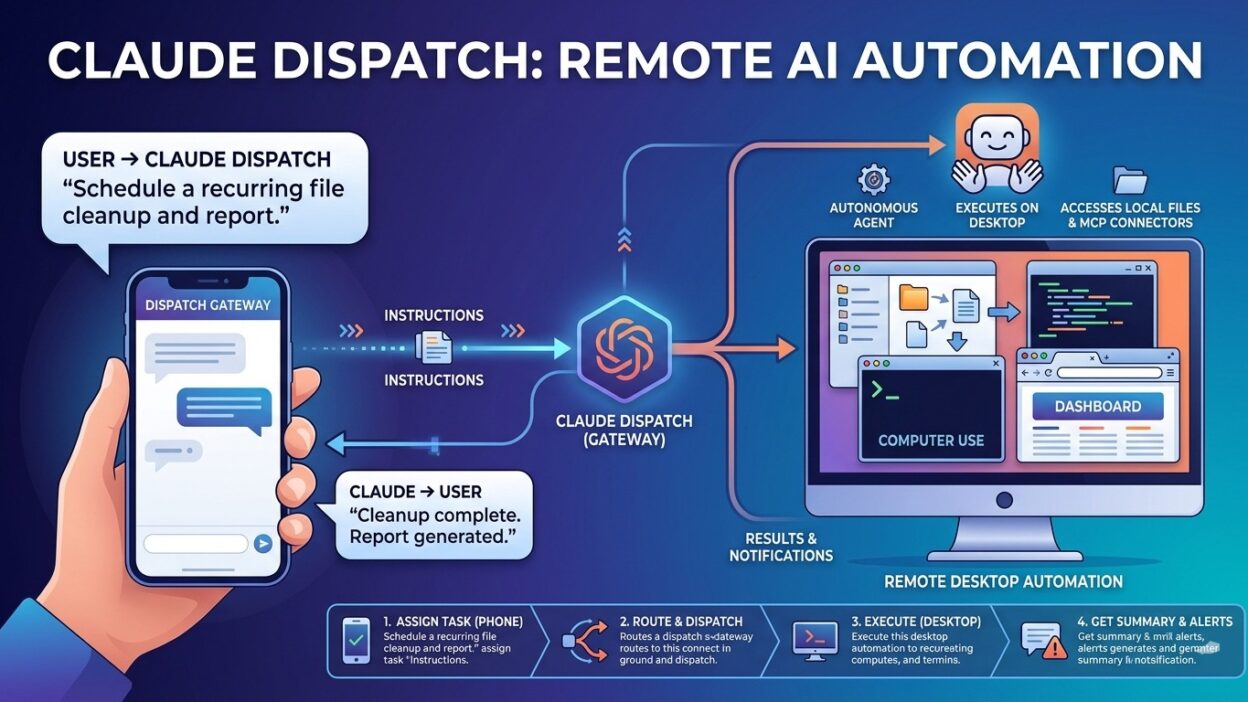
Claude Dispatch refers to the practice of remotely triggering Claude-powered tasks through structured API calls, agentic pipelines, or orchestration layers. You define a task. You send it to Claude. Claude executes it and returns a result. No human sits in the loop for every step.
This matters because manual AI interaction does not scale. Clicking send on every prompt works fine for personal exploration. It breaks down immediately when you need AI to process hundreds of documents, monitor data streams, or respond to system events in real time.
Claude Dispatch solves the scale problem. It turns Claude from an interactive assistant into a headless worker that fits inside your automation architecture.
Engineering teams use Claude Dispatch to automate code review pipelines. Content teams use it to generate drafts from structured briefs on a schedule. Operations teams use it to summarize reports the moment new data arrives.
The concept aligns directly with what Anthropic calls agentic use of Claude. Claude acts with more autonomy. It takes sequences of actions. It handles longer-horizon tasks without constant human nudging.
Secondary Keywords: AI Automation, Agentic AI, Claude API
AI automation with Claude Dispatch works because Claude understands context deeply. Most rule-based automation breaks on edge cases. Claude handles nuance. That makes Claude Dispatch a better fit for tasks that involve language, judgment, or variable input formats.
Agentic AI describes systems where AI models execute multi-step tasks independently. Claude Dispatch fits this description precisely. You set the goal. Claude figures out the steps. The output arrives without you managing every micro-decision.
The Claude API powers every Claude Dispatch workflow. You call the messages endpoint with your task description. You get a structured response back. Authentication uses API keys. Rate limits apply per tier. The infrastructure scales with your usage.
How Claude Dispatch Works Under the Hood
Claude Dispatch operates through a request-response cycle at its simplest level. You craft a message payload. You send it to the Anthropic API. Claude processes the input and returns a completion. Your system reads that completion and acts on it.
At a more sophisticated level, Claude Dispatch involves orchestration. You use a scheduler, a message queue, or a workflow engine to trigger Claude tasks at specific times or in response to specific events. The Claude API call sits inside that trigger logic.
A basic Claude Dispatch setup needs three things. First, an API key from Anthropic. Second, a server or script that can make HTTPS requests. Third, a clear prompt that tells Claude exactly what job to perform.
More advanced Claude Dispatch setups add tool use. Claude can call external functions during its reasoning process. It can search a database, call a REST endpoint, or read a file. The dispatch layer passes those tool definitions alongside the main prompt.
The model processes the task, calls any needed tools, and produces a final response. Your orchestration layer reads that response and routes it to the next step. That chain of steps is what makes Claude Dispatch powerful for complex automation.
API Call, Tool Use, Prompt Engineering
An API call inside a Claude Dispatch workflow always includes a model identifier, a maximum token limit, and a messages array. That messages array holds the system prompt, the user prompt, and any prior conversation context needed for the task.
Tool use extends what Claude Dispatch can accomplish. You define tools as JSON schema objects. Claude decides which tool to call based on the task. The result comes back to Claude. Claude incorporates it into the final answer. This pattern unlocks real-world data access inside automated workflows.
Prompt engineering shapes the quality of every Claude Dispatch output. A vague prompt produces vague output. A specific prompt with clear instructions, output format requirements, and examples produces reliable, structured output. Invest time in prompt design before automating at scale.
Setting Up Claude Dispatch for Your First Automated Workflow
Start with a concrete use case. Do not build a dispatch system in the abstract. Pick one real task your team does manually. That task becomes your first Claude Dispatch workflow.
Get your Anthropic API key from the Anthropic Console. Store it as an environment variable on your server. Never hardcode it in source files. Leaked API keys cause billing problems and security risks.
Write your dispatch script in Python or JavaScript. Both have strong HTTP request libraries. Python users reach for requests or httpx. JavaScript users reach for fetch or axios. Either works fine for Claude Dispatch calls.
Structure your prompt carefully. Write a system message that sets Claude’s role and output expectations. Write a user message that contains the specific task input. If you need JSON output, say so explicitly in the system message. Claude follows format instructions reliably when they appear clearly.
Test your Claude Dispatch script locally first. Verify the output format matches what your downstream system expects. Fix prompt issues before connecting the scheduler or queue. Debugging is far easier before you add orchestration complexity.
Anthropic Console, System Prompt, Environment Variables
The Anthropic Console gives you API key management, usage metrics, and billing information in one place. Check it regularly when you run active Claude Dispatch workflows. Unexpected usage spikes show up there first.
The system prompt in a Claude Dispatch call sets permanent context for the task. It defines Claude’s persona, output format, and behavioral boundaries. A well-written system prompt reduces inconsistency across thousands of automated calls. Write it once. Get it right. Reuse it confidently.
Environment variables keep secrets out of code repositories. Use dotenv in development. Use your cloud provider’s secrets manager in production. AWS Secrets Manager, GCP Secret Manager, and Azure Key Vault all work well for storing Claude Dispatch API credentials securely.
Real Remote Automation Use Cases for Claude Dispatch
Document processing is one of the strongest use cases. Legal teams receive contracts daily. A Claude Dispatch pipeline reads each contract, extracts key clauses, flags risks, and writes a summary. That happens automatically the moment each document arrives in the intake folder.
Customer support automation uses Claude Dispatch to handle ticket triage. Incoming support emails pass through Claude. Claude reads each email, classifies the issue category, assigns a priority level, and drafts an initial response. The human agent reviews and sends. Response time drops dramatically.
Content production teams dispatch Claude to generate first drafts from structured content briefs. A writer fills in a brief template with topic, audience, tone, and key points. The brief triggers a Claude Dispatch call. A draft arrives in minutes. The writer edits rather than starts from scratch.
Data analysis pipelines use Claude Dispatch to interpret query results. A scheduled job pulls data from a database. The numbers feed into a Claude prompt. Claude writes a plain-English summary of what changed and why it matters. The summary lands in a Slack channel before the team starts work.
Software development workflows dispatch Claude for code review. Each pull request triggers a Claude Dispatch call. Claude reads the diff, checks for common mistakes, suggests improvements, and posts a review comment. Engineers get faster feedback without waiting for a senior reviewer.
Workflow Automation, Document Processing, AI-Powered Pipelines
Workflow automation with Claude Dispatch reduces repetitive cognitive work. The goal is not to replace human judgment entirely. The goal is to handle the mechanical parts of complex tasks so humans focus on decisions that need real expertise.
Document processing pipelines benefit from Claude Dispatch more than almost any other use case. Documents vary in structure. Rule-based parsers break constantly. Claude reads variable formats reliably. That reliability makes automated document workflows viable at scale.
AI-powered pipelines built on Claude Dispatch combine Claude with other services. You might dispatch Claude to extract information, then send that information to a CRM via a separate API call, then log the event to a database. Claude Dispatch plugs naturally into multi-step pipeline architectures.
Best Practices for Running Claude Dispatch in Production
Rate limit awareness is critical in production. Anthropic enforces rate limits per API key. High-volume Claude Dispatch workflows need retry logic with exponential backoff. A single rate limit error should not crash your pipeline. Handle it gracefully and retry after the appropriate delay.
Log every Claude Dispatch call. Store the input prompt, the model version, the timestamp, and the response. Those logs help you debug unexpected outputs. They also give you an audit trail when stakeholders question why Claude produced a specific result.
Version your prompts. Treat your Claude Dispatch prompts like code. Store them in version control. Tag each version. When output quality changes, you need to know whether a prompt update or a model update caused the shift.
Monitor token usage actively. Long prompts and long responses cost more tokens. Claude Dispatch workflows that process large documents can burn through your monthly token budget faster than expected. Set usage alerts in the Anthropic Console to catch surprises early.
Test your Claude Dispatch workflows on a representative sample before full rollout. Edge cases break automation in unexpected ways. Run one hundred real examples through your pipeline. Review the outputs manually. Fix prompt issues before processing millions of records.
Rate Limiting, Token Usage, Production Reliability
Rate limiting in Claude Dispatch production environments requires a queue. Put tasks into a queue. A worker pulls from the queue and calls Claude at a controlled pace. That pattern prevents rate limit errors regardless of how fast tasks arrive upstream.
Token usage tracking prevents billing surprises. Use the usage field in the Claude API response to log input tokens and output tokens per call. Aggregate those logs daily. Compare against your plan limits. Upgrade your plan before you hit hard limits during a critical workflow run.
Production reliability for Claude Dispatch workflows depends on idempotency. Design your dispatch calls so that running the same task twice produces the same result. That makes retry logic safe. An idempotent Claude Dispatch call does not create duplicate records even when the retry fires unexpectedly.
Claude Dispatch vs Manual Prompting: When to Use Each
Manual prompting suits exploratory work. You type a question. You read the answer. You decide what to ask next. That interactive loop is exactly right for research, brainstorming, and one-off tasks. Claude Dispatch is not the right tool for those moments.
Claude Dispatch suits repetitive, structured work. You have a clear input format. You need a consistent output format. The same task runs dozens or thousands of times. That is the profile where Claude Dispatch delivers clear value.
The decision often comes down to volume and structure. One document per day? Manual prompting works fine. One hundred documents per hour? Claude Dispatch is the only viable path.
Hybrid approaches also work well. Teams often start with manual prompting to refine the right prompt design. Once output quality is reliable, they automate that prompt into a Claude Dispatch workflow. The manual phase funds the automation phase.
The skill set differs slightly between manual prompting and Claude Dispatch design. Manual prompting needs good conversational instincts. Claude Dispatch design needs prompt engineering discipline, basic API integration skills, and enough software architecture sense to build a reliable dispatch layer.
Prompt Design, Automation vs Manual, Scaling AI
Prompt design for Claude Dispatch differs from conversational prompting. Conversational prompts rely on back-and-forth clarification. Dispatch prompts must be self-contained. All context the model needs must exist inside a single call. No follow-up messages clarify ambiguity.
Automation versus manual AI usage is not an either-or choice for most teams. You automate the repeatable work. You keep manual prompting for creative exploration. Claude Dispatch handles the former. Claude.ai handles the latter. Both have a place in a mature AI workflow strategy.
Scaling AI with Claude Dispatch means treating Claude like infrastructure. You provision capacity, you monitor uptime, and you plan for growth. Teams that think of Claude Dispatch as infrastructure invest in reliability from the start. Teams that treat it as a quick hack regret it at scale.
Integrating Claude Dispatch With Your Existing Tool Stack
Claude Dispatch connects naturally to most modern tool stacks. The API speaks standard JSON over HTTPS. Any system that can make an HTTP request can trigger a Claude Dispatch call.
Zapier and Make users can call the Anthropic API through HTTP action steps. You build no code. You configure the request headers and body in the Zapier or Make interface. Claude Dispatch triggers fit inside existing automation sequences.
n8n users get full control through the HTTP Request node. Pair that node with database nodes, email nodes, and CRM nodes to build complete data pipelines where Claude Dispatch handles the intelligence layer.
Python developers integrate Claude Dispatch into Django, FastAPI, or Flask applications. The Anthropic Python SDK simplifies the integration. Import the SDK. Instantiate the client. Call messages.create with your prompt. Parse the response. Return it to your application layer.
JavaScript developers integrate Claude Dispatch into Node.js backends with the Anthropic TypeScript SDK. The same patterns apply. The SDK handles authentication, retries, and response parsing. Your code handles business logic and routing.
Zapier Integration, n8n, Anthropic SDK
Zapier integration with Claude Dispatch works well for non-technical teams. Marketing operations teams build dispatch workflows without writing code. A new row in a Google Sheet triggers a Claude Dispatch call. The output writes to another sheet. That loop runs automatically on a schedule.
n8n gives developers more flexibility than Zapier for Claude Dispatch workflows. You self-host n8n on your own server. You control data residency. You build complex branching logic. Claude Dispatch fits as one node in a larger n8n workflow graph.
The Anthropic SDK abstracts away HTTP request boilerplate for Claude Dispatch development. You install the SDK with pip or npm. You get typed response objects, automatic retries, and streaming support. That saves hours of integration work compared to raw HTTP calls.
FAQs: What People Ask About Claude Dispatch
What exactly is Claude Dispatch in practical terms?
Claude Dispatch is the practice of sending tasks to Claude through the Anthropic API programmatically, outside of a manual chat interface. You automate the triggering of Claude tasks from scripts, applications, or workflow tools. The result is AI output on demand, without a human pressing send each time.
Does Claude Dispatch require coding skills?
Basic Claude Dispatch setups require minimal coding. A simple Python or JavaScript script with ten to twenty lines handles the core API call. No-code tools like Zapier and Make let non-developers access Claude Dispatch through visual interfaces. Advanced Claude Dispatch architectures with queues, retries, and monitoring require more engineering depth.
How do I handle errors in a Claude Dispatch pipeline?
Wrap every Claude Dispatch API call in error handling. Catch HTTP errors separately from parsing errors. Implement retry logic for rate limit responses, specifically HTTP 429 errors. Log errors with full context including the prompt and the timestamp. Alert your team when error rates exceed a defined threshold.
Can Claude Dispatch handle confidential data?
Review Anthropic’s data usage policies before sending confidential information through Claude Dispatch. Enterprise customers get additional data handling commitments. For highly sensitive data, consider on-premise deployment options or data anonymization before dispatch. Always align your Claude Dispatch data practices with your organization’s security and compliance requirements.
How is Claude Dispatch different from using Claude.ai?
Claude.ai is a manual chat interface for interactive use. Claude Dispatch uses the API to trigger Claude tasks programmatically without human interaction at each step. Claude.ai suits personal and exploratory use. Claude Dispatch suits business workflows, pipelines, and any scenario where AI tasks run automatically at scale.
Common Mistakes Teams Make With Claude Dispatch
The first mistake is writing prompts that are too vague for automation. Conversational ambiguity works in chat because you clarify on the next turn. In Claude Dispatch, there is no next turn. Vague prompts produce inconsistent outputs. Write specific, complete prompts.
The second mistake is ignoring output variability. Claude does not produce identical output for identical inputs every time. Temperature settings affect this. For structured data extraction tasks, set temperature to zero. That maximizes output consistency across Claude Dispatch calls.
The third mistake is not setting max_tokens appropriately. If max_tokens is too low, Claude Dispatch responses truncate mid-sentence. If max_tokens is too high, you pay for unused capacity. Calibrate max_tokens based on the expected output length for your specific task.
The fourth mistake is building Claude Dispatch without observability. You need to see what is happening inside your pipeline. Add logging. Add metrics. Add alerting. A Claude Dispatch workflow that runs silently in the dark will fail silently when something breaks.
The fifth mistake is launching Claude Dispatch at full scale on day one. Start with a small batch. Review the outputs manually. Confirm quality meets your standard. Scale volume gradually. That approach catches problems before they affect thousands of records or customers.
Read More:-Replit Agent Skills Complete Guide: Write Your Own Skills in Replit
Conclusion

Remote teams need tools that work without someone standing over them. Claude Dispatch fits that requirement exactly.
You define the task once. Claude Dispatch executes it reliably across any volume, any time zone, and any schedule. The manual bottleneck disappears. The output scales with your demand.
The concepts covered in this blog give you a complete picture. You know what Claude Dispatch is, how the pipeline works, what use cases it fits, and how to avoid the common mistakes that break automation at scale.
Start with one workflow. Pick the most repetitive AI task your team handles manually today. Build a Claude Dispatch pipeline around that task. Measure the time saved. Let that win justify expanding to the next workflow.
Claude Dispatch is not a future technology. It is available now through the Anthropic API. The teams building on it today gain an operational advantage that compounds over time. That advantage starts with your first dispatch call.