Introduction
AI Agents Have a Memory Problem
TL;DR Ask any developer building AI agents what frustrates them most. Memory issues top the list almost every time.
An agent that forgets context between sessions is an agent that fails users. A customer support bot that cannot remember past conversations forces users to repeat themselves constantly. A coding assistant that loses track of your project architecture gives advice that does not fit your codebase.
Memory is the difference between an AI agent that feels useful and one that feels broken. Developers have known this for years. The solutions until recently were either too complex or too fragile.
LangMem SDK changes that equation entirely. It gives developers a structured, scalable way to build semantic memory into AI agents. The result is agents that remember, adapt, and personalize in ways that feel genuinely intelligent.
This blog breaks down everything you need to know about LangMem SDK. You will learn what it is, how it works, why it matters, and how to start using it in your own projects today.
Table of Contents
What Is LangMem SDK?
LangMem SDK is an open-source memory management toolkit built by the LangChain team. It gives AI agents the ability to store, retrieve, and reason over long-term semantic memories.
The word semantic is critical here. LangMem SDK does not just store raw conversation logs. It extracts meaningful information from interactions. It stores that information in a structured way that makes retrieval fast, relevant, and contextually accurate.
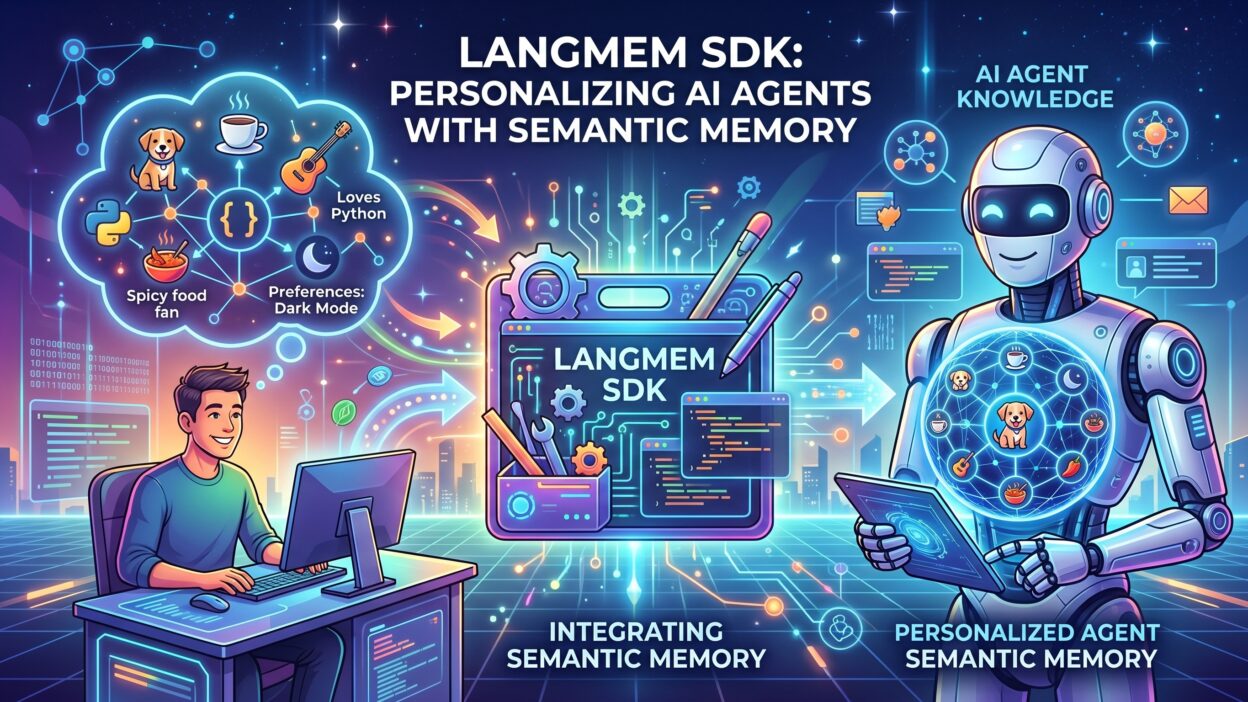
A user tells your agent they prefer concise answers. LangMem SDK stores that preference as a semantic memory. The next session, the agent recalls that preference without being reminded. The interaction feels personal from the first message.
LangMem SDK integrates directly with LangGraph, LangChain’s framework for building stateful AI agent workflows. Developers already working in that ecosystem gain memory capabilities without switching tools or relearning architectures.
The SDK handles the hardest parts of memory management automatically. Memory extraction, deduplication, storage, and retrieval all work out of the box. Developers focus on building agent logic rather than memory infrastructure.
LangMem SDK supports multiple memory backends. In-memory storage works for development and testing. Production deployments connect to persistent stores like PostgreSQL or Redis. The abstraction layer keeps your agent code clean regardless of the storage backend.
Why Semantic Memory Matters for AI Agents
Understanding why semantic memory beats simple storage helps you make better architectural decisions.
Simple storage saves raw text. A chat history database stores every message in sequence. Retrieval means searching through those messages with keywords or embeddings. That approach works for basic recall but breaks down at scale and nuance.
Semantic memory works differently. LangMem SDK extracts meaning from interactions and stores structured representations of that meaning. A user mentioning they work in healthcare and prefer formal communication generates two distinct semantic memories: professional domain and communication style. Those memories retrieve independently based on relevance to future queries.
This structured approach produces far more accurate retrieval. An agent looking for user preferences does not need to scan hundreds of past messages. LangMem SDK surfaces the relevant semantic memories directly. Retrieval is faster and more precise.
Semantic memory also enables reasoning over stored knowledge. LangMem SDK does not just retrieve memories as text snippets. It surfaces memories in a form that the language model can reason about actively. The agent does not just remember what you said. It understands what that information means for the current interaction.
Personalization becomes genuinely possible with this foundation. LangMem SDK turns every user interaction into structured knowledge that improves future interactions. That compounding improvement is what makes semantic memory a foundational capability for serious AI agent development.
The Architecture Behind LangMem SDK
Knowing the internals helps you design agents that use LangMem SDK effectively.
Memory Extraction
LangMem SDK runs a memory extraction step after each interaction. The language model analyzes the conversation and identifies information worth storing. Not every message generates a memory. The extraction logic filters for meaningful, durable information.
User preferences, stated goals, domain expertise, communication style, and biographical details all qualify as meaningful. Casual conversational filler does not. LangMem SDK applies extraction criteria consistently so your memory store stays clean and relevant.
Developers can customize extraction prompts. If your agent operates in a specialized domain, you configure LangMem SDK to extract domain-specific information that generic extraction might miss. A legal research agent extracts case preferences and citation styles. A fitness coaching agent extracts training history and physical goals.
Memory Storage
Extracted memories store in a structured format. LangMem SDK uses a memory schema that captures the content of the memory, the type of information it represents, the source interaction, and metadata for retrieval ranking.
That structure makes retrieval intelligent rather than exhaustive. LangMem SDK does not search all stored memories for every query. It uses the memory type and context to narrow the retrieval scope before ranking candidates.
The storage layer abstracts backend details from your agent code. You configure the backend once at initialization. Every memory operation your agent performs routes through the same interface regardless of whether the backend is in-memory, PostgreSQL, or a custom store.
Memory Retrieval
Retrieval in LangMem SDK uses semantic similarity plus structured filtering. A query for user communication preferences retrieves memories of type “communication style” ranked by semantic relevance to the current context.
This two-stage retrieval — filter then rank — produces better results than pure vector similarity search. Pure similarity search sometimes surfaces memories that are semantically adjacent but contextually wrong. The filtering stage eliminates those false matches before ranking runs.
Developers control retrieval parameters. You set how many memories to surface per query, the minimum relevance threshold, and which memory types to include. Those controls let you tune retrieval behavior for your specific agent design.
Memory Consolidation
LangMem SDK includes a consolidation process that merges redundant memories and resolves conflicts. A user who states a preference in three different ways across three sessions generates three separate raw memories. Consolidation merges those into a single authoritative memory with higher confidence.
Conflict resolution handles cases where new information contradicts stored memories. A user who changes their communication preference from formal to casual generates a conflict. LangMem SDK resolves that conflict by updating the stored memory and logging the change history. The agent always works from the most current understanding.
Setting Up LangMem SDK in Your Project
Practical setup guidance makes this actionable immediately.
Installation
LangMem SDK installs through pip. Open your terminal and run the installation command for the core package. Depending on your storage backend, you install additional dependencies for PostgreSQL, Redis, or other supported stores.
pip install langmem
For PostgreSQL backend support, add the database connector package alongside the core installation. The LangMem SDK documentation lists the exact dependency combinations for each supported backend.
Basic Configuration
Import LangMem SDK into your agent script. Initialize the memory manager with your chosen backend configuration. For development, the in-memory backend requires no additional configuration. For production, pass your database connection string to the backend initializer.
from langmem import MemoryManager
from langmem.backends import InMemoryBackend

memory = MemoryManager(backend=InMemoryBackend())
The MemoryManager object is your primary interface for all memory operations. Extraction, storage, retrieval, and consolidation all run through this object. Keep your configuration in one place and pass the initialized manager to your agent components.
Integrating With LangGraph
LangMem SDK integrates with LangGraph through a standard node pattern. Your agent graph includes a memory retrieval node at the start of each turn and a memory extraction node at the end. Those two nodes handle all memory operations automatically.
from langgraph.graph import StateGraph
from langmem.integrations.langgraph import MemoryRetrievalNode, MemoryExtractionNode

graph = StateGraph(AgentState)
graph.add_node("retrieve_memories", MemoryRetrievalNode(memory))
graph.add_node("extract_memories", MemoryExtractionNode(memory))
The retrieved memories inject into your agent’s context automatically. Your agent logic reads them as part of the standard state object. You do not need special memory access calls inside your agent nodes. LangMem SDK handles the injection transparently.
Customizing Extraction Prompts
Default extraction works well for general-purpose agents. Specialized agents benefit from custom extraction prompts that target domain-specific information.
Pass your custom extraction prompt to the MemoryExtractionNode at initialization. LangMem SDK uses that prompt instead of the default during every extraction cycle. Test custom prompts against representative conversations before deploying to production.
Real-World Use Cases for LangMem SDK
Concrete examples make the value of LangMem SDK immediately clear.
Personalized Customer Support
Customer support agents built with LangMem SDK remember every user’s history. A returning user does not re-explain their account situation, their communication preferences, or their past issues. The agent surfaces relevant history automatically and adapts its approach to the individual.
Support quality improves measurably. Agents reach resolution faster because they start each conversation with context. Customer satisfaction scores rise because users feel understood rather than processed. LangMem SDK turns a generic support bot into a personalized support partner.
Adaptive Learning Companions
Educational AI agents need to track student knowledge, learning style, and progress over time. LangMem SDK stores all of that information as structured semantic memories. The agent knows which concepts a student has mastered and which ones need more work.
Lesson pacing adapts automatically. A student who demonstrates strong grasp of foundational concepts gets advanced material faster. A student who struggles with a specific topic gets additional practice without needing to ask. LangMem SDK gives learning agents the continuous context they need for genuine adaptation.
Long-Horizon Research Assistants
Research assistants built with LangMem SDK maintain project context across weeks of work. A researcher’s preferred sources, citation style, theoretical framework, and open questions all store as semantic memories. Every new research session picks up exactly where the last one ended.
The agent does not just remember what you have researched. It understands your research agenda well enough to make proactive suggestions. LangMem SDK gives research agents the kind of project awareness that makes them genuinely useful collaborators over long timescales.
Personal Productivity Agents
Productivity agents powered by LangMem SDK learn your work style, your priorities, and your recurring tasks. They stop needing explicit instructions for routine work. They anticipate your needs based on patterns stored as semantic memories.
A scheduling agent remembers you prefer morning meetings. A writing agent remembers you favor direct, concise prose. A project management agent remembers your typical sprint velocity. LangMem SDK makes these preferences durable and actionable across every session.
Healthcare Information Assistants
Healthcare information agents carry unique memory requirements. Patient history, medication preferences, and communication sensitivities all matter enormously. LangMem SDK stores this information with the structure and reliability that healthcare contexts demand.
Compliance-focused deployments configure LangMem SDK with appropriate data handling policies at the backend level. The SDK’s abstraction layer supports encrypted storage backends for sensitive information. Healthcare teams gain a memory-capable agent foundation without sacrificing compliance requirements.
LangMem SDK vs. Alternative Memory Approaches
Developers evaluating memory solutions benefit from honest comparison.
LangMem SDK vs. Raw Vector Stores
Raw vector stores save conversation embeddings and retrieve by similarity. They work for basic recall but lack structure. Retrieval returns similar text rather than relevant semantic information. Deduplication and conflict resolution require custom engineering.
LangMem SDK adds a structured semantic layer above the vector store. You get similarity-based retrieval plus type filtering, consolidation, and conflict resolution out of the box. The engineering cost of building those features from scratch is significant. LangMem SDK eliminates that cost.
LangMem SDK vs. Full-Text Conversation Logs
Storing full conversation logs and searching them with keyword or vector queries scales poorly. Log volume grows linearly with usage. Retrieval latency increases as logs accumulate. Relevant information buries inside irrelevant conversational noise.
LangMem SDK extracts and stores only meaningful information. Memory stores stay lean. Retrieval stays fast regardless of how many past interactions exist. The signal-to-noise ratio remains high because extraction filters continuously.
LangMem SDK vs. Custom Memory Systems
Some teams build custom memory systems tailored to their exact needs. That approach maximizes flexibility but demands significant engineering investment. Maintenance burden grows as the system scales. Edge cases in extraction, deduplication, and conflict resolution multiply quickly.
LangMem SDK covers the common cases well and provides extension points for custom requirements. Most teams find LangMem SDK handles 90% of their memory needs out of the box. Custom work focuses on the remaining 10% rather than rebuilding foundational infrastructure.
Common Mistakes When Using LangMem SDK
Avoiding these mistakes saves development time and prevents production issues.
Extracting Too Much or Too Little
Poorly tuned extraction prompts create memory stores that are either too noisy or too sparse. Over-extraction fills the store with trivial information that degrades retrieval precision. Under-extraction misses important user information that the agent needs.
Invest time calibrating extraction prompts against real conversation samples before going live. Review extracted memories regularly in early deployment. Adjust extraction criteria based on what your agent actually needs to personalize effectively.
Ignoring Consolidation Scheduling
LangMem SDK’s consolidation process runs on a schedule you configure. Teams that skip consolidation configuration accumulate redundant memories rapidly. Retrieval quality degrades as redundancy grows. Conflicts between old and new memories go unresolved.
Set up a consolidation schedule appropriate for your usage volume. High-volume agents need frequent consolidation. Low-volume agents can consolidate less frequently. The right schedule keeps your memory store clean without adding unnecessary processing overhead.
Skipping Backend Selection for Production
The in-memory backend is for development only. It does not persist between process restarts. Teams that deploy agents with in-memory backends lose all stored memories whenever the service restarts. Users experience that as the agent forgetting everything.
Choose and configure a persistent backend before any production deployment. Test your backend configuration thoroughly in a staging environment. Confirm that memories persist across restarts and that retrieval latency meets your performance requirements.
Not Testing Cross-Session Behavior
Memory systems behave differently from stateless systems. Bugs in cross-session memory often do not appear in single-session testing. A memory that stores correctly in one session might retrieve incorrectly in a different context. Conflict resolution might produce wrong outcomes in specific scenarios.
Build a test suite that explicitly covers cross-session memory behavior. Simulate multi-session user journeys. Verify that the right memories surface at the right times. LangMem SDK’s structured design makes this testing tractable if you invest in it early.
Advanced Patterns With LangMem SDK
These patterns unlock the full potential of LangMem SDK in complex agent architectures.
Multi-User Memory Namespacing
LangMem SDK supports namespaced memory stores. Each user’s memories store in a separate namespace. The agent retrieves only from the current user’s namespace. Different users never see each other’s stored information.
Namespace configuration happens at initialization. Pass a user identifier to the MemoryManager at session start. LangMem SDK routes all operations for that session to the correct namespace automatically. This pattern is essential for any multi-user deployment.
Memory-Conditioned Prompt Templates
Advanced agents use retrieved memories to dynamically construct system prompts. LangMem SDK retrieves the most relevant memories for the current context. Those memories inject into a prompt template that shapes the agent’s persona and approach for the specific user.
This technique produces agents that feel dramatically more personalized than agents using static system prompts. The agent’s personality adapts to what it knows about the user. The adaptation happens invisibly from the user’s perspective.
Hierarchical Memory Types
LangMem SDK supports custom memory type hierarchies. You define a taxonomy of memory types specific to your domain. The extraction and retrieval logic operates within that taxonomy.
A coaching agent might define memory types for physical goals, nutrition preferences, schedule constraints, and motivational patterns. Each type retrieves independently based on what the current interaction needs. The hierarchical structure keeps retrieval precise even as the total memory volume grows.
Frequently Asked Questions About LangMem SDK
What is LangMem SDK used for?
LangMem SDK gives AI agents long-term semantic memory. Developers use LangMem SDK to build agents that remember user preferences, past interactions, and ongoing goals across sessions. The SDK handles memory extraction, storage, retrieval, and consolidation automatically.
Is LangMem SDK free to use?
LangMem SDK is open-source and freely available. You pay only for the infrastructure you use to host it. Database costs for persistent backends depend on your usage volume and your chosen cloud provider.
Does LangMem SDK work with models other than OpenAI?
LangMem SDK works with any language model that LangChain supports. That includes Anthropic Claude, Google Gemini, Mistral, and many others. The memory operations are model-agnostic. The extraction and retrieval logic uses whichever model you configure for your agent.
How does LangMem SDK handle sensitive user data?
LangMem SDK’s backend abstraction supports encrypted storage configurations. Sensitive data handling depends on your backend choice and configuration. Teams with strict data requirements should configure encrypted backends and implement appropriate access controls at the infrastructure level.
Can LangMem SDK scale to millions of users?
LangMem SDK scales with the backend you choose. Persistent backends like PostgreSQL scale horizontally with standard database scaling techniques. Memory namespacing ensures user isolation at scale. Teams running high-volume deployments should benchmark their backend configuration before full production rollout.
How does LangMem SDK handle conflicting memories?
LangMem SDK’s consolidation process detects memory conflicts and resolves them using configurable resolution strategies. The default strategy prefers more recent information. Custom resolution logic is available for cases where recency is not the appropriate resolution criterion.
Does LangMem SDK require LangGraph?
LangMem SDK works best with LangGraph for stateful agent architectures. The SDK provides native LangGraph integration nodes. Developers can use LangMem SDK outside LangGraph through the core MemoryManager API, though the integration requires more manual wiring.
Where can I find the LangMem SDK documentation?
The official LangMem SDK documentation lives in the LangChain documentation ecosystem. The GitHub repository contains additional examples, tutorials, and contribution guidelines. The LangChain community Discord is an active resource for developer questions about LangMem SDK.
Read More:-Claude Dispatch: How to Use It for Remote AI Automation
Conclusion

Memory is not a nice-to-have for AI agents. It is the feature that separates useful agents from frustrating ones.
LangMem SDK gives developers the infrastructure to build agents that genuinely remember. Semantic extraction, structured storage, intelligent retrieval, and automatic consolidation combine into a complete memory solution. Teams no longer need to build these capabilities from scratch.
The use cases are wide. Customer support, education, research, productivity, and healthcare all benefit from agents that carry meaningful memory across sessions. LangMem SDK makes all of those applications more buildable for every team regardless of memory engineering expertise.
The mistakes to avoid are well-defined. Tune your extraction prompts carefully. Set up consolidation schedules early. Choose persistent backends for production. Test cross-session behavior explicitly. These practices turn LangMem SDK from a promising library into a reliable production foundation.
The advanced patterns unlock even more capability. Memory namespacing, dynamic prompt construction, and hierarchical memory types give experienced developers tools for building agents that feel remarkably personalized at scale.
Start with LangMem SDK on your next agent project. Build a simple memory-enabled agent in development. Observe how semantic memory changes the interaction quality. Then carry that foundation into your production architecture.
The agents worth building in 2025 and beyond are agents that remember. LangMem SDK makes that possible today. Every conversation your agent holds becomes smarter than the last one.