Introduction
TL;DR Artificial intelligence has grown at a remarkable pace. Most AI models give direct answers. They skip the reasoning steps entirely. That approach works for simple questions. It fails completely for complex problems.
Chain of Thought prompting fixes that failure. It forces an AI model to show its work. Every step of reasoning appears in the output. The model does not jump to the final answer. It walks through each logical stage first.
Chain of Thought prompting has changed how professionals use AI tools. Developers use it. Researchers rely on it. Business analysts apply it daily. Anyone who needs accurate, explainable AI outputs needs to understand this technique.
This guide covers everything. You will learn what Chain of Thought prompting is, how it works, when to use it, and how to write CoT prompts that deliver real results.
Table of Contents
What Is Chain of Thought Prompting?
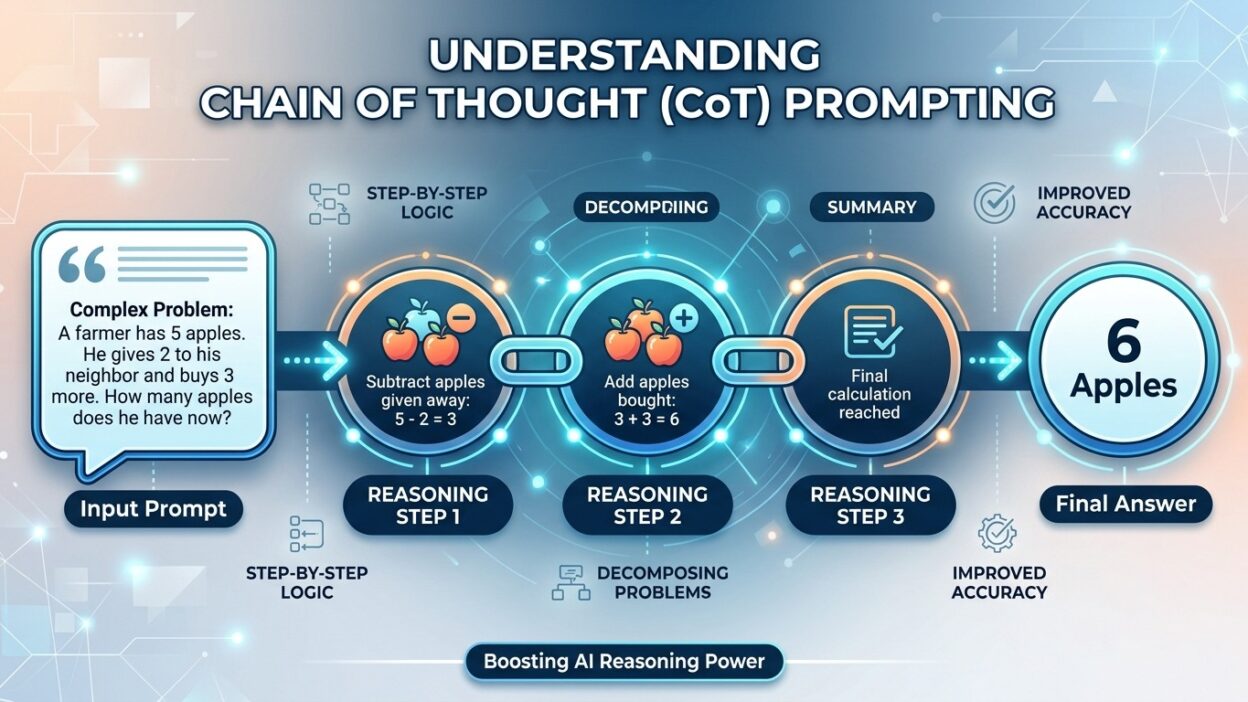
Chain of Thought prompting is a prompt engineering technique. It instructs a large language model (LLM) to reason through a problem step by step. The model explains each stage before reaching the final answer.
A standard prompt asks a question. The model answers directly. A Chain of Thought prompt asks the model to think out loud. Every reasoning step appears as part of the response.
The term “Chain of Thought” refers to the linked sequence of reasoning. Each thought connects to the next. The final answer sits at the end of this chain. Nothing skips. Nothing gets assumed.
Researchers at Google Brain introduced this concept formally in 2022. The paper showed a clear pattern. Larger models benefit more from Chain of Thought prompting. The technique unlocks reasoning ability that standard prompting cannot access.
This method matters because AI models are not always reliable. They often guess on hard problems. Chain of Thought prompting forces structure. It reduces guessing. It increases accuracy on multi-step reasoning tasks significantly.
How Chain of Thought Prompting Works
The mechanics are straightforward. You write a prompt. Inside that prompt, you either show the model an example of step-by-step reasoning or you instruct it directly to reason step by step.
The model reads your instruction. It generates a reasoning chain before producing the answer. Each thought leads logically to the next. The answer at the end reflects the full reasoning process.
Chain of Thought prompting works in two main formats. The first is few-shot. You give the model examples of CoT reasoning inside the prompt. The model learns the pattern and applies it.
The second format is zero-shot. You simply add a phrase like “Let us think step by step” to your prompt. The model applies its own reasoning structure without examples. This approach requires no additional examples from you.
The zero-shot version is faster to write. The few-shot version is more precise. Both formats of Chain of Thought prompting improve performance on complex tasks. The right choice depends on your specific use case and the complexity of the problem.
Why Chain of Thought Prompting Matters
It Improves Accuracy on Hard Problems
Standard prompts often produce wrong answers on multi-step problems. The model skips logical steps. It jumps to a conclusion. Chain of Thought prompting eliminates that shortcut. The model cannot skip steps. Each step must connect logically.
Studies show consistent accuracy improvements. On math word problems, CoT prompting boosts accuracy dramatically. On logical reasoning tasks, the gains are even larger. The model reasons better when it writes its reasoning out loud.
It Makes AI Reasoning Transparent
Explainability is a major challenge in AI. Black-box answers create trust problems. You cannot verify a conclusion you cannot see. Chain of Thought prompting solves this directly.
Every reasoning step appears in the output. You see how the model arrived at its answer. You can check each step. You can spot errors before acting on the conclusion. This transparency makes CoT prompting valuable in high-stakes professional settings.
It Handles Complex Instructions Better
Many real-world tasks involve multiple requirements at once. A contract analysis needs legal reasoning, context interpretation, and risk identification. Standard prompts often miss requirements. Chain of Thought prompting keeps every requirement in the reasoning chain. Nothing gets forgotten. Nothing gets ignored.
Types of Chain of Thought Prompting
Zero-Shot Chain of Thought Prompting
Zero-shot Chain of Thought prompting requires no examples. You add one simple instruction: “Let us think step by step.” The model applies its own structured reasoning. The output shows each thinking stage.
This approach works well for general reasoning tasks. It saves prompt space. It requires no example writing. For many common use cases, zero-shot CoT delivers strong results without extra effort.
Few-Shot Chain of Thought Prompting
Few-shot Chain of Thought prompting includes examples in the prompt. Each example shows a question followed by a full reasoning chain and the correct answer. The model learns the exact pattern from your examples.
This approach delivers higher precision. You control the reasoning style. You define the level of detail. Few-shot Chain of Thought prompting is the preferred method for technical tasks, domain-specific analysis, and structured outputs.
Auto Chain of Thought Prompting
Auto-CoT is an advanced variation. The system generates reasoning examples automatically. It clusters questions by type and selects diverse examples for the prompt. This approach combines the precision of few-shot CoT with automation.
Auto Chain of Thought prompting suits large-scale applications. It reduces manual work. It maintains high reasoning quality across many different question types. AI developers use this format in production environments frequently.
Self-Consistency with Chain of Thought Prompting
Self-consistency enhances standard CoT further. The model generates multiple reasoning chains for the same problem. Each chain may reach a slightly different answer. The final answer comes from a majority vote across all reasoning paths.
This technique reduces errors from individual reasoning chains. It gives more reliable results on ambiguous or probabilistic problems. Self-consistency plus Chain of Thought prompting represents one of the most accurate AI reasoning approaches available today.
How to Write Effective Chain of Thought Prompts
Be Explicit About Reasoning Requirements
Do not assume the model will reason step by step on its own. State it clearly. Say “Reason through this step by step before giving your answer.” Explicit instructions produce explicit reasoning. Vague instructions produce vague reasoning.
The model follows your lead. If you ask for a final answer only, you get one. If you ask for a detailed reasoning chain, you get that. Chain of Thought prompting only works when you ask for it directly.
Provide a Worked Example in the Prompt
Examples teach the model your preferred reasoning style. Write one complete example. Show the question, the full reasoning process, and the correct answer. The model replicates this structure on new questions automatically.
Good examples are specific. They show realistic reasoning for your domain. A financial analysis example should include domain-specific logic. A medical reasoning example should reflect clinical thinking. Match your example to your actual use case.
Break the Task into Subproblems
Complex tasks benefit from explicit subproblem structure. Tell the model to solve each subproblem before combining the results. This structure mirrors how human experts approach difficult problems. The model performs better with this guidance.
For example, say: “First, identify all relevant facts. Second, analyze each fact separately. Third, combine your analysis to reach a final conclusion.” This structure guides the Chain of Thought prompting process toward organized, reliable outputs.
Ask for Confidence Levels
High-quality CoT prompts sometimes include confidence checking. Ask the model to rate its confidence at key reasoning steps. This reveals where the model is uncertain. You can investigate uncertain steps manually. This makes Chain of Thought prompting safer for critical decisions.
Real-World Applications of Chain of Thought Prompting
Mathematics and Scientific Reasoning
Math was the original benchmark for Chain of Thought prompting research. Multi-step math problems require exact reasoning sequences. A single skipped step breaks the entire solution. CoT prompting forces each arithmetic or algebraic step to appear explicitly.
Scientists use this technique for hypothesis evaluation. They ask AI to reason through experimental evidence step by step. The reasoning chain shows which evidence supports the hypothesis and which contradicts it. This makes AI a useful scientific thinking partner.
Legal and Contract Analysis
Legal reasoning involves layers of interpretation. A clause must be read in context. Prior case law applies. Regulatory requirements intersect. Standard AI prompts miss these layers constantly.
Chain of Thought prompting handles legal complexity better. The model reasons through each layer explicitly. It applies contract terms before interpreting their effect. It flags conflicting clauses as part of the reasoning chain. Legal teams get more reliable AI assistance this way.
Medical Diagnosis Support
Medical reasoning is high stakes. Wrong answers cost lives. Chain of Thought prompting makes AI medical reasoning visible and verifiable. Clinicians can follow the reasoning chain. They can catch errors before acting on the output.
Diagnostic support tools use CoT prompting to explain symptom evaluation. The reasoning chain shows which symptoms were weighted most heavily. It shows which diagnoses were ruled out and why. Transparency builds appropriate trust in AI medical tools.
Business Strategy and Financial Analysis
Business decisions involve many interdependent variables. A market entry decision depends on competition, cost structure, regulatory risk, and consumer behavior simultaneously. Chain of Thought prompting handles this interdependency well.
Analysts ask AI to reason through each factor in sequence. The model connects factors logically. The final recommendation reflects a complete analysis rather than a shallow guess. Business professionals get more defensible AI-generated insights this way.
Limitations of Chain of Thought Prompting
It Does Not Eliminate Hallucination
Chain of Thought prompting reduces errors. It does not remove them. A model can reason incorrectly and produce a confident wrong answer. Each step in the chain may seem logical while the overall conclusion is still factually wrong.
Always verify critical outputs. CoT prompting gives you more to check, which helps. But verification remains your responsibility. Never rely on AI reasoning chains for high-stakes decisions without human review.
It Increases Token Usage
Detailed reasoning chains are long. Longer outputs cost more in token-based AI systems. For high-volume applications, Chain of Thought prompting increases operating costs. Balance reasoning depth with cost requirements.
Shorter reasoning chains cost less. They sacrifice some accuracy. You need to decide the right trade-off for your application. Token efficiency matters in production environments.
It Needs Strong Underlying Models
Chain of Thought prompting works best on large, capable models. Smaller models do not benefit as much. Their reasoning chains often contain errors even with perfect CoT instructions.
Use Chain of Thought prompting with models that have strong language understanding. Results on weaker models can be misleading. The technique amplifies existing capability. It cannot create capability that does not exist.
Frequently Asked Questions About Chain of Thought Prompting
What is Chain of Thought prompting in simple terms?
Chain of Thought prompting tells an AI model to explain its reasoning step by step before giving a final answer. Instead of jumping straight to a conclusion, the model shows its thinking process. This produces more accurate and explainable results on complex problems.
Who invented Chain of Thought prompting?
Researchers at Google Brain introduced Chain of Thought prompting in a 2022 research paper. Jason Wei and colleagues demonstrated that large language models reason significantly better when prompted to show their step-by-step thinking. The technique quickly spread across the AI community.
What is the difference between standard prompting and Chain of Thought prompting?
Standard prompting asks a question and expects a direct answer. Chain of Thought prompting asks the model to reason through the problem explicitly before answering. CoT produces longer outputs. It also produces more accurate answers on problems that require multiple reasoning steps.
Does Chain of Thought prompting work with all AI models?
Chain of Thought prompting works best with large language models. Smaller models show less improvement. The technique scales with model size. Models with 100 billion or more parameters benefit the most from CoT reasoning instructions.
When should I use zero-shot versus few-shot Chain of Thought prompting?
Use zero-shot Chain of Thought prompting for general tasks where you need quick results. Use few-shot CoT prompting for domain-specific tasks where precision matters. Few-shot works better when your task has a specific reasoning style or format requirement.
Can Chain of Thought prompting replace human reasoning?
Chain of Thought prompting improves AI reasoning. It does not replace human judgment. The model can make errors within its reasoning chain. Human review remains essential for critical decisions. CoT prompting is a tool to assist human thinking, not substitute it.
Is Chain of Thought prompting useful for creative tasks?
Chain of Thought prompting shines on analytical and logical tasks. It helps with creative tasks that require structured thinking, such as planning a story arc or designing a marketing strategy. For purely creative or generative tasks, standard prompting often works equally well.
Read More:-15+ Solved Agentic AI Projects with Github Links
Conclusion

Chain of Thought prompting stands as one of the most important developments in practical AI use. It takes an already powerful tool and makes it dramatically more reliable. It shows reasoning clearly. It reduces errors. It builds trust.
Every professional who uses AI tools regularly should understand Chain of Thought prompting. The technique applies across industries. Math, law, medicine, business strategy, and research all benefit from structured AI reasoning.
Start with the simplest approach. Add “Let us think step by step” to your next complex prompt. Observe how the output changes. The improvement will feel immediate. From there, experiment with few-shot examples and subproblem structuring.
Chain of Thought prompting does not make AI perfect. It makes AI reasoning visible, structured, and verifiable. That combination gives you far more control over AI output quality. Professionals who master this technique get consistently better results from every AI tool they use.
The future of AI prompting moves toward more structured reasoning. Chain of Thought prompting is the foundation of that future. Learn it now. Apply it consistently. Your AI outputs will never be the same.