Introduction
TL;DR Agentic AI is no longer a research topic. It is a practical engineering skill. Developers, data scientists, and ML engineers are building autonomous AI systems that plan tasks, use tools, and solve complex problems with minimal human input.
But learning agentic AI from theory alone is slow. Real progress happens when you build things. That is exactly why curated Agentic AI Projects with Github Links matter so much for learners and professionals.
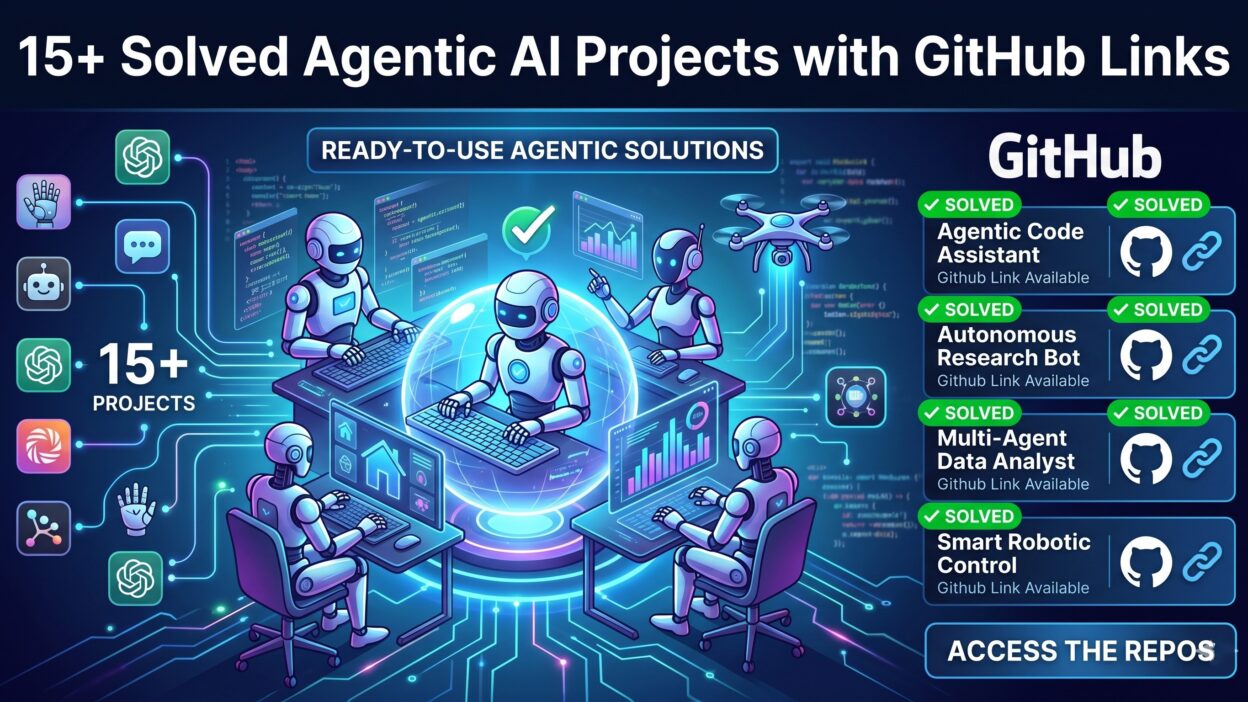
This blog covers 15+ fully solved agentic AI projects. Each project includes a GitHub link, a clear description, the tools used, and what you will learn by studying it. Whether you are a beginner or an experienced engineer, this list gives you real projects to explore, fork, and build upon.
Table of Contents
What Is Agentic AI and Why Does It Matter?
Agentic AI refers to systems where an AI model acts as an autonomous agent. The agent perceives its environment, plans actions, uses tools, and iterates toward a goal. It does not just respond to a single prompt. It executes multi-step workflows with minimal human supervision.
The core components of an agentic system include a reasoning engine, a set of tools or APIs, memory for context retention, and a task orchestration layer. These components work together to let the agent complete complex objectives.
The business and career value of agentic AI is enormous. Companies are deploying autonomous agents for customer support, software development, research automation, and supply chain management. Engineers who understand how to build these systems command significant job market advantages.
Studying Agentic AI Projects with Github Links accelerates learning dramatically. Real code exposes design patterns, debugging strategies, and integration techniques that no tutorial covers fully.
How Agentic AI Differs from Standard LLM Applications
Standard LLM applications follow a simple pattern. User sends a prompt. Model returns a response. The interaction ends. This single-shot paradigm is powerful for many tasks but limited for complex workflows.
Agentic AI extends this pattern significantly. The agent receives a high-level goal. It breaks that goal into subtasks. It selects appropriate tools for each subtask. It executes the subtasks, evaluates results, and adjusts its plan dynamically. The loop continues until the goal is achieved.
This planning-execution-evaluation cycle is what separates agentic systems from standard LLM wrappers. Building this cycle correctly requires engineering skills that only hands-on project work can develop.
Key Frameworks Used in Agentic AI Projects
Before exploring individual projects, it helps to understand the main frameworks these projects rely on. Most Agentic AI Projects with Github Links use one or more of these tools.
LangChain
LangChain is the most widely used framework for building agentic AI applications. It provides abstractions for chains, agents, tools, and memory. Its large ecosystem includes hundreds of integrations with APIs, databases, and external services.
LangChain’s agent module lets you define a reasoning loop, connect tools, and manage conversation history. Most beginner-to-intermediate agentic projects use LangChain as their backbone.
LangGraph
LangGraph extends LangChain with graph-based workflow orchestration. Complex multi-agent systems with branching logic and state management use LangGraph effectively. It provides precise control over agent execution flows that simple chain-based approaches cannot match.
Advanced Agentic AI Projects with Github Links increasingly rely on LangGraph for production-grade multi-agent architectures.
AutoGen by Microsoft
AutoGen is Microsoft’s open-source framework for multi-agent conversation systems. It lets multiple AI agents converse, collaborate, and complete tasks together. Agents can play different roles like coder, reviewer, planner, or executor within the same system.
AutoGen projects demonstrate agent collaboration patterns that are directly applicable to enterprise AI development.
CrewAI
CrewAI is a framework for building role-based multi-agent teams. You define a crew of agents, assign each agent a role and set of tools, and describe the overall task. CrewAI orchestrates the agents to collaborate on the task efficiently.
Several projects in this list use CrewAI for team-based agentic workflows. It is beginner-friendly and produces well-structured project code.
15+ Solved Agentic AI Projects with Github Links
Each project entry includes a description, the frameworks and tools used, what it teaches, and its GitHub repository link. These are all real repositories with working code.
1. AutoGPT — Autonomous GPT-4 Agent
AutoGPT is one of the earliest and most influential agentic AI projects ever built. It takes a single goal as input and autonomously plans and executes tasks to achieve that goal. It searches the web, writes files, executes code, and manages its own memory across sessions.
AutoGPT uses GPT-4 as its reasoning core. It stores long-term context in a vector database. Short-term memory keeps track of the current task loop. This project teaches autonomous planning, tool use, and memory management in a single codebase.
GitHub: https://github.com/Significant-Gravitas/AutoGPT
2. BabyAGI — Task-Driven Autonomous Agent
BabyAGI is a compact but powerful agentic system. It maintains a task list. An LLM-powered task creation agent adds new tasks based on completed results. An execution agent completes each task. A prioritization agent reorders the task list after each completion cycle.
This project demonstrates task queue management, iterative planning, and the feedback loop that makes autonomous agents effective. The codebase is concise and easy to read. It is an ideal starting project for anyone new to Agentic AI Projects with Github Links.
GitHub: https://github.com/yoheinakajima/babyagi
3. AgentGPT — Browser-Based Autonomous Agent
AgentGPT provides a web interface for deploying autonomous AI agents without any local setup. Users define a goal in the browser. The agent plans and executes tasks step by step. The interface shows each reasoning step in real time.
This project teaches how to build the frontend layer for agentic systems. It also demonstrates streaming output for long-running agent tasks. The combination of a React frontend and a Python backend serves as a production-aware architecture reference.
GitHub: https://github.com/reworkd/AgentGPT
4. MetaGPT — Multi-Agent Software Company
MetaGPT is a sophisticated multi-agent framework that simulates an entire software development company. Different agents play the roles of product manager, architect, engineer, and QA tester. They collaborate to develop software from a single natural language requirement.
The project demonstrates complex role-based agent collaboration. Agents produce structured artifacts like PRDs, system designs, code files, and test cases. MetaGPT is one of the most educational Agentic AI Projects with Github Links for engineers interested in multi-agent system design.
GitHub: https://github.com/geekan/MetaGPT
5. SuperAGI — Open-Source Autonomous Agent Infrastructure
SuperAGI is a developer-first autonomous agent framework. It provides agent management, tool integrations, memory systems, and performance monitoring through a unified interface. Multiple agents run concurrently with shared tool access.
SuperAGI teaches production-oriented agent infrastructure design. It shows how to manage agent lifecycles, handle failures, and monitor performance. Teams building enterprise agentic systems study this project for its architectural patterns.
GitHub: https://github.com/TransformerOptimus/SuperAGI
6. GPT Researcher — Autonomous Research Agent
GPT Researcher is an autonomous research agent that produces detailed reports on any topic. Given a research question, it searches the web, reads sources, synthesizes information, and generates a structured research report.
The project uses multiple sub-agents for different research phases. A planning agent defines the research scope. Search agents gather sources. A synthesis agent writes the final report. GPT Researcher is among the most popular Agentic AI Projects with Github Links for researchers and content creators.
GitHub: https://github.com/assafelovic/gpt-researcher
7. CrewAI Trip Planner — Multi-Agent Travel Planning
This project uses CrewAI to build a multi-agent travel planning system. A research agent gathers destination information. A budget agent calculates costs. An itinerary agent builds the day-by-day plan. The agents collaborate to produce a complete travel plan.
The trip planner project is beginner-friendly and well-documented. It teaches CrewAI agent role definition, tool assignment, and task delegation. It is an excellent entry point into Agentic AI Projects with Github Links for developers new to multi-agent frameworks.
GitHub: https://github.com/joaomdmoura/crewAI-examples
8. LangChain ReAct Agent — Reasoning and Acting Loop
The LangChain ReAct agent implements the ReAct prompting pattern. ReAct stands for Reasoning and Acting. The agent alternates between reasoning steps and action steps to solve problems. It explains its reasoning before each action and updates its plan based on action results.
This project teaches the fundamental agent loop pattern that underlies most modern agentic systems. Understanding ReAct is foundational for anyone studying Agentic AI Projects with Github Links. The LangChain implementation is clean and well-commented.
GitHub: https://github.com/langchain-ai/langchain
9. OpenAI Swarm — Lightweight Multi-Agent Orchestration
OpenAI Swarm is an experimental multi-agent framework released by OpenAI. It focuses on simplicity and ergonomic agent handoffs. Agents pass control to each other based on task requirements. The system is lightweight and easy to understand.
Swarm teaches agent handoff patterns and minimalist multi-agent design. OpenAI published it specifically for educational purposes. It is one of the clearest Agentic AI Projects with Github Links for learning fundamental multi-agent coordination patterns.
GitHub: https://github.com/openai/swarm
10. Voyager — LLM-Powered Minecraft Agent
Voyager is a research project that uses GPT-4 to build an autonomous learning agent inside the Minecraft game environment. The agent explores the game world, acquires skills, and builds a skill library it uses to complete progressively harder tasks.
Voyager demonstrates lifelong learning in an agentic context. The agent accumulates skills over time without human intervention. It is one of the most innovative Agentic AI Projects with Github Links from the academic research community.
GitHub: https://github.com/MineDreamer/Voyager
11. AgentBench — Agent Evaluation Framework
AgentBench is not a single agent project. It is an evaluation benchmark for LLM agents across eight different interactive environments. It tests agents on tasks involving operating systems, databases, web browsers, and code execution.
Studying AgentBench teaches you how to evaluate agentic systems rigorously. It also shows how different LLMs perform as agent backbones across varied task types. Every serious engineer exploring Agentic AI Projects with Github Links should study this evaluation methodology.
GitHub: https://github.com/THUDM/AgentBench
12. TaskWeaver — Code-First Data Analytics Agent
TaskWeaver is Microsoft’s code-first agent framework for data analytics tasks. The agent converts natural language data requests into executable Python code. It runs the code, evaluates the results, and iterates until the analysis is complete.
This project teaches code generation agents, execution sandboxing, and result verification. Data science teams use TaskWeaver patterns to build autonomous analysis systems. It is a highly practical addition to any list of Agentic AI Projects with Github Links.
GitHub: https://github.com/microsoft/TaskWeaver
13. AutoGen Studio — Visual Multi-Agent Builder
AutoGen Studio provides a web-based visual interface for building and testing multi-agent workflows. Users define agents, assign tools, and configure workflows through a drag-and-drop interface. The system runs conversations and shows agent interactions in real time.
This project teaches how to build GUI layers for complex agentic systems. It also demonstrates workflow persistence and agent configuration management. Teams building internal AI tooling study AutoGen Studio for its frontend-backend architecture.
GitHub: https://github.com/microsoft/autogen
14. LangGraph Customer Support Agent
This LangGraph project builds a full customer support agent with branching conversation logic. The agent handles order inquiries, refund requests, product questions, and escalation to human agents. Each conversation state gets managed through LangGraph’s graph-based execution model.
Customer support is one of the most commercially valuable agentic AI use cases. This project shows production-ready patterns for conversation state management, tool integration with backend systems, and human-in-the-loop escalation logic.
GitHub: https://github.com/langchain-ai/langgraph
15. WebVoyager — Web Browsing Agent
WebVoyager is an autonomous web browsing agent. It accepts a natural language task and navigates real websites to complete it. It clicks buttons, fills forms, reads content, and extracts information from live web pages.
Web automation is a high-demand skill for building agentic AI systems. WebVoyager teaches computer vision-based web interaction, action planning for GUI environments, and multi-step navigation logic. It is one of the most practically applicable Agentic AI Projects with Github Links available today.
GitHub: https://github.com/MinorJerry/WebVoyager
16. Camel — Communicative Agents for Role-Playing
Camel is a research framework that explores role-playing between AI agents. Two agents take on different roles and collaborate through structured conversations to complete tasks. The framework studies how agents develop communication strategies autonomously.
Camel introduces the concept of inception prompting for role assignment. It is a foundational research project for understanding agent communication dynamics. AI researchers and advanced developers study this project frequently among Agentic AI Projects with Github Links.
GitHub: https://github.com/camel-ai/camel
What You Learn by Building These Agentic AI Projects
Working through Agentic AI Projects with Github Links teaches skills that courses and tutorials rarely cover. Each project builds a different set of competencies.
Agent Architecture Design
Real projects force you to design agent architectures for specific goals. You learn when to use a single agent versus multiple agents. You understand when to add memory and what type of memory fits each use case. These design decisions only become clear through hands-on experience.
Tool Integration and API Use
Agents use tools to interact with the real world. Working projects show how to integrate search APIs, code execution environments, database connectors, and external services. Tool integration is the most practical skill in modern agentic AI development.
Prompt Engineering for Agents
Agent prompts are fundamentally different from standard LLM prompts. System prompts define agent personas, constraints, and output formats. Tool-use prompts must follow strict schemas. Studying working code reveals expert-level prompt engineering patterns.
State and Memory Management
Long-running agents need to remember context across many steps. Different memory architectures suit different tasks. In-context memory uses the LLM’s context window. External memory uses vector databases. Working projects show when and how to implement each type.
Error Handling and Retry Logic
Real agents fail. APIs time out. Tools return unexpected results. LLMs hallucinate tool call formats. Professional agentic codebases include robust error handling and retry strategies. Studying real projects exposes these patterns that textbook examples omit.
How to Get Maximum Value from Agentic AI Projects with Github Links
Having access to great projects is only the first step. Using them effectively determines how much you actually learn.
Start by Reading, Not Running
Clone the repository first. Read the README thoroughly. Study the folder structure before running any code. Understanding the project architecture before execution saves hours of confusion later.
Run the Project End to End
Set up the environment and run the project with the provided examples. Watch how the agent behaves on known inputs. This gives you a baseline understanding of the system before you start modifying anything.
Break Something Intentionally
Remove a tool from the agent. Change a prompt parameter. Reduce the maximum iteration count. Observe how the agent fails. Understanding failure modes builds deeper intuition than reading documentation alone.
Add a New Feature
Pick one feature not in the original project. Add a new tool. Extend the memory system. Add logging for agent decisions. Building on existing code is the fastest way to develop real engineering skills with Agentic AI Projects with Github Links.
Rebuild a Simpler Version
After studying a project deeply, rebuild a simpler version from scratch. Implement just the core agent loop without all the supporting infrastructure. This exercise reveals which components are truly essential and which are convenience features.
Career Value of Agentic AI Projects with Github Links
The job market for agentic AI engineers is growing fast. Companies actively search for developers who can build autonomous AI systems. A strong GitHub portfolio with real agentic projects provides significant career leverage.
Portfolio Building
Fork a project from this list. Extend it with a new capability. Document your changes clearly. Push the extended version to your own GitHub profile. A portfolio of forked-and-extended agentic projects demonstrates practical skills more convincingly than certificates alone.
Interview Preparation
AI engineering interviews increasingly include system design questions about agentic architectures. Studying real Agentic AI Projects with Github Links prepares you to answer these questions with concrete implementation experience. You can reference actual code patterns rather than abstract theory.
Freelance and Consulting Opportunities
Businesses need help building custom AI agents for their specific workflows. Engineers with hands-on agentic project experience can offer high-value consulting services. Each project in this list represents a class of commercial problems you can solve for clients.
Frequently Asked Questions About Agentic AI Projects with Github Links
What programming language do most agentic AI projects use?
Python dominates the agentic AI project ecosystem. Nearly all major frameworks including LangChain, AutoGen, CrewAI, and LangGraph are Python-based. JavaScript implementations exist but are less common. Strong Python skills are essential for working with Agentic AI Projects with Github Links effectively.
Do I need a paid OpenAI API key to run these projects?
Most projects default to OpenAI models and require an API key. Several projects support open-source alternatives like Ollama-hosted models, Anthropic Claude, or Mistral. Check each project’s documentation for supported LLM backends before assuming you need a paid key.
Which project is best for a complete beginner?
BabyAGI is the best starting point. Its codebase is small and the logic is clear. The task creation and execution loop uses about 200 lines of Python. Understanding BabyAGI fully gives you a solid mental model for more complex Agentic AI Projects with Github Links.
How do I contribute to open-source agentic AI projects?
Start by reading the contributing guide in the repository. Look for issues labeled good first issue or help wanted. Fix a bug, improve documentation, or add a test. Open a pull request with a clear description. Active contributors to popular agentic AI projects gain significant community visibility.
Are there agentic AI projects focused on specific industries?
Yes. GPT Researcher targets content and research workflows. TaskWeaver targets data analytics. WebVoyager targets web automation. MetaGPT targets software development. The GitHub ecosystem contains many domain-specific agentic projects beyond the general-purpose frameworks covered here.
What are the hardware requirements for running these projects locally?
Projects using OpenAI APIs run on any modern laptop because compute happens on OpenAI’s servers. Projects using local models like Llama or Mistral require more hardware. A machine with 16GB RAM handles most 7B parameter models. GPU acceleration significantly improves inference speed for local model projects.
How often do these repositories update?
Active repositories like LangChain, AutoGen, and MetaGPT update frequently. Weekly or even daily commits are common. Always check the last commit date before relying on a project. Archived repositories may have outdated dependencies that require manual fixes.
Read More:-How to Build Your Personal Fitness Coach Using LangChain?
Conclusion

Agentic AI is the defining skill of the next phase of AI engineering. Autonomous systems that plan, use tools, and execute complex workflows are already reshaping entire industries. Engineers who can build these systems will lead the next wave of AI adoption.
The Agentic AI Projects with Github Links in this blog give you a clear starting path. From BabyAGI’s simple task loop to MetaGPT’s full software company simulation, each project teaches a distinct set of agentic engineering skills. The knowledge compounds as you work through more projects.
Reading about agentic AI is useful. Building agentic AI is transformative. Every hour you spend studying and extending real codebases builds practical expertise that classroom learning cannot replicate.
Pick one project from this list today. Clone it. Run it. Break it. Extend it. That cycle of hands-on exploration is how the best agentic AI engineers develop their skills. The GitHub repositories are open, the frameworks are free, and the learning curve rewards every hour you invest.
Agentic AI Projects with Github Links are more than a study resource. They are a community of engineers pushing the boundaries of what autonomous AI systems can accomplish. Join that community by contributing code, filing issues, and sharing your own extended implementations.
The best time to start with Agentic AI Projects with Github Links was six months ago. The second-best time is right now.