Introduction
TL;DR The real estate market moves fast. Buyers expect instant responses. Sellers want data-driven pricing. Agents carry a crushing workload every single day.
AI sales tools for real estate are changing all of that right now.
In 2026, these tools are not just smart software. They are the difference between an agent who closes 10 deals a month and one who closes 30. They handle lead generation, follow-up, pricing analysis, content creation, and client communication — all in real time.
This guide breaks down everything you need to know. You will learn which tools matter, how they work, and how to use them without losing the human touch that clients still want.
Table of Contents
Why 2026 Is a Turning Point for Real Estate Technology
Real estate has always been a relationship business. Agents built trust face to face. They knew every neighborhood detail by heart.
That model still works. But the volume of data, leads, and competition has grown massively.
Buyers now search online for weeks before calling an agent. They compare listings, neighborhoods, school districts, and mortgage rates before a single conversation. Sellers want instant comparisons to recent sales.
Agents who rely on manual processes cannot keep up. The ones winning right now use AI sales tools for real estate to handle the heavy lifting while they focus on building relationships.
The 2026 real estate market rewards speed, accuracy, and personalization. AI makes all three possible at scale.
What AI Sales Tools for Real Estate Actually Do
Many agents hear “AI” and imagine robots replacing them. That is not what happens.
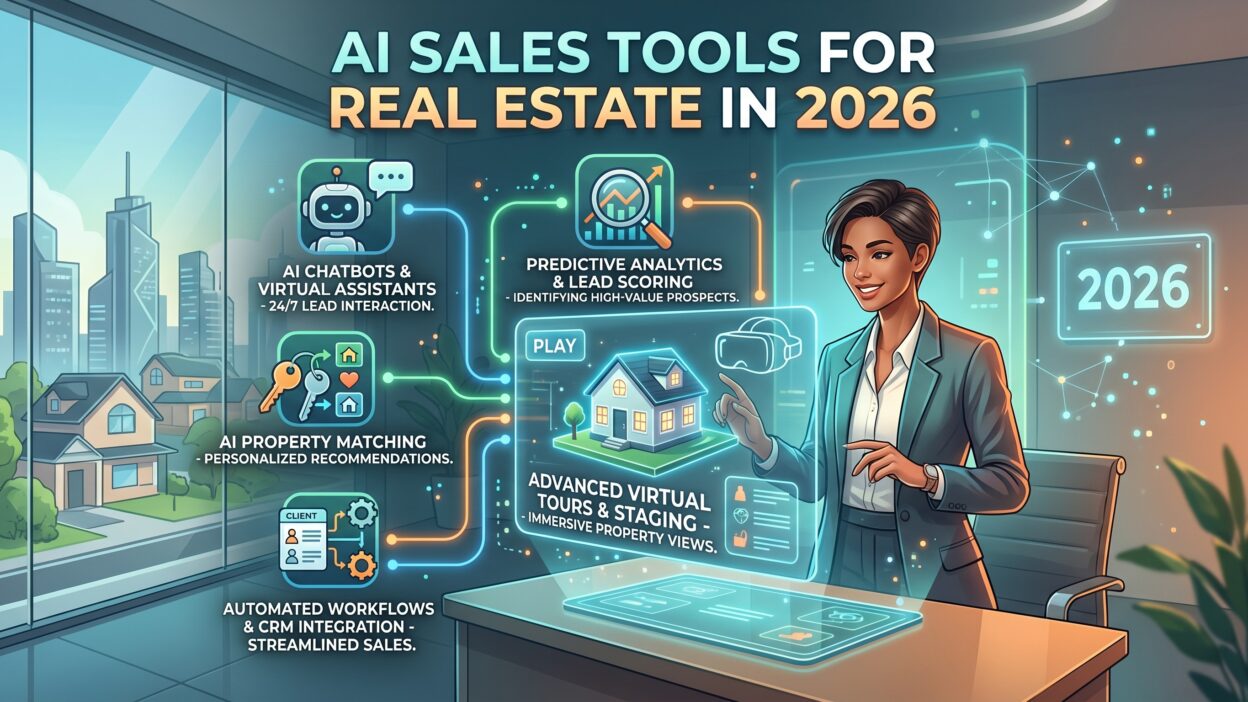
AI sales tools for real estate work as smart assistants. They analyze data at speeds no human can match. They identify patterns across thousands of transactions. They personalize communication without the agent spending hours at a keyboard.
Here is what these tools handle today.
Lead Generation and Scoring
Every real estate team deals with a flood of leads. Not all leads are equal. Some buyers are ready to move in 30 days. Others are just browsing.
AI tools score each lead based on behavior. They track how many listings someone viewed, how long they spent on each page, and what price ranges they explored. The agent gets a ranked list every morning showing who deserves a call first.
This saves hours of guesswork. It means agents reach hot leads before competitors do.
Automated Follow-Up and Nurturing
Most leads go cold because no one followed up at the right time. Agents get busy showing properties. Messages pile up. Opportunities disappear.
AI handles follow-up automatically. It sends personalized texts, emails, and reminders based on where a lead is in the buying journey. A lead who looked at condos near downtown gets content about condo living, not suburban family homes.
This kind of smart nurturing keeps leads warm for months without the agent writing a single message manually.
Predictive Pricing and Market Analysis
Pricing a listing wrong is expensive. Too high means the property sits for weeks. Too low means the seller loses money.
AI sales tools for real estate analyze comparable sales, neighborhood trends, days-on-market data, and seasonal patterns simultaneously. They produce pricing recommendations with confidence scores.
Some tools go further. They predict how market conditions will shift over the next 60 to 90 days. Agents use this data to advise sellers on the best time to list.
Virtual Tours and AI-Powered Staging
Buyers still want to walk through a home. But they also want to preview it digitally first.
AI staging tools digitally furnish an empty room in seconds. They show buyers what a space looks like with modern furniture without paying for physical staging. This increases listing engagement significantly.
Virtual tour tools create immersive 3D walkthroughs from smartphone video. Buyers tour a property at midnight from their couch. This filters out unqualified showings and saves everyone time.
The Best AI Sales Tools for Real Estate in 2026
Choosing the right tools matters. Not every platform delivers what it promises. These are the categories that serious agents should know well.
AI-Powered CRM Platforms
A good CRM is the backbone of any real estate business. AI-powered CRMs go far beyond storing contacts.
They analyze communication history and suggest the best time to reach each client. They flag when a past client’s home anniversary is coming up. They remind agents to send market updates to leads who went quiet three months ago.
The best platforms in this category integrate with MLS data, email, SMS, and social media. Everything lives in one place. Agents see a full picture of every relationship without clicking between five different apps.
Conversational AI and Chatbots
Website visitors want answers immediately. Most agents cannot be online 24 hours a day.
AI chatbots handle initial website inquiries around the clock. They answer questions about listings, neighborhoods, and the buying process. They collect contact information and qualify leads before a human ever gets involved.
The best chatbots in 2026 feel remarkably natural. They ask follow-up questions. They adjust responses based on what the visitor asks. They hand off to a live agent at exactly the right moment.
This kind of tool ensures no lead ever falls through the cracks because of time zones or busy schedules.
AI Content and Marketing Tools
Real estate marketing requires constant content. Social media posts, email newsletters, property descriptions, blog articles, and video scripts all take time.
AI content tools generate first drafts in seconds. An agent inputs a property address and basic details. The tool produces a compelling listing description optimized for search engines and buyer emotion.
These tools also create personalized email campaigns. They segment a contact list by buyer type, price range, and location preference. Each segment gets content tailored to their specific situation.
AI sales tools for real estate that include marketing features allow small teams to produce content volumes that used to require a full marketing department.
Predictive Analytics Platforms
The agents who consistently win listings know what sellers want before a competitor calls. Predictive analytics tools make this possible.
These platforms identify homeowners who are likely to sell in the next 6 to 12 months. They analyze factors like how long someone has owned the home, life event indicators, mortgage data, and neighborhood movement patterns.
Agents receive a list of high-probability sellers. They can reach out with a market update or a personalized valuation before the homeowner even starts thinking about listing.
This proactive approach builds trust. It positions the agent as an expert rather than someone chasing leads.
AI Transaction Management Tools
Closing a deal involves massive amounts of paperwork, deadlines, and communication. Missing one detail can delay or kill a transaction.
AI transaction management tools track every deadline automatically. They send reminders to buyers, sellers, lenders, and attorneys. They flag missing documents before they become problems.
Some platforms use AI to review contracts and identify unusual clauses. They do not replace a real estate attorney. They do help agents catch potential issues early and ask the right questions.
How to Choose the Right AI Sales Tools for Real Estate
Every agent has different needs. A solo agent working luxury properties needs different tools than a team of 20 doing high-volume residential sales.
Identify Your Biggest Time Drains First
Start by tracking where your time goes for one week. Most agents discover they spend 40% or more of their time on tasks that do not directly generate revenue.
Common time drains include answering repeat questions, manually entering data, writing property descriptions, and chasing down signatures.
Pick tools that solve your specific problem first. Do not buy a platform because it has 50 features if you only need three of them.
Prioritize Integration Over Features
A tool that does not connect with your existing software creates more work. Before buying anything, ask whether it integrates with your CRM, MLS, email platform, and calendar.
The best AI sales tools for real estate in 2026 connect seamlessly with other software. Data flows automatically. You are not copying and pasting information between platforms all day.
Test Before You Commit
Most serious platforms offer a free trial. Use it fully. Involve your team if you have one.
During the trial, pay attention to two things. Does the tool actually save you time, or does it create a new learning curve that costs more time than it saves? And does the output — whether leads, content, or data — actually improve your results?
Good tools feel obvious after a week. If you are still struggling to understand basic functions after 10 days, it is probably not the right fit.
Consider Your Client Experience
The best technology should make your clients feel better served, not like they are dealing with a robot.
AI follow-up messages should feel personal. Virtual tour software should actually help clients visualize themselves in the property. Chatbots should answer real questions, not send people in circles.
Test every client-facing tool from the client’s perspective before rolling it out.
Common Mistakes Agents Make With AI Tools
Buying tools is easy. Using them well takes discipline.
Over-Automating Client Communication
Some agents automate everything. Every touchpoint becomes a pre-written message. Clients notice. They feel like a number, not a person.
Use automation for timing and personalization. Keep the most important conversations — price negotiations, emotional moments, big decisions — fully human.
Ignoring the Data These Tools Produce
AI tools generate enormous amounts of useful data. Most agents check the dashboard once and forget about it.
Schedule a weekly review of your key metrics. Lead response rates, follow-up conversion, listing performance, content engagement. Use the data to make smarter decisions every week.
Skipping Team Training
A tool no one uses is wasted money. If you run a team, build training into your onboarding process for every new platform.
Identify one team member to become the internal expert on each tool. They troubleshoot issues, share best practices, and help others get up to speed faster.
AI Sales Tools for Real Estate and the Human Touch
Every top agent asks the same question. Will AI replace me?
The answer is no. Here is why.
AI is exceptional at processing data, identifying patterns, and handling repetitive tasks. It cannot build genuine trust with a family buying their first home. It cannot read the room during a difficult negotiation. It cannot understand a client’s emotional attachment to a neighborhood they grew up in.
AI sales tools for real estate make great agents better. They remove the friction from the business side of real estate. They give agents more time to do what machines cannot — build real human connections.
The agents who struggle with AI are those who use it as a replacement for relationship skills. The ones who thrive use it as infrastructure that supports deeper client relationships.
Related Topics to Know
Understanding the broader landscape of AI in real estate helps agents make smarter technology decisions.
Predictive analytics in real estate helps agents identify sellers before competitors reach them. This is one of the fastest-growing use cases for AI in the industry.
Real estate CRM with AI refers to customer relationship management platforms that use machine learning to prioritize leads and automate follow-up. These are the most widely adopted AI tools in the industry today.
AI property valuation tools use comparable sales data, market trends, and property characteristics to produce accurate pricing recommendations in seconds.
Real estate chatbot software powers 24/7 lead capture on agent websites and real estate portals.
Automated listing descriptions use AI to generate compelling property copy from basic details, saving agents 20 to 40 minutes per listing.
Virtual staging AI transforms empty rooms into beautifully furnished spaces without physical staging costs.
Frequently Asked Questions About AI Sales Tools for Real Estate
Are AI sales tools for real estate expensive?
Pricing varies widely. Entry-level tools start around $50 per month. Full-featured platforms with CRM, analytics, and marketing capabilities can run $300 to $1,000 per month or more. Most tools price on a per-seat or per-lead basis. The return on investment is usually clear within the first 60 to 90 days when used consistently.
Do I need technical skills to use these tools?
Most modern AI sales tools for real estate are built for non-technical users. Setup usually involves connecting your email and MLS account and following guided onboarding steps. No coding required. If you can use a smartphone, you can use most of these platforms.
Will AI replace real estate agents?
No. AI handles data processing, repetitive communication, and administrative tasks at scale. Real estate transactions involve massive financial and emotional decisions. Clients need a trusted human advisor to guide them through complex negotiations, legal questions, and personal circumstances. AI improves agent productivity. It does not replace agent judgment.
How do I know which AI tool is right for my business?
Start with your biggest operational pain point. If you are losing leads because follow-up is inconsistent, start with an AI CRM or automated follow-up tool. If pricing your listings takes hours of manual research, start with a predictive analytics platform. Solve one problem completely before adding new tools.
Are AI-generated listing descriptions good enough to publish?
AI tools produce strong first drafts. Most agents review and adjust the output before publishing. A good AI content tool saves 80% of the writing time while leaving room for the agent to add local knowledge, emotional details, and their own voice. Never publish AI content without a human review.
Is my client data safe with AI platforms?
Reputable platforms follow strict data privacy regulations including GDPR and CCPA. Before subscribing to any tool, review their data security policy, ask about encryption standards, and confirm they do not sell client data to third parties. Look for platforms with SOC 2 compliance certifications.
Can small teams or solo agents benefit from AI tools?
Absolutely. Solo agents often benefit the most. A single agent using good AI sales tools for real estate can handle a volume of leads and listings that previously required a full team. The tools level the playing field between solo agents and large brokerages.
The Future of AI Sales Tools for Real Estate
The pace of change in real estate technology is not slowing down.
Voice AI is becoming a serious tool. Agents interact with their CRM using natural speech. Clients ask questions through smart home devices. Voice-powered showing schedulers are already in testing at major brokerages.
Hyper-personalization is the next frontier. AI tools in 2026 already personalize communication. Within the next two to three years, they will predict client needs before the client articulates them. An AI tool will know a buyer is ready to upgrade based on behavioral signals months before that buyer calls their agent.
Real estate platforms will embed AI deeper into every workflow. Searching for listings, submitting offers, scheduling inspections, and managing closings will all have AI-driven automation behind them.
Agents who build AI literacy now will be positioned to lead their markets for the next decade.
Read More:-Best Conversational AI & Chatbot Platforms for Sales in 2026
Conclusion

Real estate in 2026 belongs to agents who work smarter. AI sales tools for real estate give every agent — solo operator or large team — the ability to generate better leads, follow up faster, price listings more accurately, and market properties more effectively.
These tools are not a replacement for the skills that make a great agent. They are the infrastructure that makes those skills available to more clients.
The agents thriving right now are not the most technologically sophisticated people in the room. They are the ones who identified their biggest operational problems and found the right tools to solve them. They stayed consistent. They used the data their tools produced. They kept the human moments human.
AI sales tools for real estate are no longer optional for serious professionals. They are the foundation of a competitive, scalable real estate business.
Start with one tool. Use it well. Build from there.
The market is moving fast. The agents who move with it win.