Introduction
TL;DR Words sell. The right sentence at the right moment closes a deal. The wrong one loses a customer forever.
Sales copywriting has always demanded skill, time, and deep customer knowledge. Most sales teams struggle to produce great copy consistently. Reps write emails that sound flat. Scripts feel robotic. Landing pages fail to convert.AI for sales copywriting is solving all of this right now.
In 2026, sales teams use AI to write cold emails, call scripts, ad copy, landing pages, and follow-up sequences faster than ever before. The output is sharp, personalized, and built around real buyer psychology.
This guide covers everything. You will learn what AI for sales copywriting does, which tools matter, how to use them well, and how to keep your copy sounding human even when a machine helps write it.
Table of Contents
What Is AI for Sales Copywriting?
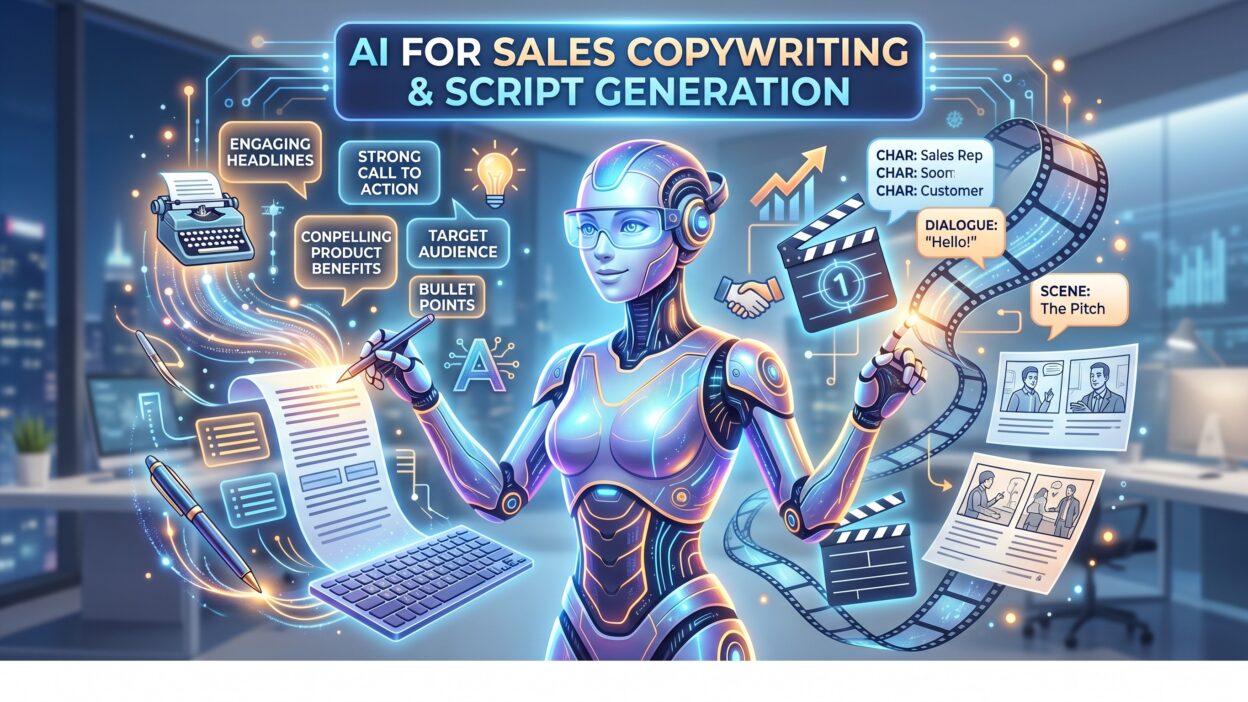
AI for sales copywriting refers to using artificial intelligence tools to create, optimize, and personalize written sales content. This includes cold outreach emails, sales scripts, ad copy, product descriptions, landing page headlines, and video sales letters.
These tools use large language models trained on billions of examples of effective sales writing. They understand persuasion frameworks, buyer psychology, and the structure of high-converting copy.
The result is a first draft in seconds instead of hours. A sales rep describes their product, target audience, and goal. The AI produces ready-to-edit copy that follows proven frameworks like AIDA, PAS, and FAB.
AI for sales copywriting does not replace skilled writers or experienced reps. It removes the blank page problem. It gives teams a strong starting point. It accelerates the iteration process so teams can test more variations and find winners faster.
Why Sales Copy Matters More Than Ever in 2026
Buyers receive hundreds of sales messages every week. Their inboxes are crowded. Their attention is limited.
Generic copy gets ignored. Personalized, relevant, well-structured copy gets read and acted on.
The challenge is that personalization at scale used to be impossible. A sales team of five reps cannot manually personalize 200 cold emails per day per rep. They either send generic messages that underperform or spend so long personalizing that they cannot hit volume targets.
AI solves this tension. It produces personalized copy at scale. Each email references the prospect’s industry, role, and pain points. Each script adapts to the product, the buyer stage, and the conversation context.
Sales teams that master AI for sales copywriting close more deals. Their messaging is sharper. Their outreach volume is higher. Their conversion rates improve because every message connects with the right buyer emotion at the right time.
The Core Applications of AI for Sales Copywriting
Understanding where AI delivers the most value helps teams prioritize their use of these tools. The applications below cover the full sales cycle.
Cold Email Copywriting
Cold email remains one of the highest-ROI sales channels when done well. Most cold email underperforms because it sounds like every other cold email.
AI for sales copywriting helps reps write subject lines that get opened. It structures email bodies around a single clear value proposition. It ends with a low-friction call to action that gets replies.
Good AI email tools let reps input the prospect’s name, company, role, industry, and one personalization detail. The tool generates a complete email that feels personally written. Reps review, adjust the tone, and send.
Teams can generate 50 unique cold emails in the time it used to take to write 5. Each one reads differently. Each one speaks directly to the prospect’s world.
Sales Call Scripts
Sales scripts serve a real purpose. They keep reps on track during live calls. They ensure the key value points land every time. They help new reps sound confident before experience builds naturally.
The problem with traditional scripts is that they sound scripted. Buyers feel the rigidity. Conversations go off track and reps lose the thread.
AI generates sales scripts that feel like real conversations. They include natural objection-handling language. They branch at key decision points so reps know what to say whether a buyer says yes, no, or maybe.
AI for sales copywriting applied to scripts also helps teams build industry-specific versions quickly. A software company selling to healthcare buyers needs a different script than one selling to retail. AI produces both in minutes.
Landing Page and Ad Copy
Every click on a paid ad deserves a landing page that converts. Most landing pages fail because the headline does not match the ad promise or the copy buries the value proposition under too many words.
AI tools write landing page headlines, subheadlines, and body copy optimized for conversion. They apply proven frameworks. They test multiple headline angles so marketing teams can run A/B tests without spending a week writing variations.
Ad copy benefits equally. A single product can be positioned 10 different ways for 10 different audience segments. AI generates all 10 angles in minutes. Teams test them all and scale the winners.
Follow-Up Email Sequences
Most sales happen after the fifth or sixth contact. Most reps stop following up after two. The gap between those numbers is where revenue disappears.
AI for sales copywriting builds complete follow-up sequences. It writes five to seven emails that each offer a new reason to respond. Each email in the sequence provides value — a relevant insight, a case study, a question — rather than just asking for the sale again.
These sequences stay consistent in voice and message. They escalate naturally from soft outreach to confident value offer. They give every lead a full sales journey without the rep manually writing each touchpoint.
Video Sales Letter Scripts
Video sells. A well-written video sales letter converts better than almost any other format. Writing one from scratch takes most copywriters two to three days.
AI generates VSL scripts in minutes. It structures the script around a proven framework — hook, problem, agitation, solution, proof, offer, call to action. Reps or marketers fill in the specific details. The AI handles the structure and the persuasive language.
Teams can iterate quickly. If a hook is not converting, generate five new versions and test them. The cost of experimentation drops to almost zero.
How AI for Sales Copywriting Actually Works
Understanding the mechanics helps teams use these tools more effectively. It also removes unrealistic expectations.
AI copywriting tools are trained on large datasets of marketing and sales content. They learn patterns associated with high-performing copy. They understand which sentence structures drive urgency, which phrases build trust, and which formats match specific channels.
When a rep or marketer inputs a prompt, the AI matches the request to its training. It produces output that follows the patterns associated with the type of copy requested.
The quality of the output depends heavily on the quality of the input. Vague prompts produce generic copy. Specific, detailed prompts produce sharp, relevant copy.
A prompt that says “write a cold email for my software company” produces mediocre output. A prompt that says “write a cold email for a B2B SaaS product that automates expense reporting, targeting CFOs at mid-size manufacturing companies who are frustrated by manual reconciliation processes” produces excellent first-draft copy.
AI for sales copywriting rewards the teams that learn to prompt well. This is a learnable skill. Most teams see significant improvement in output quality within two to three weeks of consistent use.
Choosing the Right AI Tools for Sales Copywriting
The market offers dozens of AI writing tools in 2026. Not all of them serve sales teams equally well. Some are built for general content creation. Others are purpose-built for sales and marketing contexts.
General AI Writing Platforms
Platforms like the leading large language models handle a wide range of copywriting tasks. They produce cold emails, scripts, landing pages, and ad copy with strong results when prompted well.
These platforms offer maximum flexibility. They handle unusual requests, complex products, and niche industries better than specialized tools because their training data is broader.
The trade-off is that they require stronger prompting skills. Teams need to invest time in building effective prompt templates for each use case.
Specialized Sales Copywriting AI Tools
Some platforms are built specifically for sales teams. They include pre-built frameworks for cold email, outreach sequences, and scripts. They integrate with CRM and email platforms. They produce structured output that maps directly to common sales workflows.
These tools lower the learning curve. A rep can generate a cold email in under two minutes without knowing anything about prompting. The trade-off is less flexibility for unusual use cases.
AI for sales copywriting works best when teams match the tool to the use case. General platforms for complex or unusual content. Specialized tools for high-volume, repeatable tasks like cold outreach.
Tools With Sales Performance Data
The most advanced platforms in 2026 connect copy performance to outcomes. They track which email subject lines got the highest open rates. They identify which script phrases correlated with the most booked meetings. They use this data to improve future output.
This closed-loop system means the AI learns what works in your specific market with your specific buyers. Output improves over time without the team doing anything beyond using the tool consistently.
Best Practices for Using AI for Sales Copywriting
Buying the tool is the easy part. Using it well requires discipline and good process.
Build a Prompt Library
Every use case needs a tested prompt template. A cold email for a new product launch needs a different prompt than a follow-up email for a trial user.
Build a shared prompt library for the team. Include prompts for every common scenario. Review and update them monthly based on which outputs are performing best.
This consistency means every rep — regardless of writing skill — produces strong copy. The library becomes a competitive asset over time.
Always Edit Before Sending
AI produces first drafts. Every piece of AI copy needs a human review before it reaches a buyer.
Check for factual accuracy. Add specific details that only a human would know. Adjust the tone to match your brand voice. Remove any phrases that sound stiff or generic.
The goal is copy that reads like a skilled human wrote it with the speed advantage of AI. Raw AI output rarely achieves that standard without editing.
Test Variations Systematically
One of the biggest advantages of AI for sales copywriting is the ability to test multiple angles quickly. Use this advantage deliberately.
Generate three subject line variations for every email campaign. Test two headline versions on every landing page. Try a script with a different opening line for two weeks and compare booking rates.
Build a testing rhythm. Document what you test. Record what wins. Feed winning patterns back into your prompt library.
Keep the Human Moments Human
AI handles volume. Humans handle the moments that matter most.
A prospect who just raised a funding round deserves a personally written congratulations before a pitch. A long-term client renewing a major contract deserves a genuine personal note, not a template.
Use AI for the repeatable, scalable parts of sales communication. Reserve genuine personal writing for the high-value relationship moments.
Common Mistakes Teams Make With AI Sales Copy
Understanding what goes wrong helps teams avoid the same pitfalls.
Over-Reliance on Raw Output
Some teams treat AI output as finished copy. They send the first draft without editing. Buyers notice. The copy sounds like it came from a machine.
AI for sales copywriting is a productivity multiplier. It is not a substitute for human judgment and editing.
Using AI Without a Clear Message Strategy
AI cannot tell you what your value proposition should be. It cannot identify your best-fit customer or your most compelling differentiator. It needs humans to define the strategy.
Teams that feed AI a confused or weak message strategy get confused or weak copy output. AI amplifies the strategy you give it. A strong strategy produces great copy. A weak one produces polished noise.
Define your messaging clearly before using AI to scale it. Know your buyer, their pain, your solution, and why you win. Then let AI express that message at scale.
Ignoring Compliance and Legal Review
Sales copy makes claims. Some claims require legal review depending on the industry. Financial services, healthcare, and insurance have strict rules about what sales copy can say.
AI tools do not know your legal requirements. They write persuasive copy without considering compliance constraints. Always run AI-generated copy through your legal or compliance review process before publishing or sending at scale.
Related Topics
Understanding the broader content landscape around this topic strengthens topical authority for SEO.
AI sales script generator refers to tools that produce phone and video call scripts for sales reps. This is one of the most searched use cases within the broader AI sales writing category.
Sales email copywriting AI covers tools focused specifically on email outreach, cold email, and follow-up sequences. Teams searching for this term want solutions to email-specific challenges.
AI ad copy generator addresses the paid advertising application. Marketing teams use these tools to produce Facebook, Google, and LinkedIn ad variations at scale.
Automated sales content creation describes the broader workflow of using AI to handle content production across the full sales cycle.
Conversion copywriting AI targets teams focused specifically on landing pages, product pages, and conversion-rate optimization.
AI-powered outreach tools covers the combination of AI writing and outreach automation, where copy generation and sending happen within the same platform.
Frequently Asked Questions About AI for Sales Copywriting
Does AI for sales copywriting really produce quality output?
Yes — with the right inputs. The quality of AI copywriting output depends heavily on the quality of the prompt. Detailed, specific prompts that include target audience, product details, and desired outcome produce strong first-draft copy. Teams that invest time in prompt development see output that requires minimal editing.
How much time does AI for sales copywriting save?
Most sales reps report saving two to four hours per week on writing tasks after adopting AI tools. Teams running high-volume cold outreach save significantly more. Some teams report reducing email creation time by 70 to 80 percent. The time savings compound when teams also use AI for scripts, sequences, and ad copy.
Will buyers know my copy was written by AI?
Not if you edit it properly. Raw AI output often has recognizable patterns — certain phrases, sentence structures, and generic statements that experienced buyers notice. A thorough human edit removes these patterns and adds specific, authentic details. The goal is copy that reads as if a skilled human wrote it. That standard is achievable with proper editing.
Can AI write copy for any industry?
AI for sales copywriting handles most industries effectively when prompted with sufficient context. Niche technical industries — advanced manufacturing, specialized medical devices, complex financial instruments — may require more detailed prompts and heavier editing to ensure accuracy. In these cases, the AI handles structure and persuasion while the human adds technical precision.
What is the best AI tool for sales copywriting?
The best tool depends on the use case and team size. General large language model platforms offer the most flexibility for complex tasks. Purpose-built sales tools like outreach platforms with built-in AI offer faster workflows for high-volume cold email and sequence creation. Many teams use a combination — a general platform for strategy and content, a specialized tool for high-volume outreach.
How do I make AI copy sound more human?
Four practices consistently improve the human quality of AI copy. Add specific names, companies, and real details that only a human observer would include. Remove filler phrases and generic openers that AI tools favor. Vary sentence length throughout the copy. Read the copy aloud — anything that sounds stiff when spoken aloud needs rewriting.
Is AI for sales copywriting suitable for small sales teams?
It is especially valuable for small teams. A solo rep or small team cannot afford a dedicated copywriter. AI fills that gap at a fraction of the cost. It gives small teams the same quality of sales messaging that large teams with full marketing departments produce. The competitive advantage for small teams is significant.
The Future of AI for Sales Copywriting
The tools available today are impressive. What is coming over the next two to three years is even more significant.
Personalization is moving toward real-time context. AI tools will access a prospect’s recent LinkedIn activity, company news, and hiring patterns to generate copy that references current, specific details. Every cold email will feel like it was written by someone who spent an hour researching the prospect.
Voice and tone matching will become standard. AI tools will learn each rep’s individual writing style. They will generate copy that sounds like that specific rep wrote it — not generic corporate language, but the rep’s authentic voice at scale.
Performance-connected generation is emerging now. The best platforms already connect copy to outcomes. Within two to three years, AI will generate copy predictions — showing which version is likely to perform better before a single send.
The teams investing in AI for sales copywriting today are building skills and systems that will deliver compounding advantages as the technology improves.
Read More:-Best AI Digital Workers & Virtual Sales Reps in 2026
Conclusion

Words are still the foundation of every sale. The most advanced product fails to close if the copy does not connect. The right message at the right moment moves buyers forward.
AI for sales copywriting gives every sales team — large or small — the ability to produce that right message consistently, quickly, and at scale.
The mechanics are straightforward. Great prompts produce great first drafts. Human editing turns first drafts into finished copy that converts. A systematic testing process identifies what works. The results compound over time.
The teams winning in 2026 are not the ones with the biggest budgets or the most experienced writers. They are the ones who built smart systems around AI for sales copywriting, kept the human judgment at the center, and used the time savings to focus on the relationships that close deals.
Start with one use case. Build your prompt library. Edit every output before it reaches a buyer. Test variations. Let the data guide your next move.
AI for sales copywriting is not the future. It is the present. The only question is whether your team is using it.