Introduction
TL;DR Your best hire may not have the right job title. Their resume may skip your keywords. A basic search will miss them. Your competitor might not.
Recruiters know this pain. You type a title into a search bar. You get hundreds of near-identical profiles. The strongest people hide in the gaps. A product manager calls herself a program lead. A data analyst lists Python but never writes the word analytics. A teacher moves into customer success, and no filter catches the jump.
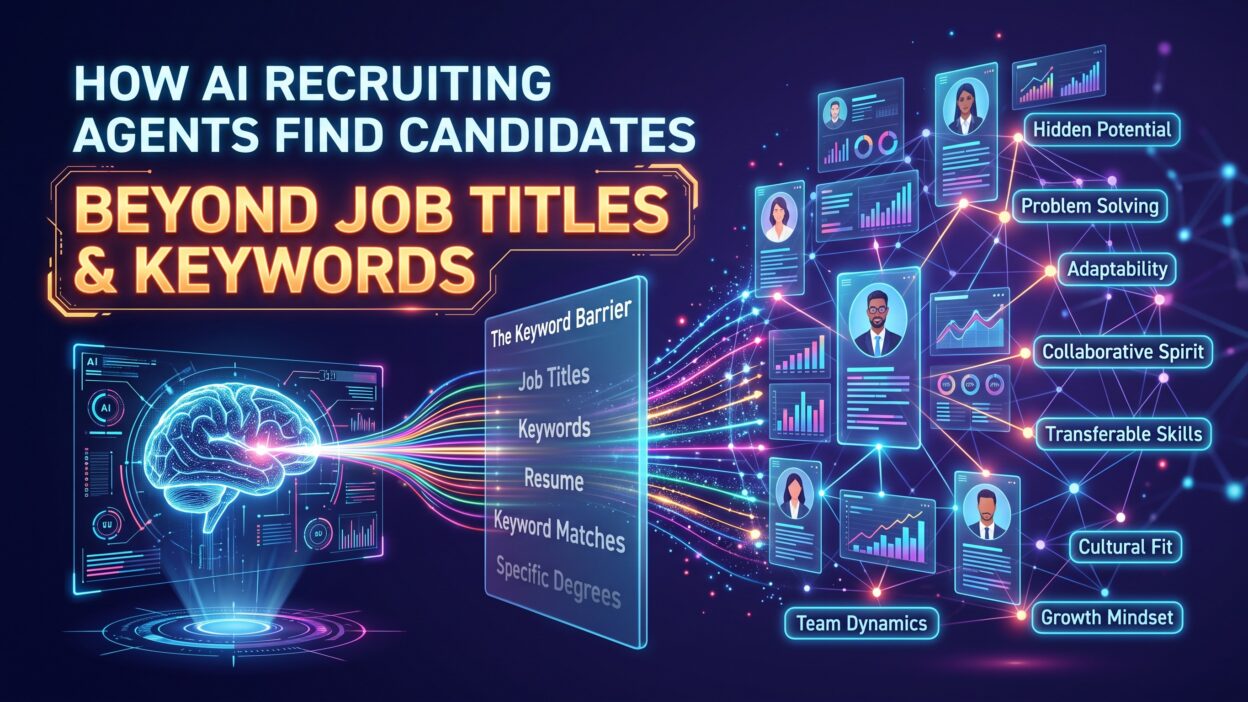
AI Recruiting Agents change how you search. They read profiles the way a skilled recruiter reads them. They look at skills, projects, growth and context. They surface people the keyword box ignores.
This guide explains how the technology works. You will see where it helps and where it needs a human. You will get a plan to start. Vendor claims vary a lot, so test any product on your own open roles before you commit.
Table of Contents
What Are AI Recruiting Agents and How Do They Work?
AI Recruiting Agents are software programs that carry out hiring tasks with some independence. They search for talent. They read profiles. They rank matches. Some send outreach and book interviews. You set the goal. The agent plans the steps and runs them.
The word agent matters. A simple tool follows one command. An agent follows a goal. You tell it to find senior backend engineers who have scaled payment systems. It breaks that goal into searches. It checks the results and refines the query. It learns from your feedback and improves with each round.
Most products run on large language models and machine learning. The models read text and grasp meaning. They connect related ideas. They know that a people operations lead and an HR manager often do similar work. That skill is the foundation of modern AI sourcing.
How They Differ From Chatbots and Resume Screeners
Chatbots answer questions. They greet candidates and share job details. Resume screeners filter incoming applications. They sit at the end of the funnel. Agents work at the start. They go out and find people who never applied.
Older screeners match keywords. Agents match meaning. That one difference changes the quality of every shortlist.
A screener rejects a resume that lacks the word “Kubernetes.” An agent reads that the candidate ran container orchestration for three years. It understands the match. The screener sees a missing word. The agent sees a qualified engineer.
Where They Fit in Your Hiring Stack
Your applicant tracking system stores candidate records. The agent reads and writes to it. Your sourcing databases hold profile data. The agent queries them. Your email and calendar tools handle outreach and scheduling. The agent connects those pieces.
Recruiters stay in charge of decisions. The agent handles the busywork around them. It builds the first list. It drafts the first message. It tracks replies. You spend your time on conversations and judgment.
Why Job Titles and Keywords Fall Short
Keyword search made sense twenty years ago. Databases were small. Titles were consistent. Resumes followed a standard shape. That world is gone.
Work has changed fast. Companies invent new roles every year. Startups use playful titles. Large firms use rigid ones. The same job carries five names across five companies. A search built on exact words misses most of the field.
Titles Hide Real Skills
A title shows rank and function. It does not show what a person can do. A “manager” at a ten-person startup writes code, closes deals and hires staff. A “manager” at a global bank approves forms. The words match. The work does not.
Career changers suffer most. A military logistics officer has deep supply chain skills. Their title says “lieutenant.” A keyword search for supply chain talent never finds them. Skills-based hiring fixes this blind spot. Agents make that approach practical at scale.
Keywords Reward Resume Writers, Not Talent
Candidates learn to game keyword filters. They paste job description phrases into their resumes. They add hidden text. They list every tool they have ever touched. Filters reward those tricks.
Quiet experts lose. A brilliant engineer writes a short, honest resume. She skips the buzzwords. The filter ranks her below a polished stuffer. Recruiters never see her profile.
Keyword search also ignores context. The word “Python” appears on a data scientist’s resume and on a zookeeper’s cover letter. Meaning lives in context. Only systems that read context can use it.
How AI Recruiting Agents Search Beyond Titles and Keywords
AI Recruiting Agents use several methods at once. Each method catches talent that the others miss. Together they build a far richer picture of a candidate.
Semantic Search Reads Meaning
Semantic search turns text into numbers that capture meaning. Similar ideas sit close together in that number space. A query for “led a team through a cloud migration” lands near profiles that describe moving systems to AWS or Azure, even when the words differ.
You can write your search the way you would brief a colleague. You describe the work. The agent finds people who did similar work. You skip the guesswork of listing every possible synonym.
Skills Inference Fills the Gaps
Agents infer skills that a profile never lists. A candidate who built recommendation engines likely knows machine learning basics. A candidate who managed a hospital budget likely knows financial planning. The agent reads the evidence and draws the link.
Many systems build a skills graph. The graph maps how skills relate. It knows that someone with React experience can learn Vue quickly. It knows which adjacent skills transfer well. That knowledge widens your talent pool in a smart way.
Career Trajectory Shows Potential
Agents study the shape of a career. They notice fast promotions. They notice steady growth in scope. They notice a move from individual work to team leadership. These patterns signal ambition and learning speed.
A resume lists jobs in a flat row. A trajectory tells a story. An agent can spot a candidate who gained a new level every eighteen months. That person may outgrow a rigid title filter. They may also outperform a candidate with a perfect title match.
Signals Beyond the Resume
Some agents look at public work. They read open-source contributions, conference talks, published articles and portfolio projects. These sources show real ability. A developer’s code reveals more than a bullet point about code.
Use this power with care. Respect privacy laws and platform rules. Tell candidates how you use their data. Strong teams set clear limits on what the agent may read. Trust matters as much as reach.
Matching and Ranking Tie It Together
After the agent gathers signals, it scores each person against the role. Good candidate matching shows its reasoning. It tells you why a profile ranks high. It might note a strong project history, a relevant domain and a steady growth path.
You review the list. You mark good and bad fits. The agent learns your taste. The next round improves. Within a few cycles, the shortlist feels like it came from a colleague who knows your team well.
Real Use Cases for Recruiting Teams
The technology fits many hiring needs. Four use cases stand out in practice.
Finding Passive Candidates
Most talented people do not apply for jobs. They already have one. They answer only when a message feels relevant. AI Recruiting Agents find these passive candidates by matching deep skills instead of surface titles. They also draft outreach that mentions real details from the person’s work. Replies rise when messages feel personal and accurate.
Rediscovering Your Own Database
Your applicant tracking system holds thousands of past applicants. Many were strong. You hired someone else. Those silver medalists sit untouched. An agent can search that archive with new meaning-based queries. It surfaces people who fit today’s roles. You pay nothing for sourcing, and the candidates already know your brand.
Hard-to-Fill Technical Roles
Rare skills defeat keyword search. A role like machine learning platform engineer has no standard title. Agents search for the underlying work, such as building training pipelines and managing model deployment. They find the few people who match, across titles that never mention your phrase.
Internal Mobility
Your own staff may fit open roles. Managers rarely know every skill their peers hold. An agent can read internal profiles and project history. It suggests employees who could move into new positions. You keep talent, cut hiring costs and boost morale.
The Benefits for Recruiters and Candidates
Recruiter productivity jumps first. Sourcing eats hours each week. Agents shrink that time. They build lists in minutes. They draft messages and follow up on silence. Recruiters spend their days talking with people. That work builds relationships and closes offers.
Quality improves too. Shortlists contain stronger matches. Hiring managers see candidates they might never have found. Interview-to-offer rates often climb when the early match is sharper. Results depend on your data and your roles, so measure your own numbers.
Speed matters in a tight market. Top candidates accept offers within days. An agent works around the clock. It never forgets a follow-up. Your team reaches people before rivals do.
Candidates gain as well. A fair agent looks at skills, not pedigree. A self-taught developer gets a look. A career changer gets a look. People without elite schools or famous employers get a look. Skills-based hiring opens doors that old filters kept shut.
The experience improves, too. Candidates hear back faster. Messages match their real interests. They feel seen instead of spammed.
Risks You Must Manage
Powerful tools bring real risks. Smart teams plan for them from the start.
Hiring Bias
Models learn from past data. If your past hires skewed toward one group, the model may copy that pattern. Hiring bias can hide inside a score. The system never says it. It simply ranks certain profiles lower.
Audit your results often. Compare shortlists across gender, age, ethnicity and other protected groups where the law allows. Ask vendors how they test for bias. Ask for their audit reports. Several regions now require bias audits and candidate notices for automated hiring tools. Check the rules where you hire.
Privacy and Transparency
Agents handle personal data. Follow data protection laws such as GDPR and local rules. Collect only what you need. Store it securely. Tell candidates how you use it.
Pick tools that explain their logic. A black-box ranking breeds distrust. Recruiters need to know why a profile scored high. Candidates deserve a clear process.
Overreliance on the Machine
Agents make mistakes. They can misread a profile or overrate a flashy project. Humans must make final hiring decisions. Treat the agent as a strong assistant. It does not replace judgment, empathy or accountability.
How to Choose the Right Solution
Start with your problem. Do you struggle to find rare talent? Do you drown in repetitive outreach? Do you want to mine your old applicant pool? Different products excel at different jobs. Name your top need before you watch a demo.
Check integration next. The product must connect with your applicant tracking system. Poor connections create double entry and angry recruiters. Ask for a live demonstration inside a system like yours.
Test accuracy on your own roles. Give each vendor the same three open positions. Compare the shortlists. Ask your hiring managers to rate them blindly. This test beats any marketing slide.
Demand transparency. Ask how the product ranks candidates. Ask what data it reads. Ask how it handles bias and privacy. Vague answers are a warning sign.
Look at the human side. Can recruiters adjust the agent’s behavior? Can they approve messages before sending? Control keeps quality high and protects your employer brand.
Compare the full cost. Include licenses, setup, training and any data fees. Ask about contract terms. Short pilots reduce risk.
Read customer references. Speak to teams of your size and in your industry. Ask what went wrong during rollout. Honest answers teach you more than success stories.
How to Roll Out Your Agent Successfully
Begin with a pilot. Pick one team and two or three roles. Choose roles with clear success measures, such as time to shortlist or interview rate. Small tests give fast lessons.
Prepare your data. Clean your applicant tracking system. Remove duplicates. Update stale records. Write clear job descriptions that describe the work, not just a list of requirements. Agents perform better with strong inputs.
Define the agent’s boundaries. Decide which tasks it handles alone and which need approval. Many teams let agents search and draft freely. They keep a human in the loop for sending messages and for every hiring decision.
Train your recruiters. Show them how to write goal-based briefs. Teach them to read the reasoning behind a ranking. Encourage them to give feedback on every shortlist. Feedback sharpens the system.
Set metrics before launch. Track time to fill, response rates, interview rates and offer acceptance. Track the diversity of your shortlists. Compare pilot results with your old process.
Review every few weeks. Meet with recruiters and hiring managers. Ask what works and what annoys them. Adjust the settings. Expand after you see clear gains.
Talk openly with your team. Some recruiters fear replacement. Explain the goal. The agent removes drudgery. It frees people for the human parts of the job. Staff who feel safe adopt tools faster.
Frequently Asked Questions
What are AI Recruiting Agents?
They are software programs that pursue hiring goals with some autonomy. They search for candidates, read profiles, rank matches and handle outreach. Humans set goals and make final decisions.
How do they find candidates without job titles?
They use semantic search and skills inference. They read what a person did, not just what the title says. They connect related skills and experiences across different industries.
Are they better than keyword search?
They usually find more relevant people, especially for roles with unclear titles. Keyword search still works for exact needs, such as a specific license. Many teams use both.
Can they remove hiring bias?
They can reduce some bias when designed and audited well. They can also copy bias from old data. Regular testing and human review are essential.
Do they replace recruiters?
No. They take over repetitive work. Recruiters still build relationships, assess culture fit, negotiate offers and make decisions.
Are they legal to use?
Rules vary by region. Some places require bias audits, candidate notices or consent for automated decision tools. Check local laws and consult legal counsel before you launch.
How fast can a team start?
A small pilot can begin within weeks if your applicant tracking system connects easily. Full rollouts take longer. Clean data speeds everything up.
What does it cost?
Pricing differs widely by vendor and company size. Many charge per seat or per usage. Request current quotes and compare total cost, not just license fees.
Read More:-OptinMonster Features: A Complete Breakdown in 2026
Conclusion

Hiring does not need to depend on the right title or the right keyword. Great talent hides in unexpected places. Career changers, self-taught experts and quiet achievers all fit that group. Old filters miss them every day.
AI Recruiting Agents offer a smarter path. They read meaning, infer skills and study career growth. They search your own database and the wider market. They give recruiters time back and give candidates a fairer look.
The tools carry risks. Bias, privacy and overreliance need constant attention. Audit your results. Keep humans in charge of decisions. Choose vendors who explain their methods.
Start small this quarter. Pick two stubborn roles. Run a pilot. Compare the shortlist with your usual one. Let your recruiters and hiring managers judge the difference. The results will tell you how far to go.
Your next great hire may already sit in a profile you have never opened. Give your team the tools to find that person.