Introduction
TL;DR Display campaigns fail for one simple reason. The wrong ad size gets built for the wrong placement. Publishers reject creative that does not match their inventory. Advertisers waste budget on formats nobody actually shows. Standard banner ad sizes solve this problem. They give advertisers and publishers one shared language for every ad slot. This guide covers the standard banner ad sizes that matter most in 2026. You will learn what each size does, where it runs, and how to pick the right one for your next campaign.
Table of Contents
What Are Standard Banner Ad Sizes?
Standard banner ad sizes are fixed pixel dimensions set by the Interactive Advertising Bureau. Every major ad network recognizes these sizes. A 300×250 banner built for one publisher works on thousands of other sites without changes. This consistency saves advertisers time and money.
Why Standard Banner Ad Sizes Matter for Advertisers
Non-standard sizes create real problems. Publishers reject creative that does not fit their layout. Ad networks lower fill rates for odd dimensions. Standard banner ad sizes avoid these issues completely. They guarantee your creative runs across the widest possible inventory.
The IAB and Standard Banner Ad Sizes
The IAB created its New Ad Portfolio to modernize digital advertising. This update shifted some focus toward flexible, ratio-based formats. Fixed-pixel sizes still dominate real campaigns in 2026. Publishers sell fixed slots. Ad servers require exact dimensions. Standard banner ad sizes remain the backbone of display advertising today.
Most Common Standard Banner Ad Sizes in 2026
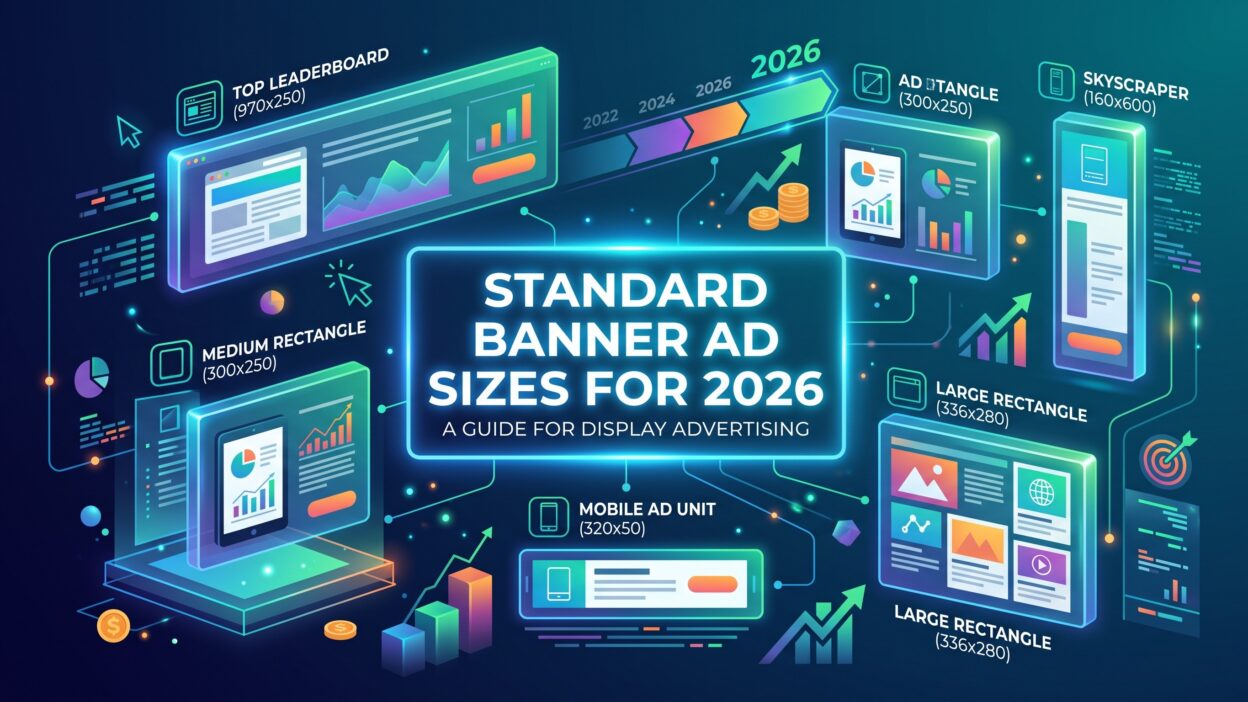
A handful of sizes cover most available ad inventory. Build these first before adding anything custom.
Medium Rectangle (300×250)
The medium rectangle stands as the most used banner size in digital advertising. It works on desktop and mobile screens equally well. Publishers place it inside articles, sidebars, and mobile feeds. This size earns the highest click-through rate among all standard banner ad sizes. Build this size first if your budget allows only one format.
Leaderboard (728×90)
The leaderboard sits at the top of most web pages. Its wide, horizontal shape grabs attention immediately. Publishers favor this placement for header space above the fold. Among standard banner ad sizes, the leaderboard delivers strong visibility for brand awareness campaigns.
Wide Skyscraper (160×600)
The wide skyscraper runs vertically along the side of a webpage. Readers see it during the entire scroll session. This banner size works well for campaigns that need sustained visibility rather than a single glance.
Half Page (300×600)
The half page format gives advertisers more space than any other common banner. Its large canvas allows bigger images and bolder messaging. Publishers use it for premium placements that command higher rates. This size ranks among the fastest-growing standard banner ad sizes for engagement campaigns.
Mobile Banner (320×50)
Mobile traffic keeps growing every year. The 320×50 mobile banner fits neatly at the top or bottom of a phone screen. It stays small enough to avoid disrupting content. This size remains essential for any campaign targeting mobile users.
Large Mobile Banner (320×100)
The large mobile banner doubles the height of the standard mobile format. This extra space allows a clearer message and a visible call-to-action button. Many advertisers see stronger mobile results with this size compared to the smaller 320×50 format.
Billboard (970×250)
The billboard format delivers maximum visual impact. Its large size dominates the page and commands premium pricing. Publishers reserve this placement for high-value campaigns and brand launches. Among standard banner ad sizes, the billboard works best for awareness goals rather than direct response.
Large Rectangle (336×280)
The large rectangle offers a bigger version of the medium rectangle format. It fits similar placements but provides extra room for detailed messaging. Advertisers often test this size against the standard 300×250 to compare performance.
Desktop vs Mobile Standard Banner Ad Sizes
Desktop and mobile campaigns need different approaches. Screen size and user behavior both shape which format performs best.
Desktop-First Sizes
Desktop screens support larger formats like the leaderboard, billboard, and half page. Users browse desktop sites with more patience. Larger standard banner ad sizes work well here because they fit naturally into wider layouts.
Mobile-First Sizes
Mobile screens demand compact, simple formats. The 320×50 and 320×100 sizes dominate mobile inventory. Mobile users scroll fast and skim content. Smaller standard banner ad sizes match this behavior without slowing down the page.
How to Choose the Right Standard Banner Ad Sizes for Your Campaign
Picking the right size depends on placement and goal, not personal preference.
Match Size to Placement
Check where your ad will actually appear before choosing a size. A sidebar placement calls for a skyscraper. An in-content placement calls for a medium rectangle. Matching standard banner ad sizes to real placements prevents wasted creative work.
Match Size to Campaign Goal
Brand awareness campaigns benefit from large, visual formats like the billboard. Direct response campaigns often perform better with smaller, high-frequency sizes like the medium rectangle. Define your goal first. Then pick from the standard banner ad sizes that support it.
Best Practices for Designing Standard Banner Ad Sizes
Good design turns a standard size into a high-performing ad.
Keep File Size Small
Large files slow down page load times. Most networks cap file weight around 150 KB. Keep your standard banner ad sizes lightweight to avoid rejection and protect user experience.
Design for Readability
Small formats need short, clear messaging. Use five to seven words for your main message. Keep fonts large enough to read on any screen size.
Maintain Brand Consistency
Use the same colors, fonts, and logo placement across every size. This consistency builds recognition even when users see different standard banner ad sizes across different sites.
Common Mistakes When Using Standard Banner Ad Sizes
Many advertisers make the same errors when building display campaigns.
Ignoring Mobile Sizes
Some teams build only desktop formats. This mistake cuts off a huge share of available inventory. Mobile-specific standard banner ad sizes deserve equal attention during production.
Overloading the Banner with Text
Cramming too much copy into a small banner hurts readability. Keep messaging short. Let the image and CTA carry most of the weight.
Tools to Create Standard Banner Ad Sizes Faster
Manual resizing wastes valuable production time. Modern design tools now generate every standard size from one master file automatically. This shift lets small teams produce a full set of standard banner ad sizes in minutes instead of hours. Look for tools that export directly to your ad server or DSP to save additional time during trafficking.
Frequently Asked Questions
What are standard banner ad sizes? Standard banner ad sizes are fixed pixel dimensions set by the IAB. Common examples include 300×250, 728×90, and 160×600. These sizes work across nearly every ad network.
Which standard banner ad sizes perform best? The 300×250 medium rectangle typically earns the highest click-through rate among standard banner ad sizes. The 728×90 leaderboard and 320×50 mobile banner also perform strongly.
Do standard banner ad sizes still matter with responsive ads? Yes. Responsive ads still rely on standard banner ad sizes as a foundation. Publishers sell fixed slots that require exact dimensions, so these sizes remain essential.
How many standard banner ad sizes should I build for one campaign? Most campaigns only need three to five standard banner ad sizes. Start with 300×250, 728×90, and 320×50 to cover the majority of available inventory.
Are mobile standard banner ad sizes different from desktop sizes? Yes. Mobile formats like 320×50 and 320×100 fit smaller screens. Desktop formats like 728×90 and 970×250 need wider layouts.
What file size works best for standard banner ad sizes? Keep files under 150 KB. This file size limit keeps standard banner ad sizes loading fast across every device and connection speed.
Read More:-Best AI Tools for Sales & Marketing Alignment in 2026
Conclusion

Standard banner ad sizes give every display campaign a solid foundation. They guarantee your creative runs across publishers, networks, and devices without friction. Start with the core sizes: the medium rectangle, the leaderboard, and the mobile banner. Add larger formats like the billboard and half page once your budget grows. Match each size to its real placement and campaign goal. Keep files light and messaging short. Master these standard banner ad sizes, and your display advertising will reach more of the right people, faster.