Introduction
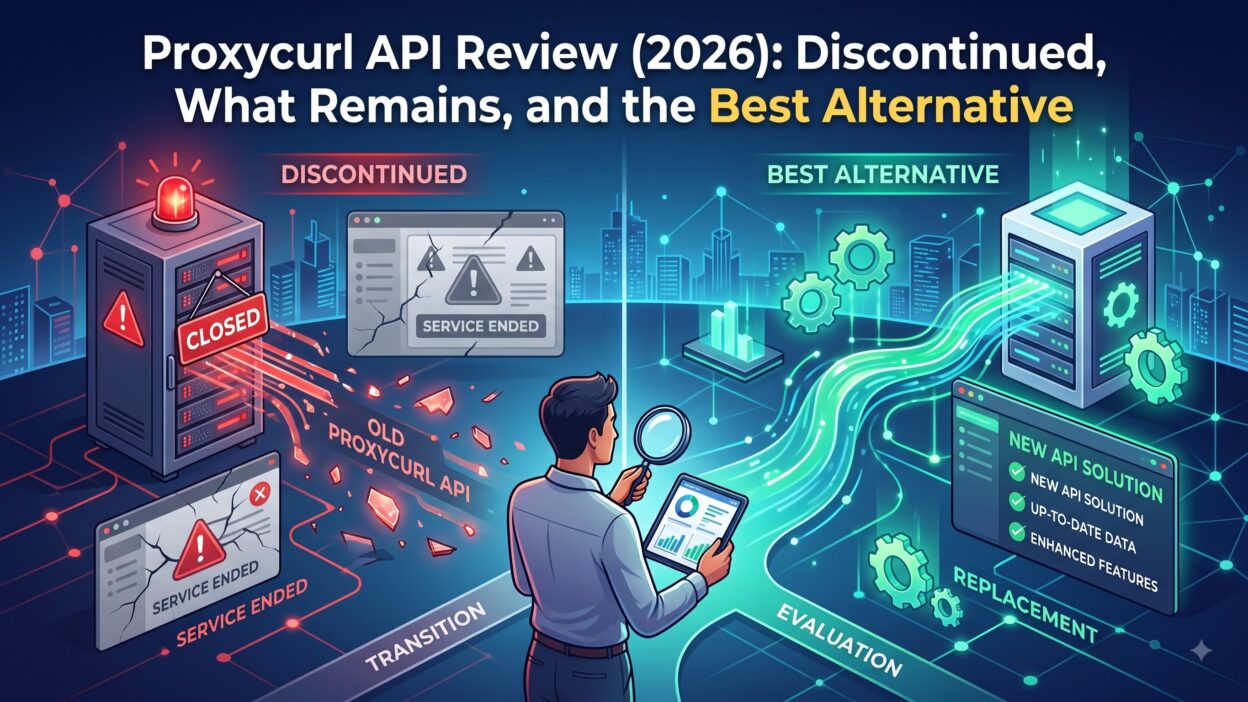
TL;DR Proxycurl shut down in July 2025. If you built a product on top of its LinkedIn data, your pipeline broke overnight. This guide covers exactly what happened, what still exists under a new name, and the best Proxycurl API alternative for your specific use case.
You will learn why LinkedIn forced Proxycurl to shut down. You will learn what the original founder built afterward. You will also learn how to pick a real Proxycurl API alternative based on the type of data you actually need. By the end, you will know exactly where to migrate your integration.
Table of Contents
What Happened to Proxycurl
Proxycurl built its business on pulling structured LinkedIn profile and company data through a clean REST API. Developers loved it for years. Sales teams and recruiters used it to enrich leads without touching LinkedIn manually.
LinkedIn, owned by Microsoft, filed a federal lawsuit against Proxycurl’s parent company, Nubela, in January 2025. The lawsuit accused the company of running large numbers of fake LinkedIn accounts to scrape millions of member profiles, including data that wasn’t public. Fighting a company backed by Microsoft’s legal budget made little sense for a bootstrapped startup. Proxycurl settled and shut the service down completely on July 4, 2025.
The API endpoints stopped responding. The documentation came down. Sign-ups closed for good. Every business that depended on Proxycurl needed a real Proxycurl API alternative fast, since there was no way to reactivate the old service.
Why Proxycurl Got Shut Down
Understanding the shutdown reason matters if you want to avoid the same mistake with your next vendor. This wasn’t a simple pricing dispute or a funding issue.
The LinkedIn Lawsuit
LinkedIn’s complaint centered on unauthorized data collection at massive scale. The lawsuit claimed Proxycurl created fake accounts specifically to bypass LinkedIn’s normal access limits. This approach let Proxycurl pull far more data than a real user account ever could, which violated LinkedIn’s user agreement directly.
The Settlement and Shutdown
Rather than fight a drawn-out legal battle, Proxycurl’s founder chose to settle. Part of that settlement required deleting the LinkedIn data the company had already collected. The founder later said the business generated close to ten million dollars in revenue, with roughly half tied directly to LinkedIn scraping. Losing that revenue stream meant the company had no clear path forward under the old model.
The Compliance Lesson
Any tool that scrapes LinkedIn profiles without an official partnership carries this same legal exposure. Businesses now searching for a Proxycurl API alternative should weigh compliance just as heavily as price or data coverage, since a repeat shutdown could hit any vendor built the same way.
What Remains of Proxycurl in 2026
Proxycurl itself is gone, but its founder didn’t walk away from the business entirely. The same team now runs NinjaPear, a company intelligence platform built on a narrower, compliant data model.
NinjaPear covers company-level data instead of individual LinkedIn profiles. This includes customer listings, competitor mapping, employee search at the company level, and RSS-based monitoring of company activity across blogs and social platforms. The old People API, Jobs API, School API, and person search endpoints that made Proxycurl popular no longer exist in any form.
If your original use case involved pulling individual LinkedIn profile data, NinjaPear won’t cover that need. You still need a real Proxycurl API alternative built specifically for profile-level enrichment. If your use case centered on company intelligence instead, NinjaPear might actually solve your problem without forcing a full migration to a new vendor.
How to Choose the Best Proxycurl API Alternative
Picking the right replacement depends entirely on what your original integration actually did. Not every Proxycurl API alternative solves the same problem.
Real-Time Profile Lookups
If your product pulled a LinkedIn URL and returned structured JSON on demand, you need a real-time scraper. Tools like Bright Data, Apify, and ScrapIn fill this role today. Response times run similar to what Proxycurl offered, though pricing structures vary quite a bit between providers.
Bulk Data Enrichment
If you enriched large batches of contacts or companies at once, a dataset provider fits better than a real-time scraper. Coresignal and People Data Labs both offer bulk enrichment built on licensed and aggregated data sources instead of live scraping.
Account-Based Access
If you need live data plus the ability to take action, like sending connection requests or messages, an account-based API makes more sense. Unipile and Linked API both operate through a user’s own LinkedIn account rather than a shared scraped database, which lowers the legal risk that ended Proxycurl.
Best Proxycurl API Alternative Options Compared
Every business searching for a Proxycurl API alternative should compare options across three dimensions: data model, compliance risk, and pricing structure.
Real-Time Scrapers
Real-time scrapers deliver a similar experience to the old Proxycurl API. You send a profile URL and get structured data back within seconds. The tradeoff is legal exposure, since these tools still scrape LinkedIn without an official partnership. Pricing usually starts around fifty dollars a month, with higher tiers for larger volume.
Dataset Providers
Dataset providers pull from licensed sources rather than live scraping. This model carries less legal risk than a direct scraper, though data freshness sometimes lags behind real-time tools. Businesses that prioritize compliance over instant freshness often pick this type of Proxycurl API alternative.
Account-Based APIs
Account-based APIs route requests through an actual LinkedIn account instead of a shared database. This model avoids the fake-account problem that triggered Proxycurl’s lawsuit in the first place. It also enables actions beyond data pulls, like outreach automation, which neither scrapers nor dataset providers support natively.
Multi-Provider Waterfalls
Some newer platforms combine several data providers into one API call, falling back to a secondary source if the first one returns nothing. This approach improves match rates and adds a layer of protection against any single provider shutting down again. Teams that got burned by relying on one vendor often prefer this model as their next Proxycurl API alternative.
Migrating Away From Proxycurl: What to Expect
Migration difficulty depends on how deeply your product depended on Proxycurl’s specific endpoint structure. Most teams find the process takes an afternoon to a few days, not weeks.
Start by mapping every Proxycurl endpoint your product called against the equivalent endpoint on your new provider. Person lookups often map to a single enrichment call on most platforms. Company search calls usually map cleanly too, though field names rarely match exactly.
Update your error handling next. Every provider structures error responses differently. Build in retry logic for rate limits, and treat a null result as “not found” rather than throwing an error, since this pattern matches how most modern APIs behave.
Test with a small batch before switching your full pipeline over. This catches mapping mistakes early and avoids a larger outage while you validate that your chosen Proxycurl API alternative returns the data quality your product actually needs.
Red Flags to Avoid When Picking a New Provider
Not every company that markets itself as a Proxycurl API alternative operates safely. Watch for providers that still rely on fake account networks to scrape LinkedIn, since this is the exact behavior that got Proxycurl sued in the first place.
Avoid vendors with vague or missing compliance documentation. A legitimate provider explains clearly where its data comes from and how it stays within platform terms of service. Pricing opacity is another warning sign. Providers that hide pricing behind a mandatory sales call often turn out more expensive than advertised once you actually sign a contract.
Check independent reviews on platforms like G2 or Trustpilot before committing. Marketing pages rarely mention data accuracy problems, but real user reviews usually do.
FAQs About Proxycurl API Alternative Options
Is Proxycurl coming back?
No, Proxycurl shut down permanently in July 2025 after settling its lawsuit with LinkedIn. There’s no indication the original service will return under its old name or model.
What is the closest Proxycurl API alternative for profile lookups?
Real-time scrapers like Bright Data, Apify, or ScrapIn offer the closest match to Proxycurl’s original “URL in, JSON out” experience for individual LinkedIn profiles.
Does NinjaPear replace Proxycurl completely?
No, NinjaPear only covers company-level intelligence, not individual LinkedIn profile scraping. Anyone who relied on person-level data needs a separate Proxycurl API alternative built for that use case.
Is scraping LinkedIn data still legal in 2026?
Scraping public data sits in a legal gray area that shifts based on court rulings and platform terms. Using fake accounts to bypass access limits, which is what triggered Proxycurl’s lawsuit, carries clear legal risk regardless of the data being public or not.
How much does a typical Proxycurl API alternative cost?
Pricing varies widely by provider and data model. Real-time scrapers often start around fifty dollars a month, while dataset providers and account-based APIs price based on volume and can run higher for enterprise-level usage.
Can I get my old Proxycurl data back?
No, under the settlement terms, Proxycurl deleted the LinkedIn data it had collected. Any data your product stored locally before the shutdown remains yours, but nothing further is retrievable from Proxycurl itself.
Which Proxycurl API alternative is safest from a legal standpoint?
Account-based APIs that route requests through a real user’s LinkedIn account generally carry lower legal risk than tools relying on fake account networks or unauthorized scraping at scale.
Read More:-Phone Enrichment API: Verified Direct Dials and Mobile Numbers
Conclusion

Proxycurl’s shutdown left a real gap for any business that depended on its LinkedIn data. The lawsuit that ended it also set a clear precedent for how platforms respond to unauthorized scraping at scale. Choosing your next Proxycurl API alternative means looking past price alone and weighing compliance just as seriously.
Match your alternative to your actual use case instead of picking the first name you recognize. Real-time scrapers fit profile lookups. Dataset providers fit bulk enrichment. Account-based APIs fit teams that need both data and action. Whichever Proxycurl API alternative you choose, build your migration around compliance from day one, so your next integration doesn’t face the same fate.