Introduction
TL;DR Few names carry more weight in the AI research world than Andrej Karpathy. His work has shaped how developers, researchers, and engineers think about neural networks and large language models. His ability to explain complex ideas clearly has built him a following that extends far beyond academic circles.
Karpathy’s Autoresearch is his most ambitious idea yet. It proposes a system where AI does not just execute research tasks — it actively improves the very process used to train it. That concept sounds simple on the surface. The implications run extremely deep.
The idea of an AI system that participates in its own development cycle has been discussed theoretically for years. Karpathy’s Autoresearch moves it from theoretical territory into a concrete, grounded framework. It connects ideas from reinforcement learning, automated machine learning, and self-supervised training into a coherent research direction.
This blog covers what Karpathy’s Autoresearch actually proposes, why it matters, how it connects to current AI progress, and what challenges still stand in its way. It also answers the questions researchers and developers ask most often when they first encounter this concept.
Table of Contents
Who Is Andrej Karpathy and Why His Ideas Matter
A Track Record That Commands Attention
Andrej Karpathy built his reputation through years of impactful work. He served as Director of AI at Tesla, leading the Autopilot team through significant capability jumps. He completed his PhD at Stanford under Fei-Fei Li. He worked at OpenAI as a founding member and research scientist.
His educational contributions stand out just as strongly. His deep learning course lectures on YouTube have been watched millions of times. His implementation of GPT from scratch — published as a teaching tool — became a reference that universities, bootcamps, and self-taught developers worldwide use regularly.
When Karpathy proposes an idea, the AI community pays attention. His ideas combine theoretical grounding with practical clarity. Karpathy’s Autoresearch follows that same pattern. It presents a serious research direction with implications that span academia, industry, and the long-term trajectory of AI development.
From Educator to Research Architect
Karpathy returned to OpenAI and later stepped back to pursue independent research and content creation. That independence gave him space to think at a longer time horizon than fast-moving product teams typically allow.
Karpathy’s Autoresearch emerged from that independent thinking. It reflects the kind of systems-level question that someone with his background naturally gravitates toward — not “how do we improve this model” but “how do we build systems that improve themselves.”
That shift in question framing is precisely what makes Karpathy’s Autoresearch significant. It moves the unit of improvement from individual model performance to the research process itself.
Why Developers and Researchers Should Follow This Work
Karpathy communicates ideas at a level accessible to practitioners, not just theorists. Karpathy’s Autoresearch carries that same accessibility. Understanding it does not require a PhD in machine learning. It requires genuine curiosity about where AI development is heading and why.
What Is Karpathy’s Autoresearch — The Core Idea
The Central Proposition
Karpathy’s Autoresearch describes a system where an AI model participates actively in designing, evaluating, and refining its own training process. Traditional AI development separates the researchers from the model. Humans set objectives, design experiments, collect data, run training runs, and evaluate results. The model is the subject of that process, never a participant in it.
Karpathy’s Autoresearch challenges that separation. It asks what happens when the AI system itself takes on research tasks — hypothesis generation, experiment design, evaluation of outcomes — that currently rely entirely on human researchers.
The proposal is not that AI replaces human researchers entirely. It argues that AI can meaningfully contribute to the research loop that produces better AI. That contribution, applied at scale and with proper feedback structures, could dramatically accelerate the pace of AI capability improvement.
The Feedback Loop at the Center of the Idea
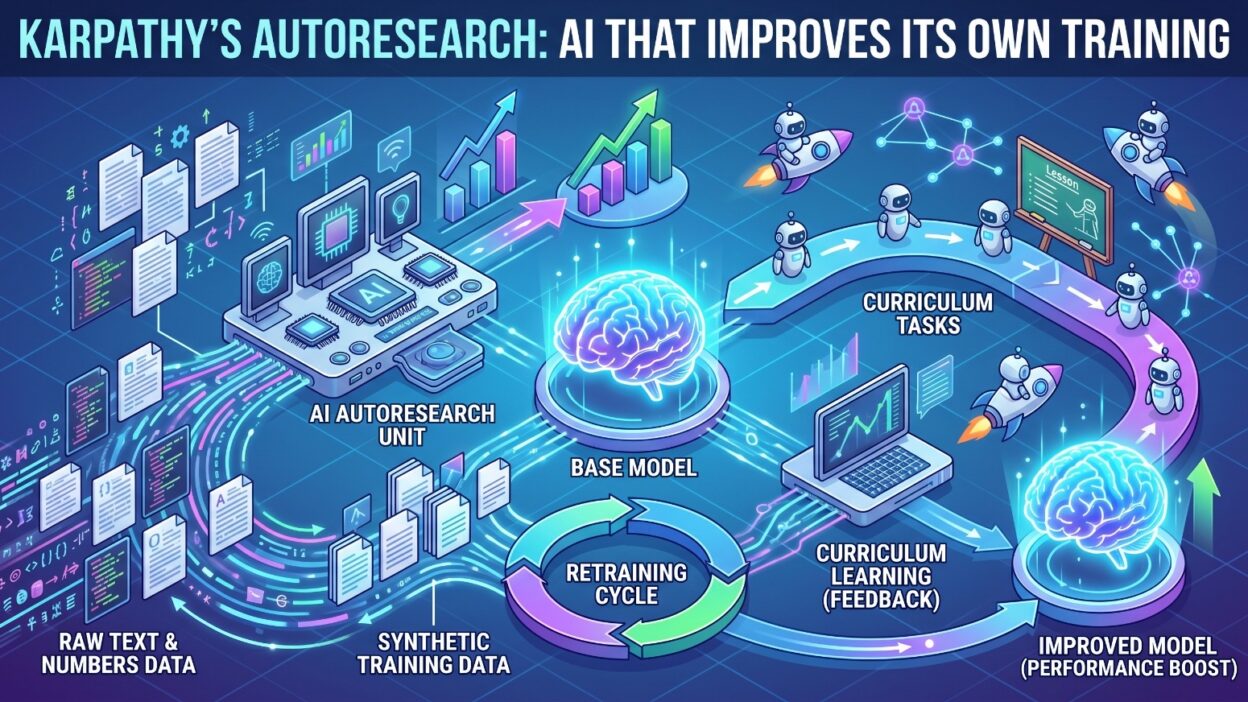
Karpathy’s Autoresearch centers on a feedback loop. The AI model generates hypotheses about what changes to its training setup might improve its performance. Those hypotheses get tested. Results feed back into the model’s understanding. The model generates better hypotheses based on that evidence.
This loop mirrors how good human researchers work. A researcher forms a hypothesis based on current understanding. They design an experiment. They observe results. They update their understanding and form new hypotheses. Karpathy’s Autoresearch proposes embedding this scientific reasoning process inside the AI development pipeline itself.
The feedback loop requires that the AI system understands its own performance well enough to generate meaningful hypotheses. It requires evaluation mechanisms that produce clear, reliable signals. It requires infrastructure that can run experiments and return results efficiently. Each of these requirements points toward specific technical challenges the framework must address.
How It Differs from Standard AutoML
AutoML — automated machine learning — already automates parts of the model development process. It searches over hyperparameter spaces, architecture choices, and training configurations automatically. Karpathy’s Autoresearch goes further.
AutoML optimizes within a defined search space. It finds good configurations from a set of pre-specified options. Karpathy’s Autoresearch proposes that the AI system itself expands and redefines the search space. It generates genuinely new hypotheses rather than searching through predefined options. That distinction separates incremental optimization from something closer to genuine scientific inquiry.
The Technical Architecture Behind Karpathy’s Autoresearch
The Role of Language Models in Research Generation
Large language models excel at synthesizing existing knowledge and generating novel combinations of ideas. Karpathy’s Autoresearch leverages this capability directly. A language model trained on AI research literature, experimental results, and technical documentation can generate plausible hypotheses about training improvements.
The model reads its own evaluation metrics. It reads descriptions of its current training setup. It reads summaries of related research. From that context, it generates specific, testable proposals — adjust the learning rate schedule in this way, modify the data mixing ratio in that way, introduce a new regularization technique from this paper.
The quality of generated hypotheses depends heavily on the model’s understanding of AI research itself. Karpathy’s Autoresearch requires that the model develop genuine competence in evaluating research ideas, not just reciting them. That requirement pushes toward more capable, better-calibrated models as a prerequisite.
Evaluation and Experiment Management
Every hypothesis Karpathy’s Autoresearch generates must face empirical testing. The framework requires a robust experiment management infrastructure. Experiments must run reliably, produce consistent results, and return meaningful evaluation signals.
Evaluation signals must be fast enough to enable iteration. Full training runs on large models take days or weeks. Karpathy’s Autoresearch needs proxy evaluation methods that return meaningful signals on shorter time horizons. Evaluation on smaller model scales, shorter training runs, or targeted benchmark subsets can serve as proxies for full-scale results.
The proxy evaluation problem is genuinely difficult. A change that improves a small model’s performance on a short training run does not always improve a large model’s performance on a full training run. Building reliable proxies requires extensive validation work — an ironic challenge, since validating proxies is itself a research problem that the autoresearch system might eventually help solve.
The Self-Improvement Gradient
Karpathy’s Autoresearch introduces what might be called a self-improvement gradient — a direction of change in the training process that the AI system itself identifies and pursues. This gradient operates at a higher level than the standard gradient descent that trains neural network weights.
Standard training gradients adjust model parameters to reduce loss on a training objective. The self-improvement gradient in Karpathy’s Autoresearch adjusts the training process itself — the data, the objectives, the curriculum, the architectural choices — based on higher-level performance signals.
Maintaining stability in a system with two levels of gradient-like optimization is non-trivial. Changes to the training process affect the model, which affects the hypotheses the model generates, which affects future changes to the training process. This recursive dependency requires careful design to prevent instability or degenerate solutions.
Why Self-Improving AI Research Matters Now
The Scaling Plateau Problem
AI capability has improved dramatically through scaling — more data, more compute, more parameters. Many researchers observe that pure scaling yields diminishing returns at the frontier. The next capability leap may require qualitative changes to training methods rather than purely quantitative increases in scale.
Karpathy’s Autoresearch addresses this challenge directly. If the training process itself can improve through AI-driven research, the dependency on human researchers to discover better methods decreases. AI development could accelerate even as the easy scaling gains narrow.
This matters enormously for the industry. The organizations that develop better training methods faster hold a significant advantage. Karpathy’s Autoresearch points toward a mechanism for generating those better methods at machine speed.
Compounding Returns on Research Efficiency
Human research teams improve incrementally. A team that discovers a better training method publishes it, other teams adopt it, and the field advances. This process takes months to years per meaningful advance. Karpathy’s Autoresearch proposes compressing that cycle dramatically.
An AI system that generates, tests, and adopts better training methods within its own development loop creates compounding returns. Each improvement makes the next generation of the model slightly better at generating hypotheses. A slightly better hypothesis generator produces slightly better training improvements. The compound effect over many iterations is potentially very large.
Reducing the Bottleneck of Human Research Bandwidth
The global AI research community is large but finite. Researcher time is the ultimate bottleneck on how fast AI development can progress. Karpathy’s Autoresearch reduces the dependency on human researcher time for certain classes of research tasks.
Routine hypothesis generation, experiment configuration, and result interpretation are tasks where AI assistance could meaningfully extend human researcher capacity. That extension does not replace human insight — it amplifies it. Researchers focus on higher-level questions while the autoresearch system handles the empirical exploration that currently consumes enormous human time.
Current Progress and Related Research
Connections to Existing Research Directions
Karpathy’s Autoresearch does not emerge from a vacuum. Several active research directions connect directly to its core proposals. Understanding those connections places the idea in proper context.
Meta-learning — learning to learn — trains models to adapt quickly to new tasks. It demonstrates that models can learn aspects of their own learning process. Karpathy’s Autoresearch extends this idea to the research process level rather than the task adaptation level.
Neural architecture search automates the discovery of effective model architectures. It showed that automated search over design spaces can discover architectures that match or exceed human-designed alternatives. Karpathy’s Autoresearch generalizes this approach beyond architecture search to the full training pipeline.
Constitutional AI and reinforcement learning from human feedback demonstrate that AI systems can use feedback signals to align their behavior with desired outcomes. Karpathy’s Autoresearch applies a similar principle — using performance feedback to align the training process with the goal of producing better models.
What Has Already Been Built
Research teams at major labs have built early versions of systems that exhibit autoresearch-like properties. AI Scientist from Sakana AI demonstrates automated research paper generation and evaluation. AlphaCode and subsequent systems show that AI can contribute meaningfully to technical problem-solving. Automated experiment management tools at companies like Google and Meta handle parts of the experimental pipeline that Karpathy’s Autoresearch envisions.
None of these systems yet implements the full loop Karpathy’s Autoresearch describes. Each addresses a component. The integration challenge — connecting hypothesis generation, experiment execution, result evaluation, and model update into a coherent self-improving loop — remains an open problem.
Karpathy’s Specific Contributions to the Framework
Karpathy’s Autoresearch contributes most distinctively through its emphasis on language model-driven hypothesis generation. Karpathy argues that current language models already possess enough knowledge of AI research to generate meaningful research hypotheses. The framework to actually test and act on those hypotheses needs to be built around them.
This is a practitioner’s perspective on autoresearch — not waiting for a theoretical breakthrough, but building with available tools toward a working system.
Challenges and Risks in Karpathy’s Autoresearch
The Evaluation Problem
The hardest unsolved problem in Karpathy’s Autoresearch is evaluation. To improve its own training, the AI system needs a clear signal that distinguishes better training approaches from worse ones. That signal must be reliable, fast, and relevant to the actual capabilities we care about.
Current benchmarks have well-known limitations. Models can improve benchmark scores through narrow optimization without improving general capability. Karpathy’s Autoresearch would face the same benchmark gaming risk that affects all evaluation-driven AI development — but amplified by the fact that the AI system is actively searching for improvements against those benchmarks.
Building evaluation frameworks that are robust to gaming, fast to run, and genuinely predictive of real-world capability is as important as any other component of the system.
The Stability Challenge
A system that modifies its own training process introduces recursive dynamics that can become unstable. Changes to the training process affect the model. The changed model generates different hypotheses. Those hypotheses produce further changes to the training process. Without careful design, this loop can drift toward degenerate solutions or oscillate without converging.
Karpathy’s Autoresearch requires robust stability mechanisms. These might include conservative update policies that limit how much the training process changes per iteration. They might include ensemble approaches that test multiple hypotheses simultaneously and adopt only changes with consistent positive effects. They might include human oversight checkpoints that review proposed changes before implementation.
Alignment and Safety Implications
Any system that modifies its own training process raises alignment and safety questions. If the AI system optimizes for an imperfect proxy of what we actually want, the self-improvement loop amplifies that misalignment with each iteration.
Karpathy’s Autoresearch must incorporate alignment considerations from the ground up. The objectives used to evaluate training improvements must reflect genuine human values and capability goals, not just narrow benchmark performance. This requirement connects Karpathy’s Autoresearch directly to the broader AI alignment research agenda.
How Developers Can Engage with These Ideas
Study the Foundational Papers
Engaging seriously with Karpathy’s Autoresearch requires building relevant technical knowledge. Study meta-learning through the MAML paper and its successors. Study neural architecture search through the DARTS and ENAS papers. Study reinforcement learning from human feedback through the InstructGPT technical report. These foundational papers build the conceptual vocabulary the autoresearch framework uses.
Karpathy’s own educational materials provide essential background. His makemore and nanoGPT implementations demonstrate the kind of clear, ground-up thinking that Karpathy’s Autoresearch applies at a larger scale. Understanding how he thinks about simple systems gives insight into how he approaches complex ones.
Experiment with Small-Scale Versions
Build small-scale experiments that implement components of Karpathy’s Autoresearch. Use a language model to generate training configuration hypotheses. Run those configurations on small datasets with small models. Measure results and feed them back to the language model. Observe whether the language model generates better hypotheses in subsequent rounds.
These small experiments will not reproduce the full power of what Karpathy’s Autoresearch envisions. They will give you direct experience with the real challenges — evaluation noise, hypothesis quality variation, experiment management complexity — that the full system must address.
Follow the Research Community’s Response
Karpathy’s Autoresearch has generated significant discussion in the AI research community. Follow that discussion through Twitter, research blogs, and ArXiv preprints. The community’s response reveals both the strongest counterarguments and the most promising extensions of the core idea.
Frequently Asked Questions About Karpathy’s Autoresearch
Is Karpathy’s Autoresearch the same as AGI self-improvement?
No. Karpathy’s Autoresearch describes a structured system where AI contributes to specific research tasks within a human-designed framework. It is not a proposal for unconstrained recursive self-improvement. The system operates within defined objectives, evaluation criteria, and infrastructure constraints. It is ambitious without being speculative in the way that AGI self-improvement discussions often become.
Does Karpathy’s Autoresearch require new AI breakthroughs?
Not necessarily. Karpathy’s position is that current language models already possess enough capability to contribute meaningfully to hypothesis generation. The missing pieces are infrastructure and framework rather than new fundamental capabilities. This makes Karpathy’s Autoresearch a near-term engineering challenge as much as a long-term research vision.
How does Karpathy’s Autoresearch handle the risk of AI optimizing for the wrong objectives?
This is the central safety challenge the framework must address. Karpathy’s Autoresearch requires careful objective design — evaluation criteria that reflect genuine capability improvement rather than narrow benchmark performance. Human oversight at key decision points provides an additional check against objective misalignment. The framework treats this as an ongoing design challenge rather than a solved problem.
What programming skills does someone need to contribute to this area?
Strong Python skills and familiarity with PyTorch or JAX are the practical starting points. Experience with experiment management tools like Weights and Biases or MLflow helps. Understanding of reinforcement learning fundamentals and language model fine-tuning provides important conceptual background. Reading the related research papers listed in this blog gives the theoretical grounding.
Where can I follow Karpathy’s current thinking on this topic?
Karpathy shares ideas through his Twitter account, his GitHub repositories, and occasional long-form content. His YouTube channel contains lectures that provide essential background. The AI research community’s discussion of his ideas appears across research forums, Discord servers, and ArXiv comment sections.
Read More:-ChatGPT is Now Inside Excel and Google Sheets: Here is How to Use it
Conclusion

Karpathy’s Autoresearch lands at an important moment. AI capabilities are advancing rapidly. The human research bandwidth required to direct that advancement is not growing at the same pace. The gap between what AI systems can potentially do and what human researchers can manually discover and test is widening.
Karpathy’s Autoresearch proposes a partial solution to that gap. It argues that AI systems can take on research tasks — hypothesis generation, experimental reasoning, result interpretation — that currently consume enormous human time. It argues that this participation can be structured, evaluated, and made reliable through careful engineering rather than waiting for a theoretical breakthrough.
The challenges are real. Evaluation quality, loop stability, and alignment considerations each present genuine engineering and research problems. None of them are obviously unsolvable. Each points toward specific research directions that the community can pursue in parallel.
What makes Karpathy’s Autoresearch worth taking seriously is not that it promises an immediate revolution. It is that it articulates a plausible path toward AI-assisted AI research that builds on existing capabilities and existing infrastructure. The path is hard. The destination is worth pursuing.
Karpathy has a track record of identifying hard problems early and explaining them clearly enough for a broad community to engage. Karpathy’s Autoresearch follows that pattern. It names a research direction that many people sensed was important without quite being able to articulate why.
Developers, researchers, and practitioners who engage seriously with Karpathy’s Autoresearch now will be better prepared for the infrastructure challenges, the evaluation design questions, and the alignment considerations that will define this work over the next several years.
The AI system that helps improve its own training may not arrive tomorrow. The groundwork for building it starts now.