Introduction
TL;DR The AI world rarely stays quiet for long. OpenAI has introduced a model that is shaking the entire tech and security community. GPT-5.4-Cyber is not your average language model release. It carries weight far beyond what a version number suggests.
This model sits at the intersection of two powerful forces — artificial intelligence and cybersecurity. That combination raises serious questions. It also raises serious eyebrows among regulators, researchers, and enterprise security teams.
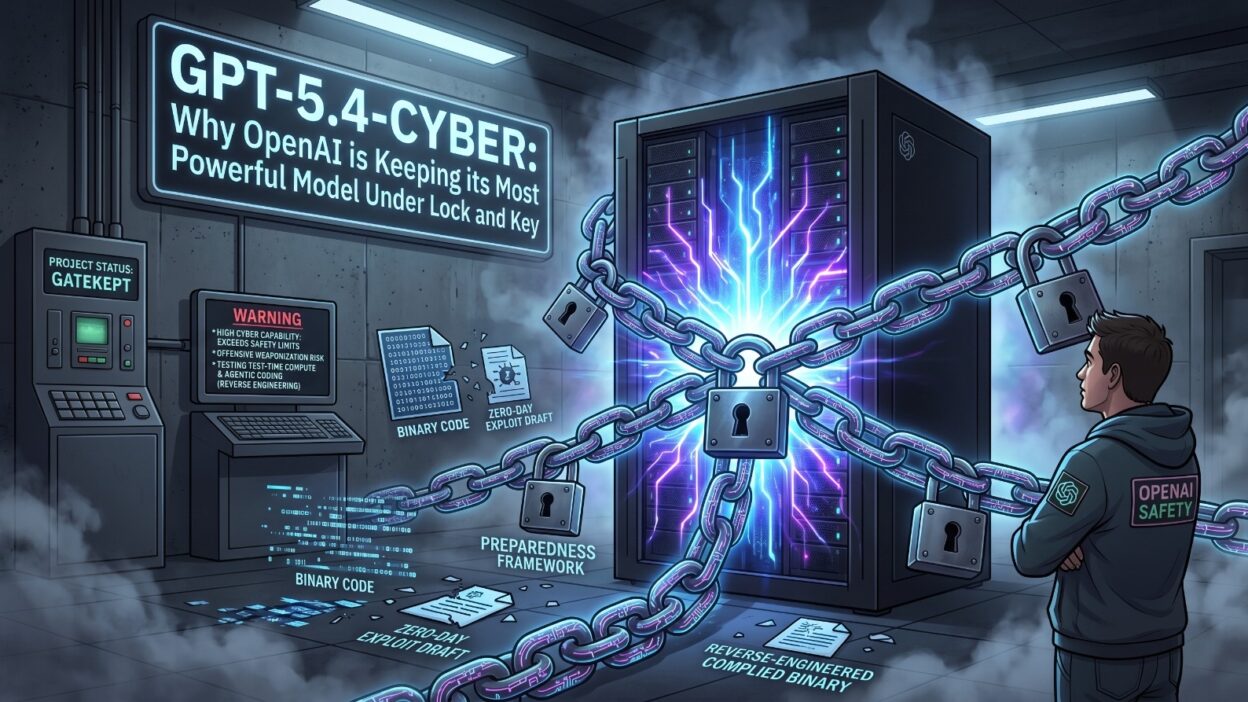
OpenAI made a deliberate choice. GPT-5.4-Cyber will not be available to the general public. That decision deserves a thorough explanation. This blog will walk you through everything — from what this model does, to why access is restricted, to what that means for the future of AI-powered security.
If you work in cybersecurity, AI development, enterprise tech, or government policy, this is a conversation you need to follow closely.
What Exactly Is GPT-5.4-Cyber?
The Model Behind the Name
GPT-5.4-Cyber is a specialized version within OpenAI’s GPT-5 family. It targets cybersecurity use cases specifically. The model underwent fine-tuning on massive datasets involving threat intelligence, vulnerability analysis, malware behavior, network forensics, and penetration testing frameworks.
Most GPT models aim for broad general capability. GPT-5.4-Cyber takes a different path. It goes deep into one domain with extraordinary precision.
The model can analyze complex attack vectors. It can simulate threat actor behavior with frightening accuracy. It can generate exploit concepts, identify software vulnerabilities, and map attack surfaces at a speed no human team can match alone.
What Makes It Different from GPT-5
GPT-5 is OpenAI’s flagship general-purpose model. GPT-5.4-Cyber builds on that foundation. The “.4” denotes an advanced subversion. “Cyber” reflects the domain-specific training overlay.
Regular GPT-5 handles a broad range of tasks — writing, coding, reasoning, research. GPT-5.4-Cyber narrows the lens dramatically. It operates with heightened sensitivity to security concepts, hacker methodologies, and defensive architecture patterns.
Think of it this way. GPT-5 is a generalist doctor. GPT-5.4-Cyber is a neurosurgeon who also has advanced knowledge in virology, toxicology, and emergency trauma.
Core Technical Capabilities
GPT-5.4-Cyber demonstrates several standout capabilities that set it apart from every previous model. It identifies zero-day vulnerability patterns in code before human analysts often notice them. It reverse-engineers obfuscated malware to extract behavioral signatures. It models attacker decision trees to help defenders anticipate next moves. It generates detailed incident response playbooks tailored to specific breach scenarios. It evaluates entire enterprise network configurations against current threat landscapes.
These capabilities make it enormously valuable. They also make unrestricted access enormously dangerous.
Why OpenAI Is Restricting Access to GPT-5.4-Cyber
The Dual-Use Dilemma
Every powerful tool has two sides. A scalpel saves lives in a surgeon’s hands. The same blade causes harm in the wrong hands. GPT-5.4-Cyber sits in exactly that position.
The model’s strengths as a defensive tool make it equally powerful as an offensive one. A threat actor with access to GPT-5.4-Cyber would gain enormous leverage. That actor could automate vulnerability discovery across thousands of targets simultaneously. That actor could generate convincing phishing infrastructure at scale. That actor could design evasion techniques that bypass modern endpoint detection tools.
OpenAI recognizes this reality clearly. The restrictions are not about competitive secrecy. They reflect a genuine responsibility calculus.
Regulatory Pressure and Government Dialogue
OpenAI does not operate in isolation. Governments worldwide are watching AI capability growth with increasing urgency. Several national security agencies have engaged OpenAI directly regarding GPT-5.4-Cyber.
The United States Cybersecurity and Infrastructure Security Agency flagged concerns early in the model’s development cycle. The European Union’s AI Office opened formal dialogue regarding deployment risk assessment. The UK’s National Cyber Security Centre requested detailed briefings.
These engagements signal something important. Governments view GPT-5.4-Cyber not as a consumer product but as critical technology infrastructure. That view shapes how OpenAI approaches release decisions.
Responsible Scaling Policy in Action
OpenAI published its Responsible Scaling Policy to address exactly these situations. The policy creates thresholds at which AI capabilities trigger enhanced scrutiny before any deployment. GPT-5.4-Cyber crossed several of those thresholds during internal testing.
The model demonstrated what OpenAI internally calls “uplift potential” — the ability to meaningfully enhance a non-expert’s capacity to conduct serious cyberattacks. That determination alone places GPT-5.4-Cyber in a restricted deployment category regardless of other factors.
Previous Incidents Informing the Decision
History informs this caution. Earlier AI tools with far less capability still caused measurable harm when accessed by bad actors. Researchers documented cases where earlier GPT variants assisted in crafting phishing campaigns. Security firms recorded instances of AI-generated malware appearing in real-world incidents.
GPT-5.4-Cyber operates at a fundamentally different capability level. The potential for harm scales accordingly. OpenAI’s caution reflects lessons learned from those earlier incidents.
Who Can Actually Access GPT-5.4-Cyber?
The Controlled Access Framework
OpenAI built a multi-layer access framework for GPT-5.4-Cyber. Access does not happen through a simple API key request. The process resembles obtaining a security clearance more than a software subscription.
Organizations must submit formal applications. OpenAI conducts background reviews of applying organizations. Applicants must demonstrate legitimate security use cases. Usage monitoring remains active for all authorized users.
Approved Use Categories
OpenAI defined specific categories of acceptable use. National defense organizations represent the first category. Critical infrastructure protection teams form the second. Academic cybersecurity research institutions with established ethics review processes form the third. Enterprise security operations teams at companies managing significant public or financial infrastructure represent the fourth.
Each category comes with distinct usage terms, monitoring requirements, and output logging conditions. No category receives unrestricted access. Even approved users operate within defined boundaries.
Partnership with Government Security Agencies
OpenAI established formal partnerships with several government security agencies to deploy GPT-5.4-Cyber in controlled environments. These partnerships include technical oversight provisions. Government partners can observe model behavior in operational settings. Findings feed back into OpenAI’s safety research pipeline.
This model creates a feedback loop. Real-world secure deployment generates data. That data refines both capability development and safety measures.
Enterprise Security Program
Large enterprises can apply through OpenAI’s Enterprise Security Program. This program launched alongside GPT-5.4-Cyber’s controlled release. Participating companies must meet minimum security standards. They must also agree to usage audits and output review processes.
The program gives enterprises access to GPT-5.4-Cyber’s capabilities within a managed environment. The model does not operate as a free-standing external API in this context. It operates behind an additional governance layer that OpenAI manages directly.
The Cybersecurity Implications of GPT-5.4-Cyber
Transforming Defensive Security Operations
GPT-5.4-Cyber has the potential to reshape how security operations centers function. Traditional SOC workflows rely heavily on human analysts working through alert queues. That work is slow, labor-intensive, and prone to fatigue-driven errors.
GPT-5.4-Cyber changes the operational tempo. The model analyzes alert data at machine speed. It correlates signals across disparate data sources. It surfaces high-priority threats before they escalate to critical severity. It drafts initial incident reports while analysts focus on decision-making rather than documentation.
Security teams that gain access describe it as gaining an additional expert analyst who never sleeps and never misses context buried in log data.
Threat Intelligence at a New Level
Threat intelligence work involves synthesizing enormous volumes of unstructured data. Analyst teams process reports, forums, dark web activity, vulnerability disclosures, and attacker infrastructure data simultaneously. Human capacity limits how much synthesis is possible.
GPT-5.4-Cyber removes that ceiling. The model processes and cross-references threat data at a scale no human team achieves. It generates actionable intelligence products faster than traditional workflows allow. Security teams can move from raw data to decision-ready intelligence in a fraction of the previous time.
Red Team and Penetration Testing Enhancement
Penetration testing requires creative adversarial thinking. Human red teams bring experience and intuition. GPT-5.4-Cyber adds computational scale to that creative process.
The model generates attack scenario variations that human testers might not consider. It models attacker pathways through complex environments. It identifies subtle configuration weaknesses that standard scanning tools overlook. Red teams using GPT-5.4-Cyber in authorized testing environments report finding vulnerabilities faster and with greater coverage than previous methods allowed.
The Offensive Risk Landscape
The same capabilities that make GPT-5.4-Cyber powerful for defenders create serious risks in attacker hands. Automated vulnerability discovery becomes accessible to less sophisticated threat actors. Social engineering campaigns gain personalization and scale that previously required significant human resources. Malware development cycles shorten. Evasion techniques multiply faster than defenders can adapt.
This risk landscape explains why OpenAI treats GPT-5.4-Cyber with such careful access controls. The defensive benefits are real. The offensive risks are equally real.
OpenAI’s Safety Research Around GPT-5.4-Cyber
Red Team Testing Before Any Deployment
Before GPT-5.4-Cyber reached any external user, OpenAI’s safety team conducted extensive red team testing. The team included external cybersecurity experts, former intelligence community professionals, and academic researchers specializing in AI safety.
Red team exercises focused on identifying the model’s most dangerous potential outputs. Testers probed for scenarios where the model might provide genuine uplift to malicious actors. Results from those exercises directly shaped the access control framework and the model’s behavioral guardrails.
Behavioral Guardrails and Output Filtering
GPT-5.4-Cyber operates with specialized behavioral guardrails that differ from standard GPT-5 safety measures. These guardrails recognize cybersecurity-specific harmful output categories. They intercept requests that would provide meaningful assistance to offensive operations.
The filtering is not simple keyword blocking. The model understands intent and context. A legitimate penetration tester asking about exploit techniques in a documented authorized engagement context receives different handling than an unverified user asking the same question without context.
Ongoing Safety Research Collaboration
OpenAI established collaboration agreements with independent AI safety organizations to study GPT-5.4-Cyber’s behavior under varied conditions. These collaborations produce research that feeds into OpenAI’s broader safety work. Published findings help the wider AI community understand how to build responsible cybersecurity-capable models.
What GPT-5.4-Cyber Means for the Future of AI in Cybersecurity
Setting a Precedent for Specialized AI Deployment
GPT-5.4-Cyber represents more than a single model release. It establishes a deployment model for future high-capability specialized AI systems. The controlled access framework, the government engagement process, the enterprise program structure — these innovations will likely define how the industry handles future releases with significant dual-use potential.
Other AI developers are watching. Microsoft, Google DeepMind, and Anthropic all develop AI systems with potential security applications. The framework OpenAI built around GPT-5.4-Cyber gives the industry a template to consider.
The Push for AI-Powered Cyber Defense Infrastructure
GPT-5.4-Cyber signals something important about the direction of cybersecurity infrastructure. AI-powered defense is becoming a necessity, not a luxury. Threat actors already use AI tools to enhance offensive capabilities. Defenders need matching capability.
Models like GPT-5.4-Cyber represent the next generation of defensive infrastructure. Governments and enterprises that invest in understanding and responsibly deploying these tools will hold meaningful defensive advantages over those that do not.
Regulatory Frameworks Will Evolve Around This Model
GPT-5.4-Cyber’s existence will accelerate regulatory development around high-capability AI systems with dual-use potential. Governments currently lack comprehensive frameworks for managing these tools. The model’s controlled release creates pressure on regulatory bodies to move faster.
Expect to see formal AI and cybersecurity regulatory proposals referencing GPT-5.4-Cyber as a benchmark case. The policy conversations happening now in Washington, Brussels, and London will produce frameworks that shape how future models are developed, classified, and deployed.
Talent and Training Implications
Security professionals who develop expertise in working with AI tools like GPT-5.4-Cyber will command significant value in the job market. Skill sets combining deep cybersecurity domain knowledge with AI operational capability are already rare. Models at this capability level widen the gap between AI-proficient security professionals and those without that fluency.
Training programs, certifications, and academic curricula will evolve to address this gap. The demand for AI-augmented security analysts will grow substantially over the next five years.
Frequently Asked Questions About GPT-5.4-Cyber
Is GPT-5.4-Cyber available to individual researchers?
Individual researchers cannot access GPT-5.4-Cyber through standard API channels. Independent researchers affiliated with accredited academic institutions that have established ethics review boards can apply through OpenAI’s research access program. Approval is not guaranteed. OpenAI evaluates each application against defined criteria including institutional affiliation, research purpose, data security practices, and prior research record.
How does GPT-5.4-Cyber compare to existing cybersecurity AI tools?
Existing cybersecurity AI tools focus on narrow, well-defined tasks — anomaly detection, signature matching, log analysis. GPT-5.4-Cyber operates with generalized reasoning capability applied to cybersecurity domains. The difference in scope is significant. Narrow tools do one thing well. GPT-5.4-Cyber reasons across multiple security domains simultaneously, connects context between disparate signals, and generates novel analysis rather than pattern-matching against known signatures.
Will GPT-5.4-Cyber become publicly available eventually?
OpenAI has not announced any timeline for broader public access. The controlled access model may remain permanent for this specific capability tier. Future versions may introduce architectures that allow safer public deployment at reduced capability levels. The current judgment from OpenAI is that full public availability creates unacceptable risk given the model’s demonstrated offensive uplift potential.
What safeguards prevent misuse within authorized access programs?
Authorized users operate under continuous usage monitoring. Outputs are logged and periodically reviewed. Usage patterns that suggest policy violations trigger review processes. Access can be revoked without appeal for confirmed violations. Organizations must designate responsible use officers who carry personal accountability for their organization’s compliance. These measures create multiple layers of deterrence and detection against misuse.
How does GPT-5.4-Cyber handle sensitive vulnerability information?
The model applies contextual judgment when handling vulnerability information. Authorized users in documented testing contexts receive substantive technical assistance. The model declines to provide specific exploitation code for vulnerabilities in systems the user has no apparent authorization to test. The judgment is imperfect — no filtering system achieves perfection — but the behavioral guardrails meaningfully reduce the risk of misuse compared to an unguarded model.
Read More:-GenAI Ops Roadmap: Your Path to Master LLMOps and AgentOps
Conclusion

GPT-5.4-Cyber represents a genuine inflection point. It is not just another model update. It is the first time a general-purpose AI architecture has been fine-tuned to cybersecurity capability at a level that crosses clear dual-use risk thresholds.
OpenAI’s decision to restrict access is not corporate timidity. It reflects an honest assessment of the risks that accompany extraordinary capability. The company deserves recognition for choosing caution over revenue maximization at this juncture.
The controlled access framework OpenAI built around GPT-5.4-Cyber is imperfect. No access control system stops every determined bad actor. But the framework meaningfully raises the barrier to misuse. It creates accountability structures that did not previously exist in AI model deployment.
The security community’s relationship with GPT-5.4-Cyber will evolve. Authorized users will generate real-world data on its defensive value. That data will inform future deployment decisions. The regulatory landscape will develop frameworks that bring more structure to how governments and enterprises engage with models at this capability level.
For now, GPT-5.4-Cyber sits behind careful controls — accessible to those with legitimate need and sufficient accountability infrastructure, out of reach for general public use. That arrangement is the right one for this moment.
The bigger question is not whether GPT-5.4-Cyber will eventually become more accessible. The bigger question is whether the cybersecurity community, the AI development industry, and governments will build the trust infrastructure, the technical safeguards, and the regulatory frameworks needed to make responsible wider deployment possible.
That work is underway. GPT-5.4-Cyber is both the reason for urgency and a proof point that the work is necessary. The model’s power demands it. The security stakes require it. The future of AI-augmented cybersecurity depends on getting it right.