Introduction
TL;DR Generative AI moved from research labs into production systems faster than any technology in recent memory. Companies built prototypes overnight. Demos impressed stakeholders. Budgets unlocked. Then came the hard part.
Running generative AI in production is not like running a web app. It is not like managing a traditional machine learning model either. The failure modes are different. The monitoring requirements are different. The deployment patterns are different. Organizations that skipped the operational foundation paid a steep price.
A clear GenAI Ops Roadmap solves that problem. It gives teams a structured path from experimentation to reliable, scalable, production-grade AI systems. It covers what to build first, what to defer, and how to connect the operational layers that keep LLMs and AI agents running safely over time.
This guide lays out that roadmap in full. You will understand the core disciplines of LLMOps and AgentOps. You will see how they connect. You will get a stage-by-stage plan for building operational maturity. You will also find the answers to the most common questions teams ask when they start this journey.
Table of Contents
Why GenAI Operations Demand a New Approach
Traditional MLOps Is Not Enough
MLOps gave data science teams a framework for deploying and maintaining machine learning models. It addressed versioning, pipeline automation, monitoring, and retraining. For classical ML models, that framework worked well. The models were deterministic. The outputs were numerical. Drift was measurable with standard statistical tests.
Generative AI breaks those assumptions. LLMs produce open-ended text. Outputs are non-deterministic. The same prompt can produce meaningfully different responses. Quality is subjective. Drift does not show up in statistical distributions the same way it does in regression or classification models.
Agent systems add another layer of complexity entirely. Agents do not just generate text. They plan, reason, use tools, call APIs, write code, and execute multi-step workflows. Failures cascade across steps. Debugging requires tracing entire reasoning chains. Evaluation requires judging not just outputs but the quality of the reasoning path that produced them.
A GenAI Ops Roadmap must account for all of this. It cannot simply extend MLOps with a few LLM-specific tools. It needs a rethought operational stack built for the unique properties of generative systems.
The Cost of Operating Without a Roadmap
Organizations that skip operational planning for generative AI face predictable problems. Prompt changes break production behavior without warning. Model provider updates alter output quality without notice. Agent workflows fail silently when external tools return unexpected results. Costs spiral because no one monitors token usage at the system level.
These are not hypothetical risks. They are documented failure patterns from early enterprise generative AI deployments. Every one of them traces back to the same root cause: no structured GenAI Ops Roadmap guiding the operational work.
Who Needs a GenAI Ops Roadmap
Every team deploying LLMs or AI agents in production needs one. Startups building AI-native products need it from day one. Enterprises scaling proof-of-concept projects into production need it before they flip the switch. Platform teams supporting internal AI development need it to create shared infrastructure. Data science teams transitioning from classical ML to generative AI need it to understand what changes and what carries over.
The GenAI Ops Roadmap is not a luxury for mature organizations. It is a prerequisite for responsible generative AI deployment at any scale.
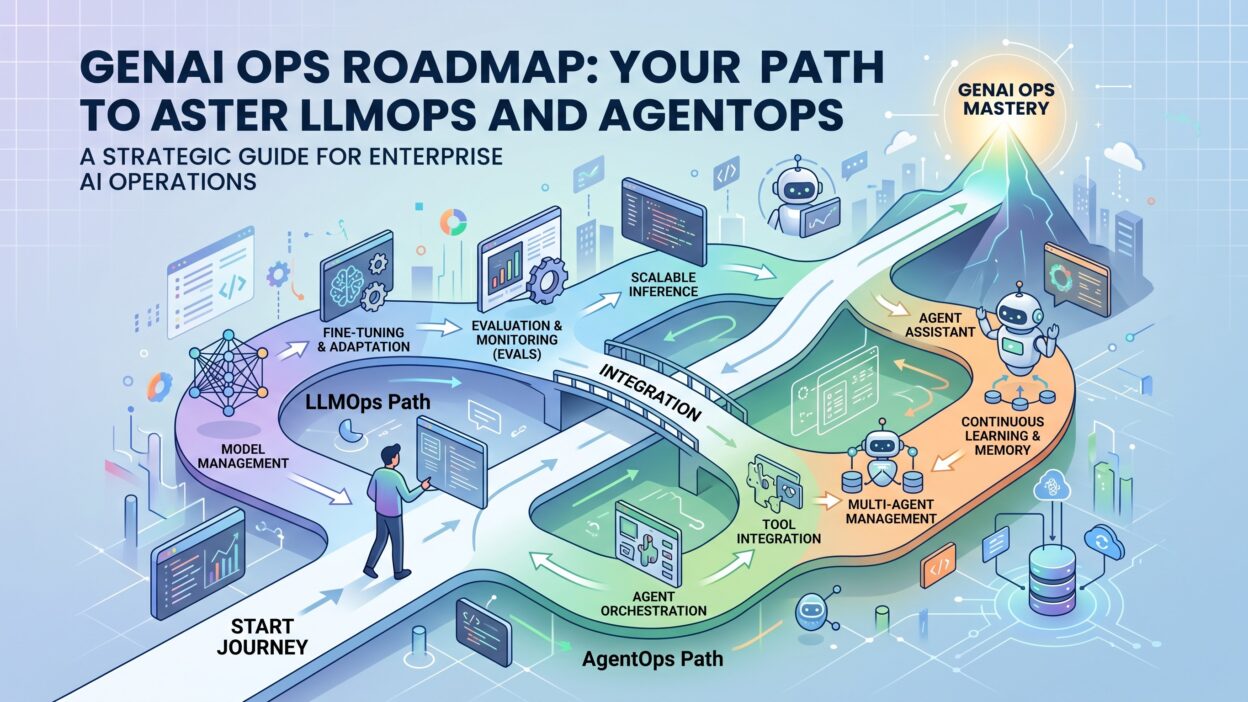
The Two Pillars — LLMOps and AgentOps
What LLMOps Covers
LLMOps is the operational practice around large language model deployment and management. It covers the full lifecycle of an LLM-powered application. That lifecycle starts with prompt design and runs through evaluation, deployment, monitoring, and iterative improvement.
Prompt management sits at the core of LLMOps. Unlike traditional code, prompts are natural language artifacts that directly shape model behavior. They need versioning just like code. Changes need testing before deployment. Rollback capability matters when a prompt change degrades output quality in production.
Model management in LLMOps addresses the selection, fine-tuning, and switching of language models. Teams choose between frontier model APIs and self-hosted open-source alternatives. Fine-tuning decisions require data curation pipelines, training infrastructure, and evaluation frameworks. Model versioning matters because the same base model updated by a provider can produce different outputs.
Evaluation is the most challenging part of LLMOps. Text output does not evaluate itself. Automated evaluation uses LLM-as-judge approaches where a separate model scores outputs against defined criteria. Human evaluation provides ground truth for calibrating automated systems. The GenAI Ops Roadmap must address both and integrate them into a continuous quality assurance loop.
Cost management is an LLMOps concern that every production team underestimates initially. Token consumption drives API costs. Context window management, output length limits, caching, and model tier selection all affect the cost profile of an LLM application significantly. Without active cost monitoring and optimization, generative AI budgets expand unpredictably.
What AgentOps Covers
AgentOps is the operational practice for AI agent systems. It extends LLMOps with the additional complexity that comes from agents that reason, plan, and act across multiple steps.
Agents use tools. Tool use introduces new failure modes. An API call fails. A browser action produces unexpected HTML. A code execution environment returns an error. AgentOps covers the monitoring, error handling, and retry logic that keeps tool-using agents reliable in production.
Agents produce reasoning traces. Each step in a multi-step task generates intermediate outputs that influence subsequent steps. Tracing these reasoning chains is essential for debugging failures and improving agent behavior. AgentOps infrastructure captures full execution traces and makes them queryable.
Agents require safety controls. An agent with access to file systems, databases, and external APIs can cause real-world harm if it reasons incorrectly. AgentOps addresses guardrails, permission scoping, human-in-the-loop checkpoints, and rollback mechanisms that contain agent failures before they propagate.
Memory management is a unique AgentOps concern. Agents need both short-term working memory and long-term persistent memory. Managing what agents remember, how they retrieve relevant past context, and how memory gets updated without growing unbounded all require explicit operational design.
The GenAI Ops Roadmap brings LLMOps and AgentOps together into a single coherent operational strategy. They share infrastructure, tooling, and organizational processes. Separating them into isolated practices creates redundancy and gaps.
The GenAI Ops Roadmap — Stage by Stage
Foundation: Getting the Basics Right
Every GenAI Ops Roadmap starts with foundations. These are the operational capabilities that every production AI system needs regardless of complexity. Skip them and every subsequent stage becomes unstable.
The first foundation is environment management. Separate development, staging, and production environments must exist from the beginning. Prompt changes and model updates should move through this pipeline the same way code changes do. Mixing development and production environments causes the most common and most avoidable production incidents in generative AI.
The second foundation is secrets and API key management. LLM applications call external APIs. Those calls require authentication. Keys must rotate. Access must scope to the minimum necessary permissions. Hardcoded credentials in application code are a security failure waiting to happen. Use a secrets management system from day one.
The third foundation is basic logging. Every LLM call should log the prompt, the model, the parameters, the output, the latency, and the token count. This data is the raw material for everything that follows — cost analysis, quality evaluation, debugging, and performance monitoring. Without it, operational work runs blind.
The fourth foundation is cost instrumentation. Set spending limits at the account level with your model provider. Track token usage per feature, per user, and per time period. Know what your generative AI system costs before stakeholders ask. The GenAI Ops Roadmap always treats cost visibility as a foundation, not an afterthought.
Quality Infrastructure: Building Evaluation Systems
Once foundations are stable, the focus shifts to evaluation. Quality infrastructure is the part of the GenAI Ops Roadmap that most teams underinvest in during early deployment. They pay for that underinvestment later when output quality degrades without detection.
Start with a golden dataset. This is a curated set of inputs with expected outputs or quality criteria. The dataset represents the range of real use cases your system handles. Every significant prompt change or model update runs against this dataset before promotion to production.
Build automated evaluation on top of the golden dataset. LLM-as-judge evaluation uses a capable model to score outputs on defined dimensions. Relevance, accuracy, tone, and safety are common dimensions. Calibrate automated scores against human judgments. Track the correlation between automated and human scores as an ongoing quality metric for the evaluation system itself.
Implement regression testing in your deployment pipeline. A prompt change that improves performance on one class of inputs should not degrade another. Regression tests catch these tradeoffs before they reach users.
For agent systems, evaluation extends to trace quality. Did the agent use the correct tools? Did it reason through the problem in a logical sequence? Did it reach the correct final answer via the correct path? Trace evaluation requires dedicated tooling and evaluation criteria specific to agent behavior.
Observability: Seeing What Is Happening in Production
Observability is the third stage in the GenAI Ops Roadmap. It transforms raw logs into operational intelligence. With good observability, teams know exactly what their AI systems are doing, how well they are performing, and where problems are emerging.
Distributed tracing connects every step in an LLM or agent workflow into a single queryable trace. LangSmith, LangFuse, Arize AI, and similar platforms provide this capability. Each LLM call, tool invocation, and retrieval step appears as a span within a parent trace. Debugging a failed agent run means pulling the trace and reading the reasoning sequence step by step.
Metrics dashboards aggregate trace data into operational signals. Track prompt success rates, output quality scores, latency percentiles, error rates, and token costs over time. Set alert thresholds. Know immediately when success rates drop, latency spikes, or costs exceed budget.
User feedback integration closes the quality loop. Thumbs-up and thumbs-down signals, correction inputs, and explicit ratings all feed back into the evaluation system. Real user feedback catches quality problems that automated evaluation misses. It also surfaces the highest-value improvement opportunities.
Scale: Handling Growth Without Degradation
The fourth stage of the GenAI Ops Roadmap addresses scale. Systems that work at low volume often fail as usage grows. Scale introduces new operational demands that require deliberate design.
Caching reduces cost and latency at scale. Semantic caching stores previous LLM responses and retrieves them when a new query is semantically similar to a cached query. This avoids redundant API calls for common requests. Response caches require cache invalidation logic to prevent serving stale content when prompts or models change.
Rate limiting protects both cost and quality at scale. Per-user limits prevent individual users from consuming disproportionate resources. System-level limits prevent runaway agent loops from consuming the entire API budget. Rate limiting is an operational safety mechanism in the GenAI Ops Roadmap.
Load management for agent systems requires particular care. A single agent run can spawn multiple concurrent sub-agents. Each sub-agent makes tool calls. Tool calls hit external APIs. External APIs have their own rate limits. Orchestration systems must manage concurrency across all of these layers without creating cascading failures.
Governance: Responsibility at Production Scale
The fifth stage brings governance into the GenAI Ops Roadmap. At scale, generative AI systems touch many users, many use cases, and sometimes sensitive data. Governance ensures responsible operation across all of these contexts.
Access controls determine who can modify prompts, update models, deploy changes, and access production logs. Role-based permissions prevent unauthorized changes. Audit logs capture who changed what and when. Change management processes require review and approval for significant system modifications.
Content safety systems filter harmful outputs before they reach users. Classifier models, rule-based filters, and output validation layers work together. For agent systems, input validation prevents prompt injection attacks where malicious user input attempts to hijack agent behavior.
Data governance covers what data touches LLM systems. Personally identifiable information, protected health information, and financial data all require careful handling. The GenAI Ops Roadmap must specify data handling rules, masking requirements, and retention policies for all data that flows through generative AI systems.
Tooling and Infrastructure for the GenAI Ops Roadmap
Prompt Management Tools
Prompt management platforms version, test, and deploy prompts with the same rigor applied to code. PromptLayer, LangSmith, and Helicone all offer prompt versioning with comparison views. You see exactly how a prompt changed between versions. You compare output quality across versions on your evaluation dataset. You roll back to a previous version with one action.
Treat every prompt as a versioned artifact. Attach metadata: author, creation date, intended use case, evaluation scores. Build a prompt registry that your team queries before writing new prompts. Reuse proven prompts across similar use cases rather than recreating from scratch each time.
Observability and Tracing Platforms
LangSmith integrates deeply with LangChain workflows. LangFuse works across multiple frameworks and supports self-hosted deployment. Arize AI offers strong analytics on top of trace data. Weights and Biases provides experiment tracking that bridges classical ML and generative AI workflows.
Choose a platform that fits your existing stack. Self-hosted options matter for teams with strict data residency requirements. Cloud-managed options reduce operational overhead for teams without dedicated platform engineering resources. The GenAI Ops Roadmap works with any platform that provides trace capture, metric aggregation, and alerting.
Agent Orchestration Frameworks
LangChain, LlamaIndex, CrewAI, and AutoGen all provide agent orchestration with built-in logging and tracing hooks. These frameworks standardize how agents use tools, manage memory, and structure reasoning. They also produce trace data that observability platforms consume.
Pick one framework and build operational depth within it. Switching frameworks after building production systems carries high migration cost. Evaluate frameworks on their observability support, their tool ecosystem, and their community activity before committing.
Vector Databases for Agent Memory
Pinecone, Weaviate, Chroma, and Qdrant all serve as long-term memory stores for agent systems. Evaluate on query latency, metadata filtering capability, hosted versus self-managed options, and integration quality with your chosen agent framework. Memory infrastructure is part of the GenAI Ops Roadmap because it directly affects agent reliability and performance.
FAQs About the GenAI Ops Roadmap
What is a GenAI Ops Roadmap and who needs one?
A GenAI Ops Roadmap is a structured plan for building the operational infrastructure needed to deploy and maintain generative AI systems in production. It covers prompt management, evaluation, observability, scaling, and governance. Any team moving from AI experimentation to production deployment needs one. Without it, teams discover operational gaps through production failures rather than through planning.
How does a GenAI Ops Roadmap differ from a standard MLOps strategy?
Standard MLOps addresses deterministic model deployment, statistical drift detection, and numerical output monitoring. The GenAI Ops Roadmap covers open-ended text evaluation, prompt versioning, LLM-as-judge assessment, agent trace analysis, and multi-step reasoning quality. The concerns overlap in areas like deployment pipelines and cost management. They diverge significantly in evaluation methodology, failure mode analysis, and safety controls.
How long does it take to build GenAI Ops maturity?
Stage one foundations take two to four weeks for a focused team. Evaluation infrastructure adds another four to eight weeks depending on dataset curation complexity. Observability implementation takes two to four weeks with the right tooling. Scale and governance work is ongoing. A realistic timeline for reaching full operational maturity across all five stages is six to twelve months. Teams that rush skip stages and pay through production incidents.
What is the most important stage to get right first in the GenAI Ops Roadmap?
Stage one foundations are non-negotiable. Environment separation, secrets management, logging, and cost instrumentation must exist before anything else. Teams that skip foundations to reach observability or governance faster find that their observability data is incomplete and their governance policies have nothing reliable to enforce. Build stage one before touching stage two.
Can small teams implement a full GenAI Ops Roadmap?
Yes, with prioritization. Small teams should implement foundations completely, build a minimal evaluation pipeline with a small golden dataset, and adopt a managed observability platform to avoid infrastructure overhead. Governance and full-scale observability can mature as the team grows. The GenAI Ops Roadmap scales down to small teams when they focus on high-leverage capabilities first and defer complexity that does not yet match their operational scale.
How does the GenAI Ops Roadmap handle multi-model environments?
Multi-model environments require model abstraction layers that standardize how the application calls different models. Evaluation pipelines must run against each active model. Observability platforms must tag traces by model for comparison. Cost tracking must separate spending by model and provider. The GenAI Ops Roadmap applies to each model in the environment, not just the primary one. Teams frequently use different models for different tasks — fast cheap models for low-stakes generation, capable expensive models for complex reasoning.
Read More:-Gemini API File Search: The Easy Way to Build RAG
Conclusion

Building generative AI products is the easy part. Running them reliably, safely, and efficiently in production is the hard part. Every team that skips operational planning discovers this truth the same way — through production failures that damage user trust and waste engineering time.
The GenAI Ops Roadmap exists to prevent that experience. It gives teams a clear, staged path from foundation to full operational maturity. It connects LLMOps and AgentOps into a unified strategy rather than treating them as separate concerns. It addresses the real problems that real teams face when they move beyond demos into production.
The five stages — foundation, quality infrastructure, observability, scale, and governance — build on each other deliberately. Each stage unlocks the next. Each delivers operational value immediately while preparing the ground for what follows.
The GenAI Ops Roadmap is not a one-time project. It is an ongoing discipline. Models update. Prompts evolve. Agent capabilities expand. User volumes grow. New regulatory requirements emerge. Operational maturity means staying ahead of these changes rather than reacting to them after they cause problems.
Teams that invest in this roadmap ship better AI products. Their systems run reliably. Their costs stay predictable. Their users trust the outputs they receive. Their engineers spend time on innovation rather than firefighting.
Start with stage one today. Pick one foundation element that your current system lacks. Build it. Measure the improvement. Move to the next. The GenAI Ops Roadmap rewards consistent, deliberate progress. Every step forward compounds into a more capable, more trustworthy AI system.
The organizations that master generative AI operations will define what production AI looks like for the next decade. Build your GenAI Ops Roadmap now. The foundation you lay today determines what you can build tomorrow.