Introduction
TL;DR Memory makes intelligence possible. Without memory, every experience starts from zero. Every decision ignores all previous learning. Every conversation forgets what came before. Memory is not a nice-to-have feature. It is the backbone of intelligent behavior in any system, biological or artificial.
Cognitive science spent decades studying how humans store, retrieve, and use information. Researchers mapped memory systems. They identified patterns. They explained why some things stick and others fade. That work built a detailed picture of how minds handle information across time AI research borrowed heavily from those findings. Agent memory patterns in modern AI systems reflect cognitive science principles in direct and meaningful ways. The parallels are not accidental. AI designers explicitly modeled artificial memory after human memory theory.
This blog explores agent memory patterns from both angles. You will see what cognitive science says about memory. You will see how AI systems implement those ideas. You will get a clear picture of why these patterns matter and where they are heading.
Whether you build AI systems, study cognitive science, or simply want to understand how intelligent agents work, this guide delivers the depth you need.
The Cognitive Science Foundation of Memory
How Human Memory Works at the System Level
Human memory does not work like a hard drive. Information does not get saved to a fixed location and retrieved perfectly every time. Human memory is reconstructive. Each recall event rebuilds a memory from fragments. That reconstruction can be accurate. It can also drift over time.
Cognitive scientists identify multiple distinct memory systems. Each system handles different types of information. Each operates on different timescales. Each serves different functions in everyday behavior. Understanding these systems gives AI researchers a blueprint for agent memory patterns that mirror biological intelligence.
The Three Core Memory Systems in Cognitive Science
The first system is sensory memory. It holds raw perceptual input for fractions of a second. Sights, sounds, and tactile signals pass through sensory memory before reaching conscious processing. Most sensory memory decays instantly. Only a small fraction reaches the next stage.
The second system is working memory. It holds information currently in active use. Working memory has limited capacity. George Miller’s famous research suggested humans hold roughly seven items at once, give or take two. Modern research places the number lower, around four chunks of meaningful information. Working memory is where thinking happens. It is the mind’s active workspace.
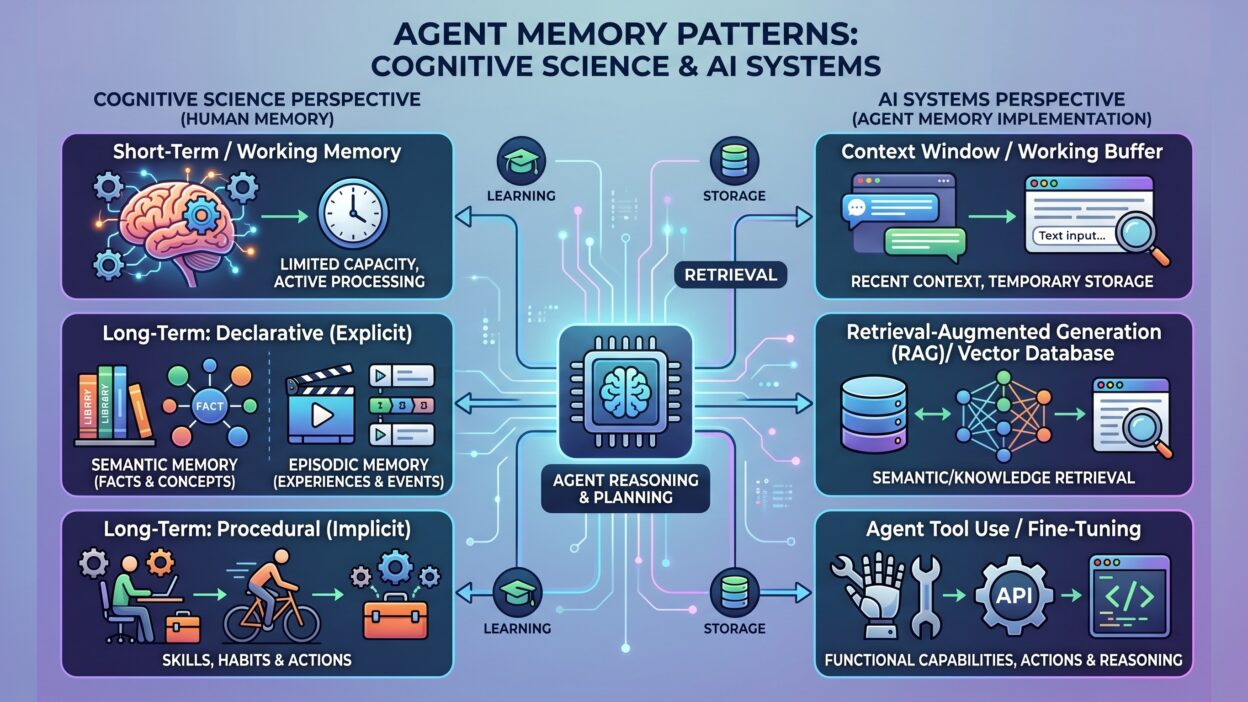
The third system is long-term memory. It stores vast amounts of information over extended periods. Long-term memory breaks further into subtypes. Declarative memory holds facts and events. Procedural memory holds skills and habits. Semantic memory holds general world knowledge. Episodic memory holds personal experiences tied to specific times and places.
These three systems interact constantly. Understanding their interaction is fundamental to understanding agent memory patterns in both biological and artificial contexts.
Why Memory Patterns Matter for Intelligence
Memory patterns determine what an agent learns, what it forgets, and what it retrieves when needed. An agent with poor memory patterns makes decisions without context. It repeats mistakes. It cannot generalize from experience.
Strong memory patterns allow an agent to connect past experience to present situations. They allow generalization across contexts. They support planning by retrieving relevant prior knowledge. Memory is not separate from intelligence. It is intelligence made persistent across time.
Core Agent Memory Patterns in AI Systems
What Agent Memory Patterns Mean in AI
Agent memory patterns refer to the structured ways AI agents store, access, and use information during operation. These patterns define what an agent remembers across interactions, how it retrieves relevant information at the right moment, and how it updates its knowledge as new information arrives.
Different AI architectures implement different agent memory patterns. The choice of pattern shapes the agent’s behavior profoundly. A conversational AI without persistent memory starts every session blank. An autonomous agent with episodic memory builds a running record of every action it takes and every outcome it observes. These are not minor implementation differences. They produce fundamentally different kinds of intelligence.
Pattern 1 — In-Context Memory
In-context memory is the most immediate form of agent memory patterns. It corresponds directly to working memory in cognitive science. The agent holds all active information within its current processing window. In large language model agents, this is the context window — the full text of the current conversation plus any injected knowledge.
In-context memory is fast. Retrieval requires no external lookup. Everything the agent needs is already present in its active state. The limitation is capacity. Context windows have a finite size. As conversations grow longer, older content drops out. The agent loses access to information it saw earlier in the session.
Modern LLM systems manage this limitation through careful context management. Important information gets summarized and re-injected. Older turns get compressed. The active window stays populated with the most relevant information for the current task.
Pattern 2 — Episodic Memory
Episodic agent memory patterns mirror the human episodic memory system. The agent records sequences of events, actions, and outcomes. Each episode captures what happened, in what order, and what resulted.
Episodic memory allows agents to learn from specific past experiences. An autonomous coding agent that tried a particular approach and failed stores that episode. On a similar future task, it retrieves the relevant episode and avoids the failed approach. This is experience-driven behavior. It mirrors exactly how humans use episodic memory in problem-solving.
Technically, episodic memory in AI agents uses vector databases for storage. Each episode gets embedded as a dense vector. Retrieval uses similarity search. The agent queries the database with a representation of the current situation. The most similar past episodes surface as context for the current decision.
Pattern 3 — Semantic Memory
Semantic agent memory patterns store general knowledge rather than specific experiences. This corresponds to the semantic memory system in cognitive science. The agent holds facts, concepts, relationships, and domain knowledge that are not tied to any particular event.
For AI agents, semantic memory often takes the form of a knowledge base or a fine-tuned model weight. The knowledge is baked into the system. Retrieval does not require remembering when or how the knowledge was acquired. The agent simply accesses what it knows about a topic.
Retrieval-augmented generation (RAG) systems implement semantic memory explicitly. A vector store holds documents, facts, and knowledge chunks. The agent queries this store at inference time. Retrieved chunks augment the agent’s response with domain knowledge it could not hold in-context alone.
Pattern 4 — Procedural Memory
Procedural agent memory patterns encode skills, routines, and action sequences. Cognitive science describes procedural memory as the how-to knowledge that operates below conscious awareness. You know how to ride a bike. You cannot easily explain every micro-adjustment you make. That implicit skill knowledge is procedural.
In AI agents, procedural memory manifests in learned behaviors, trained policies, and tool-use patterns. A reinforcement learning agent encodes procedural knowledge in its policy network. An LLM agent learns procedural patterns through fine-tuning on demonstration data. The agent develops reliable routines for recurring task types without re-reasoning from scratch each time.
Pattern 5 — External Memory
External agent memory patterns extend the agent’s memory beyond internal storage. The agent writes information to external systems — databases, files, APIs — and reads it back when needed. This pattern has no direct equivalent in biological cognition. It is a uniquely artificial capability.
External memory removes capacity limits entirely. An agent can store unlimited information across unlimited time. Retrieval requires explicit lookup mechanisms. The agent must know what to store, when to store it, and how to query it effectively. Well-designed external memory systems make agents dramatically more capable on long-horizon tasks.
How Agent Memory Patterns Map to Cognitive Science Theory
The Atkinson-Shiffrin Model and AI Context Windows
Richard Atkinson and Richard Shiffrin proposed a multi-store model of memory in 1968. Their model described sensory memory, short-term memory, and long-term memory as distinct stores with different capacities and durations. Information flowed from one store to the next through attention and rehearsal.
Modern AI agent memory patterns follow this exact architecture. Sensory input arrives as raw data. Attention mechanisms select relevant signals. Selected information enters the active context window, which mirrors short-term memory. Persistent storage systems mirror long-term memory. The flow matches the Atkinson-Shiffrin model strikingly well.
This parallel was not inevitable. AI designers chose architectures that reflect what cognitive science already knew works. The result is AI memory systems that share structural principles with human cognition.
Working Memory Capacity and Context Window Limits
Alan Baddeley’s working memory model refined the Atkinson-Shiffrin approach. Baddeley identified a central executive, a phonological loop for verbal information, a visuospatial sketchpad for visual information, and an episodic buffer that integrates across systems.
Context window limits in LLMs mirror working memory capacity limits in humans. Both systems face a fundamental constraint: active processing space is finite. Both systems use similar compensatory strategies. Humans chunk information to increase effective capacity. AI systems compress and summarize older context to maintain relevance within window limits.
Agent memory patterns that acknowledge this capacity constraint perform better than those that ignore it. The best AI agent designs include explicit mechanisms for managing what stays in context and what moves to longer-term storage.
Consolidation and Retrieval in Biological vs. Artificial Systems
Human long-term memory consolidation happens during sleep. The brain replays experiences. Important patterns strengthen. Irrelevant details fade. Retrieval later reconstructs the memory from strengthened traces.
AI agents implement analogous consolidation mechanisms. Memory distillation processes compress long conversation histories into structured summaries. Important facts extract into semantic stores. Less critical details drop. On retrieval, the agent reconstructs context from stored summaries and retrieved chunks.
Agent memory patterns that include deliberate consolidation steps produce better long-term performance. The agent’s memory stays organized and relevant. Retrieval surfaces useful information rather than noise.
Implementing Agent Memory Patterns in Practice
Designing Memory Architecture for AI Agents
Good memory architecture starts with a clear question. What does this agent need to remember, for how long, and for what purpose? Answering that question determines which agent memory patterns fit the use case.
A customer service agent needs short-term session context and long-term customer history. A research assistant agent needs vast semantic memory and episodic recall of past research sessions. A game-playing agent needs procedural skill memory and episodic memory of past game outcomes. Each use case demands a different memory architecture.
Do not default to a single memory pattern. Real-world agents combine multiple patterns. The in-context window handles immediate state. A vector database handles episodic and semantic retrieval. External storage handles persistent records. These layers work together to create a complete memory system.
Using Vector Databases for Long-Term Agent Memory
Vector databases are the primary tool for implementing long-term agent memory patterns. Systems like Pinecone, Weaviate, Chroma, and Qdrant store dense vector embeddings alongside metadata. The agent encodes experiences or knowledge as vectors. Retrieval uses approximate nearest-neighbor search to find the most relevant stored items.
The quality of the embedding model determines retrieval quality. High-quality embeddings cluster semantically similar content together. Retrieval surfaces relevant memories even when the query uses different wording from the stored content. Semantic similarity beats keyword matching for agent memory retrieval.
Metadata filtering adds precision on top of semantic similarity. Filter by date, user, topic, or task type before applying vector similarity. The combination produces sharp, relevant retrieval from large memory stores.
Memory Compression and Summarization Strategies
As agent memory grows, compression becomes necessary. Raw storage of every interaction does not scale. More importantly, uncompressed memory fills retrieval results with noise. The agent surfaces irrelevant old content alongside relevant recent context.
Periodic summarization keeps agent memory patterns manageable. After each session, summarize key facts, decisions, and outcomes. Store the summary. Discard the raw transcript. The summary carries the important information at a fraction of the storage cost.
Hierarchical compression works well for very long-running agents. Summarize daily sessions into daily summaries. Summarize weekly sessions into weekly summaries. The agent retrieves at the appropriate level of granularity based on the task at hand.
Retrieval Strategies That Improve Agent Performance
Retrieval quality determines how useful stored memory actually becomes. Poor retrieval surfaces irrelevant content. Good retrieval surfaces exactly what the agent needs at the right moment.
Recency weighting boosts recent memories in retrieval rankings. Recent information is usually more relevant than old information for most tasks. Temporal decay functions reduce the retrieval score of older items gradually over time.
Importance scoring adds another dimension. Not all memories deserve equal retrieval weight. Outcomes that produced strong results, errors that caused significant failures, and facts that the agent referenced frequently deserve higher importance scores. Weight retrieval by importance alongside recency and semantic similarity. The combination produces retrieval that reflects how human memory works: recent, important, and relevant information surfaces first.
Challenges and Frontiers in Agent Memory Patterns
The Forgetting Problem
Catastrophic forgetting is one of the central challenges in agent memory patterns for learning systems. A neural network agent that learns new information often overwrites weights that encoded older knowledge. The agent gains new skills at the cost of losing established ones.
Cognitive science addresses this through complementary learning systems theory. The hippocampus handles rapid new learning. The neocortex handles slow, stable consolidation. The two systems interact to allow new learning without destroying old knowledge.
AI research replicates this with replay mechanisms. Agents periodically train on stored past experiences alongside new data. The blend prevents new learning from overwhelming old knowledge. Elastic weight consolidation protects critical weights during new learning. These techniques bring AI agent memory patterns closer to biological robustness.
Privacy and Security in Persistent Agent Memory
Persistent memory raises serious privacy concerns. An agent that remembers everything about a user accumulates a rich personal data profile. That profile creates security risks. Unauthorized access to agent memory exposes sensitive personal information.
Responsible agent memory patterns include explicit retention policies. Information should not persist indefinitely by default. Users should control what the agent remembers. Memory contents should encrypt at rest. Access controls should limit which components of the system can read stored memories.
Privacy-first memory design is not optional. It is a requirement for deploying agents in consumer and enterprise contexts where user data protection is both a legal obligation and a trust requirement.
The Future of Agent Memory Patterns
Research at the frontier explores biologically inspired memory architectures more deeply. Sparse distributed memory models, Hopfield networks, and associative memory systems all offer new approaches to agent memory patterns that go beyond current vector database implementations.
Neuromorphic computing promises hardware that implements memory and computation in a unified substrate, mirroring how biological neurons work. Agents running on neuromorphic hardware may develop memory patterns that more closely match the efficiency and robustness of biological cognition.
Continual learning research works to solve catastrophic forgetting definitively. Agents that learn continuously from experience without forgetting older knowledge represent a major milestone. Solving that problem unlocks agents that genuinely improve throughout their operational lifetime.
FAQs About Agent Memory Patterns
What are agent memory patterns and why do they matter?
Agent memory patterns are the structured methods AI agents use to store, retrieve, and apply information across time. They determine what an agent remembers between interactions, how it accesses relevant past knowledge, and how it updates its understanding as new information arrives. Strong memory patterns enable consistent, intelligent behavior over long operational periods. Weak or absent memory patterns force agents to treat every interaction as a fresh start with no context.
How do agent memory patterns differ between LLM agents and reinforcement learning agents?
LLM agents primarily use in-context memory, vector database retrieval, and external storage. Their memory is explicit and retrievable in human-readable form. Reinforcement learning agents encode memory primarily in their policy network weights. Their procedural memory is implicit and distributed across millions of parameters. Both implement agent memory patterns, but the mechanisms and representations differ fundamentally. Hybrid systems combine both approaches to capture the advantages of each.
Can an AI agent have too much memory?
Yes. Unlimited memory without good retrieval and compression creates noise. An agent drowning in stored information cannot surface the relevant subset quickly. Memory quality matters more than memory quantity. Good agent memory patterns include not just storage but active curation, compression, and prioritized retrieval. The goal is relevant recall, not total recall.
How do vector databases support agent memory patterns?
Vector databases store information as dense numerical vectors that encode semantic meaning. When an agent needs to retrieve relevant memories, it encodes the current situation as a query vector and searches for stored vectors with high similarity. This approach retrieves conceptually related memories even when exact wording differs. Vector databases give agents a scalable, semantically rich long-term memory that classical keyword-based databases cannot match.
What role does attention play in agent memory patterns?
Attention mechanisms determine which stored information the agent accesses and weights most heavily at any moment. In transformer-based LLM agents, attention over the context window functions like working memory. In retrieval systems, relevance scoring functions like selective attention over long-term storage. Attention is the mechanism that makes memory useful. Without selective attention, all stored information carries equal weight. The agent cannot focus on what matters for the current task.
How should developers choose between different agent memory patterns?
Match the memory pattern to the task requirements. Short interactions with no cross-session continuity need only in-context memory. Long-running agents with persistent user relationships need episodic and semantic memory. Skill-based agents benefit from procedural memory patterns. Agents working with large knowledge bases need robust semantic retrieval. Most production agents combine two or three patterns. Start with the simplest combination that meets your requirements and add complexity only when clear gaps appear in performance.
Read More:-RIP Prompt Engineering? Why Verbalized Sampling Changes Everything!
Conclusion

Memory separates reactive systems from truly intelligent ones. A system that cannot remember cannot learn from experience. A system that cannot retrieve relevant knowledge makes every decision in isolation. Memory is what makes intelligence cumulative rather than static.
Agent memory patterns bring decades of cognitive science insight into practical AI system design. The mapping between biological memory systems and artificial memory architectures is not superficial. It is deep, deliberate, and validated by results. AI systems that implement well-designed memory patterns perform better, adapt more effectively, and deliver more consistent value over time.
The five core patterns — in-context, episodic, semantic, procedural, and external memory — each serve a distinct function. Real-world agents need all of them working together. The architecture that combines these patterns mirrors how human cognition integrates multiple memory systems into a unified, flexible intelligence.
The challenges ahead are real. Catastrophic forgetting, privacy requirements, and retrieval quality all demand continued research and engineering attention. The direction of progress is clear. Agent memory patterns grow more capable, more efficient, and more closely aligned with biological principles with every research cycle.
Understanding agent memory patterns is not just an academic exercise. It is a practical design skill for anyone building the next generation of AI systems. The agents that will matter most in the coming years will remember, learn, and apply knowledge across time in ways that current systems only begin to approach.
Memory is not a feature. It is the foundation. Build it well.