Introduction
TL;DR Every business wants loyal customers. But loyalty means nothing without a number attached to it. Customer Lifetime Value gives you that number. It tells you exactly how much a customer is worth over their entire relationship with your company.
This guide breaks down Customer Lifetime Value step by step. You will learn the formulas. You will see real examples. You will also learn how to use this number to grow your business smarter, not just harder.
Table of Contents
What Is Customer Lifetime Value?
Customer Lifetime Value measures the total revenue a business earns from one customer over their full relationship. It looks beyond a single purchase. It captures the bigger picture.
A customer who buys once brings limited value. A customer who buys repeatedly for years brings far more. Customer Lifetime Value puts a dollar figure on that difference.
Companies use this metric to guide marketing budgets, pricing decisions, and customer retention strategies. Without it, teams often chase short-term sales instead of long-term profit.
Why Customer Lifetime Value Matters for Your Business
Acquiring a new customer costs more than keeping an existing one. Studies across multiple industries confirm this pattern consistently. Customer Lifetime Value helps you see which customers deserve the most attention.
This metric shapes smarter spending. If a customer segment shows high lifetime value, you invest more in keeping them happy. If a segment shows low value, you rethink your approach or reduce spending there.
Investors also care about this number. A growing Customer Lifetime Value signals a healthy, sustainable business model, not just short bursts of revenue.
Core Formulas for Calculating Customer Lifetime Value
Several formulas exist for Customer Lifetime Value. Each one fits a different business model and level of complexity.
The Simple Historic Formula
This formula looks backward at actual customer spending. You add up total revenue from a customer and stop there. It works well for small businesses without much purchase history data yet.
The formula looks like this: total revenue from a customer equals their historic Customer Lifetime Value. It stays simple, but it ignores future buying behavior entirely.
The Predictive Formula
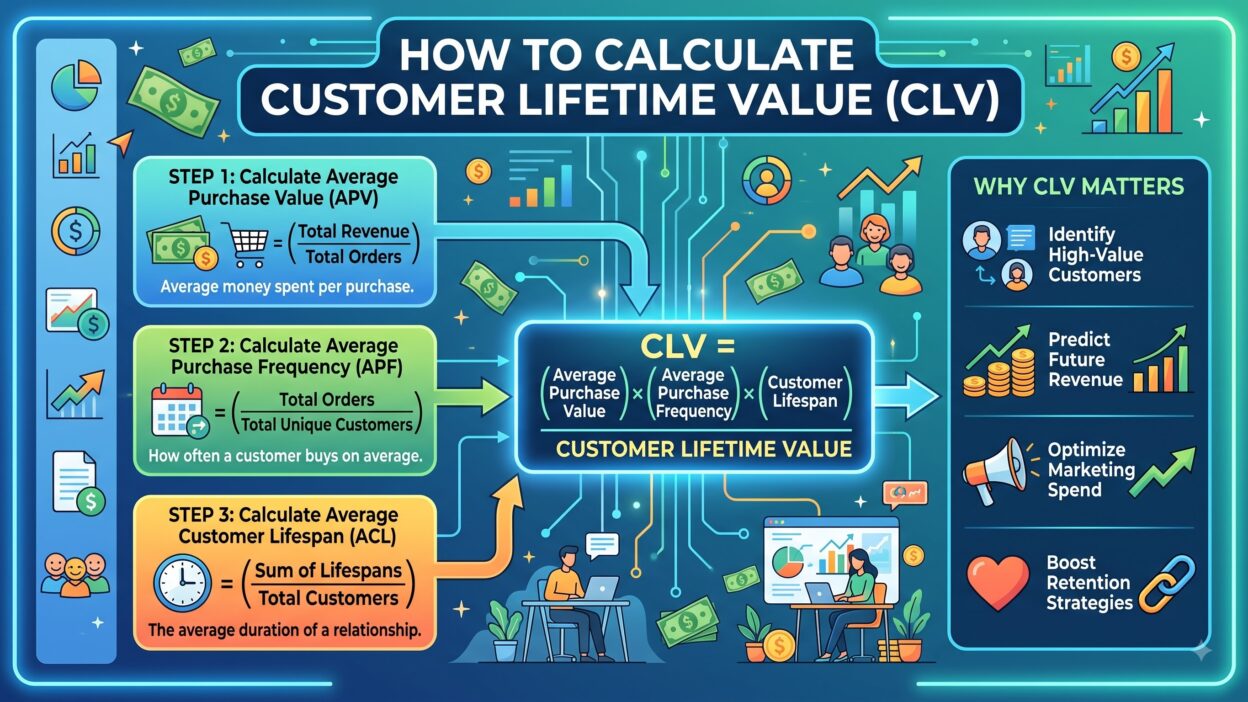
This formula estimates future value based on past patterns. It multiplies average purchase value by purchase frequency, then multiplies that result by average customer lifespan.
The formula reads: Customer Lifetime Value equals average purchase value multiplied by purchase frequency multiplied by customer lifespan. This version works better for businesses with steady purchase patterns over time.
The Churn-Based Formula
Subscription businesses often use this version. It divides average revenue per customer by the churn rate, giving a value based on how long customers typically stay before canceling.
The formula reads: Customer Lifetime Value equals average revenue per customer divided by churn rate. A lower churn rate produces a higher lifetime value, since customers stick around longer.
Step-by-Step Guide to Calculating Customer Lifetime Value
Calculating Customer Lifetime Value doesn’t require advanced math skills. Follow these steps in order, and the process stays manageable.
Calculate Average Purchase Value
Divide total revenue over a set period by the number of purchases during that same period. This gives you the average amount a customer spends per transaction.
For example, if your store earns $50,000 from 1,000 purchases in a month, your average purchase value equals $50.
Calculate Average Purchase Frequency
Divide the number of purchases by the number of unique customers during the same period. This shows how often a typical customer buys from you.
If those 1,000 purchases came from 400 unique customers, your average purchase frequency equals 2.5 purchases per customer.
Calculate Customer Value
Multiply average purchase value by average purchase frequency. This gives you customer value, a number that shows revenue per customer during the measured period.
Using our example, $50 multiplied by 2.5 equals $125. This represents the average customer’s value during that single month.
Estimate Average Customer Lifespan
Look at historical data to see how many years or months a typical customer keeps buying from your business before they stop entirely.
Many businesses estimate this using existing customer cohorts, tracking how long customers remain active before their last recorded purchase.
Calculate Final Customer Lifetime Value
Multiply customer value by average customer lifespan. This final number represents your Customer Lifetime Value, the total worth of a customer across their entire relationship with you.
If customer value equals $125 per month and average lifespan equals 24 months, Customer Lifetime Value equals $3,000.
Customer Lifetime Value by Business Model
Different business models calculate and interpret this metric in slightly different ways.
Suggested word count: 50–70 words
Ecommerce Businesses
Ecommerce brands track repeat purchase rate closely, since Customer Lifetime Value rises sharply when customers return for a second or third order. Email marketing and loyalty programs often drive this repeat behavior.
Subscription and SaaS Businesses
Subscription companies rely heavily on the churn-based formula. A small drop in monthly churn can raise Customer Lifetime Value significantly, since customers stay active much longer on average.
Service-Based Businesses
Service companies, like agencies or consultants, often calculate lifetime value based on contract length and renewal rates rather than purchase frequency, since clients typically sign longer-term agreements.
How Customer Lifetime Value Connects to Customer Acquisition Cost
Customer Lifetime Value means little without comparing it against Customer Acquisition Cost. This comparison shows whether your marketing spend actually pays off.
The LTV to CAC Ratio
Divide Customer Lifetime Value by Customer Acquisition Cost to get this ratio. Most healthy businesses aim for a ratio around three to one, meaning customers generate three times what it costs to acquire them.
A ratio below one signals a serious problem. You’re spending more to acquire customers than they’re worth over time.
Why This Ratio Guides Budget Decisions
Marketing teams use this ratio to justify or cut ad spend. A strong ratio supports scaling campaigns further. A weak ratio signals a need to fix retention before spending more on acquisition.
Tools and Software for Tracking Customer Lifetime Value
Manual calculation works for small businesses, but growing companies often turn to software for accuracy and speed.
CRM Platforms
Tools like HubSpot and Salesforce track purchase history automatically, calculating Customer Lifetime Value without manual spreadsheet work. These platforms update the number in real time as new purchases come in.
Analytics Platforms
Ecommerce analytics tools, like those built into Shopify or specialized platforms, calculate lifetime value using built-in purchase and customer data, saving teams from building formulas manually.
Spreadsheet Templates
Smaller businesses often start with a simple spreadsheet. Basic templates use the core formulas covered earlier, pulling data from sales reports to calculate Customer Lifetime Value by hand.
Common Mistakes When Calculating Customer Lifetime Value
Several mistakes throw off accuracy when businesses calculate this metric for the first time.
Ignoring Customer Segments
Treating all customers as one group hides important differences. High-value segments and low-value segments blend together, producing an average that misrepresents your actual customer base.
Using Too Short a Time Frame
Calculating lifespan from only a few months of data leads to inaccurate predictions. Longer historical data produces more reliable Customer Lifetime Value estimates over time.
Forgetting Costs and Margins
Some businesses calculate lifetime value using revenue alone, ignoring product costs and profit margins. A more accurate version factors in gross margin, not just total revenue collected.
How to Improve Customer Lifetime Value
Once you know your number, the next step involves raising it. Several strategies work well across most business types.
Improve Customer Onboarding
A strong onboarding experience keeps customers engaged from day one. Customers who understand your product fully tend to stick around longer, directly raising Customer Lifetime Value over time.
Build Loyalty Programs
Rewards and loyalty programs encourage repeat purchases. Even small incentives, like discounts on a second order, can meaningfully increase purchase frequency across your customer base.
Strengthen Customer Support
Fast, helpful support reduces churn significantly. Customers who feel supported during problems stay loyal far longer than customers left to solve issues alone.
Personalize the Customer Experience
Personalized recommendations and targeted offers increase both purchase frequency and order value. This directly raises Customer Lifetime Value without requiring new customer acquisition spend.
Real-World Example of Customer Lifetime Value Calculation
Consider a coffee subscription business. The average order value sits at $30. Customers order twice per month on average. The average subscriber stays active for 18 months before canceling.
Customer value equals $30 multiplied by two, totaling $60 per month. Multiply that by 18 months, and Customer Lifetime Value equals $1,080 per subscriber.
This number helps the business decide how much to spend acquiring each new subscriber while staying profitable.
Frequently Asked Questions
What is a good Customer Lifetime Value? A good number depends on your industry and acquisition costs. Most businesses aim for a lifetime value at least three times higher than their acquisition cost per customer.
How often should businesses recalculate Customer Lifetime Value? Quarterly recalculation works well for most businesses, though fast-growing companies sometimes review this number monthly to catch shifts in customer behavior early.
Does Customer Lifetime Value include profit margin? Basic formulas often use revenue alone, but more advanced calculations factor in gross margin for a more accurate picture of true profitability per customer.
Can small businesses calculate Customer Lifetime Value without software? Yes. Small businesses can calculate this metric using a basic spreadsheet and the core formulas, without needing specialized analytics software right away.
How does churn rate affect Customer Lifetime Value? Higher churn lowers lifetime value significantly, since customers generate revenue for a shorter period. Reducing churn remains one of the fastest ways to raise this number.
Why do investors care about Customer Lifetime Value? This number signals whether a business builds lasting customer relationships or relies on constant new acquisition. Investors view a strong, growing number as a sign of sustainable growth.
Read More:-HubSpot Klaviyo Integration: Complete Setup Guide [2026]
Conclusion

Customer Lifetime Value turns loyalty into a measurable number. It shows exactly how much a customer contributes over their full relationship with your business, not just their first purchase.
The formulas stay simple once broken into clear steps. Average purchase value, purchase frequency, and customer lifespan combine to reveal a number that guides smarter marketing and retention decisions.
Track this number regularly. Compare it against acquisition costs. Use it to decide where your business should invest next. Customer Lifetime Value gives you a clearer path toward sustainable, long-term growth.