Introduction
Tl;DR Companies run dozens of systems across sales, finance, and operations. These systems rarely talk to each other cleanly. Orders sit in one platform. Inventory sits in another. Invoices sit somewhere else entirely.
B2B data integration connects these separate systems into one working flow. It moves data between your company and your partners automatically. It removes manual entry and the errors that come with it.
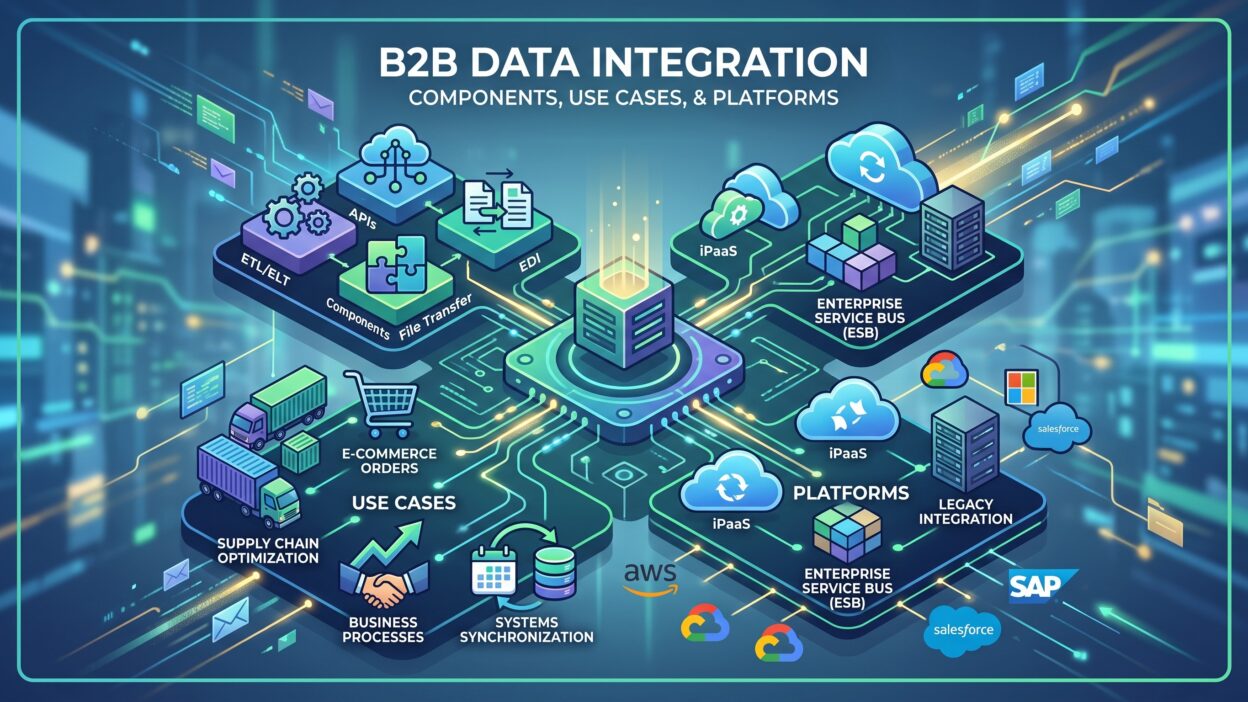
This guide breaks down what B2B data integration actually means. You will learn the core components behind a working setup. You will also see real use cases and how to choose the right platform for your business.
Disconnected data slows every process down. B2B data integration fixes this at the root instead of patching symptoms one at a time.
Table of Contents
What Is B2B Data Integration
A Clear Definition
B2B data integration connects data flows between two or more business systems, often across separate companies. It moves purchase orders, invoices, shipping updates, and inventory data automatically between partners. This removes the need for manual file transfers or repeated data entry.
The goal stays simple. Get the right data to the right system at the right time, without a human copying numbers by hand.
How It Differs From Internal Data Integration
Internal data integration connects systems inside one company. A sales tool talks to a finance tool inside the same organization. B2B data integration adds another layer of complexity entirely.
It connects your systems to systems owned by outside partners, suppliers, or customers. Each partner may use different formats, different standards, and different technical capabilities. B2B data integration must bridge these gaps reliably across every partner relationship.
Why It Matters for B2B Companies
Manual data entry between companies creates constant errors. A wrong quantity on an order form causes shipping delays. A missed invoice update causes payment disputes. These small errors compound fast across a growing partner network.
B2B data integration removes this friction directly. It keeps data accurate and current across every connected partner, without constant manual checking.
Common Myths About B2B Data Integration
The Myth That It Only Matters for Large Enterprises
Some smaller companies assume integration only matters once they reach enterprise scale. Small and mid-size businesses feel the pain of manual data entry just as sharply, often earlier. A ten-person operations team drowns fast without automated data flows between partners.
B2B data integration scales down well for smaller companies with the right platform choice.
The Myth That One Format Covers Every Partner
Many buyers assume a single data format works across all partner relationships. Reality looks messier than this assumption suggests. Different partners use different standards, different file types, and different update frequencies.
Strong B2B data integration handles this variety directly. It maps and transforms data between formats instead of forcing every partner onto one rigid standard.
The Myth That Integration Is a One-Time Project
Some teams treat integration as a project with a clear finish line. New partners join constantly. Formats change over time. Systems get replaced or upgraded regularly.
B2B data integration works best as an ongoing capability, not a single completed project. Teams need a platform built for continuous change, not a one-time fix.
Core Components of B2B Data Integration
Electronic Data Interchange Standards
EDI remains a common standard for exchanging structured business documents. Purchase orders, invoices, and shipping notices often move through EDI formats between large trading partners. Many industries, especially retail and manufacturing, still rely heavily on this standard.
A strong B2B data integration setup supports EDI alongside newer formats, since many partners still expect it.
APIs for Real-Time Data Exchange
APIs allow systems to exchange data instantly instead of through batch file transfers. This method suits fast-moving relationships where timing matters, like inventory updates or order status changes. Modern B2B data integration platforms lean heavily on APIs for this reason.
APIs also simplify connections with smaller or newer partners who may not support older EDI standards.
Data Mapping and Transformation
Different systems structure data differently, even for the same basic information. One partner might list product codes one way. Another might use a completely different numbering system. Data mapping translates between these formats automatically.
Transformation logic sits at the center of any working B2B data integration setup. Without it, connected systems still misunderstand each other constantly.
Data Governance and Quality Controls
Connecting systems means nothing if the underlying data stays messy. Governance rules catch errors before they spread across connected partners. Validation checks confirm order quantities, pricing, and formatting before data moves downstream.
Strong governance protects every partner relationship from costly, avoidable mistakes.
Common Use Cases for B2B Data Integration
Automated Order Processing
Orders flow directly from a customer’s system into your own order management platform. This removes manual entry and the delays that come with it. B2B data integration here speeds up the entire order-to-cash cycle significantly.
Inventory and Supply Chain Sync
Suppliers and retailers need matching inventory numbers at all times. A mismatch causes overselling or missed restocking opportunities. B2B data integration keeps inventory counts synced automatically across every connected partner in the supply chain.
CRM and ERP Synchronization
Sales data and financial data often live in separate systems. Keeping these systems aligned manually wastes time and creates errors. Integration keeps customer records, orders, and financial data consistent across every connected platform.
Partner and Vendor Data Exchange
Companies working with multiple vendors need consistent, accurate data flowing both directions. Pricing updates, contract terms, and compliance documents all move faster through automated integration. B2B data integration removes the email chains and spreadsheet attachments this process once required.
How to Choose the Right B2B Data Integration Platform
Evaluate Connector Coverage
Check whether a platform already supports the systems your partners use. Strong connector libraries save significant setup time. A platform lacking key connectors forces custom development, which adds cost and delay.
Consider Scalability for Growth
Your partner network will grow over time. A platform built for ten connections may struggle at one hundred. Choose a platform built to scale smoothly as your B2B data integration needs expand across new partners and regions.
Prioritize Security and Compliance
B2B data integration often involves sensitive business and financial information. Check encryption standards, access controls, and compliance certifications carefully. A weak security setup here creates real risk across every connected partner relationship.
Test Real Setup and Support Quality
Ask for a real trial with your actual data and actual partners. Sales demos rarely reveal true setup complexity. Strong vendor support during onboarding often separates a smooth rollout from a painful one.
B2B Data Integration by Business Size and Industry
For Small and Mid-Size Businesses
Smaller companies need simple setup and predictable pricing. Look for platforms offering pre-built connectors and quick onboarding. B2B data integration for smaller teams should avoid heavy custom development requirements wherever possible.
For Enterprise Organizations
Enterprise companies manage hundreds of partner relationships across multiple regions. Integration platforms here need deep customization and strong governance controls. Centralized oversight matters heavily at this scale, given the complexity across so many connections.
For Supply Chain and Manufacturing
Manufacturing relies heavily on accurate, real-time inventory data across suppliers. B2B data integration here often centers on EDI standards combined with newer API connections for speed. Delays in this industry ripple quickly across entire production schedules.
For Healthcare and Regulated Industries
Regulated industries add strict compliance requirements on top of standard integration needs. Data must move securely and meet specific regulatory standards during every exchange. B2B data integration platforms serving this space need proven compliance credentials from the start.
Benefits of B2B Data Integration
Faster Transaction Cycles
Automated data flow removes the delays tied to manual processing. Orders move faster. Invoices process faster. Partners notice this speed and often prefer working with companies who integrate well.
Fewer Costly Errors
Manual entry introduces mistakes at every step. B2B data integration removes this risk by moving data directly between systems without human retyping. Fewer errors mean fewer disputes and less time spent on corrections.
Stronger Partner Relationships
Partners value smooth, reliable data exchange. A company with strong B2B data integration becomes easier to work with. This reputation helps win new partnerships and strengthens existing ones over time.
Better Visibility Across the Business
Connected systems give leadership a clearer picture of orders, inventory, and financial data in real time. This visibility supports faster, more confident decisions across the entire organization.
Common Mistakes to Avoid
Choosing a Platform Based on Price Alone
Cheap platforms often lack the connector coverage or support needed for real partner relationships. Evaluate total value, not just sticker price, before committing to any B2B data integration platform.
Ignoring Data Governance From the Start
Skipping validation rules early leads to messy data spreading across every connected system. Build governance rules into the setup from day one, not as an afterthought later.
Underestimating Partner Onboarding Time
New partners need setup time to connect properly. Rushing this process creates errors and delays down the line. Plan realistic onboarding timelines for every new partner relationship.
Treating Integration as a Finished Project
Systems change. Partners change. Formats change. Treating B2B data integration as a completed project instead of an ongoing capability leads to breakdowns over time.
The Future of B2B Data Integration
B2B data integration will keep moving toward real-time, API-first connections. Batch file transfers will slowly give way to instant data exchange across most industries. AI-assisted mapping tools will speed up new partner onboarding significantly.
Companies that invest in strong integration capability now will move faster than competitors stuck with manual processes. B2B data integration will shift from a technical nice-to-have into a core requirement for competitive B2B operations.
Frequently Asked Questions
What is B2B data integration in simple terms?
B2B data integration connects systems between companies so data like orders, invoices, and inventory moves automatically instead of through manual entry.
Is EDI still relevant for B2B data integration?
Yes. Many industries, especially retail and manufacturing, still rely on EDI standards alongside newer API-based connections.
How long does B2B data integration setup usually take?
Setup time varies by partner complexity. Simple connections take days. Complex enterprise setups can take several weeks or longer.
Does B2B data integration work for small businesses?
Yes. Small businesses benefit significantly since manual data entry drains limited staff time faster at a smaller scale.
What is the biggest risk in B2B data integration?
Weak data governance creates the biggest risk. Errors spread quickly across connected systems without proper validation controls in place.
Can B2B data integration improve partner relationships?
Yes. Reliable, accurate data exchange builds trust with partners and often becomes a real competitive advantage over time.
Read More:-Apollo vs. Seamless.AI: Key Differences Explained
Conclusion

B2B data integration connects your business to every partner, supplier, and customer system without manual data entry slowing things down. It relies on strong components like EDI, APIs, data mapping, and solid governance working together.
Choose a platform based on real connector coverage, scalability, and security, not price alone. Treat integration as an ongoing capability instead of a one-time project.
B2B data integration removes friction across every partner relationship. Companies that invest here move faster, make fewer errors, and build stronger partnerships across their entire network.