Introduction
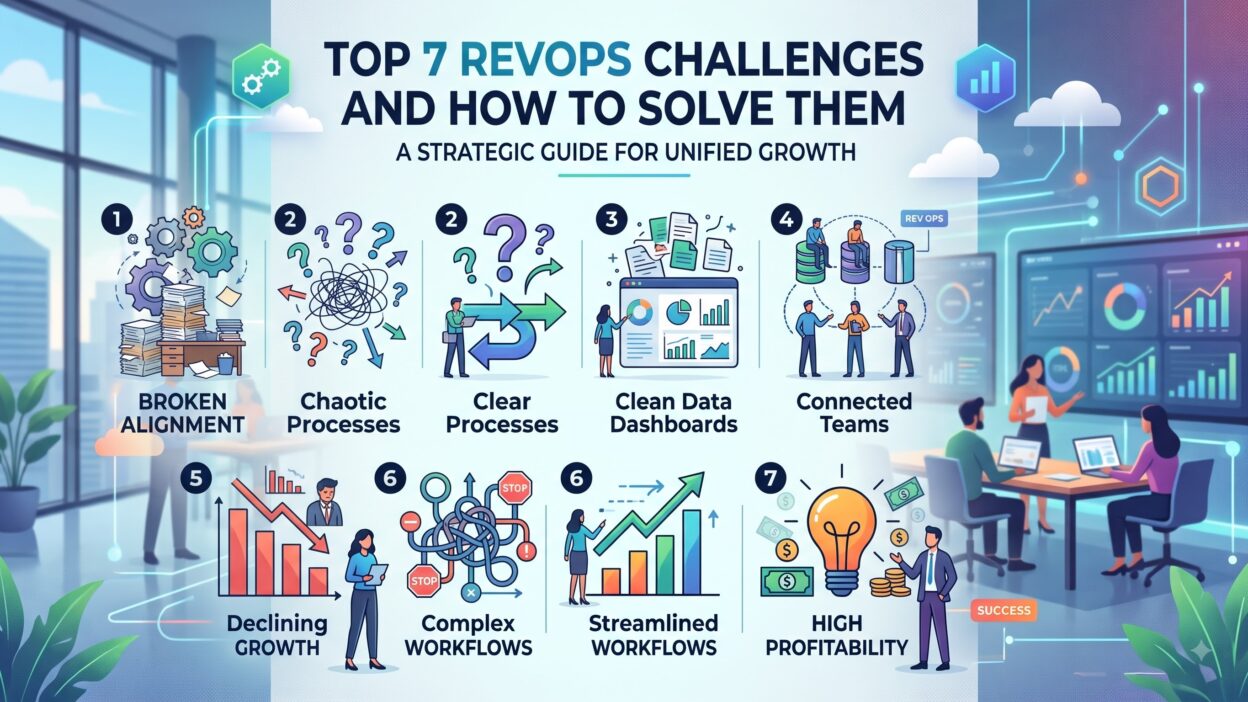
TL;DR Revenue teams grow fast, and processes often break under that growth. Sales, marketing, and customer success start pulling in different directions. These RevOps challenges slow down deals and confuse leadership. This guide walks through the seven most common problems teams face. It also breaks down clear, practical fixes for each one.
Table of Contents
What Is RevOps and Why Challenges Keep Appearing
RevOps stands for revenue operations. It combines sales, marketing, and customer success into one connected system. The goal stays simple. Every team works from the same data and the same goals.
Companies adopt RevOps to fix silos between departments. New RevOps challenges appear anyway, especially during fast growth. Teams add tools quickly and skip proper planning along the way.
The Growing Complexity of Revenue Teams
A five-person sales team runs on simple spreadsheets easily. A fifty-person revenue org cannot survive that way. More people means more handoffs. More handoffs means more room for mistakes.
This complexity creates most RevOps challenges companies face today. Growth outpaces the systems built to support it. Leadership notices cracks only after revenue numbers start slipping.
Why These RevOps Challenges Feel Familiar
Most companies hit the same walls in a similar order. Data gets scattered first. Reporting breaks next. Team friction follows soon after. Recognizing this pattern early helps leaders act before real damage happens.
Challenge 1: Disconnected Sales, Marketing, and Customer Success Data
Data often lives in separate systems across departments. Marketing tracks campaigns in one tool. Sales tracks deals in another. Customer success tracks renewals somewhere else entirely.
Why This Happens
Teams pick tools independently based on their own needs. Nobody plans for cross-team visibility from the start. Over time, these separate systems create serious blind spots across the revenue funnel.
How to Solve It
Centralize data inside one shared system, usually a CRM built for the whole revenue team. Set clear rules for what data every department must log. This single source of truth removes one of the biggest RevOps challenges almost immediately.
Challenge 2: Inconsistent Reporting Across Teams
Every department builds its own reports using its own definitions. A “qualified lead” means something different to marketing than it does to sales. These mismatched definitions cause confusion during every leadership meeting.
Why This Happens
Teams grow reporting habits independently before RevOps gets involved. Nobody agrees on shared metrics early enough. By the time leadership notices, the mismatch feels deeply embedded.
How to Solve It
Build one shared reporting framework with clear, agreed definitions. Document exactly what counts as a qualified lead, an opportunity, or a closed deal. This shared language solves one of the most persistent RevOps challenges companies deal with long term.
Challenge 3: Poor Lead Handoff Between Marketing and Sales
Leads often fall through the cracks between marketing and sales. Marketing hands off a lead, and sales never follows up in time. Interest fades, and the opportunity disappears quietly.
Why This Happens
Marketing and sales rarely share clear handoff criteria. Marketing might pass leads too early. Sales might ignore leads that need more nurturing first. This mismatch wastes real pipeline potential.
How to Solve It
Create a shared scoring system both teams agree on before launch. Set clear rules for exactly when a lead moves from marketing to sales. Automated alerts help sales respond faster once a lead crosses that threshold. This fix directly addresses one of the most common RevOps challenges in growing companies.
Challenge 4: Lack of Clear Revenue Ownership
Some companies never assign clear ownership over the full revenue process. Sales blames marketing for weak leads. Marketing blames sales for slow follow-up. Nobody takes full responsibility for the outcome.
Why This Happens
Revenue operations often start as a side responsibility instead of a dedicated role. Without clear ownership, accountability spreads too thin across multiple teams.
How to Solve It
Appoint a dedicated RevOps leader with authority across departments. This person owns the full funnel, not just one piece of it. Clear ownership resolves many RevOps challenges before they even start, since decisions move faster with one accountable leader.
Challenge 5: Too Many Disconnected Tools
Fast-growing companies often stack tools without a clear strategy. A team ends up with overlapping platforms doing similar jobs. Data gets scattered further with every new tool added.
Why This Happens
Each department buys tools independently to solve immediate problems. Nobody evaluates the full tech stack together. This pattern creates serious RevOps challenges around integration and reporting.
How to Solve It
Audit every tool currently in use across revenue teams. Cut tools that overlap or rarely get used. Choose a smaller, well-integrated stack that connects data automatically between systems. Fewer tools almost always mean fewer problems.
Challenge 6: Weak Forecasting Accuracy
Inaccurate forecasts create serious planning problems for leadership. A pipeline might look strong on paper but convert poorly in reality. Executives make decisions based on numbers that never match actual results.
Why This Happens
Forecasts often rely on outdated data or inconsistent deal stages. Reps update deals inconsistently, which skews the entire pipeline view. This inconsistency ranks among the most damaging RevOps challenges for company planning.
How to Solve It
Standardize deal stage definitions across the entire sales team. Require regular pipeline reviews to catch stale or inflated deals early. Use historical data to build more realistic forecasting models moving forward.
Challenge 7: Resistance to Process Change
New processes often meet resistance from long-tenured reps. People get comfortable with old habits, even broken ones. This resistance slows down every RevOps improvement effort.
Why This Happens
Change feels risky, especially for reps hitting their targets already. Teams rarely explain the “why” behind new processes clearly enough. Without that context, resistance grows naturally.
How to Solve It
Communicate the reasoning behind every process change clearly and early. Show reps how the new system saves time or improves results directly. Involve top performers in the rollout process to build trust across the wider team. This approach turns one of the trickiest RevOps challenges into a smoother transition.
Building a Long-Term Plan to Avoid Future RevOps Challenges
Solving today’s problems matters, but prevention matters more. Build quarterly reviews into your revenue process permanently. Check data quality, tool usage, and reporting accuracy on a set schedule.
This ongoing discipline stops small issues from growing into major RevOps challenges later. Teams that review consistently catch problems while they stay small and manageable.
Frequently Asked Questions
What causes most RevOps challenges in growing companies? Fast growth without matching process planning causes most problems. Teams add people and tools faster than they build proper structure.
How long does it take to fix common RevOps challenges? Simple fixes like reporting alignment take weeks. Deeper issues like tool consolidation often take a full quarter or longer.
Who should own RevOps inside a company? A dedicated RevOps leader works best. This person needs authority across sales, marketing, and customer success teams.
Can small companies face RevOps challenges too? Yes. Small teams often face lighter versions of the same problems. Fixing these issues early prevents bigger headaches during growth.
Do RevOps challenges affect customer retention? Yes, significantly. Poor data and weak handoffs often extend into the customer success stage, hurting renewals and expansion revenue.
What is the first step toward solving RevOps challenges? Start with a full audit of data, tools, and reporting definitions. This audit reveals exactly where the biggest problems live.
Read More:-Competitive Technology Discovered: How to Turn Tech Stack Signals into Pipeline
Conclusion

Growth exposes weak processes fast, and revenue teams feel that pressure first. These seven RevOps challenges show up in nearly every growing company at some point. Disconnected data, weak reporting, and poor handoffs all slow down real revenue results.
The good news stays simple. Every challenge here has a clear, practical fix. Centralized data, shared definitions, and clear ownership solve most problems quickly. Regular reviews keep new RevOps challenges from building up again over time.
Companies that address these issues early build stronger, faster revenue engines. Teams stop blaming each other and start working from the same playbook. That alignment becomes the real competitive advantage behind sustainable revenue growth.