
Introduction
TL;DR Every B2B founder hits the same fork in the road. One path lets the product sell itself. The other path puts skilled people in front of buyers. Both paths can build a great company. Picking the wrong one can burn years and cash.
The debate has raged for a decade. Product-led growth became a hot topic because it promised fast scale with low spend. Sales-led growth built the biggest software firms in history. Smart leaders now ask a better question. Do you need to pick just one?
This guide explores Product-led vs. Sales-led Growth in plain terms. You will see how each model works, where each one shines, and where each one struggles.
Table of Contents
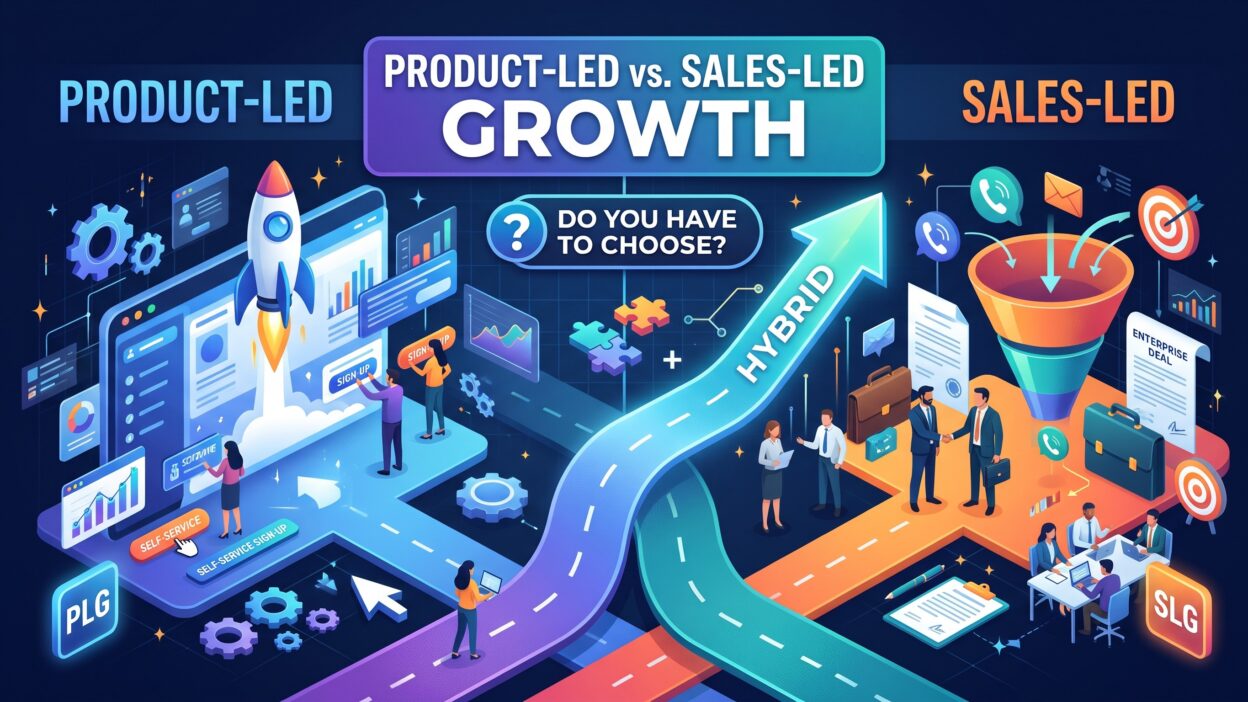
Product-led vs. Sales-led Growth: The Core Difference
The core difference comes down to one question. Who moves the buyer forward? In one model, the product does the work. In the other, a person does.
A product-led company lets users try the product before they pay. The product teaches, proves value, and prompts the upgrade. A sales-led company uses people to educate buyers, answer questions, and close deals. The product still matters, but conversation drives the decision.
Think about how you buy tools in your own life. You might download a note-taking app, use it for a week, and pay when you love it. You never speak to a salesperson. Now think about buying a company-wide security platform. You will want a demo, a custom quote, and a call with an expert. Both journeys feel natural for their product.
The two models also differ in who they target. Product-led teams often win individual users and small teams first. Sales-led teams often target executives and procurement groups. The first path works from the bottom up. The second path works from the top down.
Cost structures differ as well. Product-led companies invest heavily in product design, onboarding, and self-serve billing. Sales-led companies invest in sales hires, marketing programs, and long cycles. Neither path is cheap. They spend money in different places.
Understanding Product-led vs. Sales-led Growth starts with this idea. Each model is a way to answer one question: how will buyers discover value?
What Is Product-Led Growth?
Product-led growth, or PLG, treats the product as the main engine of growth. The product itself drives customer acquisition, conversion, and retention. Marketing and sales support the product. They do not replace its role. dock
The typical PLG journey begins with free access. A visitor signs up for a free plan or a trial. They explore features on their own. They reach a moment where the product delivers real value. Teams call this the aha moment. Users who hit that moment often stay.
Upgrades follow natural limits. A free plan may cap users, storage, or features. A team that outgrows the cap pays for more. Payment feels like a small step, not a big decision.
Virality helps. Users invite coworkers. A shared document, a team workspace, or a public link brings new people into the product. Each new user may become a future customer. Growth spreads through use.
PLG creates rich data. Teams see which features people use, where they get stuck, and who is ready to buy. Product analytics guide design changes. Marketers send messages tied to real behavior.
The model needs a product that people can understand fast. Setup must feel easy. Value must show up quickly. A product that needs weeks of configuration does not suit pure PLG.
Well-known examples include Slack, Zoom, Dropbox, Notion, and Figma. Each one let users start alone and spread inside companies. Their growth stories shaped the current debate on Product-led vs. Sales-led Growth.
What Is Sales-Led Growth?
Sales-led growth, or SLG, relies on people to drive revenue. Marketing generates interest. Sales development reps qualify leads. Account executives run demos, handle objections, and negotiate contracts. Customer success managers help buyers adopt the product.
SLG fits products with complexity. Outfunnel notes that more complex products need more personalized sales support. An enterprise platform may touch many systems. It may need security reviews, legal terms, and executive approval. A person must guide the buyer through that path.
Deal sizes run larger in SLG. A single contract may reach six or seven figures. The buyer wants to trust the vendor before signing. Relationships matter. References matter. Custom proposals matter.
The model offers control. Leaders can forecast revenue from pipeline stages. They can coach reps on specific deals. They can shape pricing to fit each customer. Predictable processes help finance teams plan.
SLG also has costs. Salaries, commissions, travel, and tools add up. Sales cycles can stretch for months. New reps need time to ramp. A weak hire or a slow quarter hurts results quickly.
The model scales through headcount. More revenue often means more reps. That link makes margins sensitive to productivity. Leaders watch quota attainment and ramp time closely.
SLG remains the dominant motion for large enterprise software. Banks, hospitals, and governments buy through people. They expect service, security reviews, and negotiated terms. A strong sales team earns that trust.
Product-led vs. Sales-led Growth Side by Side
A direct comparison helps clarify the trade-offs. Look at each area below.
Customer Acquisition
PLG attracts users through free access, content, and word of mouth. Visitors sign up without talking to anyone. SLG attracts buyers through outbound outreach, events, and inbound demo requests. A rep guides each opportunity.
Speed to Value
PLG aims to show value in minutes or hours. Users test the product right away. SLG often shows value after a demo, a pilot, or a proof of concept. The path takes longer but can build deeper confidence.
Cost to Acquire Customers
PLG often lowers acquisition cost per user because the product does much of the selling. Product and engineering costs rise to support onboarding and self-serve flows. SLG carries higher cost per deal because people spend time on each account. Larger deals can justify that cost.
Deal Size and Complexity
PLG tends to start with small purchases. Teams pay by credit card. SLG tends to land larger contracts with custom terms. Complex needs call for human guidance.
Data and Feedback
PLG produces behavioral data at scale. Teams see every click and session. SLG produces rich qualitative feedback. Reps hear objections, goals, and competitive details in conversations. Both types of insight help.
Scalability
PLG can reach many users with a small team. Growth can feel exponential when virality kicks in. SLG scales more linearly. Each added rep brings added capacity. Leaders must hire, train, and manage people.
Risk
PLG risks low conversion from free to paid. Many users stay free forever. SLG risks long cycles and missed quotas. A few lost deals can swing a quarter.
No column wins every category. Each model fits different products, buyers, and stages. That reality fuels the question at the heart of Product-led vs. Sales-led Growth.
When Product-Led Growth Fits Best
PLG works best under specific conditions. Check your situation against the signs below.
Your product must be easy to start. Users should create an account and see value within minutes. Complex setup kills the model. TechCrunch notes that PLG works best for products with some level of virality. Products that spread through sharing and teamwork fit well.
Your buyers should include individual users who can try tools on their own. Developers, designers, marketers, and small teams often choose tools by hand. Their managers approve spending later. General Catalyst notes that developer tools often suit a bottoms-up, product-led motion.
Your price point should allow low-friction purchases. A monthly fee that fits on a team credit card suits PLG. A six-figure contract does not.
Your market should have many potential users. A broad audience supports a high-volume funnel. Free users fuel word of mouth, even when most never pay.
Your team should have strong product, design, and data skills. PLG needs great onboarding, clear messaging, and rich analytics. Engineers and designers become growth drivers.
You also need patience for the freemium math. A free plan costs money to serve. Conversion rates may sit in the low single digits. Volume must cover that cost. Model the numbers early.
When these conditions hold, PLG can build a fast, efficient engine. Startups often begin here to prove demand with limited cash. Early traction attracts investors and talent.
When Sales-Led Growth Fits Best
SLG works best when buyers need guidance. Look for these signs.
Your product solves a complex problem. Buyers must understand how it fits into their systems and workflows. A person can explain this far better than a landing page can.
Your deals are large. Contract values justify the cost of reps and long cycles. Buyers expect a high-touch experience when they commit big budgets.
Your buyers involve many stakeholders. Security, legal, finance, and executives each have a say. A sales leader can build consensus across the group. Self-serve checkouts cannot.
Your market has strict requirements. Regulated industries ask for audits, certifications, and custom terms. Sales teams manage those talks.
Your product needs configuration. Data migration, integrations, and training take effort. Human guidance reduces risk and speeds adoption.
General Catalyst adds a useful point. If a lot of friction blocks an end user from adopting the product, you may need to lean more on sales than on a product-led motion. Friction signals a need for human help.
SLG also helps when you target a narrow set of high-value accounts. Account-based marketing and personalized outreach fit that approach. Reps can research each account and craft tailored messages.
Strong sales leadership matters. You need people who can hire, coach, and forecast. Weak leadership turns a promising SLG motion into a cost problem. Choose this path only when you can staff it well.
Do You Have to Choose? The Case for a Hybrid Model
Many leaders now say no. You do not have to choose forever. You can blend both motions.
Jason Eubanks, CRO of Harness, said it does not matter where you start because you will need to do both. That view reflects what many growing companies learn. Early traction may come from one motion. Scale often demands the other.
Consider a PLG company that grows fast. Thousands of teams use the free plan. A few teams grow into large departments. Those teams want security features, custom contracts, and a named contact. Self-serve checkout stops working for them. The company hires sales reps to serve that demand.
Consider an SLG company that wants faster growth. Reps close big deals, but the pipeline limits growth. Leaders add a free trial or a sandbox. Smaller buyers sign up without help. Reps focus on the largest accounts.
The question shifts. Dock frames it well. The question is not whether you will add sales, but when you add sales and what your sales team will do when it arrives. Timing and role decide success.
Hybrid models offer real advantages. They reach more buyer types. They lower risk by spreading growth sources. They let product usage guide sales focus. They improve retention through both product value and human relationships.
Hybrid models also add complexity. Teams must share data, set clear rules, and avoid conflict. Reps need to respect the user experience. Product teams need to respect sales needs. Leaders must manage both without favoring one by habit.
The most useful view of Product-led vs. Sales-led Growth treats them as tools. You use each tool where it fits the job.
Product-Led Sales: Where the Two Models Meet
Product-led sales, often called PLS, sits at the meeting point. The product attracts and activates users. Sales teams step in when usage shows buying intent.
The key idea is timing. A rep does not call a user on day one. The rep waits for signals. A team that adds many users may be ready for a bigger plan. A user who hits a usage limit may want an upgrade. A company with many sign-ups from one domain may deserve outreach.
These signals have a name. Teams call them product-qualified leads, or PQLs. A PQL shows real product engagement and fit with your ideal customer profile. PQLs often convert better than cold leads because the user already knows the product.
The rep’s role changes too. They do not pitch basics. The user already understands the product. The rep helps expand adoption across the company. They discuss security, billing, and rollout. They act like consultants.
G2 offers a helpful reminder. The move from pure PLG to product-led sales is not as simple as many assume, and many firms make gradual changes as they pivot. Start small. Test with one segment. Learn what works.
McKinsey adds context. Executives and investors commonly believe that product-led companies beat sales-led peers on growth, efficiency, and valuation. That belief draws many leaders toward PLG. The product-led sales model shows that sales still plays a vital role in turning usage into large contracts.
How to Decide: Factors That Shape Product-led vs. Sales-led Growth
A clear decision needs clear inputs. Work through the factors below with your leadership team.
Start with your product. How fast can a new user see value? If the answer is minutes, PLG has strong footing. If the answer is weeks, you need guided onboarding.
Look at your buyer. Who feels the pain, and who holds the budget? If the same person does both, self-serve can work. If different people hold each role, you need a way to reach the budget holder.
Examine your price and contract size. Low prices fit card payments. High prices fit negotiated deals. Plot your average contract value against your cost of sales.
Study your market. Count potential users and potential accounts. A huge pool of small users suits PLG. A small pool of large accounts suits SLG.
Review your competition. Check how rivals sell. If competitors offer free trials, buyers may expect one. If competitors run long sales cycles with named reps, buyers may expect that service.
Assess your team. Do you have strong product designers and growth engineers? Do you have seasoned sales leaders? Build on your strengths first.
Consider your cash and runway. PLG can need heavy upfront product investment. SLG needs steady funding for sales hires. Match your model to your capital plan.
Think about your stage. Early startups often use whichever motion gets traction fastest. Later-stage companies add the second motion to expand.
Score each factor on a simple scale. Tally the results. A lopsided score points to a clear choice. A mixed score points to a hybrid. The goal is not perfection. The goal is a reasoned starting point.
Metrics That Show Whether Your Model Works
Metrics keep teams honest. Each model has its own set.
For PLG, track activation rate. This number shows how many new users reach the aha moment. Track free-to-paid conversion. Track time to value. Track product usage depth and frequency. Track virality, such as invites sent per user. Track expansion revenue from existing accounts.
For SLG, track pipeline coverage and win rate. Track average deal size and sales cycle length. Track quota attainment and rep ramp time. Track customer acquisition cost and payback period. Track net revenue retention.
For hybrid models, track both sets and add bridge metrics. Count PQLs created and PQLs converted. Measure the share of revenue from self-serve and from sales. Measure expansion from accounts that began as free users. Compare cost per dollar of revenue across both motions.
Watch retention in every model. Growth means little if customers leave. Track logo churn and revenue churn. Track customer health scores. Watch for patterns by segment.
Look at efficiency metrics as well. The magic number, CAC payback, and revenue per employee show how well you turn spend into growth. Investors watch these closely.
Share dashboards across teams. Product, marketing, sales, and success should see the same numbers. Shared data builds shared goals. It also prevents arguments about whose motion deserves credit.
Building Teams and Incentives for a Blended Motion
People and pay shape behavior. A blended model needs careful design.
Start with structure. Decide who owns each stage. Product teams own onboarding and activation. Growth teams own experiments and funnels. Sales teams own large deals and expansion. Success teams own adoption and renewal. Clear ownership prevents gaps and overlaps.
Set rules for handoffs. Define when a user becomes a PQL. Define which accounts go to reps and which stay self-serve. Share context with the rep, including product usage and team size. Reps who see usage data start better conversations.
Design compensation with care. General Catalyst gives sound advice. Equal investment in each motion is not the goal, and sales quotas and pay plans should reflect the contract value that comes from product-led and sales-led paths. A rep who earns commission on self-serve revenue may feel unfair. A rep with no credit for expansion may ignore it. Align pay with the behavior you want.
Train sales teams to respect the user experience. Reps must avoid spamming free users. They should reach out with helpful, timely messages. They should offer value first.
Train product teams to understand sales needs. Enterprise buyers need admin controls, security features, and reporting. Product roadmaps should include them.
Foster a shared culture. Hold joint planning sessions. Invite sales to product reviews and product to sales calls. Shared customer stories build empathy.
Mistakes in Product-led vs. Sales-led Growth Decisions
Leaders make predictable errors. Learn from them.
Copying a famous company is the most common mistake. A company that thrived with PLG may have a viral product and a broad market. Your product may differ. Choose a model for your own conditions.
Another mistake is forcing PLG onto a complex product. A visitor who needs weeks of setup will not finish a free trial. Fix the product or add guided onboarding.
Some leaders reject sales too long. They fear cost and complexity. Large customers then walk away because nobody helps them buy. Add sales when demand shows up.
Others add sales too early. A team hires reps before the product has clear value. Reps burn leads and morale. Prove value first.
Poor handoffs hurt hybrid models. A user who signs up and then gets a cold call feels chased. A rep who calls a user with no context wastes time. Use data to time outreach.
Ignoring the free user experience hurts too. Free users form opinions that spread. A weak free plan damages the brand. A free plan that gives away too much hurts revenue. Balance generosity and limits.
Unclear metrics create confusion. Teams that measure only signups or only revenue miss the full story. Track the whole journey.
Treating the choice as permanent traps teams. Markets change. Products grow. Review your model every year. Adjust as needed.
A Roadmap to Blend Both Motions
You can build a blended model in stages. Use the roadmap below as a guide.
Understand Your Current Motion
Document how customers find, try, and buy today. Map each step. Record conversion rates and cycle times. Interview customers about their journey. Identify where friction slows progress.
Add the Missing Entry Point
If you run SLG, add a low-friction way to try the product. Offer a trial, a sandbox, or an interactive demo. If you run PLG, add a path to talk to someone. Offer a contact sales option and a demo request for larger teams.
Define Signals and Routing
Define product-qualified leads. Combine usage signals with company data. Pick thresholds that suggest buying intent. Route PQLs to the right reps. Track response times.
Align Teams and Incentives
Share goals across product, marketing, sales, and success. Adjust compensation to match the new model. Create a regular meeting to review funnel data. Give every team a voice.
Test, Learn, and Expand
Pilot the blended approach with one segment. Measure results against your baseline. Adjust the signals, messages, and handoffs. Expand to more segments once results hold.
Review Each Year
Revisit your model each year. Check whether customer needs, product complexity, or market conditions have changed. Update your mix of self-serve and sales. Keep the system flexible.
FAQs About Product-led vs. Sales-led Growth
Which model is better for early-stage startups?
It depends on the product and buyer. Products that users can try alone often suit PLG. Complex or high-price products often suit SLG. Many founders start with the motion that gets traction fastest and add the other later.
Is product-led growth cheaper than sales-led growth?
PLG can lower acquisition cost per user. It raises spending on product design and engineering. SLG carries higher cost per deal but can win larger contracts. Compare total cost against revenue and payback time.
Can a company use both models at once?
Yes. Many companies run a hybrid model. Self-serve handles small teams. Sales handles large accounts and expansion. Clear rules and shared data keep the motions from clashing.
What is a product-qualified lead?
A product-qualified lead is a user or account that shows real engagement and fits your ideal customer profile. Examples include a team that hits a usage limit or many users from one company. Sales teams use PQLs to time outreach.
Does product-led growth work for enterprise software?
It can, with adjustments. Many enterprise vendors use free trials or small team plans to land users. They then add sales to handle security, procurement, and expansion. The mix depends on product complexity.
How do I know when to add sales to a PLG company?
Watch for signals. Large teams using the product, requests for custom contracts, security questionnaires, and frequent support questions all suggest demand for sales. Add reps in a focused way and test with one segment.
How do I measure success in a hybrid model?
Track metrics for both motions. Look at activation, conversion, and expansion for self-serve. Look at pipeline, win rate, and cycle length for sales. Add shared metrics such as net revenue retention and customer acquisition cost.
Read More:-CaptivateIQ vs. Everstage: Comprehensive Comparison [2026]
Conclusion

The debate over Product-led vs. Sales-led Growth has matured. Early on, leaders treated it like a fight. Experience taught a better lesson. Each model solves a different problem. Smart companies use each one where it fits.
PLG shines when products are easy to try and spread through use. SLG shines when deals are complex, large, and built on trust. Hybrid models combine both strengths. They let the product attract and educate users. They let people guide big buyers to a confident decision.