
Introduction
TL;DR Picking a marketing platform feels hard. The market holds hundreds of tools. Two names show up often in search results.
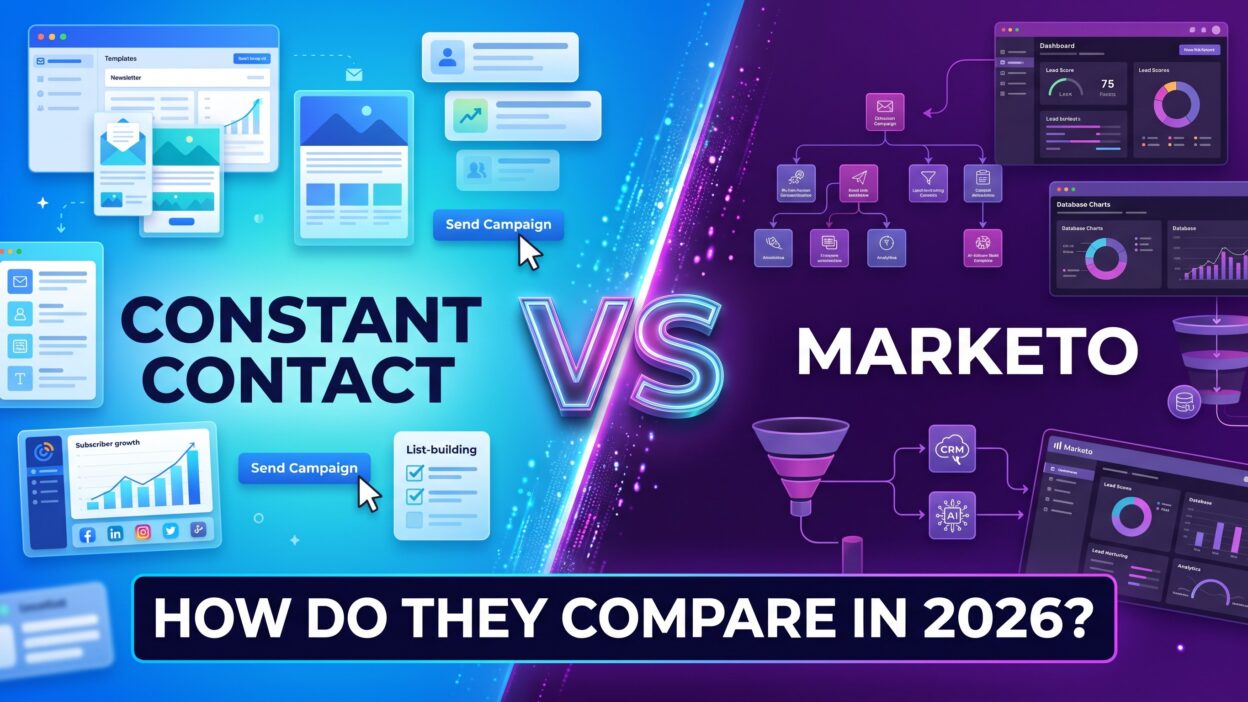
Constant Contact is a well-known email marketing tool. Marketo, now called Marketo Engage, is an enterprise marketing automation platform from Adobe. They serve very different buyers. Many people still compare them.
This guide covers Constant Contact vs Marketo for 2026. We look at features, automation, reporting, pricing, and fit.
Table of Contents
Constant Contact vs Marketo: The Quick Answer
Here is the short version. Constant Contact fits small businesses, nonprofits, and local organizations. It sends newsletters, manages contacts, and runs simple campaigns. Setup takes hours.
Marketo fits large B2B teams with complex sales cycles. It handles lead scoring, account-based marketing, and revenue attribution. Setup takes weeks or months.
One review site calls them different worlds. The comparison exists because people search for it. The tools serve different organizations.
Price shows the gap. Constant Contact starts near $12 per month, according to one comparison. Marketo sells through custom quotes. Third-party guides list entry points near $900 per month.
The right pick in Constant Contact vs Marketo depends on your team and goals. A five-person shop that sends monthly newsletters does not need Marketo. A global B2B company with a long sales cycle will outgrow Constant Contact fast.
The sections below give the detail. Use them to test your needs against each tool.
What Is Constant Contact?
Constant Contact is email marketing software. It started with simple newsletters. It added tools over the years.
Core Features
The platform offers email templates, a drag-and-drop editor, and contact lists. It also offers event management and social media tools. Users send campaigns, track opens and clicks, and grow lists with sign-up forms.
Reviewers praise the templates and the friendly interface. Software Advice shows a 4.3 rating from nearly 3,000 reviews. Common praise centers on ease of use.
Known Limits
Reviewers also name weak spots. Some say pricing runs high for the value. Some report poor customer service. Advanced automation stays lighter than that of larger platforms.
Pricing scales with contact count. One guide says moving from 500 to 5,000 contacts can more than triple your bill. SMS marketing and promotional landing pages can cost extra.
Constant Contact fits teams that want to send good emails fast. It does not try to replace an enterprise suite. That honest focus helps buyers who compare Constant Contact vs Marketo.
What Is Marketo Engage?
Marketo Engage is a B2B marketing automation platform. Adobe owns it. Large teams use it to manage leads across many channels.
Core Features
The platform handles email, landing pages, forms, and nurture programs. It scores leads. It syncs with CRM systems such as Salesforce and Microsoft Dynamics. It supports account-based marketing and revenue attribution.
One review calls Marketo’s account-based marketing, predictive scoring, and attribution genuinely enterprise-grade. Marketing operations teams love that depth.
Known Limits
Marketo asks a lot from its users. Implementation can take months, according to one review. The interface feels dated to some users. Skilled admins matter. Many companies hire consultants.
Pricing stays private. Adobe sells by quote. Costs depend on database size, modules, and add-ons. Contracts run annually.
Marketo suits mature marketing teams. It gives them control and scale. Small teams often feel buried under its power. That gap drives many Constant Contact vs Marketo searches.
How We Compared the Two Platforms
We judged both tools on seven areas. We chose areas that matter to working marketers.
Our Criteria
We looked at email marketing. We looked at automation and lead management. We checked analytics and attribution. We reviewed integrations and ease of use. We studied pricing and contracts. We weighed implementation and support. We matched each tool to team types.
We drew on vendor pages, review sites, and independent comparison guides. Several guides come from vendors that sell their own products. We treat those claims with care. We flag gaps where sources disagree.
A fair Constant Contact vs Marketo review should admit what it cannot confirm. Marketo does not publish prices. Constant Contact entry prices vary by source. Always request a current quote.
Constant Contact vs Marketo at a Glance
Start with the big picture. Constant Contact focuses on email marketing for small organizations. Marketo focuses on enterprise marketing automation for B2B teams.
Ease of use favors Constant Contact. Depth favors Marketo. Price favors Constant Contact. Scale favors Marketo.
A ZoomInfo comparison lists Constant Contact pricing from $12 per month on a Lite plan. It lists Marketo as quote-based enterprise pricing. Other sources list Constant Contact starting prices of $10 and $20. Plan names and promotions change often.
Review sites show Marketo as a heavy platform with long setup. They show Constant Contact as light and quick.
Both tools send email. Both track engagement. Both offer templates and forms. The overlap ends there. Marketo adds scoring, nurturing logic, account tools, and attribution. Constant Contact adds event tools and a simple social posting feature.
This Constant Contact vs Marketo snapshot gives you the pattern. The next sections test each area.
Email Marketing Features
Constant Contact Email Tools
Email is the heart of Constant Contact. The editor is simple. Templates look polished. You can build a newsletter in minutes. Image libraries and layout tools help non-designers.
List management feels easy. You import contacts, tag them, and segment them. Reports show opens, clicks, and bounces. Deliverability gets good marks in reviews.
Event and survey tools support small organizations. Nonprofits find them useful. Constant Contact offers a nonprofit discount of 20 to 30 percent, according to one pricing guide.
Marketo Email Tools
Marketo handles email at scale. You build emails with templates and tokens. You personalize by field. You send from programs that tie to lead stages.
The email editor works well for trained users. It takes more effort than Constant Contact. Marketing operations teams manage template libraries and approvals.
The Winner
Constant Contact wins on speed and simplicity. Marketo wins on control and scale. In Constant Contact vs Marketo, email-only teams should lean toward Constant Contact. Teams that run complex programs should lean toward Marketo.
Marketing Automation and Workflows
Automation in Constant Contact
Constant Contact offers basic automation. You can set welcome series and simple follow-ups. Triggers cover sign-ups, clicks, and dates. The flow builder stays easy.
Higher tiers add more power. One buyer guide lists a Pro plan starting near $245 per month with automation and predictive analytics. Check current plan details. Vendors reshuffle plans often.
The tool serves small teams that want light automation. It does not support complex branching across many channels.
Automation in Marketo
Marketo is a full marketing automation platform. Smart campaigns trigger actions based on data. Nurture streams drip content to leads by stage. Programs group assets and track results.
Logic can run deep. You can build rules around behavior, fields, scores, and account data. Webhooks and APIs connect other systems. Teams build lead lifecycle models and route leads to sales.
That power needs skill. A new admin takes time to learn the system. Poor setup creates messy data.
The Winner
Marketo wins automation by a wide margin. Constant Contact wins for teams that want simple flows without training. Constant Contact vs Marketo comes down to how much complexity you need.
Lead Scoring, CRM, and Sales Alignment
Marketo Leads the Pack
B2B teams care about lead quality. Marketo scores leads on behavior and fit. It syncs with CRM systems. Sales sees scores, activity, and content history. Marketing and sales agree on handoff rules.
Predictive scoring adds another layer. The system flags leads that look like past buyers. Account-based marketing tools help teams target named accounts.
Constant Contact’s Approach
Constant Contact offers lighter contact management. It tracks email activity and basic tags. CRM features stay basic. Many users connect other tools to fill the gap.
Small teams often keep leads in a spreadsheet or a simple CRM. Constant Contact feeds that process with email signups. It does not manage a full sales funnel.
What This Means
Sales cycles decide the need. A local service business closes deals by phone. It needs list growth and reminders. A software vendor with a six-month cycle needs scoring and routing.
This section settles many Constant Contact vs Marketo debates. Lead management depth separates the two platforms more than any other feature.
Analytics, Reporting, and Attribution
Reporting guides decisions. Each platform offers a different level.
Constant Contact shows email stats. You see opens, clicks, unsubscribes, and bounces. You can compare campaigns. Reports stay easy to read. Small teams use them to refine subject lines and send times.
Marketo goes much deeper. It tracks lead behavior across channels. It ties programs to pipeline and revenue. Attribution models show which campaigns drive deals. Dashboards can feed into BI tools.
Setup matters. Marketo reports need clean data. Admins must define stages, channels, and costs. Bad setup produces bad numbers.
Many small teams never need attribution. A monthly newsletter does not require a model. Large B2B teams live and die by it. Marketing leaders must prove return on spend.
Pick based on the questions your executives ask. Ask yourself if your leaders want open rates or pipeline numbers. The answer shapes your Constant Contact vs Marketo choice.
Ease of Use and Learning Curve
Constant Contact Is Beginner Friendly
Constant Contact earns praise for simplicity. A new user can send a first campaign in an afternoon. The editor guides each step. Support articles cover common tasks. Live chat and phone help exist, though some reviewers complain about service quality.
Marketo Needs Training
Marketo asks for commitment. Admins learn programs, tokens, smart lists, and scoring rules. Many teams take courses. Others hire agencies. Reviewers say implementation can take months.
The interface feels dated to some users. Power users adapt. New users feel lost at first.
Team Skills Matter
Count your people. A solo marketer or a small team needs a tool with a short ramp. A marketing operations team of several specialists can manage Marketo.
Time costs money. Training hours, consultant fees, and admin salaries add up. Include them in your budget. Many buyers forget this step when they compare Constant Contact vs Marketo.
Integrations and Ecosystem
Tools rarely work alone. Integrations connect your stack.
Constant Contact connects with popular small business tools. It offers links to e-commerce platforms, CRMs, and form builders. Zapier fills many gaps. One comparison notes that Constant Contact offers basic data enrichment through third-party connectors.
Marketo offers a larger ecosystem. It connects with major CRMs, webinar tools, ad platforms, and analytics systems. Adobe products link in too. A marketplace lists many partner apps. APIs support custom builds.
Data enrichment deserves a note. Neither platform acts as a full B2B data source. Teams often add a data provider to fill missing company and contact fields. ZoomInfo’s own comparison highlights this need, though ZoomInfo sells such data.
Check your CRM first. Confirm the integration depth you need. Some integrations sync only a few fields. Test with real records.
Integration needs often tilt Constant Contact vs Marketo toward Marketo for enterprise stacks. Small teams rarely need that range.
Pricing and Contracts
Constant Contact Pricing
Constant Contact lists plans on its site. Starting prices differ by source. One comparison lists $12 per month. Another lists $20. A third lists $10. Plan names change, and promotions come and go.
Price rises with contact count. A list of 500 costs far less than a list of 5,000. Advanced features such as SMS and landing pages can add cost. Nonprofits can find discounts.
Contracts run monthly or annually. Annual plans often cost less per month. Check the cancellation terms.
Marketo Pricing
Marketo sells by quote. Adobe does not publish a rate card. Cost depends on database size, modules, users, and support level. Annual contracts apply.
Third-party guides give rough numbers. One lists a professional tier near $900 per month. Another lists about $895 per month at 10,000 contacts. Those figures climb with add-ons, setup, and services.
Implementation adds cost. Agencies charge for setup. Training adds hours. Admins add salary.
Total Cost of Ownership
Compare full costs. Add software, staff, training, and consultants. Constant Contact keeps those extras low. Marketo raises them.
A review of enterprise tools warns about premature upgrades. Many growing companies buy enterprise platforms early and pay for features they do not use for years. Be honest about your needs.
Pricing drives many Constant Contact vs Marketo choices. Get written quotes. Compare them against your real use.
Implementation, Support, and Onboarding
Getting Started with Constant Contact
Onboarding is quick. You create an account, import contacts, and pick a template. Most users send a first email within a day. Guides and tutorials fill the help center.
Support options include chat, phone, and email. Reviewers report mixed experiences. Test support during your trial.
Getting Started with Marketo
Onboarding is a project. Teams plan data models, CRM sync, scoring rules, and templates. Adobe offers training and support plans. Partners offer implementation services.
Expect weeks or months. Assign an owner. Set milestones. Keep the project scope tight.
Support Plans
Ask about support tiers. Premium support costs more. Large teams benefit from named contacts. Small teams often do fine with standard help.
Support affects daily life. A stuck campaign on launch day hurts. Ask both vendors about response times. Read recent reviews on that topic. These details matter in a Constant Contact vs Marketo decision.
Who Should Choose Each Platform?
Choose Constant Contact If
You run a small business, nonprofit, or local organization. You send newsletters, promotions, and event invites. You want a short learning curve. You have a small team and a small budget. You need basic automation and clean reports.
Choose Marketo If
You run B2B marketing at scale. You manage long sales cycles. You need lead scoring and CRM sync. You need account-based marketing and attribution. You have marketing operations staff. You can fund implementation and training.
Consider Neither If
You need a creator-focused tool for digital products and paid newsletters. ConvertKit offers those features. You need e-commerce email automation. Klaviyo and Drip target that space. You want a middle path between simple and enterprise. HubSpot, ActiveCampaign, and Act-On sit in that gap.
A Simple Test
Write down your top five marketing tasks. Mark which ones need complex logic. If none do, start with a simpler tool. If most do, plan for a larger platform.
Honest answers settle most Constant Contact vs Marketo choices. Fit beats feature count every time.
Alternatives to Constant Contact and Marketo
Lighter Alternatives
Mailchimp suits small teams that want a free tier and easy tools. Brevo offers email and SMS at lower cost. MailerLite keeps things simple and cheap. Sequenzy targets SaaS founders with email-volume pricing.
Mid-Market Alternatives
HubSpot Marketing Hub offers CRM and automation in one suite. ActiveCampaign gives strong automation at a moderate price. Act-On targets mid-market B2B teams that want something lighter than Marketo.
Enterprise Alternatives
Salesforce Marketing Cloud and Pardot, now Marketing Cloud Account Engagement, compete with Marketo. Oracle and Adobe offer other suites. Each requires skilled admins.
When to Look Beyond These Two
Look elsewhere if you feel stuck between simple and enterprise. Many teams fit in the middle. A mid-market tool may cost less than Marketo and do more than Constant Contact.
Compare three options in a trial. Test one real campaign in each. Judge speed, results, and support.
Alternatives widen your view. Many buyers who start with Constant Contact vs Marketo end up choosing a third tool.
Moving from Constant Contact to a Larger Platform
Growth changes needs. A small list becomes a big database. Simple newsletters become multi-step programs. Teams outgrow tools.
Watch for signs. Your sales team asks for lead scores. Your list needs deeper segments. You need attribution to defend budget. Campaign logic gets too complex for your current tool.
Plan the move with care. Export contacts and consent records. Clean your data. Map fields to the new system. Rebuild templates. Test sends before launch.
Warm up your sending domain. A sudden volume change can hurt deliverability. Move in stages.
Train your team. Schedule time for practice. Give each person a clear role.
Keep both tools for a short overlap. Run key campaigns in parallel. Compare results. Retire the old tool after checks pass.
Many teams jump too early. A mid-market tool may serve you for years. Review your needs again before you commit to enterprise software.
Frequently Asked Questions
Which is better, Constant Contact or Marketo?
Neither wins everywhere. Constant Contact wins on ease and cost for small teams. Marketo wins on automation, scoring, and attribution for large B2B teams.
What is the main difference in Constant Contact vs Marketo?
Constant Contact focuses on email marketing for small organizations. Marketo focuses on enterprise marketing automation. Scale and complexity set them apart.
Is Constant Contact cheaper than Marketo?
Yes. Constant Contact lists entry plans around $10 to $20 per month, depending on the source. Marketo sells by quote, with third-party guides listing figures near $900 per month.
Does Marketo offer a free plan?
Marketo does not advertise a free plan. Request a demo and a quote from Adobe.
Can small businesses use Marketo?
They can. Most find it too heavy and costly. A simpler tool often fits better.
Does Constant Contact offer marketing automation?
Yes, at a basic level. Higher plans add more features. Complex branching and lead scoring stay outside its focus.
How long does Marketo take to set up?
Reviewers say implementation can take months. Timelines depend on data, CRM sync, and team skill.
Does Constant Contact offer nonprofit discounts?
One pricing guide reports a discount of 20 to 30 percent. Confirm current terms with the vendor.
What should I read before I decide on Constant Contact vs Marketo?
Read current reviews, request quotes, and run a trial. Test one real campaign in each tool.
Read More:-HubSpot Dynamics 365 Integration: Complete Guide [2026]
Conclusion

Constant Contact and Marketo serve different teams. Constant Contact gives small organizations fast email tools, friendly templates, and a short learning curve. Marketo gives large B2B teams deep automation, lead scoring, account-based marketing, and attribution.
The price gap reflects that difference. Constant Contact starts near $10 to $20 per month in several sources. Marketo sells by quote, and third-party guides place it near $900 per month at entry. Setup costs push Marketo higher.
Neither tool fits everyone. A small business that buys Marketo will struggle. A global B2B team that stays on Constant Contact will hit limits fast. Mid-market tools fill the gap between them.
Start with your needs. List your top marketing tasks. Mark the ones that need complex logic. Count your team skills. Set a realistic budget that includes training and services.
Constant Contact vs Marketo gets easier once you know your goals. Request quotes from both vendors. Run a short trial. Test one real campaign.