
Introduction
TL;DR Your marketing platform shapes every customer message. A weak fit wastes budget. A strong fit grows revenue and saves your team hours.
ActiveCampaign vs Iterable is a common matchup for growing brands. Both tools send email. Both automate journeys. Both promise better results through smarter timing. The two companies still serve different buyers.
Table of Contents
ActiveCampaign vs Iterable at a Glance
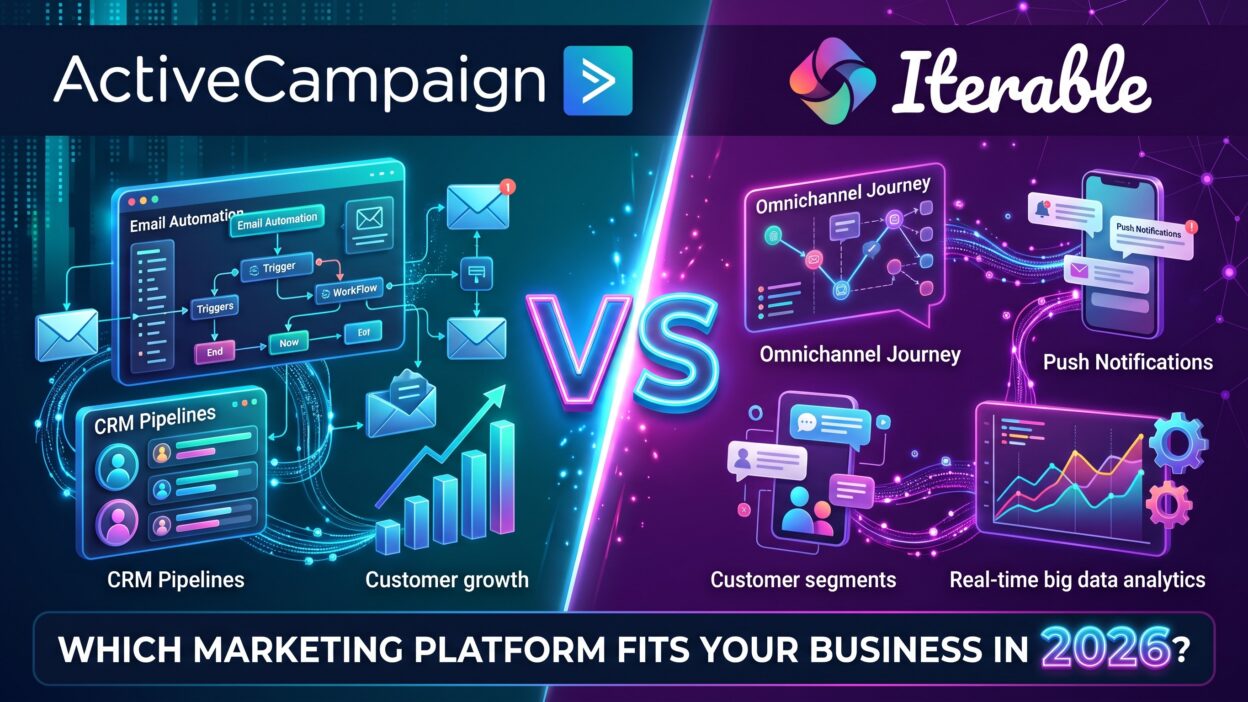
Here is the short version. ActiveCampaign suits small and mid-size businesses. It blends email, automation, and a built-in CRM. Setup is quick. Pricing starts low.
Iterable suits large brands with big data. It focuses on cross-channel messaging. It coordinates email, SMS, push, and in-app messages from one canvas. Setup takes more time. Pricing runs high.
That gap sits at the center of ActiveCampaign vs Iterable. One tool favors affordability and ease. The other favors scale and channel reach.
Business size matters. Budget matters. Your data setup matters. Your team skill matters. Rate yourself on each one before you read on. Your score will point to a likely winner.
What Is ActiveCampaign?
ActiveCampaign is a marketing automation platform. It launched in 2003 and has grown into a full customer experience tool. Millions of users send campaigns through it each month.
The product covers email marketing, SMS, site messaging, forms, landing pages, and a sales CRM. Teams can run marketing and sales follow-up from one login.
Where ActiveCampaign Shines
ActiveCampaign shines at automation for small teams. Its visual builder lets you map a customer path with simple blocks. You can trigger emails from clicks, visits, purchases, or tags. You can score leads and move them to sales.
The built-in CRM keeps deals close to campaigns. A small team does not need a second tool. Templates speed up launch. New users build a working welcome series in an afternoon.
Where ActiveCampaign Struggles
Large brands push past its limits. Very high message volume strains the plan structure. Deep cross-channel orchestration needs more than it offers. Some users find the interface crowded as automations grow. Reporting for complex enterprise needs can feel thin.
What Is Iterable?
Iterable is a cross-channel growth marketing platform. It serves brands that send large volumes of messages. Retail, media, finance, and travel companies use it often.
The platform sends email, SMS, push notifications, and in-app messages. Its automation lives in Studio, a visual journey canvas that coordinates messages across every channel from one place.
Where Iterable Shines
Iterable shines at scale and data flexibility. It accepts event data from your app or site in real time. Marketers build journeys that react to each customer action. A user abandons a cart and gets a push message in seconds.
Data teams like the open structure. Custom fields and event streams fit complex products. Large brands send millions of messages without trouble. Testing tools help teams improve each journey.
Where Iterable Struggles
Iterable asks for more skill. Marketers often need data or engineering help. Setup takes longer. Costs rise fast. Small teams rarely need this much power. A simple newsletter plan does not justify the spend.
ActiveCampaign vs Iterable Features Compared
Feature depth decides many ActiveCampaign vs Iterable deals. Both tools handle the basics. Each one sends email, builds journeys, and tracks results. The gap shows up in how each tool handles data, channels, and scale.
Email Marketing
Email still drives most revenue. ActiveCampaign offers a drag-and-drop editor, ready templates, and smart sending features. Small teams launch campaigns fast. Segments update as contacts act.
Iterable offers a flexible editor and strong template tools. Teams can store reusable blocks. Dynamic content pulls from live data. Large teams manage many brands and languages with ease.
Both tools deliver solid email. ActiveCampaign wins on speed. Iterable wins on depth.
Automation and Customer Journeys
Automation is the core of both platforms. ActiveCampaign uses a clear workflow builder. You pick a trigger, add actions, and set conditions. Goals and splits help you test paths. The builder reads like a flowchart.
Iterable uses Studio. It handles branching paths, wait steps, and multi-channel decisions. Marketers can pull event data into each step. Journeys react to behavior across your app, site, and store.
ActiveCampaign gives you a gentle learning path. Iterable gives you a bigger canvas. Match the tool to your journey complexity.
Channels and Messaging
Channel reach matters for modern marketing. ActiveCampaign covers email, SMS, site messages, and some chat tools. That range works for most small businesses.
Iterable covers email, SMS, push, in-app, and web push. It treats every channel as part of one journey. A customer might get an email, then a push alert, then a text. One canvas controls the whole flow.
Brands with a mobile app benefit most from Iterable. Brands that live on email and SMS do fine with ActiveCampaign.
CRM and Sales Tools
ActiveCampaign includes a CRM. Sales reps track deals, tasks, and notes. Lead scores tell them who to call. Marketing and sales share one record.
Iterable does not aim to replace your CRM. It connects to Salesforce and similar tools. Your sales team stays in its own system. Iterable focuses on messaging and data flow.
Pick ActiveCampaign if you want one tool for marketing and sales. Pick Iterable if your CRM already works well.
AI and Personalization
Both vendors push AI in 2026. ActiveCampaign offers AI content help, send-time tools, and predictive features. These save small teams real time.
Iterable offers AI-driven send timing, channel choice, and content tools. Its data depth feeds better models. Large brands see stronger gains at scale.
Test each AI feature with your own data. Run one campaign in each tool. Compare open rates and revenue. Marketing claims run high. Real results speak louder.
ActiveCampaign vs Iterable Pricing in 2026
Pricing drives many ActiveCampaign vs Iterable searches. The two vendors price in different ways. One lists plans in the open. The other sells by quote.
ActiveCampaign Pricing
ActiveCampaign pricing starts low. The entry plan starts at about $15 a month and a 14-day trial is available. Cost rises with contact count and plan tier. Higher tiers unlock more automation, CRM features, and reporting.
Add-ons raise the bill. SMS credits cost extra. Premium support costs extra. Plan your list growth. A list that doubles will lift your monthly cost.
Most small and mid-size teams pay a few hundred dollars a month or less. Large lists cost more.
Iterable Pricing
Iterable pricing runs on custom quotes. Iterable uses custom pricing, so you must contact the vendor. Cost depends on message volume, channels, data usage, and contract length.
Third-party trackers report high annual spend for large accounts. One tracker lists average enterprise spend near six figures. Treat that as a rough guide. Your quote could land higher or lower.
Expect a sales process. Expect a contract of one year or more. Ask for a full bundle price in writing.
Hidden Costs
The license is only part of the bill. Setup costs time. Data work costs engineering hours. Training takes team hours. Extra channels may need paid add-ons.
Switching costs matter. Moving templates, lists, and journeys takes weeks. Plan for that work before you start.
Build a twelve-month cost model for each tool. Count license, setup, data work, and training. Add growth in contacts or messages. The cheaper sticker price does not always win. A tool that fits your team saves money over time.
ActiveCampaign vs Iterable: Ease of Use and Setup
Setup speed is where ActiveCampaign vs Iterable differs most. Your team will use the tool every day. Comfort matters.
Learning Curve
ActiveCampaign feels friendly. Templates guide new users. Marketers launch a first automation in hours. Help articles and video lessons fill the gaps.
Iterable asks for more. Marketers must understand events, fields, and data flow. New users need training. Teams with a technical partner learn faster.
Implementation Time
ActiveCampaign rollouts often finish in days or weeks. You import contacts, connect your site, and build your first flows. A single marketer can lead the work.
Iterable rollouts often run for weeks or months. Engineers connect data sources. Teams map events and fields. A project owner keeps the work on track. The effort pays off for brands with complex data.
Team Skills Needed
ActiveCampaign fits a marketing generalist. You do not need code. Iterable fits a team with a marketer, a data lead, and an engineer. Count your people before you choose. A powerful tool with no owner fails quickly.
Integrations, Support, and Community
Support quality shapes the ActiveCampaign vs Iterable choice more than buyers expect. You will need help during setup. You will need help when a campaign breaks.
ActiveCampaign connects to hundreds of apps. Shopify, WordPress, Salesforce, and Zapier all link in. A small team can wire up a store in an afternoon. Support runs through chat and email on most plans. A large help library covers common tasks.
Iterable connects to data warehouses, customer data platforms, and ad tools. It fits modern data stacks. Enterprise plans include dedicated support. Teams get an account manager and onboarding help.
Read recent reviews on G2 and Capterra. Look for patterns in the last six months. Ask each vendor for two customer references near your size. Call them. Ask what went wrong in the first ninety days. Honest answers reveal more than any sales deck.
ActiveCampaign vs Iterable: Which Platform Fits Your Business?
Use this ActiveCampaign vs Iterable guide as a filter. Match your situation to the profile below.
Who Should Choose ActiveCampaign
Choose ActiveCampaign if you run a small or mid-size business. Choose it if your budget has limits. Choose it if one marketer runs the program. Choose it if you want email, SMS, and a CRM in one place.
Service firms, online shops, coaches, and agencies love this tool. They need strong automation without a big team. They want fast results.
Plan for some limits at scale. If your message volume grows into the millions, test the platform early. Check that reporting and sending limits match your goals.
Who Should Choose Iterable
Choose Iterable if you lead marketing at a large brand. Choose it if you send in many channels. Choose it if you run a mobile app. Choose it if your data team can feed events in real time.
Retail, media, finance, and travel brands fit this profile. They send huge volumes. They need journeys that react to behavior in seconds.
Budget must stretch to match. Plan for license cost, data work, and training. A smaller brand will pay for power it does not use.
ActiveCampaign vs Iterable and Other Alternatives
Some buyers look past both tools. ActiveCampaign alternatives and Iterable alternatives exist at every price point. Brevo, Klaviyo, Mailchimp, HubSpot, and Braze all compete in this space. Each one serves a slightly different buyer.
Online stores often pick Klaviyo for its shop data. Teams that want a free CRM often pick HubSpot. Very large mobile brands often pick Braze. Budget-minded teams often pick Brevo.
Build a short list of three tools. Include ActiveCampaign or Iterable based on your size. Add one outsider. Run the same test on all three. The outsider keeps both vendors honest on price and features.
How to Decide: A Simple Evaluation Plan
Run the same test on both tools. A fair ActiveCampaign vs Iterable trial needs one script. Write the script before you meet any vendor.
Start with your goals. Write down three outcomes. Maybe you want more sales, faster onboarding, or better retention. Rank them.
List your data sources. Name your store, app, CRM, and analytics tools. Ask each vendor to connect real data in a demo. Skip the canned demo.
Build a scoring sheet. Rate each tool on setup time, automation depth, channels, ease of use, support, and cost. Weight each row by importance. Let two marketers and one technical lead score the tools. Their daily view matters most.
Run a pilot. Build one real journey in each tool. Measure build time, message results, and team feedback.
Negotiate last. Ask for price caps at renewal. Ask for onboarding credit. Ask for a clear exit clause. Vendors expect this. Use your leverage before you sign.
ActiveCampaign vs Iterable FAQs
Is ActiveCampaign better than Iterable?
Neither tool wins every case. ActiveCampaign wins on price, ease, and built-in CRM. Iterable wins on scale, channel reach, and data depth. Your size and needs decide the better fit.
What is the main difference in ActiveCampaign vs Iterable?
The main difference in ActiveCampaign vs Iterable is audience. ActiveCampaign serves small and mid-size teams that want quick results. Iterable serves large brands that need cross-channel scale. The first asks for less effort. The second offers more power.
Does ActiveCampaign vs Iterable pricing differ a lot?
ActiveCampaign vs Iterable pricing differs for most buyers. ActiveCampaign lists low entry prices. Iterable quotes custom contracts that usually cost far more. Add setup and data costs before you compare.
Which tool is easier to set up?
ActiveCampaign is easier for most teams. Templates cut the work. A marketer can launch alone. Iterable needs data and engineering help.
Does ActiveCampaign have a CRM?
Yes. ActiveCampaign includes a built-in CRM. It tracks deals, tasks, and lead scores. Iterable does not replace your CRM.
Which tool is better for mobile apps?
Iterable is better for mobile apps. It sends push and in-app messages as part of one journey. ActiveCampaign focuses more on email, SMS, and site messaging.
Can a small business use Iterable?
A small business can use Iterable. Most find it too heavy and too costly. Test ActiveCampaign and one lighter tool alongside it.
Read More:-Capital IQ vs. PitchBook: Comprehensive 2026 Comparison
Conclusion

Choosing between these two platforms comes down to fit. ActiveCampaign vs Iterable is not a contest with one clear winner. Each tool serves a different business.
ActiveCampaign gives you speed and value. You get email, SMS, automation, and a CRM at a friendly price. Small and mid-size teams get the most from it.
Iterable gives you scale and reach. You get real-time data, true cross-channel journeys, and room to grow. Large brands with technical support get the most from it.