Introduction
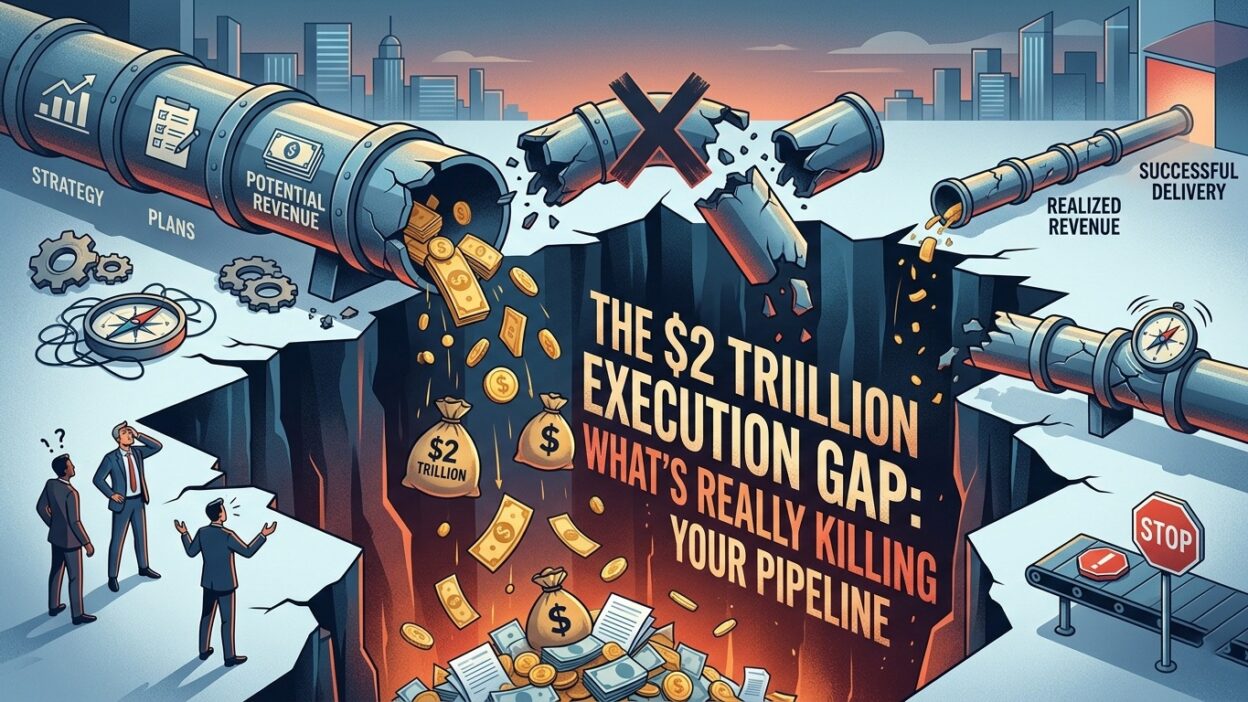
TL;DR Research firm McKinsey estimates that poor strategy execution costs global businesses over $2 trillion every year. That number is staggering. It is also believable to anyone who has ever watched a strong sales strategy produce a weak quarter. The strategy was right. The market was ready. The budget existed. Yet revenue did not follow. The execution gap swallowed it.
The execution gap is the distance between what a revenue team plans to do and what it actually does. It lives between the playbook and the rep’s daily behavior. It lives between the forecast and the final close rate. It lives between the onboarding plan and the actual customer outcome. This gap does not announce itself loudly. It erodes revenue quietly, deal by deal, week by week.
Most revenue leaders look for the problem in the wrong places. They adjust the territory plan. They revisit the ICP. They hire a new sales director. These moves rarely fix the real issue. The real issue is execution. Specifically, the consistent failure to execute the right activities at the right time across the entire revenue team.
This blog breaks down why the execution gap exists, how it shows up in your pipeline, and what high-performing organizations do to close it permanently.
Table of Contents
What the Execution Gap Actually Means for Revenue Teams
The execution gap is not a vague concept. It shows up in very specific ways inside every revenue organization. A rep skips a discovery question that would have uncovered the real pain. A manager misses a coaching moment that would have changed a rep’s behavior. A deal goes dark because no one sent the right follow-up at the right time. Each of these moments is a small execution failure. Multiplied across a team of 50 reps over a full quarter, the revenue impact is enormous.
Most organizations measure outcomes — win rates, quota attainment, pipeline coverage. They rarely measure the behaviors that produce those outcomes. This measurement gap makes the execution gap invisible until it shows up as a missed number. By that point, the quarter is over and the damage is done.
Closing the execution gap requires measuring what happens before the outcome. Call quality, next-step clarity, stakeholder coverage, deal stage accuracy — these are the behavioral signals that predict revenue. When organizations track these signals consistently, they see the execution gap emerging in real time. They can intervene before the quarter is lost.
The execution gap also compounds over time. A rep who consistently under-executes on discovery calls never builds the skill to run great enterprise deals. A manager who skips pipeline reviews loses visibility into risk until it is too late. Poor habits calcify. Weak performance becomes the baseline. The gap widens quarter by quarter until it defines the organization’s ceiling.
High-performing revenue organizations treat execution as a discipline. They define what good looks like for every role and every deal stage. They measure it. They coach to it. They make it the central conversation in every team meeting. The execution gap shrinks when execution becomes intentional rather than assumed.
The Real Reasons the Execution Gap Exists
The execution gap does not exist because reps are lazy or managers are incompetent. It exists because of structural failures that most organizations never address directly. Understanding these root causes is the only path to closing the gap for real.
No Shared Definition of Good Execution
Ask ten reps at the same company what a great discovery call looks like. You will get ten different answers. This inconsistency is the foundation of the execution gap. When good execution means something different to every person on the team, you cannot coach it, measure it, or replicate it. The execution gap grows directly from this ambiguity.
High-performing teams define great execution with precision. They document what questions to ask. They specify what outcomes each call should produce. They create a shared language for deal quality. This shared definition becomes the foundation for coaching, enablement, and performance management.
Playbooks That Live in Slide Decks Instead of Daily Work
Every sales organization has a playbook. Most of those playbooks sit in a folder that reps open twice — during onboarding and never again. A playbook that does not integrate into daily rep behavior does not reduce the execution gap. It decorates it.
Effective playbooks are embedded in the tools reps use every day. They surface at the moment of need. A rep opens an account with a new enterprise prospect and the playbook appears automatically. The next recommended action is right there. The relevant talk track is one click away. Execution becomes easy because the guidance is immediate.
Coaching That Reacts Instead of Predicts
Most sales coaching happens after something goes wrong. A deal is lost. A call goes badly. A forecast miss forces a conversation. Reactive coaching is better than no coaching but it consistently arrives too late. The execution gap widens in the space between the mistake and the correction.
Predictive coaching uses behavioral data to identify execution problems before they cost deals. When a rep stops multi-threading on enterprise accounts, a manager sees the signal immediately. When a rep’s discovery call scores drop two weeks in a row, a coaching conversation happens in week three — not after the next lost deal. The execution gap narrows dramatically when coaching becomes proactive rather than reactive.
Misaligned Incentives Across the Revenue Team
Sales incentivizes new logo acquisition. Customer success incentivizes renewal rates. Marketing incentivizes lead volume. None of these incentives directly reward execution quality. Reps rush deals to close because the incentive structure rewards speed over thoroughness. The execution gap grows in this rush. Deals close with unresolved objections. Customers onboard without full alignment. Churn follows.
Aligning incentives around execution quality — not just outcomes — changes team behavior fundamentally. When reps earn recognition for pipeline accuracy, discovery depth, and stakeholder coverage, they begin executing those behaviors consistently.
How the Execution Gap Shows Up Differently at Each Deal Stage
The execution gap is not uniform. It shows up differently depending on where a deal sits in the pipeline. Identifying it by stage makes it much easier to address with precision.
Top of Funnel: The Prospecting Execution Gap
At the top of the funnel, the execution gap looks like inconsistent outreach volume, poor personalization, and weak call-to-action discipline. Reps know they should send personalized sequences. They do it sometimes. They know they should follow up seven times before disqualifying a prospect. They follow up three times and give up. The execution gap at this stage shows up as a leaky pipeline that requires constant refilling.
Fixing this requires sequence enforcement with built-in accountability. When a rep’s sequence gaps are visible to managers in real time, behavior changes. When the system prompts the next touch instead of relying on rep memory, consistency improves across the entire team.
Mid-Funnel: The Discovery and Qualification Execution Gap
The execution gap hits hardest in the middle of the funnel. Discovery calls are where deals are truly won or lost. A rep who skips MEDDIC qualification criteria pushes unqualified deals into late stages. A rep who fails to uncover the real economic driver never builds a compelling business case. The pipeline inflates. The close rate collapses.
Mid-funnel execution gaps are the most expensive. They waste engineering resources on demos that should never happen. They consume legal time on contracts for deals that were never real. They skew the forecast and erode leader trust. Fixing this stage of the execution gap has the single biggest impact on revenue efficiency.
Late-Stage: The Closing Execution Gap
At the late stage, the execution gap shows up as stalled deals, missed follow-through, and champion neglect. A rep closes a great final presentation but fails to send the mutual success plan within 24 hours. Momentum dies. The buyer’s attention moves elsewhere. The deal slips to next quarter. This pattern is one of the most common and most preventable expressions of the execution gap.
Late-stage deals require precise task execution under time pressure. Automated reminders, deal scorecards, and manager check-ins at specified intervals keep closing execution tight. The deals that close on time are almost always the ones where every next step is clear and every commitment is tracked.
The Technology Trap That Widens the Execution Gap
Most organizations respond to the execution gap by buying more technology. A new CRM. A new sales engagement platform. A new conversation intelligence tool. Each purchase makes logical sense. Together, they often make the execution gap worse.
Technology fragmentation creates a new form of the execution gap. Reps switch between five tools to complete a single workflow. Data lives in different systems. Handoffs break. The playbook is in one tool. The contact is in another. The email history is in a third. Reps spend more time navigating their stack than executing their process.
The execution gap shrinks when technology consolidates rather than fragments. A single workspace where reps access account intelligence, execute next steps, track deal progress, and receive coaching guidance in one place removes the friction that kills execution. Technology should make great execution the path of least resistance. When it does the opposite, it becomes a core driver of the execution gap.
Revenue leaders must audit their technology stack through the lens of execution. Does each tool make it easier or harder for a rep to execute the right behavior at the right time? Tools that add complexity without adding execution clarity are widening the execution gap, regardless of their feature set.
What Closing the Execution Gap Actually Looks Like in Practice
Closing the execution gap is not a one-time project. It is a management discipline that requires consistent attention across the entire revenue organization. The organizations that close the execution gap share several specific practices.
Execution Scorecards at the Deal Level
Every active deal gets a scorecard. The scorecard tracks behavioral indicators — number of stakeholders engaged, recency of last meaningful interaction, completeness of qualification criteria, clarity of next steps. Managers review these scorecards weekly. Deals with low execution scores get immediate attention. The execution gap becomes visible before it costs revenue.
Deal scorecards shift the management conversation from gut feel to data. Managers stop asking ‘how do you feel about this deal?’ and start asking ‘why is multi-threading incomplete?’ This shift produces more useful coaching and more accurate forecasting simultaneously.
Weekly Execution Reviews Alongside Pipeline Reviews
Most organizations hold weekly pipeline reviews. Few hold weekly execution reviews. Adding an execution review as a standing agenda item changes the team’s relationship with process. Reps report on what they did this week, not just what deals moved. Managers coach on behavior, not just outcome. The execution gap shrinks because execution gets the same leadership attention as revenue.
Rep-Level Execution Benchmarks Based on Top Performers
High-performing organizations study what their best reps do differently. They measure call frequency, email quality, follow-up speed, and discovery thoroughness for top performers. They set those behaviors as the benchmark for the entire team. New reps see exactly what execution looks like at the highest level. Coaching targets specific behavioral gaps rather than generic improvement goals. The execution gap narrows because the standard is visible and concrete.
The Leadership Behaviors That Drive Execution Gap Reduction
The execution gap is a leadership problem as much as it is a rep problem. The behaviors at the top of the organization set the tone for execution quality throughout.
Leaders who communicate strategy clearly and repeatedly reduce ambiguity. When every rep understands the ICP, the value proposition, and the priority deals at any given moment, execution aligns naturally. Execution gaps often grow from strategic confusion at the rep level. Clear and consistent leadership communication closes this source of the gap directly.
Leaders who model execution discipline set the standard. A VP who runs a tight pipeline review shows managers what rigor looks like. A CRO who holds precise weekly forecasts teaches the team that accuracy matters. Leadership behavior cascades downward. The execution gap is smaller in organizations where leaders at every level demonstrate the behaviors they expect from their teams.
Leaders who invest in enablement rather than just technology close the execution gap sustainably. Training, coaching frameworks, playbook maintenance, and sales methodology reinforcement all require ongoing investment. Organizations that treat enablement as a one-time onboarding activity watch the execution gap widen as the market changes and rep knowledge calcifies.
The most important leadership behavior for closing the execution gap is patience. Network effects from great execution take time to show up in revenue. Leaders who stay committed to execution discipline through tough quarters build the organizations that compound performance year over year.
Frequently Asked Questions About the Execution Gap
What is the execution gap in sales and why does it matter?
The execution gap is the measurable difference between the revenue strategy a team designs and the revenue results it actually delivers. It matters because it is the primary reason high-quality strategies produce disappointing results. A brilliant GTM plan executed poorly will always underperform a simpler plan executed consistently well. Organizations that close the execution gap outperform peers with better strategies but weaker execution disciplines.
How do you measure the execution gap in your organization?
Measuring the execution gap starts with defining behavioral benchmarks for each role and each deal stage. Then you measure actual behavior against those benchmarks consistently. Call quality scores, discovery completeness rates, multi-threading depth, next-step specificity, and follow-up speed are all measurable behavioral proxies for execution quality. Comparing these metrics to outcome metrics like win rate and cycle length reveals where the execution gap costs the most revenue.
Can the execution gap be closed with better sales training?
Training helps but it rarely closes the execution gap on its own. Most training events produce a short-term behavior change that fades within 30 days without reinforcement. Closing the execution gap requires ongoing coaching, embedded playbooks, execution accountability in management conversations, and technology that makes good execution the easiest path for reps. Training is one input. Sustained behavior change requires the full system.
How does the execution gap affect revenue forecasting?
The execution gap corrupts forecasting in two specific ways. First, deals in the pipeline are often less qualified than they appear because reps did not complete proper discovery. Second, late-stage deals stall because closing execution is inconsistent. Both problems inflate the forecast with deals that are not actually close to closing. Closing the execution gap produces cleaner pipeline, more accurate stage progression, and forecasts that leaders can trust.
What is the fastest way to start closing the execution gap?
The fastest path to closing the execution gap is creating immediate behavioral visibility for managers. Deploy deal scorecards or execution dashboards that show rep behavior in real time. Hold one weekly execution review alongside the existing pipeline review. Start coaching on behaviors, not just outcomes. These three moves create accountability and visibility almost immediately. Revenue impact typically follows within one to two quarters of consistent application.
Building a Culture That Refuses to Accept the Execution Gap
Culture is where the execution gap either gets closed or gets normalized. Organizations that tolerate inconsistent execution at the top of the culture will see it replicated at every level below. Organizations that celebrate execution discipline create the conditions for compounding performance.
Building an execution-first culture starts with language. Leaders who talk about execution as seriously as they talk about revenue send a clear signal. When the weekly all-hands celebrates a rep for excellent discovery quality alongside a rep for a big close, execution becomes a visible organizational value. Reps learn what the organization actually rewards.
Peer accountability accelerates culture change faster than top-down mandates. When high-performing reps share their execution practices in team forums, peers naturally adopt similar behaviors. When managers discuss execution quality in public settings, not just in private coaching sessions, the standard becomes shared rather than individual.
Organizations that document and distribute best execution practices create institutional memory. The execution gap widens every time a top performer leaves and takes their knowledge with them. Capturing great execution in documented playbooks, recorded call libraries, and coaching frameworks makes excellence portable. The execution gap shrinks because knowledge stops being locked in individual heads.
Read More:-GLM-5.1: Architecture, Benchmarks, Capabilities & How to Use It
Conclusion

The $2 trillion execution gap is not a fixed cost of doing business. It is a solvable problem. Revenue teams that close the execution gap consistently outperform their markets, their competitors, and their own historical benchmarks. They do it not by working harder but by working with more precision, more accountability, and more behavioral clarity.
Closing the execution gap requires honesty first. Most organizations prefer to believe their strategy is flawed rather than their execution. Strategy changes are exciting. Execution fixes are unglamorous. But the revenue impact of great execution dwarfs the impact of another strategy pivot.
Define what great execution looks like for every role. Measure it with the same rigor applied to revenue outcomes. Coach to it every week. Embed it in your technology stack. Celebrate it publicly. These behaviors close the execution gap with compounding returns over time.
Your pipeline does not fail because your market is wrong or your product is weak. Your pipeline fails because the execution gap eats the opportunities that good strategy creates. Close the execution gap and the pipeline follows. Every quarter. Every year. Without exception.