TL;DR Every revenue leader is talking about AI right now. Boards want AI strategy. VCs fund AI-native startups. Marketing teams publish AI roadmaps. Sales organizations buy AI tools with real urgency. Yet the AI sales results most companies expected are not materializing. Win rates stay flat. Pipeline coverage stays thin. Quota attainment hovers in the same disappointing range it occupied before the AI investment.
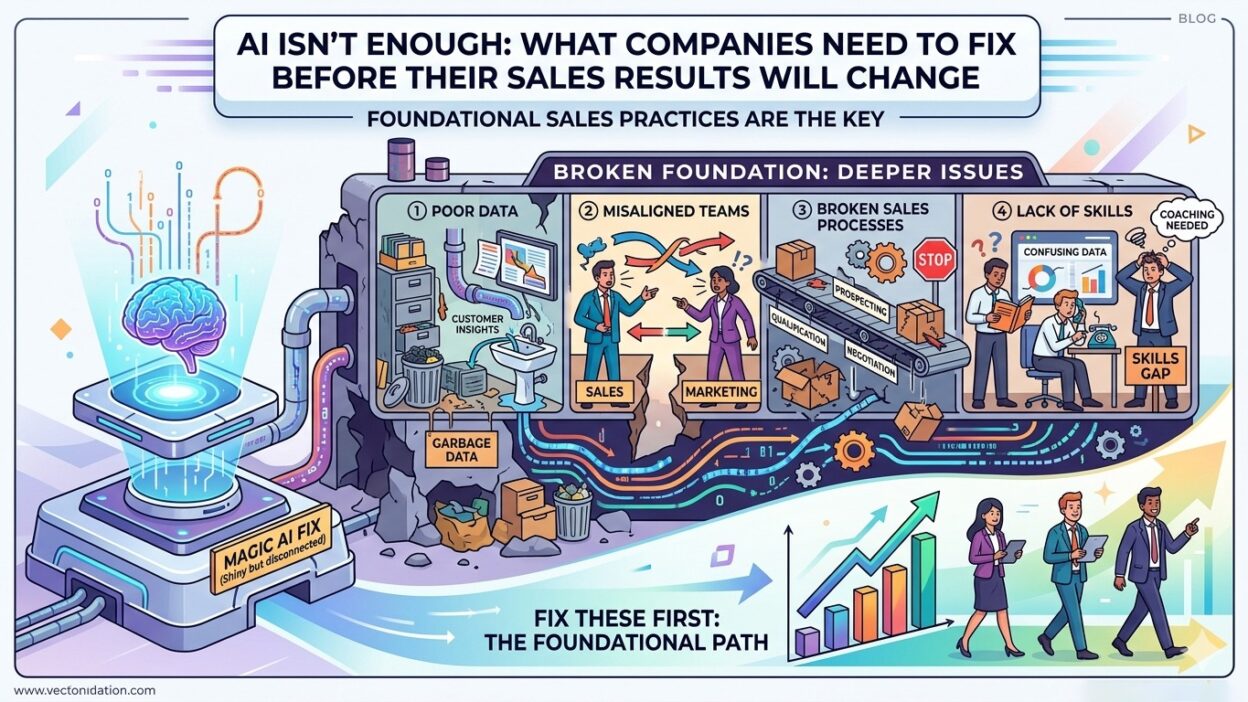
This is not an AI problem. AI is a powerful force multiplier. The issue is that force multipliers amplify whatever they touch. When AI enters a broken sales system, it accelerates the brokenness. When AI enters a well-designed sales system, it accelerates performance. Most companies are discovering this the hard way.
The gap between AI investment and AI sales results exists because organizations skip the foundational work. They buy the tool before they fix the process. They deploy the technology before they clean the data. They add AI to a team that has never had a shared definition of great execution. The tool cannot save what the foundation does not support.
This blog examines exactly what companies need to fix before AI can deliver the sales results they paid for. Each section addresses a specific foundational failure and offers a clear path to correcting it.
Table of Contents
Why AI Investment Rarely Delivers Immediate AI Sales Results
Companies spend heavily on AI sales tools expecting rapid transformation. They get modest incremental improvement at best and no measurable change at worst. This outcome frustrates leaders and breeds skepticism about AI as a category. The skepticism is misplaced. The expectations are the real problem.
AI sales results do not arrive automatically after deployment. They arrive after the conditions for AI to work are properly established. Think of AI as a high-performance engine. A high-performance engine in a car with flat tires and dirty fuel delivers a disappointing ride. Fix the tires. Clean the fuel. Now the engine performs. The same logic applies to AI in a revenue organization.
Most organizations have three structural problems that prevent AI from delivering strong AI sales results. First, the data feeding the AI is incomplete, inconsistent, or simply wrong. Second, the processes the AI should optimize are not actually defined with enough clarity to be optimized. Third, the people using AI tools have not changed their core behaviors or accountability structures. Technology layered on top of these three problems does not fix them. It just makes them slightly more visible.
The organizations that report strong AI sales results share a common pattern. They invested in process clarity and data quality before deploying AI tools. They defined what great looked like before asking AI to help replicate it. They built accountability structures before asking AI to measure adherence. AI then had something solid to work with and it delivered.
Revenue leaders who expect AI sales results without foundational preparation are not wrong to want those results. They are simply wrong about the sequence. Fix the foundation first. Then deploy AI. The results follow reliably when the order is right.
The Data Problem That Quietly Poisons AI Sales Results
AI runs on data. This is not a metaphor. Every AI recommendation, prediction, and insight is only as good as the data that trained and feeds it. Most CRM data is a mess. Fields are empty. Stages are wrong. Contact records are outdated. Activity logging is inconsistent. This data reality is the single biggest reason AI sales results disappoint.
A rep who does not log call notes leaves the AI with no information about what happened in a conversation. A manager who never updates deal stages leaves the AI guessing about pipeline health. An SDR who uses personal email outside the CRM leaves the AI with an incomplete picture of buyer engagement. Every data gap creates an AI blind spot. Enough blind spots and the AI stops being useful.
CRM Hygiene Is Not a Nice-to-Have
Organizations that want real AI sales results must treat CRM hygiene as a revenue discipline, not an administrative chore. Every missing field costs the AI accuracy. Every inconsistent stage definition costs the AI predictive power. Every unlogged activity costs the AI behavioral context. These costs accumulate silently and show up as AI recommendations that do not match reality.
Fixing CRM hygiene requires structural changes, not just reminders. Required fields with clear definitions. Stage gates with specific criteria. Activity logging enforced through process, not willpower. When data quality becomes a management priority with real accountability attached, AI sales results improve almost immediately because the AI now has accurate input to work with.
First-Party Signals Beat Third-Party Intent Data
Many organizations invest heavily in third-party intent data to feed their AI tools. Intent data has value but it cannot replace the first-party behavioral signals that live inside your own systems. Email response rates, call sentiment, content engagement, meeting frequency, and stakeholder progression all produce the richest signals for AI to interpret.
Building strong first-party signal capture infrastructure is one of the highest-return investments a revenue organization can make before deploying AI. When AI tools feed on rich, accurate first-party data, their AI sales results recommendations become genuinely actionable rather than generically directional.
Process Clarity: What AI Cannot Fix Without It
AI optimizes processes. It cannot create them. When a sales process is undefined, inconsistently followed, or understood differently by each rep, AI has no coherent process to optimize. It produces recommendations that contradict each other because the underlying process is itself contradictory. AI sales results depend entirely on process clarity that exists before the AI arrives.
Undefined Stages Create AI Hallucinations in the Pipeline
Many organizations have pipeline stages with names but not definitions. Discovery means one thing to a rep in the Northeast and something different to a rep in the Midwest. Proposal means submitted to one manager and accepted by another. This definitional chaos makes AI pipeline analysis unreliable. The AI assigns probabilities to stages that do not consistently represent the same buyer behavior. AI sales results from this environment are directionally wrong more often than organizations realize.
Fixing stage definitions is straightforward work. Document exactly what buyer behavior must occur for a deal to enter each stage. Require evidence of that behavior before stage advancement. Train every rep on the definitions until they are consistent. Now the AI has a coherent pipeline model to analyze and the accuracy of its AI sales results recommendations rises sharply.
Sales Methodology Must Precede AI Deployment
AI can reinforce a sales methodology powerfully. It can surface missing qualification criteria, flag incomplete discovery, and remind reps of methodology steps at deal-specific moments. But the methodology must exist and be consistently used before AI adds this value. Organizations that deploy AI without a working sales methodology discover that AI simply automates random behavior at slightly higher speed.
Choose a methodology that fits your market and deal complexity. MEDDIC, SPIN, Challenger, or any other framework works when it is genuinely embedded in how your team sells. Once it is embedded, AI can measure adherence to it, coach deviations from it, and predict outcomes based on it. Methodology first. AI second. AI sales results follow this sequence, not the reverse.
Handoff Protocols Determine Where Pipeline Leaks
The handoff from SDR to AE. The handoff from AE to customer success. Both are critical execution moments. Both are frequently broken. AI tools that analyze pipeline health cannot compensate for handoffs that transfer incomplete context, miscommunicated commitments, or cold relationships. Fixing handoff protocols before deploying AI ensures the AI sees complete deal narratives rather than fragmented stories that began mid-chapter.
People and Behavior: The Layer AI Cannot Replace
Technology purchases are easier than behavior change. This is why companies buy AI tools before they address the human behaviors that determine sales outcomes. AI sales results depend on the humans who use the AI tools. A rep who ignores AI recommendations. A manager who never reviews AI-generated coaching insights. An enablement team that deploys AI training without changing the surrounding accountability structure. These human failures make the AI investment worthless.
Rep Adoption Is Not Automatic
AI tools sit unused inside revenue organizations at a startling rate. Reps find workarounds. They trust their intuition over AI recommendations. They log minimum required data and ignore the rest of the platform. This adoption failure is not a technology problem. It is a change management problem.
Organizations that drive strong AI sales results invest heavily in adoption before measuring outcomes. They explain why the AI exists and what it helps reps accomplish specifically. They share early wins from reps who used AI recommendations and closed deals faster. They make AI tool usage part of the management conversation rather than an optional extra. Adoption follows culture. Culture follows leadership. Leadership must model and reinforce AI usage before reps follow.
Managers Must Coach Differently with AI Data
AI gives managers more behavioral data about their reps than ever existed before. Call analysis, email quality scores, deal health indicators, engagement signals — all of this arrives in dashboards that most managers do not know how to use yet. Having the data is not the same as coaching from it.
Training managers to coach with AI data is a precondition for meaningful AI sales results. A manager who can look at a rep’s call analysis and identify a specific discovery weakness, then coach that weakness with a targeted conversation and a follow-up recording, multiplies the value of every AI insight. Without this coaching skill, the data sits in dashboards and does nothing.
Accountability Structures Must Match AI Capabilities
AI creates visibility. Visibility only changes behavior when accountability structures back it up. If a rep knows that AI flags their incomplete qualification and also knows that no manager will act on that flag, the flag changes nothing. Organizations that achieve strong AI sales results build accountability loops around AI insights. Managers review AI findings weekly. Underperformance flagged by AI gets addressed in specific coaching conversations. Patterns identified by AI inform territory and quota decisions. The AI visibility becomes real consequence and real improvement.
The Enablement Gap That Blocks AI Sales Results
Enablement is where AI has enormous untapped potential. AI can personalize training, surface relevant content at the moment of need, analyze skill gaps at the individual rep level, and connect coaching insights to specific behavior patterns. Most organizations use a fraction of this capability because their enablement infrastructure is not ready for it.
Effective AI-powered enablement requires a content library that is organized, current, and tagged consistently. A library of 2,000 sales assets with inconsistent naming and no metadata gives AI nothing useful to surface. The AI cannot recommend the right case study for a specific industry at a specific deal stage if the case study is not tagged with industry and deal stage information. Cleaning and organizing the content library is unglamorous work. It is also a direct prerequisite for AI sales results in enablement.
Skill gap identification is another area where AI can transform enablement but only if baseline performance data is available. AI needs historical call recordings, assessment results, and outcome data to identify which skills correlate with revenue for a specific team in a specific market. Organizations without this baseline data cannot benefit from AI skill analysis because the AI has no training signal to learn from.
The organizations that see the strongest AI sales results from their enablement programs are the ones that invested 12 to 18 months in building their foundational content and performance data infrastructure before layering AI on top. The investment looks slow at first. The compounding returns become dramatic once the AI has quality data to work with.
Building the Right Foundation for AI Sales Results in 90 Days
Fixing everything before deploying AI feels overwhelming. It does not need to be. A focused 90-day foundation sprint addresses the most critical gaps and positions the AI tools already in place to deliver real AI sales results within the next quarter.
Days 1–30: Data and Process Audit
Spend the first 30 days understanding the current state honestly. Pull CRM field completion rates across the team. Identify which stages have clear definitions and which do not. Map the actual handoff process from SDR to AE to customer success. Document what the current sales methodology says versus what reps actually do in the field. This audit surfaces the specific gaps that are costing you AI sales results right now.
Days 31–60: Fix the Highest-Impact Gaps
Use the audit findings to prioritize the three or four fixes with the biggest potential impact on data quality and process clarity. Update stage definitions and hold a calibration session with the full team. Require three specific CRM fields that the audit found were consistently empty. Run a methodology refresher focused on the qualification gaps the audit identified. These fixes do not require months. They require decision and execution.
Days 61–90: Rebuild Accountability Around AI Insights
In the final 30 days, restructure the weekly management cadence to include AI insight review. Train managers on how to read AI dashboards and convert insights into specific coaching conversations. Share the first examples of AI recommendations that drove improved outcomes. Make AI adoption visible and celebrated. By day 90, the foundation is solid enough for AI tools to begin delivering the AI sales results the organization invested in.
Frequently Asked Questions About AI Sales Results
Why are our AI sales results not matching what vendors promised?
Vendor promises for AI sales results assume that your data is clean, your processes are defined, and your team uses the tool consistently. Most organizations do not meet these three assumptions at deployment. The result is AI working with incomplete data on undefined processes used by a team with inconsistent habits. The gap between the vendor’s promised outcome and your actual AI sales results reflects the gap between their assumptions and your current reality. Close the assumption gap and the AI sales results follow.
How long does it take to see real AI sales results after fixing the foundation?
Most organizations see meaningful AI sales results within one to two quarters after fixing their core data and process gaps. The timeline depends on how broken the foundation was and how aggressively the fixes get implemented. Organizations that treat foundation work as a sprint rather than a slow multi-year project consistently report faster AI sales results improvement. The connection between foundation quality and AI performance is direct and measurable.
Do smaller sales teams benefit from AI as much as enterprise teams?
Small teams benefit differently but just as significantly. Enterprise teams use AI primarily for scale — consistent execution across large rep populations. Small teams use AI for leverage — a team of 10 reps gaining the analytical power of a dedicated operations team. The foundational requirements are the same regardless of team size. Clean data. Clear process. Accountable behavior. Small teams that meet these requirements see strong AI sales results because the signal-to-noise ratio in smaller datasets is actually easier to manage.
Can AI replace sales managers in coaching roles?
AI cannot replace the human judgment, relationship trust, and situational wisdom that great sales managers provide. AI dramatically enhances coaching by giving managers better data, clearer behavioral signals, and more specific coaching targets. The best AI sales results in coaching come from managers who use AI insights to make their human coaching more precise, not from organizations that try to eliminate the manager layer. AI and human coaching are complementary, not competitive.
What AI tools actually drive the best sales results when the foundation is solid?
Conversation intelligence platforms produce strong AI sales results when reps have clear methodology to adhere to, because the AI can measure adherence precisely. Revenue intelligence platforms produce strong AI sales results when CRM data is clean, because the AI can identify real patterns rather than data artifacts. AI-powered forecasting produces strong AI sales results when stage definitions are consistent, because the AI can assign accurate probabilities. The right tool depends on your specific gap — which is why the foundation audit always comes first.
What the Best AI Sales Results Actually Look Like
Suggested Word Count: 260–300 words
Organizations that get the foundation right and deploy AI deliberately report very specific improvements. Ramp time for new reps drops by 30 to 50 percent when AI delivers personalized coaching based on actual call performance rather than generic training modules. Pipeline accuracy improves when AI flags qualification gaps before deals enter late stages with unresolved uncertainty.
Win rate improvements become measurable when AI identifies the specific behaviors that top performers use in winning deals and helps the entire team replicate those behaviors consistently. Forecast accuracy reaches a level where leaders can make real resource allocation decisions based on pipeline data rather than gut feel.
Customer success outcomes improve when AI identifies early risk signals in onboarding behavior and allows customer success managers to intervene before churn becomes likely. The AI sales results extend across the entire revenue organization, not just the top-of-funnel acquisition motion.
These outcomes are real. They are documented in organizations across industries and company sizes. They share one common prerequisite. The foundation was solid before the AI was deployed. The data was clean. The process was clear. The people were accountable. The AI had something excellent to amplify and it delivered.
Read More:-Deploying Large Language Models in Production: LLMOps with MLflow
Conclusion

AI is not the problem. AI is a powerful capability that most revenue organizations are not yet equipped to use effectively. The gap between AI investment and actual AI sales results is a foundation gap. Data quality, process clarity, behavior change, and management accountability must all come first.
This sequence feels counterintuitive when a board is asking about the AI strategy and vendors are promising immediate transformation. The pressure to show AI sales results fast pushes organizations to skip the preparation that makes results possible. Resist that pressure. The organizations that skip preparation deploy AI into dysfunction and confirm the skeptics’ belief that AI is overhyped.
The organizations that do the foundational work first and deploy AI second consistently report the AI sales results that make the investment worthwhile. Better forecasts. Faster ramp. Higher win rates. Shorter sales cycles. Cleaner pipelines. These outcomes are not hypothetical. They are what AI delivers when the foundation supports it.
Your AI tools are ready to perform. The question is whether your organization is ready to let them. Fix the data. Define the process. Build the accountability. Train the managers. Then turn the AI on fully and measure what follows. The AI sales results you expected are still available. They are waiting on the other side of the foundational work you have been postponing.