Introduction
A CFO thinks in risk and return, not in product capability. This mindset shapes every conversation a rep has with finance from the very first meeting. Most sales training focuses on features, benefits, and use cases built for an operational buyer, not a financial one. That approach falls flat once a CFO enters the room. A CFO wants to know how a purchase affects cash flow, how it reduces risk, and how it compares against every other use of that same budget. Selling to the CFO means shifting the entire pitch away from product talk and toward financial impact instead. This shift feels uncomfortable for reps who built their whole career around demos and feature walkthroughs. The discomfort fades once a rep sees how much faster deals move when finance trusts the numbers on the table. A CFO who trusts the math becomes an internal advocate, pushing the deal forward through procurement far faster than a rep working alone ever could. This advocate role matters more than most reps realize. A CFO carries real weight in budget meetings, and a single sentence of support from finance often moves a stalled deal faster than another round of demos with the original champion. Reps who understand this dynamic stop treating the CFO conversation as a hurdle near the end of the deal. They start treating it as an opportunity to gain a second internal champion, one with direct control over the budget itself.
What the CFO Actually Cares About
Four things drive almost every decision a CFO makes: risk, return, cash flow, and accountability. Risk sits at the top of that list most of the time. A CFO wants to know what happens if a purchase fails to deliver, and how the company protects itself if that happens. Return matters just as much. A CFO wants a clear, defensible number showing what the company gets back for every dollar spent on the purchase. Cash flow shapes timing decisions heavily, since a CFO cares deeply about when money leaves the business and when value starts coming back in return. Accountability closes the loop. A CFO wants to know who owns the outcome internally and how the company measures success after the deal closes, not just before it. Reps who sell to the CFO successfully build their entire pitch around these four pillars instead of leading with product depth or a long feature list nobody in finance asked to see. These four pillars rarely carry equal weight in every deal. A company facing tight cash flow weighs timing far more heavily than a company sitting on strong reserves. A company under board pressure to cut risk weighs accountability more heavily than a company focused purely on growth at any cost. Reading which pillar matters most in a specific situation takes practice, but it separates reps who close finance-heavy deals from reps who struggle every time a CFO enters the room.
How to Sell to the CFO: A Step-by-Step Guide
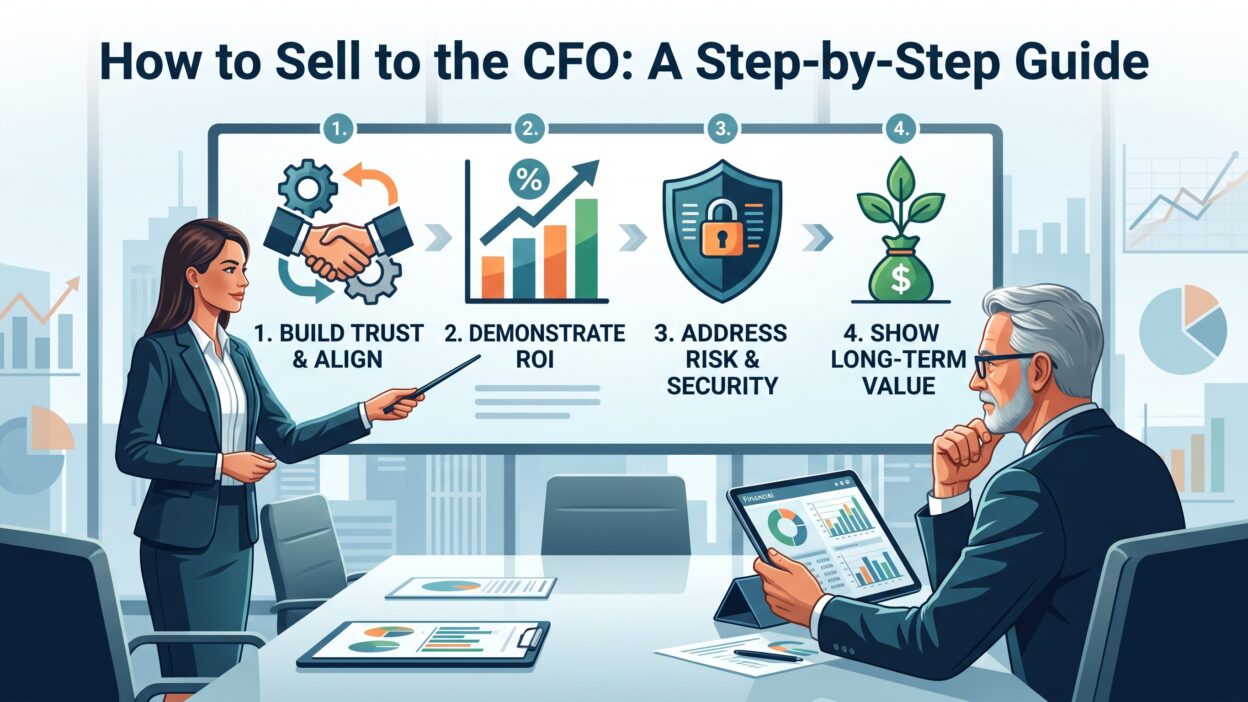
Each step below builds on the one before it. Skipping a step early often causes trouble later in the deal, once finance starts asking harder questions. Follow this sequence closely for the strongest result with any finance stakeholder.
Step 1: Research the CFO’s Priorities Before the Call
Every CFO operates under different pressure depending on the company’s stage and industry. A CFO at a fast-growing startup often cares most about runway and burn rate. A CFO at a mature company often cares more about margin and operational efficiency. Reps who sell to the CFO effectively research this context before the first meeting instead of walking in blind. Public earnings calls, investor updates, and recent press coverage all reveal what a CFO currently worries about. This research shapes the entire pitch, letting a rep speak directly to the pressure that CFO feels right now rather than a generic pitch built for any buyer. A rep who references a specific initiative mentioned in a recent earnings call earns instant credibility, since it shows real preparation instead of a copy-paste pitch delivered to every prospect the same way. LinkedIn posts from the CFO themselves often reveal even more than a formal earnings call, since executives frequently share personal views on industry trends or company direction in that space. A rep who spends thirty minutes on this research before a first meeting walks in with a real edge over a rep who shows up with only a generic slide deck built for any buyer at any company.
Step 2: Build a Business Case Around ROI
A CFO expects a clear return on investment before approving any meaningful spend. Reps who sell to the CFO successfully build this case early, well before the final negotiation stage arrives. The business case needs real numbers pulled from the prospect’s own data whenever possible, not generic industry averages borrowed from a slide deck. A strong case shows cost savings, revenue growth, or time savings translated into dollars, laid out clearly across a realistic timeline. Vague claims like “improves efficiency” carry no weight in front of finance. Specific numbers like “saves forty hours a month across a twelve-person team” carry real weight because a CFO can verify and defend that number internally. Building this case takes extra work upfront, but it pays off heavily once the deal reaches finance for final approval. A strong business case also survives internal scrutiny after the rep leaves the room. Finance often shares this document with other stakeholders who never sat through the original pitch, so the numbers need to hold up on their own without a rep present to explain the context behind each figure.
Step 3: Speak in Numbers, Not Features
Product depth impresses an operational buyer but rarely moves a CFO forward on its own. A CFO wants to hear numbers: cost, savings, payback period, and margin impact stated plainly. Reps who sell to the CFO learn to translate every feature into a financial outcome before the meeting even starts. Instead of describing a new dashboard, a strong rep describes the hours it saves and the dollar value tied to that time. Instead of describing automation, a strong rep describes the reduction in error rate and the cost that reduction avoids down the line. This translation takes practice, since most reps default to product language out of habit built over years of demos. A short written cheat sheet, converting each major feature into a financial statement, helps reps stay consistent across different finance conversations.
Step 4: Involve Finance Early in the Deal
Many reps wait until the final stage to loop in finance, and that delay often kills momentum right when a deal should be closing. Reps who sell to the CFO successfully bring finance into the conversation early, sometimes even before the technical evaluation wraps up completely. Early involvement gives finance time to ask questions, request data, and build internal alignment without rushing under deadline pressure. A rushed finance review often ends in a stalled deal or a smaller initial deal scoped down to fit a tighter comfort level. Early involvement also signals confidence. A rep who welcomes finance scrutiny early looks far more trustworthy than a rep who avoids finance until the very last possible moment before signature. Bringing finance in early also helps a rep uncover budget constraints long before those constraints become a last-minute surprise near the close date. A CFO who feels included from the start tends to move faster through internal approval steps, since the review already started weeks before the formal request landed on their desk.
Step 5: Address Risk and Compliance Upfront
A CFO thinks about downside before upside, almost every single time. Reps who sell to the CFO address risk directly instead of waiting for finance to raise it first during a tense call. This means covering data security, contract terms, and what happens if the product underperforms against the numbers promised earlier in the pitch. Reps should bring case studies and reference customers ready to speak to real outcomes, since third-party proof reduces perceived risk far more than a rep’s own claims ever could. Compliance questions deserve straight answers, not deflection toward another team or a vague promise to follow up later. A CFO who feels risk got addressed honestly moves forward with far more confidence than one left wondering what a rep avoided mentioning on purpose.
Step 6: Bring a Clear Total Cost of Ownership
Sticker price rarely tells the full financial story a CFO needs to see. Reps who sell to the CFO bring a complete total cost of ownership, covering implementation, training, ongoing fees, and any hidden costs tied to the purchase. A CFO who discovers a hidden cost after signing loses trust fast, and that lost trust follows a rep into every future renewal conversation. Transparency here builds long-term credibility that pays off well beyond the first deal. A clear cost breakdown also helps a CFO compare the purchase fairly against other options competing for the same budget line. Reps who hide costs to make a number look smaller usually lose that advantage the moment finance digs into the real contract terms during review. A well-built cost breakdown also protects the rep during renewal conversations a year later. A CFO who remembers an honest first conversation approaches the renewal with far less suspicion than a CFO who felt blindsided by a surprise fee buried somewhere in the fine print.
Step 7: Handle Budget Objections With Data
Budget objections come up constantly in CFO conversations, and most reps handle them poorly with vague reassurance instead of real evidence. Reps who sell to the CFO handle these objections with data pulled directly from the business case built earlier in the process. Instead of discounting the price immediately, a strong rep reframes the conversation around payback period and total return. A CFO often accepts a higher price when the return clearly outweighs the cost within an acceptable timeframe. Reps should also come prepared with flexible payment structures, since a CFO focused on cash flow sometimes needs a different payment schedule rather than a lower total price. This flexibility often closes a deal that a flat discount alone never would have moved forward.
Step 8: Close With a Clear Financial Outcome
The close should tie directly back to the numbers discussed throughout the entire process. Reps who sell to the CFO end the conversation by restating the expected return, the payback timeline, and the specific metric the company will track after the purchase goes live. This clarity gives the CFO something concrete to report upward to a board or an executive team who was not part of the original conversation. A vague close leaves a CFO without the ammunition needed to defend the purchase internally after the deal closes. A sharp close, backed by real numbers stated clearly, gives the CFO exactly what they need to champion the deal through the rest of the approval chain without hesitation. This final step also sets up a smoother renewal down the road. When the agreed metric gets tracked and reported back to the CFO after implementation, the next conversation starts from a position of proof rather than a fresh pitch built entirely from scratch.
Common Mistakes Reps Make When They Sell to the CFO
Many reps carry over habits built for other buyers, and those habits backfire badly in front of finance. One common mistake involves leading with a product demo instead of a business case. A CFO rarely cares about a screen full of features before understanding the financial impact behind them. Another mistake involves vague numbers pulled from a generic case study instead of numbers grounded in the prospect’s own data. A CFO spots weak math instantly and loses confidence in the entire pitch once one number falls apart under scrutiny. Reps also often avoid tough risk questions instead of addressing them directly, which reads as evasive rather than careful. Silence around risk raises more suspicion than an honest, direct answer ever would. Another frequent error involves waiting too long to involve finance, treating the CFO conversation as an afterthought near the end of the deal. This delay often forces a rushed review that hurts deal size and slows the timeline considerably. Reps who sell to the CFO successfully avoid all of these habits by treating finance as a core stakeholder from the very first conversation, not a final checkbox before signature. One more mistake deserves mention here. Some reps assume every CFO thinks the same way and use one identical pitch across every finance conversation they run. This assumption ignores real differences between industries, company stages, and individual priorities, and it shows the moment a CFO asks a question the generic pitch never anticipated.
Tools and Resources That Help Reps Sell to the CFO
A few resources make this entire process much easier to execute consistently. An ROI calculator, built around the prospect’s own numbers, turns an abstract pitch into a concrete financial case a CFO can review independently. Case studies from similar companies, ideally in the same industry or at a similar size, give a CFO third-party proof beyond a rep’s own claims. A one-page financial summary, covering cost, return, and payback period, gives a CFO something easy to forward internally without needing to summarize a long deck themselves. CRM data also helps here, surfacing past deals where finance played a heavy role, letting a rep study what worked in similar situations before walking into a new one. Reps who sell to the CFO regularly build a personal library of these resources over time, refining each one based on which numbers actually land well in real conversations with real finance leaders. A short reference sheet mapping common CFO objections to proven responses also saves real time during live calls. Instead of improvising an answer under pressure, a rep can pull from a tested response built from real deals that actually closed in the past.
FAQs
How do you sell to the CFO without a deep finance background? Focus on clear numbers rather than finance jargon. A CFO respects a simple, accurate case built around cost, return, and payback period far more than a rep trying to sound like a finance expert without the real experience behind it.
When should a rep bring the CFO into a deal? Early involvement works best. Bringing finance in during the evaluation stage, rather than right before signature, gives the CFO time to ask questions without pressure and reduces the risk of a stalled deal near the finish line.
What documents help most when reps sell to the CFO? A one-page ROI summary, a total cost of ownership breakdown, and a few relevant case studies cover most of what a CFO needs to move a deal forward through internal approval.
How does selling to the CFO differ from selling to other buyers? A CFO focuses on financial outcomes rather than product depth. The pitch needs to translate every feature into cost, savings, or risk reduction instead of leading with functionality alone.
What is the biggest mistake reps make with CFO conversations? Leading with a product demo instead of a business case ranks as the most common mistake. A CFO wants financial context first and product detail only after the numbers make sense.
How do reps handle budget pushback from a CFO? Reframe the conversation around payback period and total return instead of discounting immediately. A CFO often accepts a higher price when the return clearly justifies the cost within a reasonable timeframe.
Does deal size change how reps sell to the CFO? Larger deals usually pull the CFO in earlier and demand a more detailed business case. Smaller deals may only need a quick payback calculation, but the same core principles around risk, return, and clarity still apply either way.
Read More:-Track Commissions with QuotaPath HubSpot Integration [2026]
Conclusion

Selling to the CFO rewards preparation, clarity, and honest numbers over charm and a polished demo. The eight steps in this guide, from early research through a numbers-driven close, give any rep a real framework to follow instead of guessing how a finance conversation should unfold. A CFO wants risk addressed directly, return proven clearly, and accountability defined before signing anything. Reps who build this discipline into every finance conversation close bigger deals and close them faster than reps who treat the CFO like just another stakeholder in a long list of approvals. Start with one upcoming deal that involves finance. Build the business case early, translate every feature into a number, and bring risk into the conversation before finance raises it first. Selling to the CFO gets easier with repetition, and the reps who commit to this approach consistently become the reps finance leaders trust with the next deal too. Finance remembers a rep who brought clear numbers and honest answers, and that memory carries forward into every future renewal and every future referral inside the same company.