Introduction
TL;DR A practitioner’s guide to building, tuning, and validating evaluation frameworks that go beyond generic cross-entropy — using custom loss functions that actually match your task objectives.
Table of Contents
Why Standard Loss Functions Fall Short
Most deep learning tutorials begin with cross-entropy loss. Cross-entropy is a solid default. It works well for balanced classification tasks. It is differentiable, numerically stable, and widely supported. But the real world is not a tutorial dataset. Real problems have class imbalance, asymmetric error costs, and business constraints that generic loss functions ignore entirely.
A fraud detection model penalizes a missed fraud the same way it penalizes a false alarm. A medical imaging model treats every pixel equally. A demand forecasting model does not distinguish between overstock and stockout. These gaps cause real damage in production. The solution is not to add more layers or more data. The solution is to use custom loss functions that encode what your task actually requires.
Custom loss functions let you express business logic mathematically. They give the optimizer a precise target. They close the gap between what the model minimizes and what the product actually needs. This blog covers how to design them well, how to evaluate them rigorously, and how to pair them with calibration metrics that reveal whether your model’s confidence is trustworthy.
~40%Production gap vs. accuracy
3×Cost diff: FP vs. FN in fraud
ECEPrimary calibration metric
<0.05Target ECE for clinical AI
Foundations of Custom Loss Function Design
Before writing a single line of loss code, you need clarity on three things. What does a bad prediction cost? Are errors symmetric? What constraints exist at inference time?
Start with Task Objectives, Not Math
A well-designed custom loss function starts as a plain-language statement. Write down the cost of each type of error in business terms first. A false negative in a loan default model means an unrecovered loan. A false positive means a declined customer. Those costs are not equal. Your custom loss function must reflect that asymmetry from the start.
Only after writing the cost statement should you look for a mathematical form. The math should serve the problem statement. Working in the other direction — picking a formula and hoping it fits — produces models that optimize well on paper and fail in deployment.
Differentiability Requirements
Every custom loss function used during gradient-based training must be differentiable almost everywhere. This rules out step functions and hard thresholds directly. You can approximate them. The hinge loss approximates a threshold. The sigmoid approximates a step. Smooth surrogates are the standard tool for encoding non-differentiable objectives. Understanding which approximation works for your task is fundamental to loss design.
Numerical Stability Matters More Than You Think
A loss function that produces NaN on edge cases will silently corrupt training runs. Always add epsilon terms inside logarithms. Clamp inputs to softmax or sigmoid before computing the loss. Use log-sum-exp tricks when combining exponentials. Numerical instability in custom loss functions is one of the most common causes of mysterious training failures. Write unit tests for your loss on boundary inputs before training anything.
Design Principle
A good custom loss function passes three tests. It is differentiable. It behaves correctly on boundary inputs. And its minimum corresponds exactly to the outcome you want the model to produce in production.
Types of Custom Loss Functions in Practice
The landscape of custom loss functions is broad. Practitioners in different domains reach for different tools. Here are the most impactful categories and when to use each one.
Imbalanced Classification
Focal Loss
Focal loss addresses class imbalance by down-weighting easy examples dynamically. Standard cross-entropy assigns equal weight to every sample. Easy negatives — those the model already classifies confidently — dominate the gradient and prevent learning on hard positives. Focal loss adds a modulating factor that reduces the loss for well-classified examples. The model spends its capacity on the cases that actually matter. This custom loss function was introduced in the RetinaNet paper and has since become standard for detection tasks with severe imbalance.
Segmentation
Dice Loss and Tversky Loss
Binary cross-entropy on segmentation masks punishes every pixel equally. For tasks where the target region is small — tumor segmentation, crack detection, road marking extraction — the background dominates the loss and the model learns to predict mostly background. Dice loss optimizes the overlap coefficient directly. Tversky loss generalizes Dice with separate weights for false positives and false negatives. When false negatives carry a higher cost than false positives, Tversky loss is the right custom loss function to reach for.
Regression
Quantile Loss and Pinball Loss
Mean squared error assumes errors are symmetric. Quantile loss relaxes that assumption. It penalizes over-predictions and under-predictions with different weights depending on the target quantile. Predicting the 90th quantile means the model pays more for under-predictions. Predicting the 10th quantile means the model pays more for over-predictions. Supply chain and pricing models use quantile loss as their primary custom loss function because asymmetric cost is the norm, not the exception.
Ranking
Pairwise and Listwise Ranking Losses
Recommendation and search systems do not care about absolute scores. They care about ordering. A model that assigns score 0.9 to a relevant item and 0.4 to an irrelevant item produces the same ranking as one that assigns 0.6 and 0.1. Pairwise losses like RankNet and BPR optimize the relative ordering of item pairs. Listwise losses like LambdaLoss optimize ranking metrics like NDCG directly. For ranking problems, any pointwise custom loss function will underperform a ranking-aware one.
High-Stakes Classification
Cost-Sensitive Loss
Cost-sensitive loss encodes a cost matrix directly into the training objective. You define the cost of each type of misclassification. The loss penalizes expensive errors proportionally. A model trained with cost-sensitive loss learns to be conservative on high-cost errors. Medical diagnosis, credit scoring, and safety-critical monitoring all benefit from this approach. The custom loss function becomes a direct translation of the domain’s error cost structure.
Python — Focal Loss (PyTorch)import torch import torch.nn.functional as F def focal_loss(logits, targets, gamma=2.0, alpha=0.25): # Stable BCE base bce = F.binary_cross_entropy_with_logits( logits, targets, reduction='none' ) probs = torch.sigmoid(logits) pt = targets * probs + (1 - targets) * (1 - probs) alpha_t = targets * alpha + (1 - targets) * (1 - alpha) loss = alpha_t * ((1 - pt) ** gamma) * bce return loss.mean()
Calibration Metrics Every Engineer Needs
A model can achieve high accuracy while being poorly calibrated. Calibration measures whether predicted probabilities match observed frequencies. A well-calibrated model that predicts 80% confidence should be correct roughly 80% of the time. Most models trained with standard or custom loss functions are overconfident. Neural networks are especially prone to this.
Expected Calibration Error (ECE)
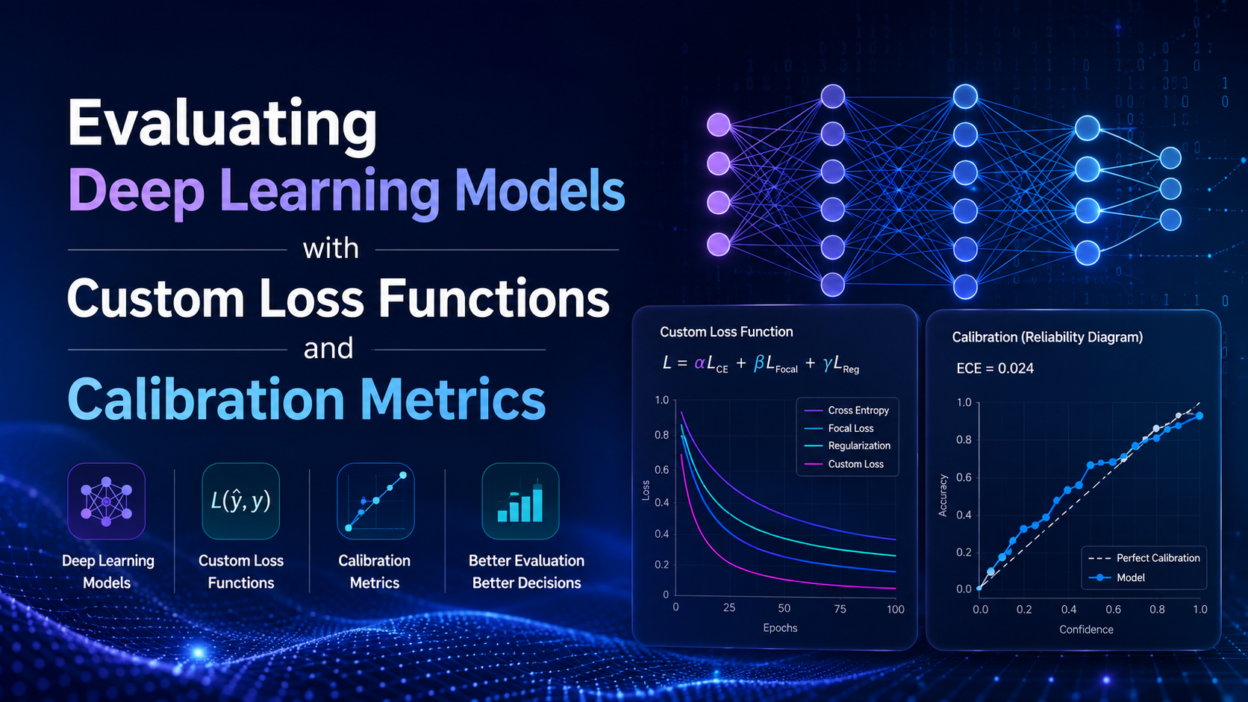
ECE is the most widely used calibration metric. It bins predictions by confidence level and measures the average gap between confidence and accuracy across bins. A perfectly calibrated model has ECE of zero. Clinical AI standards often require ECE below 0.05. ECE is straightforward to compute and easy to explain to non-technical stakeholders. Every team using custom loss functions should track ECE alongside accuracy.
Reliability Diagrams
Reliability diagrams plot predicted confidence on the x-axis and actual accuracy on the y-axis. A perfectly calibrated model falls on the diagonal. Points above the diagonal mean the model is underconfident. Points below mean overconfidence. Reliability diagrams make calibration problems visible at a glance. They also reveal whether miscalibration is uniform or concentrated in specific confidence regions. Generating reliability diagrams is a good habit after any training run that uses custom loss functions.
Maximum Calibration Error (MCE)
MCE captures the worst-case calibration gap across all bins. ECE averages across the distribution. MCE identifies the worst single bin. Safety-critical applications care deeply about MCE. A medical model that is well-calibrated on average but severely miscalibrated in the high-confidence region is dangerous. Use MCE alongside ECE when the cost of overconfident errors is high.
Negative Log-Likelihood as a Calibration Proxy
NLL captures both discrimination and calibration simultaneously. A model with high accuracy but poor calibration will have a worse NLL than a model with equal accuracy and good calibration. NLL is a useful single-number summary. It penalizes confident wrong predictions heavily. Teams evaluating custom loss functions on probabilistic tasks should include NLL in their evaluation suite.
Brier Score
The Brier score is the mean squared error of probability predictions. It decomposes into reliability, resolution, and uncertainty components. The reliability component measures calibration. The resolution component measures discrimination. Decomposing the Brier score helps diagnose whether a model’s weakness lies in calibration or in its ability to separate classes. Both custom loss functions and post-hoc calibration methods affect the reliability component directly.
“Accuracy tells you how often your model is right. Calibration tells you whether to trust it when it says it is confident.”
✦ ✦ ✦
Implementing and Debugging Custom Loss Functions
Writing a custom loss function is only half the work. Making sure it behaves correctly takes equal care. Bugs in loss code are particularly dangerous because they often produce plausible-looking training curves while silently optimizing the wrong objective.
Gradient Checking
Gradient checking compares analytical gradients from autograd with numerical gradients computed by finite differences. Any mismatch signals a bug. PyTorch provides torch.autograd.gradcheck for this purpose. Run gradient checks on every new custom loss function before using it in a full training run. This single step catches the majority of implementation errors.
Sanity Checks on Toy Data
Create a small synthetic dataset where the correct answer is known. Train a model with your custom loss function on this dataset and verify it converges to the expected solution. If the loss is asymmetric, verify that the model learns the asymmetry correctly. If the loss includes a weighting term, verify the weights are applied to the right examples. Do not skip this step even when the loss looks straightforward.
Loss Landscape Visualization
Plot the loss value as a function of model output for a range of inputs and targets. The shape of the loss surface reveals whether the gradients are well-behaved across the full range. A loss that produces very large gradients near zero predictions or very flat gradients near correct predictions will cause training instability. Visualizing the loss landscape before training is a cheap form of insurance.
Python — Tversky Loss (PyTorch)def tversky_loss(pred, target, alpha=0.7, beta=0.3, eps=1e-6): # alpha weights FN, beta weights FP pred = torch.sigmoid(pred) tp = (pred * target).sum(dim=[2, 3]) fp = (pred * (1 - target)).sum(dim=[2, 3]) fn = ((1 - pred) * target).sum(dim=[2, 3]) tversky = (tp + eps) / (tp + alpha * fn + beta * fp + eps) return (1 - tversky).mean()
Monitoring Loss Components Separately
Compound custom loss functions often combine multiple terms — a task loss, a regularization term, and possibly an auxiliary objective. Log each component separately during training. A combined loss that moves in the right direction can mask one component exploding and another collapsing. Monitoring components individually makes it easy to identify which term causes instability.
✦ ✦ ✦
Combining Custom Loss Functions with Calibration
Many custom loss functions improve discrimination while degrading calibration. Focal loss is a well-documented example. The down-weighting of easy examples shifts the model toward higher confidence on hard examples. The model becomes better at ranking but worse at producing calibrated probabilities. This is an acceptable trade-off in some applications and unacceptable in others.
Post-Hoc Calibration Methods
Temperature scaling is the simplest and most effective post-hoc calibration method. A single scalar temperature parameter is learned on a validation set after training. The temperature divides the logits before the softmax. Temperatures above 1.0 soften the distribution. Temperatures below 1.0 sharpen it. Temperature scaling does not change accuracy. It only adjusts confidence. For any model trained with a custom loss function that produces overconfident outputs, temperature scaling is the first tool to apply.
Isotonic regression and Platt scaling are alternatives for cases where temperature scaling is insufficient. Both fit a transformation to the model’s output distribution using held-out data. They are more flexible than temperature scaling but require more calibration data to fit reliably. The right choice depends on how severe and how structured the miscalibration is.
Calibration-Aware Loss Functions
Some applications cannot separate training and calibration into two stages. Online learning systems, streaming models, and models that update continuously require calibration-aware custom loss functions. One approach adds a calibration penalty term directly to the training loss. The penalty measures the ECE on the current batch and adds it to the task loss with a tunable weight. This keeps the model calibrated throughout training rather than fixing calibration after the fact.
Practical Tip
Always evaluate calibration on the test set, not the validation set used for temperature scaling. Post-hoc calibration methods can overfit to the validation distribution. A separate held-out test set gives an honest estimate of calibration quality in deployment.
Tracking Calibration Across Data Slices
Aggregate ECE can hide slice-level calibration failures. A model with good overall ECE can be severely miscalibrated on minority subgroups. Compute calibration metrics separately for each major demographic slice, data source, and prediction confidence region. Models trained with custom loss functions that up-weight certain examples can improve aggregate performance while making calibration worse on the groups they de-emphasize. Slice-level calibration monitoring catches these failures before they cause harm in production.
Common Mistakes to Avoid
Experience with custom loss functions across different domains reveals a consistent set of mistakes. Most are not conceptual errors. They are implementation and evaluation discipline failures.
Tuning Loss Hyperparameters on the Test Set
Focal loss has a gamma parameter. Tversky loss has alpha and beta parameters. These hyperparameters need tuning. Teams sometimes tune them by evaluating downstream performance on the test set. This produces optimistic results that do not generalize. Always use a separate validation set for loss hyperparameter tuning. Reserve the test set for final evaluation only.
Ignoring the Interaction Between Loss and Architecture
A custom loss function interacts with every other component of the training pipeline. Batch normalization, dropout, and output activation functions all affect the loss landscape. Changing the loss function often requires revisiting these choices. A sigmoid output paired with a loss that expects logits will produce incorrect gradients. Always verify that the output layer and the loss function are compatible.
Treating Loss as a Substitute for Evaluation Metrics
Low training loss does not mean good product performance. Custom loss functions approximate business objectives. They are not identical to them. Always evaluate final models on the actual business metric — precision at a specific recall target, revenue impact, user satisfaction score — in addition to the training loss. The loss guides training. The business metric determines deployment decisions.
Skipping Ablations on Loss Components
A compound loss with three terms requires ablation studies to understand which term contributes what. Removing one term at a time and measuring the impact on validation metrics tells you whether each component earns its place. Teams that skip ablations often carry unnecessary loss complexity into production. Simpler custom loss functions are easier to debug, faster to compute, and more likely to generalize.
Frequently Asked Questions
What are custom loss functions and when do you need them?
Custom loss functions are task-specific training objectives that replace or augment generic losses like cross-entropy or MSE. You need them when the cost of different types of errors is not equal, when your task involves ranking or structured prediction, or when standard losses produce models that optimize a metric no one actually cares about in production.
How do custom loss functions affect model calibration?
Most custom loss functions that improve discrimination also degrade calibration to some degree. Focal loss is the classic example. The fix is to apply post-hoc calibration after training or to include a calibration penalty term in the loss itself. Always measure ECE after switching to any non-standard loss function.
Can I use custom loss functions with pre-trained models?
Yes. Custom loss functions apply during fine-tuning regardless of how the base model was pre-trained. The pre-trained weights provide a starting point. Fine-tuning with a task-specific loss shapes the model toward your objective. The learning rate for fine-tuning with a custom loss should generally be lower than for pre-training to avoid destabilizing the learned representations.
What is the difference between ECE and MCE?
ECE is the weighted average calibration error across all confidence bins. MCE is the maximum calibration error in any single bin. ECE gives a global picture. MCE reveals the worst-case failure. Safety-critical applications should track both. A low ECE with a high MCE means the model is well-calibrated overall but dangerously miscalibrated at specific confidence levels.
How many hyperparameters should a custom loss function have?
As few as possible. Every hyperparameter in a custom loss function requires tuning and introduces a risk of overfitting to the validation set. Start with the simplest form that captures the core asymmetry or constraint you need. Add parameters only when ablation studies show they produce meaningful improvements on held-out data.
Are custom loss functions worth the engineering effort?
For production systems with clear asymmetric error costs, yes. The engineering overhead of a well-designed custom loss function is typically days, not weeks. The performance gains on the metrics that matter in deployment often exceed what architecture changes or additional data would achieve. The key is starting from a clear problem statement, not from mathematical curiosity.
Read More:-Why I Switched to JSON Prompting and Why You Should Too
Conclusion

Generic loss functions get models off the ground. Custom loss functions get them into production. The gap between a model that performs well on standard benchmarks and a model that delivers real value in deployment often comes down to how precisely the training objective matches the task.
The principles are consistent across domains. Start with a plain-language cost statement. Translate it into a differentiable mathematical form. Verify implementation with gradient checks and toy data. Monitor loss components separately during training. And always pair your custom loss function with calibration metrics that reveal whether the model’s confidence signals are trustworthy.
Calibration is not a post-hoc concern. It belongs in the evaluation framework from day one. ECE, reliability diagrams, MCE, and Brier score each reveal different aspects of model quality. No single metric tells the full story. The combination of a well-designed custom loss function and a thorough calibration evaluation gives you a model you can actually trust in deployment — not just one that reports good numbers on a leaderboard.
The field is moving fast. New loss formulations appear regularly in the literature. The best practitioners are not those who know every formula. They are the ones who can read a problem statement, identify the right objective, and build the evaluation pipeline that proves the model does what it claims. That skill starts with understanding why custom loss functions matter and how to use them correctly.