Introduction: The Evolution of Business Operations
TL;DR Mid-size businesses face unique challenges in today’s competitive landscape. They possess the ambition of enterprise corporations but often lack unlimited resources. Manual processes drain time and energy from teams. Repetitive tasks consume valuable hours that could drive growth.
Intelligent automation workflow orchestration changes this dynamic completely. This technology connects disparate systems and automates complex processes across departments. It creates seamless operations that run with minimal human intervention.
Modern businesses can’t afford to operate with outdated methods. Customer expectations evolve rapidly. Competition intensifies daily. The pressure to do more with less never stops.
Intelligent automation workflow orchestration offers a solution that scales with your business. It doesn’t require massive IT investments. Implementation happens in stages. Results appear quickly.
This comprehensive guide explores how mid-size companies leverage this technology. You’ll discover practical applications across various departments. Real transformation begins when you understand the full potential of automated workflows.
Table of Contents
Understanding Intelligent Automation Workflow Orchestration
What Makes This Technology Different
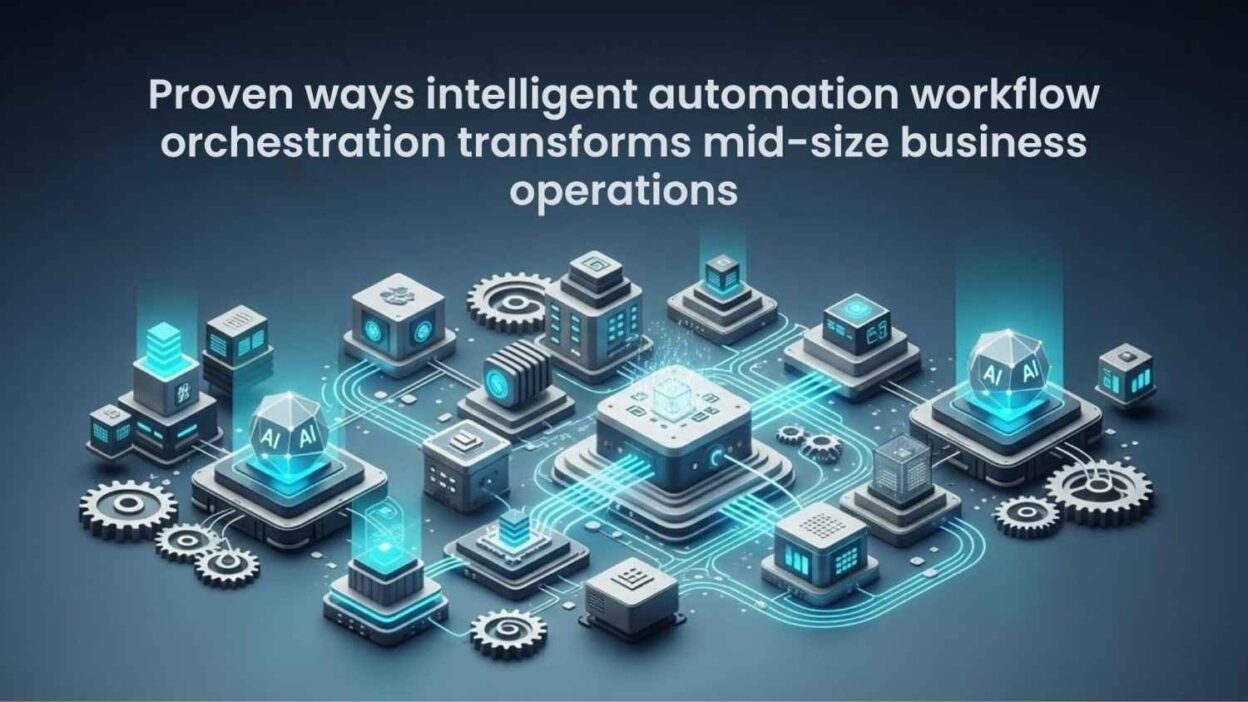
Traditional automation handles single tasks in isolation. Intelligent automation workflow orchestration coordinates multiple systems simultaneously. It creates end-to-end processes that span departments and platforms.
Think of it as a conductor leading an orchestra. Each instrument plays its part at precisely the right moment. The conductor ensures harmony throughout the performance. Similarly, orchestration ensures all automated elements work together seamlessly.
The intelligence component distinguishes modern solutions from basic automation. Machine learning algorithms adapt to changing conditions. Decision-making capabilities improve over time. The system learns from each transaction and interaction.
Core Components That Drive Value
Several elements combine to create effective intelligent automation workflow orchestration. Robotic Process Automation (RPA) handles repetitive digital tasks. Artificial intelligence adds decision-making capabilities. Integration platforms connect various software applications.
Data flows freely between systems without manual intervention. Information captured in one application triggers actions in another. Employees focus on strategic work rather than data entry. Errors decrease significantly when humans stop handling routine transfers.
Cloud infrastructure supports scalability and flexibility. Businesses add new workflows without purchasing additional hardware. Updates deploy automatically across the entire system. Maintenance requirements drop substantially compared to legacy systems.
Financial Operations: Where Numbers Meet Efficiency
Accounts Payable Transformation
Invoice processing consumes enormous time in traditional finance departments. Staff manually enter data from paper or PDF documents. They verify information against purchase orders. Approval routing happens through email chains.
Intelligent automation workflow orchestration revolutionizes this entire process. The system receives invoices through email or supplier portals. Optical Character Recognition (OCR) extracts relevant data automatically. Information validates against existing records in the ERP system.
Discrepancies flag for human review. Matching invoices route to appropriate approvers based on amount and department. Payment schedules optimize based on discount opportunities and cash flow. The entire cycle completes in hours instead of weeks.
Revenue Recognition and Reporting
Financial reporting demands accuracy and timeliness. Month-end closes stretch finance teams to their limits. Data gathering from multiple sources creates bottlenecks. Reconciliation processes uncover errors that require investigation.
Automated workflows pull data from all relevant systems continuously. Revenue recognition rules apply consistently across transactions. Accruals and deferrals calculate automatically. Reports generate with a single click.
Audit trails form automatically as transactions process. Compliance requirements are met without additional effort. Finance leaders access real-time dashboards showing current financial positions. Strategic planning improves with better data visibility.
Customer Service Excellence Through Automation
Request Management and Resolution
Customer inquiries arrive through multiple channels simultaneously. Email, chat, phone, and social media all demand attention. Manual routing causes delays and inconsistent experiences. Customers repeat information multiple times.
Intelligent automation workflow orchestration creates a unified customer service operation. All inquiries funnel into a central system automatically. Natural Language Processing analyzes content and intent. Requests route to the appropriate team based on complexity and expertise.
Simple questions receive instant automated responses. Complex issues escalate to skilled representatives with complete context. Customers never explain their situation multiple times. Response times drop dramatically while satisfaction scores climb.
Proactive Customer Engagement
Reactive customer service no longer suffices in competitive markets. Businesses must anticipate needs and reach out proactively. Manual monitoring of customer behavior proves impossible at scale.
Automated workflows monitor customer activity patterns continuously. They detect early warning signs of dissatisfaction or churn risk. The system triggers appropriate outreach at optimal times. Personalized messages reflect individual customer preferences and history.
Renewal processes begin automatically at strategic intervals. Upsell opportunities surface based on usage patterns. Customer success teams receive alerts about accounts requiring attention. Retention rates improve without expanding headcount.
Supply Chain Coordination and Visibility
Procurement Process Optimization
Purchasing involves numerous steps and multiple approvals. Requisitions require manager authorization. Vendor selection demands price comparisons. Purchase orders need creation and transmission. Receipt confirmation must match against orders.
Intelligent automation workflow orchestration streamlines this entire workflow. Employees submit requests through simple forms. The system checks inventory levels and existing contracts automatically. Preferred vendors receive requests for quotes simultaneously.
Comparison matrices generate based on predefined criteria. Approvals route based on business rules and spending thresholds. Purchase orders transmit directly to vendor systems. Receipt notifications trigger three-way matching and payment scheduling.
Inventory Management and Forecasting
Stock-outs cost revenue while excess inventory ties up capital. Manual tracking struggles to maintain optimal levels. Seasonal variations and demand fluctuations complicate planning.
Automated systems monitor inventory levels in real-time across all locations. Reorder points adjust based on sales velocity and lead times. The system considers promotions, seasonality, and market trends. Purchase requisitions generate automatically when thresholds are met.
Warehouse operations coordinate with procurement and sales automatically. Picking priorities adjust based on order urgency. Shipping notifications update customer records without manual entry. Returns processing triggers appropriate restocking or disposal workflows.
Human Resources: Empowering People Operations
Recruitment and Onboarding Excellence
Hiring processes involve numerous touchpoints and stakeholders. Resume screening consumes recruiter time. Interview scheduling requires complex coordination. Offer letters need approval and documentation. New hire setup spans multiple departments and systems.
Intelligent automation workflow orchestration transforms talent acquisition operations. Applicant tracking systems parse resumes and rank candidates automatically. Qualified candidates receive screening questionnaires via email. Responses score against role requirements.
Interview scheduling happens automatically based on interviewer availability. Feedback collection prompts send after each conversation. Hiring decisions trigger offer letter generation with approved templates. Background checks initiate without manual intervention.
Onboarding workflows activate upon offer acceptance. IT receives equipment requests automatically. Access provisioning happens across all necessary systems. Training schedules populate based on role and department. New employees feel welcomed and prepared from day one.
Performance Management and Development
Annual reviews create administrative burdens for managers and HR teams. Goal tracking happens in disconnected spreadsheets. Feedback gets lost in email threads. Development conversations lack structure and follow-through.
Automated workflows create continuous performance management systems. Goal-setting templates launch at appropriate intervals. Progress check-ins schedule automatically throughout the year. 360-degree feedback requests distribute to relevant stakeholders.
Development needs surface through skills assessments and performance data. Training recommendations match identified gaps with available resources. Career pathing discussions benefit from comprehensive historical data. Succession planning improves with better visibility into organizational capabilities.
Marketing Operations: Scaling Campaign Success
Lead Management and Nurturing
Marketing teams generate leads through various channels and campaigns. Manual qualification processes create delays. Lead routing depends on sales rep availability. Follow-up consistency varies by individual habits.
Intelligent automation workflow orchestration creates systematic lead management. Forms and landing pages capture prospect information automatically. Lead scoring algorithms evaluate quality based on demographic and behavioral data. High-value prospects route to sales immediately.
Mid-funnel leads enter nurture campaigns tailored to their interests. Content recommendations reflect browsing behavior and engagement history. Email sequences adjust based on recipient actions. Sales notifications trigger when prospects demonstrate purchase intent.
Campaign Execution and Optimization
Multi-channel campaigns require coordination across numerous platforms. Content needs scheduling across email, social media, and advertising channels. Performance tracking happens in disconnected systems. Results analysis delays optimization decisions.
Integrated workflows coordinate campaign elements across all channels. Content approvals route through stakeholders based on campaign type. Publishing schedules synchronize to maximize impact. Performance data consolidates in unified dashboards.
Budget pacing algorithms adjust spending to optimize results. Underperforming elements pause automatically. Successful tactics scale without manual intervention. Marketing teams focus on strategy and creativity rather than execution mechanics.
IT Operations: Infrastructure That Scales
System Monitoring and Incident Response
IT teams manage increasingly complex technology environments. Server health requires constant monitoring. Security threats demand immediate response. User issues need quick resolution.
Intelligent automation workflow orchestration strengthens IT operations significantly. Monitoring tools track system performance continuously. Anomalies trigger automated diagnostics and remediation attempts. Incidents that require human intervention create tickets automatically.
Severity assessments route issues to appropriate support tiers. Knowledge bases provide troubleshooting guidance to technicians. Resolution workflows document steps taken for future reference. Pattern recognition identifies recurring problems that need permanent fixes.
Access Management and Security
User access requests create security and compliance challenges. Provisioning delays frustrate new employees and role changes. Manual processes risk errors that create vulnerabilities. Deprovisioning often happens inconsistently during offboarding.
Automated workflows standardize access management completely. Role-based permissions deploy automatically upon hire or transfer. Manager approvals route based on access sensitivity. Audit logs capture all changes for compliance reporting.
Regular access reviews prompt managers to confirm continuing needs. Unused permissions revoke automatically. Departing employee offboarding triggers comprehensive access removal. Security posture strengthens without increasing IT workload.
Measuring Impact: Metrics That Matter
Productivity Gains Across Departments
Time savings represent the most immediate benefit of intelligent automation workflow orchestration. Employees reclaim hours previously spent on manual tasks. These hours redirect toward higher-value activities.
Track time-to-completion for key processes before and after automation. Document error rates and rework requirements. Measure employee satisfaction with new workflows. Calculate the cost per transaction as efficiency improves.
Financial Returns on Automation Investments
Mid-size businesses need clear ROI from technology investments. Labor cost reduction provides obvious savings. Error reduction prevents costly mistakes and rework. Faster cycle times improve cash flow and customer satisfaction.
Calculate direct cost savings from reduced manual effort. Quantify revenue gains from faster customer response and improved accuracy. Factor in compliance risk reduction and audit cost decreases. Consider competitive advantages from superior operational capabilities.
Customer retention rates often improve with better service delivery. Market expansion becomes feasible with scalable operations. Employee retention strengthens when people engage in meaningful work. These benefits compound over time as the system matures.
Implementation Strategies for Mid-Size Companies
Starting Small and Scaling Strategically
Intelligent automation workflow orchestration implementation doesn’t require massive upfront investment. Successful companies start with high-impact, low-complexity processes. Quick wins build organizational support and expertise.
Identify processes that consume significant time and involve multiple systems. Look for workflows with clear rules and minimal exceptions. Choose areas where stakeholders eagerly want improvement. Pilot projects should complete within three months maximum.
Document current state processes thoroughly before automation begins. Measure baseline metrics that will demonstrate improvement. Involve end-users in design to ensure practical solutions. Test extensively before rolling out to full user populations.
Building Internal Capabilities
Technology alone doesn’t guarantee success with automation initiatives. Organizations need people who understand both business processes and technical capabilities. Internal champions drive adoption and continuous improvement.
Designate process owners who take responsibility for workflow performance. Train business analysts in automation platforms and methodologies. Create centers of excellence that support departments seeking automation. Encourage experimentation and learning from failures.
Partner with vendors who provide strong training and support. Leverage consulting expertise during initial implementations. Transition to internal management as teams gain confidence. Build documentation and knowledge bases for ongoing reference.
Common Challenges and Solutions
Integration Complexity
Mid-size businesses often operate with diverse technology stacks. Legacy systems lack modern APIs. Custom applications require special handling. Integration challenges can derail automation projects.
Modern orchestration platforms offer pre-built connectors for popular business applications. API management layers simplify connections to custom systems. Screen scraping technologies handle legacy applications when necessary. Cloud integration platforms eliminate many traditional connectivity obstacles.
Change Management Resistance
Employees sometimes fear automation will eliminate their jobs. Existing processes have familiar comfort despite inefficiency. Learning new systems requires time and effort. Resistance can slow or prevent successful adoption.
Clear communication about automation goals proves essential. Emphasize how technology eliminates tedious work rather than jobs. Show how employees benefit from focusing on interesting challenges. Provide comprehensive training and ongoing support. Celebrate successes and share positive impacts broadly.
Future Trends in Workflow Orchestration
Artificial Intelligence Integration
Machine learning capabilities continue advancing rapidly. Pattern recognition improves with larger datasets. Natural language processing handles increasingly complex interactions. Predictive analytics anticipate needs before they arise.
Intelligent automation workflow orchestration will incorporate these AI capabilities more deeply. Workflows will adapt automatically to changing business conditions. Decision-making will improve through continuous learning. Exception handling will require less human intervention over time.
Low-Code and No-Code Solutions
Technical skills shouldn’t limit business process improvement. Modern platforms increasingly offer visual workflow builders. Drag-and-drop interfaces make automation accessible to business users. Pre-built templates accelerate deployment.
Mid-size companies particularly benefit from these accessible tools. IT departments can focus on infrastructure and integration. Business teams build and modify workflows meeting their specific needs. Innovation accelerates when more people participate in automation efforts.
Industry-Specific Applications
Manufacturing Operations
Production scheduling coordinates with material availability and customer orders. Quality control data triggers corrective actions automatically. Maintenance schedules adjust based on equipment sensor data. Supply chain visibility extends from raw materials to finished goods delivery.
Healthcare Administration
Patient intake processes gather information efficiently across systems. Insurance verification happens before appointments. Billing workflows ensure proper coding and timely submission. Compliance documentation generates automatically from treatment records.
Professional Services
Project initiation workflows activate resource allocation and planning. Time tracking integrates with billing and project management systems. Client communications maintain consistency across team members. Knowledge management captures insights from every engagement.
Frequently Asked Questions
How long does implementation typically take for a mid-size business?
Initial workflows often deploy within 60-90 days. The timeline depends on process complexity and integration requirements. Phased approaches deliver value quickly while building toward comprehensive automation. Most organizations see meaningful benefits within the first six months.
What investment level should mid-size companies expect?
Costs vary based on process scope and platform selection. Many solutions offer subscription pricing that scales with usage. Initial investments typically range from moderate five-figure to low six-figure amounts annually. ROI often materializes within the first year through efficiency gains.
Do we need dedicated IT staff to manage orchestration platforms?
Modern platforms designed for business users require minimal IT involvement. Technical support needs depend on integration complexity. Many companies succeed with existing staff after proper training. Vendor support and consulting services supplement internal capabilities.
How does this differ from simple automation tools?
Basic automation handles individual tasks in isolation. Intelligent automation workflow orchestration coordinates entire processes across multiple systems. It makes decisions based on data and conditions. Workflows adapt to exceptions and changing circumstances automatically.
Can we automate processes that involve human judgment?
Yes, through hybrid approaches combining automation with human decision points. Workflows route items requiring judgment to appropriate people. Context and relevant information present automatically. Decisions feed back into the workflow to continue processing.
Read More:-API Integration Mastery for Business Automation: From Legacy Systems to Modern Workflows in 2025
Conclusion: Transforming Operations Starts Today
Mid-size businesses stand at a critical juncture in their growth trajectory. Market demands increase while resource constraints persist. Traditional operational approaches can’t deliver the agility and efficiency modern competition requires.
Intelligent automation workflow orchestration provides the answer many organizations seek. It connects systems that previously operated in silos. Processes that once took days now complete in minutes. Employees redirect energy toward strategic initiatives that drive growth.
The technology has matured beyond early adoption risks. Proven platforms deliver reliable results across industries. Implementation approaches accommodate various budgets and timelines. Success stories demonstrate transformative potential for companies willing to embrace change.
Starting doesn’t require massive transformation initiatives. Identify one painful process that consumes excessive time. Automate that workflow and measure the results. Build on success by tackling additional opportunities. Momentum develops as benefits become visible across the organization.
Your competitors already explore these capabilities. Customer expectations continue rising. The gap between operational efficiency and market demands widens daily. Intelligent automation workflow orchestration bridges that gap effectively.
The question isn’t whether automation makes sense for mid-size businesses. Evidence overwhelmingly supports the value proposition. The real question involves when and how to begin the journey. Every day spent on manual processes represents missed opportunities.
Technology partners stand ready to guide implementation efforts. Platforms offer trial periods to demonstrate value before major commitments. Industry peers share experiences and best practices openly. Resources exist to support success at every stage.
Mid-size businesses possess distinct advantages in automation adoption. They have sufficient scale to justify investment but remain agile enough to implement quickly. Decision-making happens faster than in large enterprises. Benefits materialize throughout the organization rapidly.
Transform your operations by embracing intelligent automation workflow orchestration today. The path forward offers improved efficiency, enhanced customer satisfaction, and sustainable competitive advantage. Your team deserves freedom from tedious manual work. Your business deserves operations that scale effortlessly.
Take the first step now. Identify your highest-priority process pain point. Research platforms suited to your needs and budget. Connect with vendors offering demonstrations and proof-of-concept opportunities. Your transformed operations await just beyond that initial decision.
The future belongs to businesses that leverage technology strategically. Intelligent automation workflow orchestration represents one of the most impactful technologies available today. Mid-size companies implementing these solutions position themselves for sustained success. The transformation begins the moment you decide to move forward.