Introduction
TL;DR Business automation transforms organizations in 2025. Your systems need to communicate seamlessly. Data silos create inefficiencies and errors. Manual processes drain resources unnecessarily. APIs solve these fundamental problems. API integration for business automation connects disparate systems effortlessly.
Modern enterprises run on connected software ecosystems. Your CRM talks to marketing platforms. Accounting systems sync with e-commerce stores. Customer data flows between departments automatically. This connectivity drives competitive advantages. Companies mastering integration outperform their competitors consistently.
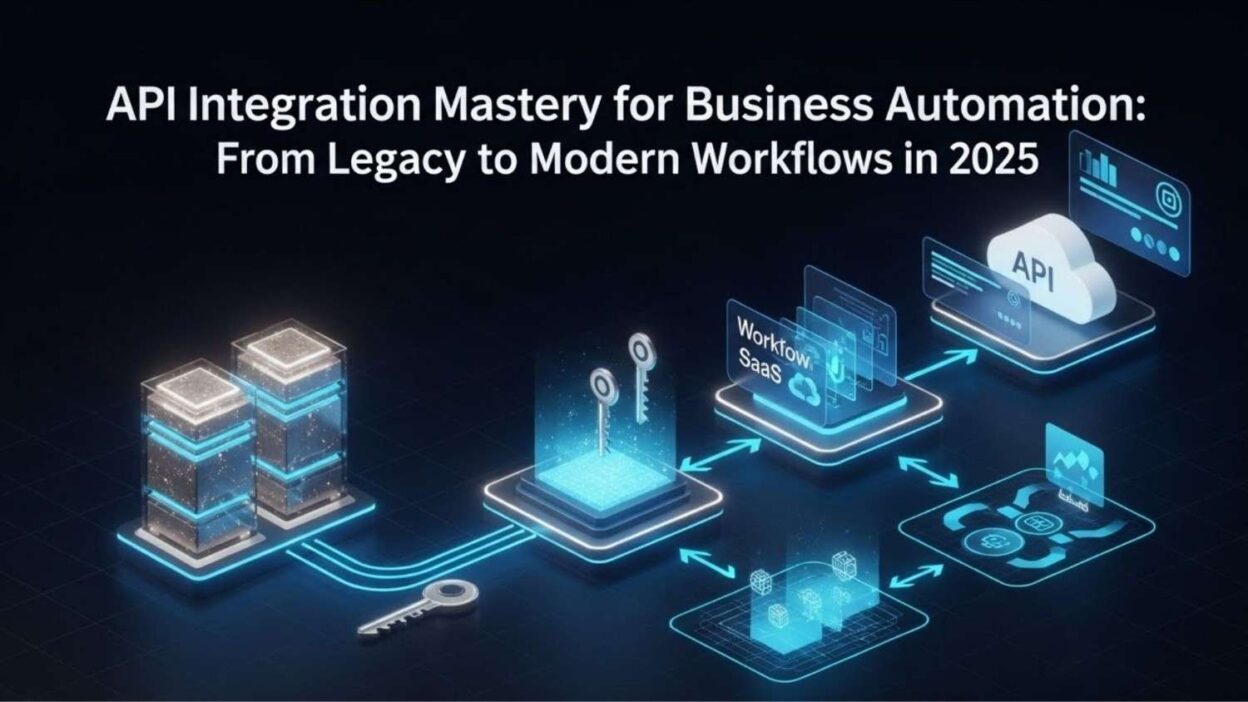
Legacy systems present unique challenges. Your organization invested millions in existing infrastructure. Replacing everything seems impossible financially. Integration bridges old and new technology. The right approach preserves investments while enabling modernization. This guide reveals proven strategies for success.
Table of Contents
Understanding API Integration for Business Automation
Application Programming Interfaces enable software communication. Your systems exchange data through standardized protocols. APIs define how applications request and receive information. Think of them as digital translators between platforms. Business automation depends entirely on these connections.
RESTful APIs dominate modern integration landscapes. Your web-based services use REST principles extensively. JSON format structures data exchanges. HTTP methods define action types. GET retrieves information. POST creates new records. PUT updates existing data. DELETE removes records. These simple verbs power complex workflows.
SOAP APIs serve enterprise environments still. Your legacy systems often require SOAP connections. XML formatting structures these messages. WSDL documents define service contracts. Security features exceed REST capabilities. Industries with strict compliance favor SOAP. Banking and healthcare rely heavily on these protocols.
GraphQL emerged as a flexible alternative. Your applications request exactly needed data. Over-fetching disappears completely. Under-fetching problems vanish. Single endpoints serve multiple needs. Facebook created GraphQL originally. Adoption accelerated across industries rapidly.
Webhooks enable real-time notifications. Your systems push data when events occur. Polling becomes unnecessary completely. Efficiency increases dramatically. Order confirmations trigger instantly. Inventory updates happen immediately. Event-driven architecture relies on webhooks.
Authentication mechanisms protect API access. Your systems verify identity before exchanging data. API keys provide basic security. OAuth 2.0 offers robust authorization. JWT tokens enable stateless authentication. Security layers prevent unauthorized access. Proper authentication protects sensitive information.
Rate limiting controls API usage. Your service providers prevent abuse. Request quotas maintain system stability. Throttling protects infrastructure performance. Understanding limits guides architecture decisions. Exceeding limits causes failures. Planning accounts for restrictions.
The Business Case for API Integration
Manual data entry costs businesses billions annually. Your staff copies information between systems. Errors occur frequently during transfer. Time wastes on repetitive tasks. API integration for business automation eliminates this waste entirely. Automated data flows maintain accuracy consistently.
Real-time synchronization improves decision-making dramatically. Your executives access current information. Sales data updates instantly. Inventory levels reflect reality. Customer interactions appear immediately. Business intelligence becomes truly real-time. Strategic decisions improve with better data.
Customer experience improves through integration. Your clients receive consistent information everywhere. Account details match across channels. Order history appears in support conversations. Personalization becomes possible at scale. Satisfaction scores increase measurably. Loyalty grows with seamless experiences.
Operational costs decrease substantially. Your IT maintenance burden reduces. Fewer manual processes need support. Error correction demands less time. Staff focuses on strategic work. Productivity multiplies across departments. Bottom-line impact appears quickly.
Scalability becomes inherent in operations. Your business growth doesn’t require proportional staffing. Systems handle increased volume automatically. Geographic expansion happens faster. New markets open with less friction. Technology enables rather than constrains growth.
Competitive advantages emerge clearly. Your response times exceed competitors. Innovation speed accelerates dramatically. Market opportunities get captured faster. Agility defines modern business success. Integration enables organizational nimbleness.
Compliance and audit trails improve. Your automated systems log everything. Regulatory reporting simplifies substantially. Data lineage becomes traceable. Audit preparation consumes less time. Risk management strengthens continuously. Legal protection increases measurably.
Assessing Your Current Integration Landscape
Inventory all existing systems comprehensively. Your organization runs dozens of applications. Each department selects preferred tools. Shadow IT complicates the picture. Complete documentation reveals true complexity. Unknown systems hide in departments.
Map current data flows manually. Your information moves through various channels. Some transfers happen automatically. Many occur through manual processes. Email attachments carry data frequently. Spreadsheets travel between teams. Understanding current state guides improvement.
Identify integration points and gaps. Your systems connect in some areas. Critical links remain missing elsewhere. Bottlenecks appear at manual touchpoints. Duplicate data entry signals opportunities. Error-prone processes demand automation. Gap analysis prioritizes projects.
Evaluate legacy system capabilities. Your older platforms vary in accessibility. Some offer modern APIs readily. Others provide only file exports. Database access might be possible. Screen scraping becomes necessary sometimes. Technical assessment informs strategy.
Document business processes thoroughly. Your workflows span multiple systems. Understanding end-to-end processes matters. Integration requirements emerge from processes. Automation opportunities become visible. Stakeholder interviews reveal pain points. Process mapping guides integration design.
Analyze current pain points specifically. Your teams experience daily frustrations. Data inconsistencies cause problems. Delays in information flow hurt performance. Manual reconciliation wastes time. Customer complaints indicate issues. Quantifying pain builds business cases.
Calculate total cost of current state. Your manual processes have dollar values. Staff time translates to expenses. Error correction costs add up. Lost opportunities represent revenue impact. Baseline metrics enable ROI calculations. Current costs justify integration investment.
Legacy System Integration Strategies
Direct database access connects old systems. Your legacy platforms use traditional databases. SQL queries extract needed information. Stored procedures update records. Database triggers enable automation. This approach works when APIs don’t exist. Security considerations guide access design.
File-based integration remains viable often. Your legacy systems export CSV files. Scheduled jobs transfer files automatically. Import processes load data systematically. FTP or SFTP protocols move files securely. Batch processing handles large volumes. Timing coordination prevents conflicts.
Middleware platforms bridge technology gaps. Your integration layer translates between systems. ESB (Enterprise Service Bus) architecture works at scale. iPaaS (Integration Platform as a Service) offers cloud alternatives. Pre-built connectors accelerate implementation. Visual workflow designers simplify development. Middleware centralizes integration logic.
API wrapper creation modernizes access. Your development team builds REST interfaces. Legacy functionality exposes through modern APIs. Internal services become reusable. Future integrations become easier. Technical debt begins decreasing. Investment protects against future changes.
Screen scraping handles extreme cases. Your system lacks all integration options. Automated tools interact through user interfaces. RPA (Robotic Process Automation) mimics human actions. This approach carries risks. User interface changes break automation. Consider this option last resort.
Strangler pattern enables gradual migration. Your new systems replace legacy incrementally. APIs route requests appropriately. Old and new coexist temporarily. Risk decreases with phased approach. Business continuity remains intact. Complete replacement happens over time.
Microservices architecture modernizes gradually. Your monolithic legacy breaks into services. Each service gets modern interfaces. Independent deployment becomes possible. Scalability improves significantly. Maintenance burden decreases. Cloud migration becomes feasible.
Modern API Integration Best Practices
Design APIs with consumers in mind. Your endpoints serve actual business needs. Documentation explains usage clearly. Examples demonstrate common scenarios. Versioning prevents breaking changes. Backward compatibility maintains stability. Developer experience determines adoption success.
Implement comprehensive error handling. Your APIs return meaningful messages. HTTP status codes communicate appropriately. Error responses include helpful details. Retry logic handles temporary failures. Circuit breakers prevent cascade failures. Graceful degradation maintains partial functionality.
Use consistent naming conventions. Your endpoints follow predictable patterns. Resource names use plural forms. Actions align with HTTP methods. Parameters follow standard formats. Consistency reduces confusion. Learning curves flatten significantly.
Implement proper authentication layers. Your security protects sensitive data. Token-based auth prevents credential exposure. Refresh tokens enable long sessions. Scope limits restrict access appropriately. Rate limiting prevents abuse. Security audits validate protection.
Monitor API performance continuously. Your metrics track response times. Error rates trigger alerts. Usage patterns inform scaling. Anomaly detection identifies problems. Dashboard visualization aids troubleshooting. Proactive monitoring prevents outages.
Document APIs comprehensively. Your API documentation serves developers. Interactive documentation enables testing. Code samples accelerate integration. Change logs track modifications. Deprecation notices warn consumers. Good documentation reduces support burden.
Version APIs thoughtfully. Your backward compatibility protects consumers. Major versions signal breaking changes. Minor versions add features safely. Deprecation periods allow migration. Multiple versions coexist temporarily. Sunset policies retire old versions.
Building Your Integration Architecture
Establish clear integration patterns. Your organization follows consistent approaches. Point-to-point connections suit simple needs. Hub-and-spoke centralizes complexity. Event-driven architecture enables real-time flows. Choose patterns matching requirements. Consistency simplifies maintenance.
Design for scalability from start. Your architecture handles growth automatically. Horizontal scaling adds capacity. Load balancing distributes requests. Caching reduces backend load. Queue systems buffer spikes. Performance remains consistent.
Implement robust security measures. Your data encryption protects transit. TLS secures all connections. API gateways centralize security. Authentication verifies identity. Authorization controls access. Audit logs track activities. Security becomes systematic.
Build fault tolerance into design. Your systems handle failures gracefully. Retry mechanisms overcome temporary issues. Circuit breakers prevent cascade failures. Fallback options maintain functionality. Health checks monitor status. Resilience becomes inherent.
Create comprehensive logging infrastructure. Your systems record all activities. Centralized logging aggregates data. Log levels separate detail. Correlation IDs trace requests. Structured logging enables analysis. Troubleshooting becomes efficient.
Design for observability deeply. Your systems expose internal state. Metrics reveal performance characteristics. Traces follow request paths. Alerts notify of problems. Dashboards visualize health. Understanding becomes possible.
Plan data governance carefully. Your integration architecture manages data quality. Validation happens at boundaries. Transformations follow standards. Master data maintains consistency. Data lineage tracks origins. Quality improves systematically.
Common Integration Challenges and Solutions
Data format inconsistencies plague integrations. Your systems use different structures. Field names vary across platforms. Date formats differ regionally. Transformation layers standardize data. Mapping tables translate values. Data dictionaries define standards. Consistency emerges from chaos.
Rate limiting restrictions constrain throughput. Your API providers impose limits. Request batching reduces calls. Caching minimizes redundant requests. Queue systems smooth demand. Multiple API keys distribute load. Optimization respects constraints.
Authentication complexity increases overhead. Your OAuth flows require multiple steps. Token management demands infrastructure. Credential rotation prevents exposure. Secrets management protects keys. Centralized auth simplifies implementation. Security and usability balance.
Network reliability issues cause failures. Your internet connections experience outages. Retry logic overcomes transient problems. Exponential backoff prevents overwhelming. Timeout settings prevent hanging. Circuit breakers protect systems. Resilience handles reality.
Schema evolution breaks integrations. Your API providers change structures. Flexible parsing handles additions. Version negotiation selects compatible. Backward compatibility protects consumers. Testing validates against changes. Adaptation becomes continuous.
Performance bottlenecks emerge at scale. Your integrations slow under load. Asynchronous processing improves throughput. Parallel requests maximize efficiency. Database optimization reduces latency. Caching eliminates redundant work. Profiling identifies bottlenecks.
Debugging distributed systems proves difficult. Your requests span multiple systems. Correlation IDs trace journeys. Centralized logging aggregates information. Distributed tracing reveals paths. Monitoring dashboards visualize flows. Troubleshooting becomes systematic.
Integration Tools and Platforms in 2025
Cloud integration platforms dominate markets. Your iPaaS solutions simplify connectivity. MuleSoft provides enterprise capabilities. Dell Boomi offers comprehensive features. Workato enables citizen integrators. Zapier serves small businesses. Tray.io targets technical teams. Platform choice depends on needs.
API management platforms control exposure. Your gateway solutions manage traffic. Kong offers open-source options. Apigee provides Google-backed features. AWS API Gateway integrates with cloud. Azure API Management serves Microsoft shops. Management becomes centralized.
Low-code integration accelerates delivery. Your business users build integrations. Visual designers eliminate coding requirements. Pre-built connectors speed implementation. Template workflows provide starting points. IT governance maintains control. Democratization increases agility.
ETL tools handle data transformation. Your batch processes move large volumes. Informatica leads enterprise markets. Talend offers open-source alternatives. Apache NiFi provides powerful capabilities. Matillion optimizes cloud environments. Data pipelines become manageable.
Streaming platforms enable real-time processing. Your event-driven architecture needs infrastructure. Apache Kafka dominates streaming. AWS Kinesis offers managed service. Azure Event Hubs serves Microsoft environments. Google Pub/Sub provides scalable messaging. Real-time becomes achievable.
RPA platforms automate legacy access. Your screen-based automation handles UI. UiPath leads RPA markets. Automation Anywhere provides enterprise features. Blue Prism serves financial services. Microsoft Power Automate integrates Office. Last-resort automation becomes reliable.
Testing tools validate integrations. Your quality assurance needs automation. Postman tests API endpoints. SoapUI handles SOAP services. JMeter performs load testing. Pact enables contract testing. Quality becomes systematic.
Security Considerations for API Integration
API keys provide basic authentication. Your simple integrations use keys. Generation happens through portals. Rotation schedules enhance security. Environment variables store keys. Hardcoding creates vulnerabilities. Key management requires discipline.
OAuth 2.0 enables delegated authorization. Your applications access on behalf. Authorization servers issue tokens. Scopes limit access appropriately. Refresh tokens extend sessions. Industry standard protects users. Implementation requires infrastructure.
JWT tokens carry claims securely. Your stateless authentication scales better. Signatures verify integrity. Expiration prevents replay attacks. Claims include user information. Decoding happens without databases. Performance improves significantly.
Encryption protects data in transit. Your TLS connections secure communications. Certificate validation prevents interception. Strong cipher suites enhance protection. Perfect forward secrecy limits exposure. Industry standards evolve continuously. Security stays current.
Input validation prevents injection attacks. Your APIs reject malicious data. Schema validation enforces structure. Sanitization removes dangerous content. Parameterized queries prevent SQL injection. Security becomes defensive.
Rate limiting prevents abuse. Your APIs enforce request quotas. IP-based limits stop attackers. User-based limits ensure fairness. Adaptive throttling responds to patterns. DDoS protection becomes inherent. Availability remains protected.
Audit logging tracks access. Your systems record all API calls. User identity gets captured. Timestamps enable analysis. Response codes indicate outcomes. Logs support compliance. Accountability increases transparency.
Measuring Integration Success
Performance metrics track speed. Your response times indicate efficiency. Latency measurements reveal bottlenecks. Throughput shows capacity. 95th percentile captures experience. SLA compliance demonstrates reliability. Speed matters for experience.
Reliability metrics indicate stability. Your uptime percentages show availability. Error rates reveal quality. Failed request counts highlight problems. Mean time between failures predicts stability. Recovery time impacts business. Reliability builds trust.
Cost metrics justify investment. Your integration expenses get tracked. Development costs amortize over time. Operational expenses continue monthly. Maintenance burden affects budgets. ROI calculations prove value. Financial impact becomes clear.
Business impact metrics prove value. Your manual process time decreases. Error rates drop substantially. Customer satisfaction increases measurably. Revenue per employee improves. Time to market accelerates. Business outcomes justify technology.
Adoption metrics show acceptance. Your integration usage grows. Number of connected systems increases. API call volumes rise. Developer satisfaction improves. Internal customers expand. Success breeds success.
Data quality metrics indicate improvement. Your accuracy rates increase. Duplicate records decrease. Completeness improves steadily. Timeliness becomes real-time. Consistency strengthens continuously. Quality drives value.
Developer productivity measures efficiency. Your integration development accelerates. Time to integrate decreases. Reuse increases significantly. Support tickets decline. Developer satisfaction improves. Efficiency compounds over time.
Future Trends in API Integration
AI-powered integration emerges rapidly. Your intelligent systems suggest mappings. Machine learning optimizes transformations. Anomaly detection identifies issues. Predictive scaling adjusts capacity. Natural language generates integrations. Automation reaches new levels.
GraphQL adoption accelerates broadly. Your flexible queries reduce overhead. Schema stitching unifies APIs. Real-time subscriptions enable push. Type safety prevents errors. Developer experience improves. Efficiency gains multiply.
Serverless integration becomes mainstream. Your functions handle processing. Event triggers invoke code. Automatic scaling manages load. Pay-per-use reduces costs. Infrastructure disappears from view. Focus shifts to logic.
API-first development dominates. Your products design APIs initially. Internal and external use identical interfaces. Documentation generates automatically. Testing happens continuously. Developer experience drives adoption. APIs become products.
Blockchain enables trusted exchange. Your tamper-proof records verify transactions. Smart contracts automate agreements. Decentralized integration removes intermediaries. Trust becomes cryptographic. New models emerge.
Edge computing processes locally. Your IoT devices integrate directly. Latency decreases dramatically. Bandwidth consumption reduces. Privacy improves with local processing. Distributed integration scales. Edge becomes essential.
Best Practices for Maintaining Integrations
Establish monitoring from day one. Your observability reveals problems early. Dashboards visualize health constantly. Alerts notify of issues. Logs enable troubleshooting. Metrics guide optimization. Visibility prevents surprises.
Document everything comprehensively. Your integration architecture gets recorded. Data flows appear in diagrams. Transformation logic explains clearly. Runbooks guide operations. Knowledge transfers easily. Documentation pays dividends.
Version control all integration code. Your Git repositories track changes. Branches isolate development. Pull requests enforce review. History enables rollback. Collaboration becomes organized. Code quality improves.
Automate testing thoroughly. Your unit tests validate components. Integration tests verify connections. End-to-end tests confirm workflows. Performance tests ensure speed. Regression tests prevent breaks. Quality becomes systematic.
Plan for disaster recovery. Your backup systems ensure continuity. Failover mechanisms redirect traffic. Recovery procedures get documented. Testing validates plans regularly. Business continuity remains protected. Preparation prevents panic.
Maintain vendor relationships actively. Your platform providers offer support. Feature requests influence roadmaps. Early access enables planning. Partnership benefits both parties. Relationships strengthen solutions.
Review and optimize continuously. Your integration landscape evolves. Performance tuning improves efficiency. Technical debt gets addressed. Architecture reviews validate design. Continuous improvement compounds. Excellence becomes habit.
Creating Your Integration Roadmap
Assess current state thoroughly. Your existing integrations need evaluation. Pain points get documented. Opportunities get identified. Stakeholder input guides priorities. Current state baseline enables measurement.
Define clear objectives specifically. Your business goals drive integration. Revenue targets inform priorities. Cost reduction goals justify projects. Customer experience improvements guide design. Objectives align efforts.
Prioritize projects strategically. Your high-impact initiatives go first. Quick wins build momentum. Dependencies influence sequencing. Resource constraints affect timing. Strategic alignment determines importance. Roadmap reflects priorities.
Allocate resources appropriately. Your team capacity limits throughput. Budget availability constrains scope. External expertise supplements gaps. Training develops capabilities. Resources enable execution.
Set realistic timelines carefully. Your complexity determines duration. Dependencies extend schedules. Testing requires adequate time. Buffer accounts for unknowns. Realistic planning prevents disappointments.
Establish governance structures. Your approval processes ensure alignment. Architecture reviews maintain quality. Security reviews protect data. Change management controls evolution. Governance enables scale.
Communicate progress regularly. Your stakeholders need visibility. Status updates maintain support. Wins get celebrated publicly. Challenges receive honest discussion. Communication sustains momentum.
Frequently Asked Questions
What exactly is API integration for business automation?
API integration connects different software systems automatically. Your applications exchange data without manual intervention. Business processes span multiple platforms seamlessly. Information flows trigger automated actions. Customer data synchronizes across departments. Orders process through connected systems. Automation eliminates repetitive manual tasks. Integration enables end-to-end workflow automation.
How much does API integration typically cost?
Costs vary widely based on complexity. Your simple integrations might cost $5,000 to $15,000. Complex enterprise projects exceed $100,000 easily. Platform subscription fees range from $500 to $5,000 monthly. Development resources represent largest expense. Ongoing maintenance requires budget allocation. ROI typically justifies investment within months. Cost savings from automation exceed implementation expenses.
Can small businesses benefit from API integration?
Modern platforms democratized integration capabilities. Your small company accesses enterprise-level tools. Cloud-based iPaaS solutions scale to any size. Low-code options require minimal technical expertise. Pre-built connectors accelerate implementation. Subscription pricing spreads costs over time. Small businesses gain proportionally more from efficiency. Size no longer determines integration viability.
How long does API integration implementation take?
Timeline depends on project scope and complexity. Your simple two-system integration completes in weeks. Complex enterprise architectures require months or years. Legacy system involvement extends duration. Custom development adds time. Thorough testing validates functionality. Typical projects span 2 to 6 months. Phased approaches spread implementation over time.
What technical skills do I need for integration projects?
Requirements vary by approach chosen. Your developers need API understanding fundamentals. REST and JSON knowledge proves essential. Authentication mechanisms require study. Low-code platforms reduce technical barriers. SQL skills help database integration. Problem-solving ability matters most. Training and documentation support learning.
How do I integrate legacy systems without APIs?
Multiple approaches handle API-less systems. Your database access enables direct integration. File-based transfers move data in batches. Screen scraping automates UI interaction. Middleware platforms translate between systems. API wrapper development modernizes access. Hybrid approaches combine multiple methods. Every system integrates somehow eventually.
What security risks does API integration introduce?
Connected systems expand attack surfaces. Your data flows through multiple platforms. Authentication weaknesses enable unauthorized access. Unencrypted connections expose information. Injection attacks exploit poor validation. Rate limiting prevents some abuse. Proper security practices mitigate risks. Protection requires systematic approach.
How do I measure API integration success?
Multiple metrics indicate performance. Your response times show speed. Error rates reveal reliability. Cost savings demonstrate ROI. Process automation percentages track progress. Customer satisfaction scores improve. Employee productivity increases measurably. Business impact proves value. Comprehensive measurement guides optimization.
What happens when integrated systems change?
Changes require ongoing maintenance. Your version management tracks updates. Testing validates continued functionality. Flexible parsing handles minor changes. Major changes demand code updates. Monitoring detects breaking changes. Vendor communication provides warning. Change management becomes continuous process.
Which integration platform should I choose?
Selection depends on specific needs. Your enterprise scale suggests MuleSoft or Boomi. Small businesses benefit from Zapier or Workato. Technical teams prefer Tray.io capabilities. Microsoft shops choose Azure offerings. AWS users select Amazon services. Budget constraints influence decisions. Free trials enable evaluation. Requirements drive platform selection ultimately.
Read More:-Sales Teams Boost Conversion Rates Using AI-Based Email Automation Workflows
Conclusion

API integration for business automation transforms organizations fundamentally. Your connected systems eliminate manual processes. Data flows seamlessly across platforms. Legacy technology continues providing value. Modern workflows enable competitive advantages. Integration mastery becomes strategic capability.
Success requires comprehensive understanding. Your technical knowledge guides implementation. Business acumen prioritizes projects. Change management ensures adoption. Security practices protect assets. Continuous learning maintains relevance.
Legacy systems present solvable challenges. Your middleware platforms bridge gaps. API wrappers modernize access. Database integration extracts value. Phased approaches reduce risk. Existing investments remain protected.
Modern integration follows proven patterns. Your architecture scales automatically. Security becomes systematic. Monitoring provides visibility. Documentation enables maintenance. Best practices guide development.
Tools and platforms accelerate delivery. Your iPaaS solutions simplify connectivity. API gateways centralize control. Low-code options democratize development. Testing frameworks ensure quality. Technology enables success.
Starting your integration journey makes sense today. Your competitors adopt these capabilities. Customer expectations continue rising. Manual processes become unsustainable. Operational efficiency demands automation. Market leadership requires technology leverage.
Begin with high-impact projects. Your quick wins build momentum. Success demonstrates value clearly. Organizational support grows. Additional projects become easier. Continuous improvement compounds results.
Investment in API integration for business automation pays substantial returns. Your operational costs decrease dramatically. Revenue opportunities multiply with agility. Customer experiences improve measurably. Competitive positioning strengthens immediately. Business transformation becomes reality.
Take action on your integration strategy today. Your organization’s future depends on connectivity. Isolated systems limit potential. Integrated platforms enable growth. Technology mastery creates advantages. Success awaits decisive action now.