Introduction
TL;DR Your sales team wastes 60% of their time calling unqualified leads. They chase prospects who will never buy. Budget constraints don’t match your premium pricing. Decision-makers remain hidden behind gatekeepers. Every wasted call costs money and demoralizes your best salespeople.
Customer onboarding creates another bottleneck entirely. New clients wait days for initial calls. Information gathering takes multiple touchpoints. Manual data entry delays activation. Your team scrambles to keep up with growth demands.
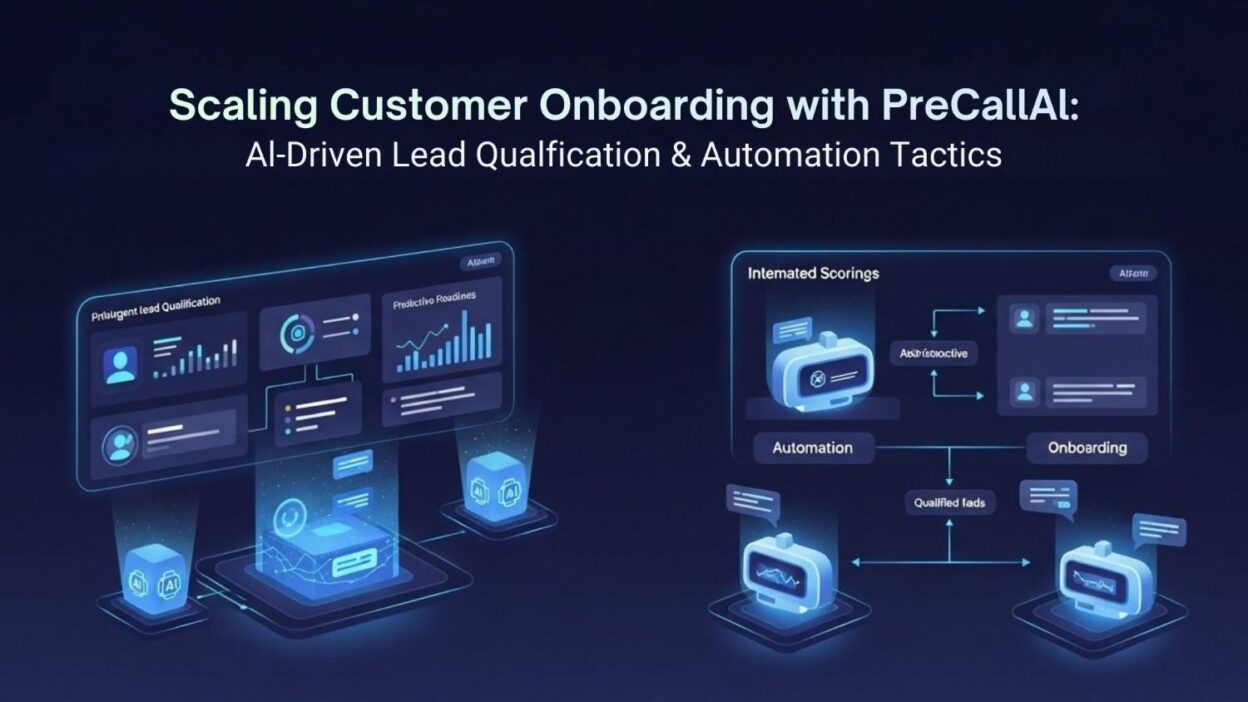
AI-driven lead qualification and automation tactics solve both problems simultaneously. PreCallAI transforms how businesses identify qualified prospects and onboard new customers. Your team focuses on high-value activities while automation handles repetitive work. Sales cycles shrink dramatically as efficiency soars.
This guide explores practical strategies for scaling customer onboarding through intelligent automation. You’ll discover specific tactics that deliver measurable results. We’ll examine how PreCallAI implements AI-driven lead qualification and automation tactics that work in competitive markets.
Table of Contents
Understanding the Customer Onboarding Challenge
Most growing businesses hit the same scaling wall. Your product generates interest. Leads flow in steadily. Then everything bogs down in manual processes that can’t handle volume.
The Cost of Manual Lead Qualification
Sales representatives spend countless hours researching prospects. LinkedIn profiles, company websites, and news articles all require review. Budget verification happens through awkward questions during initial calls. Decision-maker identification takes multiple attempts and transfers.
Each qualification call costs your company $50-$150 in fully loaded labor expenses. Your team makes 40-60 calls daily. Only 10-15% convert to qualified opportunities. The math becomes painful quickly. Thousands of dollars disappear qualifying leads that never close.
Manual qualification introduces inconsistency across your team. Different reps use different criteria. Some ask thorough questions while others rush through scripts. Qualification quality varies wildly depending on who handles the lead.
Onboarding Bottlenecks That Stall Growth
Customer onboarding typically requires 5-10 touchpoints before activation. Welcome calls explain your platform. Data gathering sessions collect necessary information. Setup calls configure accounts properly. Training sessions educate users on features.
Your team can only handle limited concurrent onboarding processes. Each customer success manager maxes out at 15-20 active onboardings. New customer influx quickly overwhelms available capacity. Wait times extend from days to weeks.
Manual onboarding creates inconsistent customer experiences. Some clients receive white-glove service while others get rushed through basics. Documentation gaps leave customers confused. Your churn risk increases during these critical first weeks.
Where Traditional Solutions Fall Short
Basic CRM automation sends emails on schedules. Forms collect information sequentially. These tools handle simple tasks but lack intelligence. They can’t adapt to customer responses. Context gets lost between interactions.
Chatbots frustrate customers with limited understanding. Simple questions receive canned responses. Complex scenarios dead-end in “contact support” messages. The experience feels robotic because it is.
Traditional approaches require choosing between speed and quality. You can process leads quickly with minimal qualification. You can qualify thoroughly but slowly. AI-driven lead qualification and automation tactics eliminate this trade-off completely.
How PreCallAI Revolutionizes Lead Qualification
PreCallAI applies artificial intelligence to the lead qualification process systematically. The platform doesn’t just automate existing workflows. It reimagines how qualification should work when intelligence joins automation.
Intelligent Prospect Research and Enrichment
PreCallAI analyzes prospects automatically before human contact occurs. The system scans company websites, LinkedIn profiles, news mentions, and public financial data. Firmographic information populates your CRM instantly. Company size, revenue estimates, technology stack, and growth indicators all extract automatically.
The AI identifies decision-makers through organizational chart analysis. Job titles, reporting structures, and recent role changes all inform who makes purchasing decisions. Your team knows exactly who to reach before dialing.
Behavioral signals enhance qualification accuracy dramatically. Website visit patterns reveal genuine interest versus casual browsing. Content downloads indicate specific pain points. Email engagement shows receptiveness to outreach. PreCallAI synthesizes these signals into actionable intelligence.
Predictive Lead Scoring Models
Machine learning models analyze historical deal data to predict close probability. The AI identifies patterns in prospects that became customers. Company characteristics, engagement behaviors, and industry verticals all factor into scoring.
PreCallAI assigns each lead a qualification score from 0-100. Scores above 70 indicate high purchase probability. Your team prioritizes these opportunities first. Scores below 30 suggest poor fit or timing. These leads route to nurture campaigns automatically.
The scoring models improve continuously through feedback loops. Closed deals teach the system what great prospects look like. Lost opportunities refine understanding of poor fits. AI-driven lead qualification and automation tactics become more accurate over time.
Automated Pre-Qualification Conversations
PreCallAI engages prospects through intelligent conversations before sales involvement. The AI asks qualifying questions naturally through email, chat, or voice interfaces. Budget ranges, timeline expectations, and decision processes all get explored conversationally.
The system adapts questions based on prospect responses. A prospect indicating immediate need receives different follow-ups than someone planning for next quarter. Context maintains throughout multi-message exchanges. The conversation flows naturally rather than following rigid scripts.
Qualified prospects receive immediate sales team routing. Calendar links appear automatically for high-score leads. Your representatives connect with ready-to-buy prospects rather than cold contacts. Conversion rates increase while talk time decreases.
AI-Driven Lead Qualification and Automation Tactics for Sales Teams
Implementing AI-driven lead qualification and automation tactics requires understanding specific applications across your sales process. These practical tactics deliver immediate impact.
Persona-Based Qualification Workflows
PreCallAI creates custom qualification paths for different buyer personas. Enterprise prospects receive questions about procurement processes and multi-stakeholder approval. Small business leads face simplified qualification focused on owner decision-making.
The AI detects persona indicators from initial data. Company size, industry, and role all signal appropriate workflows. A CFO from a 500-person manufacturer gets different treatment than a marketing manager from a 10-person agency.
Qualification depth adjusts automatically based on deal size potential. Six-figure opportunities justify extensive discovery. Small deals receive streamlined qualification that respects everyone’s time. Your team allocates effort proportional to potential value.
Intent Signal Integration
PreCallAI monitors multiple intent signals across digital channels. Website behavior tracking reveals which pages prospects visit. Time on pricing pages indicates purchase readiness. Demo request submissions signal high intent.
Email engagement metrics feed qualification models. Open rates, click-throughs, and reply patterns all contribute to scoring. A prospect who clicks every email link demonstrates different intent than someone who never opens messages.
The system integrates third-party intent data from providers monitoring content consumption across the web. When prospects research solutions in your category, PreCallAI captures these signals. Your team reaches out when buying interest peaks.
Dynamic Questionnaire Optimization
PreCallAI tests different qualification questions continuously. The AI experiments with wording, sequence, and depth. Response rates and downstream conversion metrics determine winning variations.
Questions that don’t predict deal outcomes get eliminated automatically. Your qualification becomes more efficient over time. Prospects answer fewer questions while providing more valuable information.
The system personalizes questions based on known information. Prospects from recognized companies don’t answer basic firmographic questions. The AI asks only what remains unknown. Respect for prospect time improves response rates.
Intelligent Lead Routing Rules
PreCallAI routes qualified leads based on sophisticated matching algorithms. Territory assignments happen automatically considering geography, industry, and account characteristics. No manual sorting required.
The system balances workload across your sales team. Representatives with lighter pipelines receive more new leads. Top performers handling large deals get fewer interruptions. Capacity management happens intelligently.
AI-driven lead qualification and automation tactics include timing optimization for routing. Leads reaching qualification during off-hours wait until representatives are available. Urgent high-value opportunities trigger immediate notifications regardless of time.
Scaling Customer Onboarding Through Automation
PreCallAI extends beyond lead qualification into customer onboarding automation. The same intelligence that qualifies leads accelerates new customer activation.
Automated Welcome Sequences
New customers receive personalized welcome sequences immediately after signing. PreCallAI customizes content based on customer size, use case, and technical sophistication. Enterprise clients see different messaging than small businesses.
The AI schedules touchpoints automatically considering customer timezone and preferences. Welcome emails arrive at optimal times. Calendar invitations for kickoff calls accommodate customer availability. Everything coordinates without manual intervention.
Progress tracking happens continuously. PreCallAI monitors which emails customers open and which links they click. Engagement signals trigger appropriate follow-ups. Customers showing confusion receive proactive assistance. Active users advance through onboarding faster.
Intelligent Information Gathering
PreCallAI collects necessary onboarding information through conversational interfaces. The AI asks about team size, integration requirements, and implementation goals naturally. Customers provide information when convenient rather than during scheduled calls.
The system validates responses in real-time. Conflicting information triggers clarification requests. Incomplete submissions receive gentle reminders. Data quality improves dramatically compared to manual collection.
Information flows directly into configuration systems. Technical requirements populate setup worksheets. User lists generate access provisioning tasks. Your implementation team starts work with complete, accurate information.
Adaptive Onboarding Paths
PreCallAI creates custom onboarding journeys based on customer characteristics. Technical customers receive detailed configuration guidance. Non-technical users get simplified setup with more hand-holding. Implementation complexity matches customer sophistication.
The AI adjusts pacing based on customer progress. Fast learners advance quickly through materials. Struggling customers receive additional support and simplified explanations. Everyone completes onboarding successfully regardless of starting point.
Milestone completion triggers next-step automation. Finishing account setup unlocks training modules. Completing training enables advanced features. The journey guides customers through logical sequences without overwhelming them.
Proactive Issue Resolution
PreCallAI monitors customer onboarding health continuously. The system identifies warning signs predicting implementation problems. Decreased engagement, skipped milestones, and unanswered questions all trigger alerts.
At-risk customers receive proactive outreach automatically. The AI generates personalized messages addressing specific concerns. Customers struggling with integrations get technical resources. Those confused about features receive tutorial links.
Your customer success team focuses intervention where it matters most. AI-driven lead qualification and automation tactics identify which customers need human attention. Everyone else proceeds smoothly through automated sequences.
Implementation Strategies for PreCallAI
Successfully deploying PreCallAI requires systematic planning and execution. These strategies accelerate time-to-value while minimizing disruption.
Auditing Current Qualification Processes
Document your existing lead qualification workflow completely. Map every step from lead capture through sales handoff. Identify bottlenecks where leads accumulate. Calculate time spent on various qualification activities.
Analyze qualification consistency across your team. Pull sample recordings or transcripts from qualification calls. Look for variations in questions asked and criteria applied. Inconsistency reveals automation opportunities.
Measure current qualification effectiveness. What percentage of qualified leads become customers? How long does qualification take on average? What does each qualified lead cost? These baselines demonstrate improvement after implementation.
Defining Ideal Customer Profiles
PreCallAI requires clear ideal customer profile definitions. Document characteristics of your best customers. Company size, industry, technology stack, and growth stage all matter. Past purchase patterns reveal valuable insights.
Identify disqualification criteria explicitly. Which prospect characteristics predict poor fit? Budget constraints, timeline mismatches, and technical requirements all eliminate prospects. The AI needs explicit guidance on what makes prospects unqualified.
Collaborate across sales, customer success, and product teams. Different perspectives reveal different ICP dimensions. Sales knows buying patterns. Customer success understands implementation success factors. Product teams see feature usage correlating with retention.
Data Integration and Enrichment Setup
Connect PreCallAI to your existing marketing and sales technology stack. CRM integration enables bi-directional data flow. Marketing automation platforms provide behavioral data. The system needs comprehensive information for intelligent decisions.
Configure data enrichment sources within PreCallAI. Third-party data providers supplement first-party information. Company databases, technographic data, and intent signals all enhance qualification accuracy.
Establish data quality standards before launching automation. AI-driven lead qualification and automation tactics depend on quality inputs. Clean existing data and implement validation rules preventing future degradation.
Gradual Rollout and Testing
Start PreCallAI deployment with a subset of leads. Test qualification workflows on 20-30% of volume initially. Monitor results closely while building confidence. Full-scale deployment follows successful pilot outcomes.
Run parallel operations during transition periods. Human qualification continues while AI handles the same leads. Compare results systematically. This shadow mode reveals discrepancies requiring adjustment.
Collect feedback from sales teams using AI-qualified leads. Do they agree with qualification decisions? What information proves most valuable? What’s missing? Frontline insights drive optimization.
Continuous Optimization Cycles
PreCallAI performance improves through ongoing optimization. Review qualification accuracy weekly during initial deployment. Monthly reviews suffice once operations stabilize. Always look for improvement opportunities.
Analyze leads that qualified but didn’t close. Did the AI miss disqualifying factors? Should scoring models adjust? Lost deals teach valuable lessons about prospect fit.
Celebrate wins publicly across your organization. Share stories of AI-qualified leads closing faster. Highlight efficiency gains enabling team capacity increases. Success builds momentum for broader adoption.
Measuring Success and ROI
Understanding PreCallAI’s impact requires tracking appropriate metrics. These measurements demonstrate value and guide optimization.
Lead Qualification Metrics
Track qualification volume before and after PreCallAI implementation. Qualified lead throughput should increase dramatically. Your team qualifies 3-5x more prospects with the same headcount. This volume increase alone justifies investment.
Measure qualification accuracy through win rate analysis. AI-qualified leads should convert to customers at higher rates than manually qualified prospects. Improved targeting increases downstream success.
Calculate cost per qualified lead. Divide total qualification costs by qualified lead count. AI-driven lead qualification and automation tactics reduce this metric by 60-80%. Lower costs per qualified lead improve overall marketing ROI.
Sales Efficiency Improvements
Monitor sales representative activity metrics. Call volume, meeting bookings, and proposal generation all indicate productivity. PreCallAI should enable 40-60% more selling activities by eliminating low-value work.
Track time-to-first-meeting for new leads. AI qualification dramatically accelerates this metric. Leads move from inquiry to sales conversation in hours instead of days. Faster engagement improves conversion rates.
Measure sales cycle length from qualification to close. Better-qualified leads close faster because fit clarity reduces discovery time. Expect 20-30% cycle time reductions with PreCallAI.
Onboarding Performance Indicators
Calculate time-to-activation for new customers. PreCallAI should reduce onboarding duration by 40-50%. Customers reach value faster through streamlined processes.
Monitor customer success manager capacity. How many concurrent onboardings can each CSM handle? AI-driven lead qualification and automation tactics increase capacity 2-3x by automating routine tasks.
Track early-stage churn rates during onboarding periods. Better onboarding reduces customers who cancel before going live. Expect 30-40% reduction in onboarding-related churn.
Financial Impact Assessment
Calculate fully loaded costs for current qualification and onboarding processes. Include salaries, benefits, technology, and overhead. Compare against PreCallAI subscription and implementation costs.
Project revenue impact from increased qualified lead volume. More qualified leads flowing to sales generates more opportunities. Multiply additional opportunities by win rate and average deal size.
Most PreCallAI deployments achieve ROI within 4-6 months. Ongoing benefits compound as optimization improves performance. Year-two returns typically exceed 300-500% of investment.
Real-World Applications Across Industries
PreCallAI delivers results across diverse business models and markets. These examples demonstrate practical applications.
B2B SaaS Companies
A marketing automation SaaS company struggled qualifying 1,200 monthly inbound leads. Their 6-person SDR team qualified only 180 leads monthly. The rest went to generic nurture campaigns.
PreCallAI implementation automated initial qualification completely. The AI engaged every lead within 2 hours of inquiry. Qualification conversations happened via email and chat. Qualified leads increased to 420 monthly without additional headcount.
Sales team capacity constraints became the new bottleneck. The company hired 2 additional account executives to handle increased qualified volume. Revenue grew 85% year-over-year while customer acquisition costs decreased 34%.
Professional Services Firms
A consulting firm received 500+ monthly inquiries through website forms. Partners spent 15 hours weekly on qualification calls. Many prospects lacked budget for premium services. The firm needed better targeting.
PreCallAI automated budget qualification through natural conversations. The AI asked about project scope, timeline, and budget ranges diplomatically. Prospects provided information freely to the AI that felt intrusive from humans.
Qualified lead volume decreased 40% but quality improved dramatically. Partners invested time only in well-qualified opportunities. Win rates increased from 22% to 41%. AI-driven lead qualification and automation tactics enabled focusing on best-fit clients.
E-Commerce Platforms
An e-commerce platform targeting mid-market retailers onboarded 40 new merchants monthly. Their 4-person onboarding team maxed out at this volume. Growth plans required doubling merchant acquisition without doubling headcount.
PreCallAI automated data collection and account setup coordination. New merchants answered questions through conversational interfaces at their convenience. The AI generated configuration worksheets automatically.
Onboarding capacity increased to 85 monthly merchants with the same team. Time-to-first-sale decreased from 21 days to 9 days. Merchant satisfaction scores increased by 32 points. The platform scaled successfully without proportional cost increases.
Financial Services Companies
A fintech startup qualifying loan applications manually called every applicant. The process took 45 minutes per application. Only 15% of applicants qualified based on credit and income requirements.
PreCallAI pre-qualified applicants through automated conversations. The AI collected income information, employment details, and credit authorization. Unqualified applicants received instant decisions. Qualified applicants proceeded to human underwriters.
Application processing capacity tripled without additional staff. Qualified applicant costs decreased 72%. Customer experience improved through instant feedback. The company scaled successfully while maintaining underwriting standards.
Overcoming Implementation Challenges
Every PreCallAI deployment encounters obstacles. Anticipating common challenges helps you prepare appropriate responses.
Sales Team Resistance
Sales representatives sometimes resist AI qualification initially. They fear losing control over lead quality. Concerns about AI making poor decisions create hesitation.
Address resistance through transparent communication. Share qualification criteria the AI uses. Demonstrate alignment with existing standards. Show representatives that AI applies their knowledge consistently.
Involve sales leaders in workflow design. Their input creates ownership and improves solution quality. Representatives support what they help build.
Run extended parallel operations that build confidence gradually. Sales teams see AI qualification matching or exceeding human performance. Data overcomes skepticism better than promises.
Data Privacy and Compliance
PreCallAI processes personal information during qualification and onboarding. Privacy regulations like GDPR and CCPA impose requirements. Compliance concerns create valid hesitation.
Choose vendors prioritizing privacy and security. PreCallAI should offer data processing agreements. Encryption, access controls, and audit logging should be standard features.
Configure AI-driven lead qualification and automation tactics to respect prospect preferences. Unsubscribe requests must halt automated outreach immediately. The system should maintain comprehensive consent records.
Work with legal counsel reviewing vendor contracts and configurations. Document privacy safeguards in your terms of service. Transparency builds trust with prospects and customers.
Integration Complexity
Existing technology stacks create integration challenges. Legacy CRMs lack modern APIs. Marketing automation platforms use proprietary data formats. Everything requires custom connectivity.
PreCallAI offers pre-built integrations with popular platforms. Salesforce, HubSpot, Marketo, and Pipedrive all connect easily. Standard integrations accelerate deployment dramatically.
For custom systems, prioritize core integrations delivering maximum value. Lead data and activity logging matter most initially. Advanced integrations can wait until after proving core value.
Consider middleware platforms like Zapier for connecting systems lacking direct integrations. These tools bridge gaps without custom development.
Managing Automation Boundaries
Determining what to automate versus keeping human creates difficult decisions. Automate too much and experiences feel robotic. Automate too little and efficiency suffers.
Start with high-volume, low-complexity activities. Information gathering, scheduling, and routine questions all automate well. Complex negotiations and relationship building remain human.
Implement human escalation paths for edge cases. The AI should recognize situations requiring human judgment. Clear escalation protocols maintain experience quality.
Review automation boundaries quarterly as capabilities expand. AI-driven lead qualification and automation tactics improve continuously. Activities requiring humans today might automate tomorrow.
Future Trends in AI-Driven Qualification
The technology continues evolving rapidly. Understanding emerging trends helps you prepare for future capabilities.
Voice-Based Qualification Conversations
Current PreCallAI implementations use text-based communication primarily. Future systems will conduct qualification conversations via voice naturally. Prospects will speak with AI that sounds human.
Voice interfaces feel more personal than chat or email. Many prospects prefer phone conversations over typing. Voice AI removes friction from qualification processes.
Sentiment analysis from voice tone will enhance qualification. The AI will detect hesitation, excitement, or confusion in prospect voices. Emotional intelligence will improve conversation quality.
Predictive Buying Timing
Machine learning models will predict optimal contact timing with increasing accuracy. The AI will know when prospects are most receptive to outreach. Calls and messages will arrive at perfect moments.
The system will identify buying windows months in advance. Prospects researching solutions trigger proactive outreach. Your team engages before competitors realize opportunity exists.
Seasonal patterns, company growth indicators, and external events all inform timing predictions. AI-driven lead qualification and automation tactics will seem almost prescient.
Hyper-Personalization at Scale
Future PreCallAI versions will generate completely unique qualification experiences for each prospect. Every conversation will reference specific company situations. Generic messaging disappears entirely.
The AI will research recent news, hiring patterns, and competitive moves. Outreach will connect your solution to specific prospect challenges. Relevance will increase response rates dramatically.
Personalization will extend to communication style preferences. Formal prospects receive professional messaging. Casual prospects get friendly approaches. The AI adapts to individual preferences automatically.
Continuous Learning Loops
PreCallAI will learn from every interaction continuously. Successful qualification patterns will propagate across your entire lead flow immediately. The system won’t wait for manual model retraining.
Failed qualifications will trigger automatic adjustments. The AI will experiment with different approaches. Optimization will happen autonomously without human intervention.
Your qualification process will improve daily. Six months after deployment, performance will far exceed initial results. Continuous learning creates compounding advantages.
Frequently Asked Questions
What makes PreCallAI different from basic CRM automation?
PreCallAI uses artificial intelligence to understand context and adapt conversations dynamically. Basic CRM automation follows rigid if-then rules. The AI learns from interactions and improves continuously. It handles complex qualification scenarios that break simple automation. PreCallAI thinks while basic automation executes scripts.
How quickly can we implement PreCallAI?
Simple implementations deploy in 2-4 weeks from decision to production. Complex enterprise deployments require 6-10 weeks. Timeline depends on integration requirements and process complexity. Most companies see initial results within 30 days. Full optimization takes 60-90 days as the system learns.
Will AI qualification reduce our sales team’s control?
Sales teams maintain complete control over qualification criteria and thresholds. PreCallAI applies their standards consistently. Representatives can override AI decisions anytime. The system augments rather than replaces human judgment. Control increases through better information and consistent processes.
Can PreCallAI handle complex B2B sales?
Absolutely. PreCallAI excels in complex B2B environments with multiple stakeholders and long sales cycles. The AI identifies decision-makers and buying committee members. It qualifies budget, authority, need, and timeline systematically. AI-driven lead qualification and automation tactics adapt to any sales complexity level.
What about prospects who prefer human interaction?
PreCallAI detects preferences and routes accordingly. Prospects requesting human contact receive immediate escalation. The system doesn’t force automation on people preferring traditional approaches. Most prospects appreciate instant responses and convenience. Those who don’t get alternatives automatically.
How accurate is AI lead scoring?
Accuracy depends on historical data quality and volume. Most implementations achieve 80-90% scoring accuracy within 60 days. The system identifies qualified leads better than manual processes. Continuous learning improves accuracy over time. Expect 3-5% accuracy gains quarterly during the first year.
Does PreCallAI work for small businesses?
PreCallAI scales to businesses of any size. Small companies benefit from cost-effective automation that punches above their weight class. The platform provides enterprise-level qualification without enterprise costs. Many small businesses see proportionally larger impact because manual processes consume higher resource percentages.
What data does PreCallAI need to function?
Minimum requirements include lead contact information and basic company details. More data improves performance but isn’t mandatory. The system enriches limited data automatically. Historical deal outcomes train scoring models. Email and website behavior enhances qualification. Data requirements decrease as AI capabilities advance.
Can we customize qualification criteria?
Complete customization is standard. You define what makes prospects qualified for your business. Industry, company size, budget, timeline, and any other factors configure easily. AI-driven lead qualification and automation tactics adapt to your specific requirements. The system applies your criteria consistently across all leads.
How does pricing work for PreCallAI?
Pricing typically bases on lead volume and feature requirements. Entry-level plans start around $500-1,000 monthly for small businesses. Mid-market implementations run $2,000-5,000 monthly. Enterprise deployments with advanced features cost $10,000+ monthly. Most vendors offer tiered pricing that scales with business growth.
Will this replace our sales development team?
PreCallAI augments SDR teams rather than replacing them. Manual qualification tasks automate while SDRs focus on complex prospects and relationship building. Most companies redeploy SDRs to higher-value activities. Team capacity increases 3-5x without headcount changes. Top performers become more productive and satisfied.
What ROI should we expect?
Most implementations achieve 200-400% first-year ROI. Labor savings, increased qualified lead volume, and improved conversion rates all contribute. Payback typically occurs within 4-6 months. Ongoing benefits compound as optimization improves performance. Second-year returns often exceed 500% of investment.
Read More:-DevOps Teams Reduce Deployment Risk Through AI-Driven Automation Practices
Conclusion

Scaling customer onboarding requires moving beyond manual processes that can’t handle growth. Your sales team can’t qualify thousands of leads through individual phone calls. Customer success can’t onboard hundreds of clients using manual coordination.
AI-driven lead qualification and automation tactics through PreCallAI solve these scaling challenges definitively. The platform applies intelligence to qualification and onboarding processes systematically. Every lead receives instant attention. Qualification happens accurately before sales involvement. Onboarding proceeds efficiently without manual bottlenecks.
The results speak clearly across industries and business models. Companies process 3-5x more qualified leads with the same teams. Sales cycles shrink by 20-30% through better targeting. Onboarding capacity increases 2-3x while customer satisfaction improves. Costs decrease while quality and speed both increase.
Implementation doesn’t require massive transformation initiatives. Start with focused applications addressing clear pain points. Automate initial qualification conversations. Streamline information gathering during onboarding. Prove value quickly before expanding scope.
Common concerns about control, accuracy, and customer experience all have practical solutions. Sales teams maintain complete oversight while gaining efficiency. Accuracy exceeds manual qualification through consistent criteria application. Customers appreciate instant responses and streamlined processes.
The technology continues improving rapidly. Voice interfaces, predictive timing, and hyper-personalization all emerge on the horizon. Early adopters build competitive advantages that compound over time. Your competitors are exploring these capabilities now.
Every month you delay puts you further behind market leaders. Manual qualification and onboarding can’t compete with AI-powered processes on speed, cost, or consistency. The question isn’t whether to implement AI-driven lead qualification and automation tactics but how quickly you can deploy them.
Begin your PreCallAI journey today. Audit current qualification and onboarding processes. Identify bottlenecks consuming excessive time and resources. Research platforms designed for your industry and sales model. Build a business case with conservative ROI projections.
The first step often feels hardest. You face uncertainty about outcomes and team reactions. These concerns are legitimate but shouldn’t prevent action. Thousands of companies have implemented successfully before you. The technology works. The ROI proves itself quickly. Implementation processes are well-established.
Your business has tremendous untapped potential. PreCallAI unlocks that potential by eliminating constraints limiting what your teams accomplish. Manual qualification becomes intelligent automation. Days become hours. Your sales team focuses on selling rather than sorting. Customer success scales without proportional headcount increases.
Take action now. Select your first application. Contact PreCallAI for a demonstration. Talk to companies who have implemented successfully. Build your implementation plan. Secure the resources you need. Begin deployment.