Software deployment failures cost organizations millions in lost revenue and damaged reputation. Every code release carries potential risks. Production outages frustrate customers and overwhelm support teams. DevOps professionals lose sleep worrying about what might break during deployments.
AI-driven automation in DevOps transforms how teams manage deployment risk. Machine learning algorithms predict potential failures before they occur. Intelligent systems test code more thoroughly than human testers ever could. Organizations using these practices report 70-80% fewer production incidents.
Traditional deployment processes rely heavily on manual testing and human judgment. Engineers create test cases based on past experiences. They miss edge cases and unexpected interactions. Complex systems behave unpredictably under real-world conditions. Human oversight simply cannot catch every potential problem.
Modern development teams push code multiple times daily. Speed creates competitive advantages in fast-moving markets. Rapid deployment cycles increase risk exposure significantly. Manual quality gates slow down releases without guaranteeing safety. Teams need automated safeguards that work at machine speed.
AI-driven automation in DevOps analyzes patterns across thousands of previous deployments. The technology learns which code changes typically cause problems. It identifies risky commits before they reach production. Your deployment pipeline becomes smarter with every release.
Infrastructure complexity multiplies deployment challenges exponentially. Microservices architectures involve dozens or hundreds of interdependent components. Cloud environments span multiple regions and availability zones. Container orchestration adds layers of abstraction and potential failure points. Smart automation helps teams navigate this complexity safely.
Understanding AI-Driven Automation in DevOps
DevOps combines software development with IT operations into unified workflows. Teams collaborate closely throughout the entire software lifecycle. Automation eliminates manual handoffs between development and operations. The goal is faster, more reliable software delivery.
Artificial intelligence adds predictive and adaptive capabilities to standard automation. Machine learning models analyze historical deployment data continuously. They identify patterns humans miss in massive datasets. The systems make intelligent decisions about risk and quality.
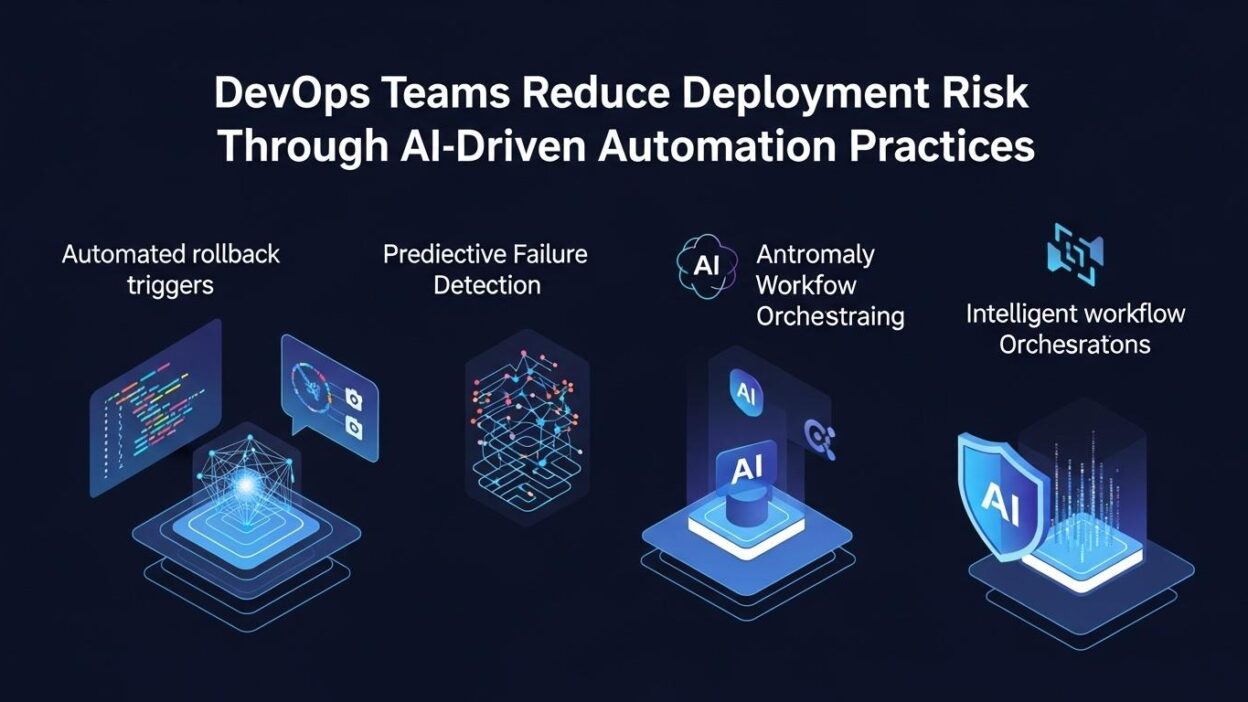
AI-driven automation in DevOps encompasses multiple technology categories working together. Predictive analytics forecast which deployments might fail. Intelligent testing generates test cases automatically. Anomaly detection spots unusual behavior in production systems. Auto-remediation fixes common problems without human intervention.
Natural language processing analyzes logs, tickets, and documentation. The technology understands error messages and their typical causes. It correlates issues across different systems and timeframes. Your team gains insights that would take weeks of manual investigation.
Computer vision techniques analyze application interfaces for visual defects. The systems detect layout problems and rendering issues automatically. User experience problems get caught before customers encounter them. Visual testing scales to cover thousands of screen combinations.
Reinforcement learning optimizes deployment strategies over time. The algorithms experiment with different approaches to releases. They learn which techniques minimize risk while maximizing speed. Your deployment process continuously improves without manual tuning.
Integration with existing DevOps tools creates seamless workflows. The AI layers add intelligence to Jenkins, GitLab, and other platforms. Your teams keep using familiar tools with enhanced capabilities. Implementation happens gradually without disruptive replacements.
How AI Predicts Deployment Failures
Historical deployment data contains valuable patterns about what causes failures. AI-driven automation in DevOps analyzes metadata from every past release. The systems examine code changes, test results, and deployment outcomes. Statistical models identify correlations between changes and incidents.
Code complexity metrics help algorithms assess risk levels. The technology analyzes lines changed, cyclomatic complexity, and dependency impacts. Changes touching critical system components receive extra scrutiny. Large refactoring efforts trigger additional automated safeguards.
Developer behavior patterns provide risk signals that humans often overlook. Commits made late at night show higher failure rates statistically. Code pushed without peer review causes more production issues. The system flags deployments exhibiting risky patterns.
Environmental factors influence deployment success in measurable ways. System load levels affect how well new code performs. Infrastructure health impacts deployment stability significantly. AI models incorporate these contextual variables into risk calculations.
Dependency analysis reveals how changes ripple through complex systems. A small modification in one service might break three others. AI-driven automation in DevOps maps these relationships automatically. The technology warns teams about unexpected downstream impacts.
Time-based patterns emerge from analyzing deployment schedules. Friday afternoon releases show higher failure rates across industries. Post-holiday deployments encounter unique challenges. Smart systems recommend optimal deployment windows for each change.
Confidence scores help teams make informed decisions about proceeding. The AI provides percentage likelihood of deployment success. Teams set acceptable risk thresholds based on business requirements. High-risk deployments receive additional review or testing automatically.
Intelligent Testing and Quality Assurance
Traditional test suites grow bloated and slow over time. Teams accumulate thousands of test cases through years of development. Test execution takes hours or even days. Developers wait idly while tests run before merging code.
AI-driven automation in DevOps optimizes test selection based on code changes. The system identifies which tests actually validate modified functionality. It skips irrelevant tests that won’t catch new problems. Test suite execution time drops by 60-80% without sacrificing coverage.
Automated test generation creates scenarios developers never imagined. Machine learning analyzes application behavior and user patterns. It generates test cases covering edge cases and unusual input combinations. Your test coverage improves without manual test authoring.
Flaky tests undermine confidence in automated quality gates. They pass sometimes and fail other times without code changes. AI-driven automation in DevOps identifies flaky tests through pattern analysis. The systems automatically quarantine unreliable tests for investigation.
Visual regression testing catches user interface problems automatically. Computer vision compares screenshots before and after changes. The technology detects layout shifts, color changes, and rendering issues. Frontend modifications deploy safely without manual visual inspection.
Performance testing happens continuously rather than as isolated events. AI baselines normal system behavior under various load conditions. It detects performance degradations from new code immediately. Teams fix problems before they impact production users.
Security vulnerability detection integrates into continuous integration pipelines. Machine learning identifies code patterns associated with security risks. The systems scan dependencies for known vulnerabilities automatically. Security problems get caught and fixed during development.
Automated Rollback and Recovery
Production incidents require immediate response to minimize customer impact. Human operators need minutes or hours to diagnose problems. They must identify the problematic deployment and initiate rollback. AI-driven automation in DevOps responds in seconds instead of minutes.
Anomaly detection monitors production metrics in real-time continuously. The systems learn normal behavior patterns for every service. They detect deviations that signal problems immediately. Alerts trigger before customers notice degraded performance.
Automated root cause analysis correlates symptoms with likely causes. The technology examines recent deployments, configuration changes, and infrastructure events. It identifies the change most likely responsible for observed problems. Your team knows where to focus investigation efforts.
Intelligent rollback systems revert problematic changes automatically. The AI determines whether rollback will solve the observed issue. It initiates rollback procedures without waiting for human approval. Service restoration happens 10x faster than manual processes.
Partial rollback capabilities minimize disruption to ongoing operations. The system can revert specific components while leaving others deployed. This surgical approach reduces the blast radius of problems. Users experience minimal service interruption during recovery.
Canary deployment strategies release changes to small user subsets first. AI-driven automation in DevOps monitors metrics from canary users closely. Problems trigger automatic halt of wider rollout. Only proven stable releases reach all customers.
Blue-green deployment auto+mation eliminates downtime during releases. The system provisions new infrastructure alongside existing production. Traffic switches instantaneously to the new version. Rollback happens just as quickly by switching back.
Continuous Monitoring and Observability
Modern applications generate enormous volumes of telemetry data. Logs, metrics, and traces pour in from hundreds of services. Human operators cannot possibly review all this information. Important signals get lost in the noise.
AI-driven automation in DevOps processes millions of data points per second. The systems establish baselines for normal operation automatically. They filter out routine events that don’t require attention. Your team focuses on genuinely important signals.
Log analysis extracts meaningful patterns from unstructured text data. Natural language processing understands error messages and stack traces. The technology groups similar issues together automatically. Related problems across different services become visible.
Metric correlation identifies relationships between different system measurements. Rising error rates might correlate with increased memory consumption. The AI connects these dots faster than human investigation. Root cause analysis happens in seconds instead of hours.
Distributed tracing follows requests through complex microservices architectures. AI-driven automation in DevOps analyzes trace data to identify bottlenecks. The systems pinpoint which service slows down overall request processing. Performance optimization efforts target the right components.
Predictive alerting warns about problems before they fully materialize. The AI recognizes patterns that precede failures historically. It alerts teams when systems exhibit pre-failure signatures. Preventive action avoids customer-facing incidents entirely.
Dashboard automation presents relevant information based on current context. The system knows which metrics matter during deployments versus normal operations. It adjusts visualizations automatically for different scenarios. Engineers see exactly what they need when they need it.
Infrastructure as Code and Configuration Management
Manual infrastructure changes create inconsistency and deployment risks. Engineers make modifications differently across environments. Configuration drift accumulates over time silently. Production behaves differently than testing environments.
Infrastructure as code defines systems through version-controlled templates. Teams apply software development practices to infrastructure management. Changes go through code review and automated testing. AI-driven automation in DevOps validates infrastructure code before deployment.
Configuration validation catches problems before they affect systems. The AI analyzes configuration files for common mistakes and antipatterns. It verifies compatibility between different configuration parameters. Invalid configurations never reach production infrastructure.
Drift detection identifies when actual infrastructure deviates from intended state. The systems compare running systems against infrastructure code continuously. They alert teams to unauthorized or accidental changes. Your infrastructure matches its definition precisely.
Auto-remediation corrects configuration drift without manual intervention. The technology applies the correct configuration automatically when drift occurs. Systems self-heal back to their intended state. Manual configuration toil disappears from operations work.
Optimization recommendations improve infrastructure efficiency over time. AI-driven automation in DevOps analyzes resource utilization patterns. The systems suggest rightsizing opportunities and architecture improvements. Your infrastructure costs decrease while reliability improves.
Change impact analysis predicts how infrastructure modifications affect applications. The AI understands dependencies between infrastructure and services. It warns about potential breakage before changes deploy. Infrastructure updates happen safely with confidence.
Security Integration and Compliance
Security vulnerabilities in code create serious business risks. Breaches damage customer trust and trigger regulatory penalties. Traditional security testing happens late in development cycles. Problems get discovered after significant development investment.
AI-driven automation in DevOps shifts security left into early development stages. Static analysis scans code as developers write it. The systems identify security issues before commits even happen. Vulnerabilities get fixed when remediation costs the least.
Dependency scanning monitors third-party libraries for known vulnerabilities. New vulnerabilities appear in popular packages regularly. The AI tracks your dependency tree continuously. Alerts trigger immediately when vulnerabilities affect your applications.
Secrets detection prevents accidental credential exposure in code. Machine learning identifies patterns that look like API keys and passwords. The system blocks commits containing secrets automatically. Credential leaks get stopped before reaching repositories.
Compliance validation ensures deployments meet regulatory requirements. The technology verifies that required security controls are present. It checks configurations against compliance frameworks automatically. Audit preparation becomes trivial with automated compliance evidence.
Threat modeling analyzes system architectures for security weaknesses. AI-driven automation in DevOps understands common attack patterns. The systems identify components vulnerable to specific threat types. Security architects focus remediation on the highest risks.
Runtime security monitoring detects attacks in production environments. Behavioral analysis spots unusual application activity patterns. The AI distinguishes between legitimate traffic and potential attacks. Security incidents receive rapid automated response.
Collaboration and Communication Enhancement
DevOps success depends on effective team collaboration. Developers, operations, and security teams must work together seamlessly. Miscommunication causes delays and increases deployment risk. Information silos prevent teams from seeing the full picture.
AI-driven automation in DevOps creates shared visibility across all teams. Centralized dashboards present information relevant to each role. Everyone sees the same data about deployments and system health. Common understanding reduces friction and confusion.
Intelligent alerting routes notifications to the right people automatically. The system knows which team handles different types of issues. It escalates problems based on severity and response time. The right experts engage without manual coordination.
ChatOps integration brings automation into team communication channels. Engineers trigger deployments and check system status from Slack or Teams. The AI responds to natural language queries about system state. Collaboration tools become command centers for operations.
Automated documentation keeps information current without manual effort. The systems generate runbooks from actual deployment procedures. They update documentation when processes change. Your teams always reference accurate operational guides.
Postmortem automation captures lessons from incidents systematically. AI-driven automation in DevOps analyzes incident timelines and response actions. It identifies improvement opportunities automatically. Learning happens faster across the organization.
Knowledge graph creation connects information across different systems. The technology maps relationships between code, infrastructure, and documentation. Engineers find relevant information quickly during troubleshooting. Institutional knowledge becomes accessible to everyone.
Building Your AI-Driven DevOps Practice
Start with areas causing the most deployment pain currently. Identify which part of your pipeline has the highest failure rates. Focus initial automation efforts there for immediate impact. Quick wins build momentum for broader transformation.
Assess your current DevOps maturity and tooling landscape. Document existing processes and identify automation gaps. Evaluate which tools already have AI capabilities. You might enhance current tools rather than replacing everything.
Define clear metrics for measuring deployment risk reduction. Track deployment frequency, failure rates, and recovery times. Establish baselines before implementing AI automation. Quantifiable improvements justify continued investment.
Build data infrastructure to support machine learning systems. AI-driven automation in DevOps requires quality historical data. Ensure logs, metrics, and deployment records are being collected. Clean, structured data improves AI effectiveness significantly.
Start with supervised learning approaches using labeled historical data. Train models on past deployments marked as successful or failed. These systems deliver value faster than unsupervised approaches. Your team sees benefits within weeks instead of months.
Create feedback loops for continuous model improvement. Track whether AI predictions match actual deployment outcomes. Retrain models regularly with new data. Your systems get smarter and more accurate over time.
Invest in training for your DevOps teams. Engineers need to understand AI capabilities and limitations. They should know when to trust automation and when to override it. Educated teams extract maximum value from AI investments.
Advanced Techniques and Future Directions
Self-healing systems automatically remediate common problems without human intervention. AI-driven automation in DevOps diagnoses issues and applies fixes autonomously. The technology handles routine problems that previously required engineer response. On-call burden decreases dramatically for operations teams.
Chaos engineering integration tests system resilience systematically. AI selects which failure scenarios to inject based on risk analysis. The systems learn which components need resilience improvements. Your applications become more robust through automated testing.
AIOps platforms unify monitoring, analytics, and automation comprehensively. These systems provide end-to-end intelligence across your entire stack. They correlate data from infrastructure, applications, and business metrics. DevOps teams gain complete operational visibility.
Quantum computing will eventually enhance deployment optimization algorithms. Complex scheduling problems will solve exponentially faster. Resource allocation will optimize across massive cloud infrastructures. These capabilities remain years away from practical deployment.
Federated learning will enable AI model training across multiple organizations. Teams will benefit from collective industry experience. Models will learn from millions of deployments across companies. Privacy-preserving techniques will protect proprietary information.
Autonomous DevOps represents the ultimate vision for the field. Systems will handle the entire deployment lifecycle without human intervention. Engineers will focus purely on feature development and architecture. AI-driven automation in DevOps will manage all operational concerns.
Natural language interfaces will simplify DevOps tool interaction. Engineers will describe desired outcomes in plain English. AI will translate intentions into specific automation actions. Technical complexity will hide behind conversational interfaces.
Common Implementation Challenges
Data quality issues undermine machine learning model accuracy. Incomplete or inconsistent historical records produce poor predictions. Clean your data thoroughly before training AI systems. Garbage in truly means garbage out with machine learning.
Tool proliferation creates integration complexity across DevOps pipelines. Teams use dozens of different tools for various functions. Making them work together requires significant effort. Standardize tooling where possible to simplify integration.
Cultural resistance slows adoption of AI-driven practices. Engineers may distrust automated decision-making systems. They want to maintain control over deployment processes. Education and gradual implementation build confidence and acceptance.
Skills gaps limit team ability to leverage AI capabilities effectively. Most DevOps engineers lack machine learning expertise. Organizations struggle to find people with both skillsets. Training existing staff proves more effective than hiring unicorns.
Legacy systems lack the instrumentation needed for AI analysis. AI-driven automation in DevOps requires comprehensive telemetry. Older applications may need significant modifications. Modernization efforts must happen alongside automation initiatives.
Alert fatigue overwhelms teams with too many notifications. Poorly tuned AI systems generate excessive false positives. Engineers start ignoring alerts when most prove irrelevant. Careful tuning and threshold adjustment prevents this problem.
Regulatory concerns arise around automated decision-making. Some industries require human approval for production changes. Autonomous systems may conflict with compliance requirements. Work with legal and compliance teams to find acceptable approaches.
Cost Considerations and ROI
AI platform licensing represents the primary direct expense. Enterprise solutions cost $50,000 to $500,000 annually typically. Costs scale with infrastructure size and feature requirements. Most organizations achieve positive ROI within 12-18 months.
Infrastructure costs increase for running AI workloads. Model training and inference require computational resources. Cloud expenses may rise initially during implementation. Savings from reduced incidents offset these costs quickly.
Incident costs decrease dramatically with better deployment practices. AI-driven automation in DevOps prevents costly production outages. Calculate your current incident expenses including lost revenue. Avoided incidents justify significant automation investment.
Engineering productivity improves when teams spend less time firefighting. Developers ship features faster with reliable deployment pipelines. Operations teams handle more services with the same headcount. Productivity gains generate substantial value.
Customer satisfaction increases when deployments cause fewer problems. Users experience better reliability and faster feature delivery. Satisfied customers renew contracts and expand purchases. Revenue impact exceeds direct cost savings often.
Competitive advantages emerge from faster, safer deployment capabilities. Organizations ship features weeks or months ahead of competitors. Market leadership generates revenue opportunities impossible to quantify. Strategic benefits justify investment beyond pure ROI calculations.
Risk reduction provides insurance value that’s hard to measure. Avoiding major outages prevents incalculable brand damage. AI-driven automation in DevOps acts as insurance against catastrophic failures. The value appears clearly when disasters don’t happen.
Industry-Specific Applications
Financial services firms deploy code multiple times daily safely. AI systems ensure compliance with strict regulatory requirements. Trading platforms update without risking transaction processing. Deployment risk drops while release velocity increases.
Healthcare organizations maintain patient safety during system updates. AI-driven automation in DevOps verifies HIPAA compliance automatically. Critical medical applications update with extensive automated safeguards. Patient care continues uninterrupted during technology changes.
E-commerce companies handle massive traffic spikes confidently. AI predicts how code changes affect performance under load. Black Friday and Cyber Monday deployments happen safely. Revenue opportunities don’t get lost to technical caution.
Gaming companies push updates to millions of players seamlessly. The systems test changes across diverse device configurations automatically. Player experience remains smooth through continuous updates. Engagement stays high with reliable service delivery.
Telecommunications providers maintain network reliability during software updates. Infrastructure changes deploy with minimal service disruption. AI predicts which updates might affect call quality. Critical communications infrastructure stays operational always.
Government agencies modernize legacy systems safely. AI-driven automation in DevOps manages risk during digital transformation. Citizen services improve through more frequent updates. Public sector technology evolves without high-profile failures.
Measuring Success and Continuous Improvement
Deployment frequency indicates team confidence in release processes. High-performing teams deploy multiple times daily. Low deployment frequency suggests fear of releases. AI-driven automation in DevOps enables organizations to ship code more often safely.
Change failure rate measures deployment quality directly. Calculate the percentage of deployments requiring remediation. Elite teams achieve failure rates below 15%. AI systems help teams reach this performance level.
Mean time to recovery shows how quickly teams resolve incidents. Faster recovery minimizes customer impact from problems. Industry leaders recover in under one hour. Automated detection and remediation make this possible.
Lead time for changes tracks efficiency of development pipelines. Measure time from commit to production deployment. Shorter lead times indicate streamlined processes. AI optimization identifies and removes pipeline bottlenecks.
Customer satisfaction scores reflect overall service reliability. Track Net Promoter Scores and customer support tickets. Improvements validate that deployment risk reduction works. Better deployments create happier customers.
Team satisfaction metrics reveal engineer experience improvements. Survey teams about on-call burden and deployment confidence. AI-driven automation in DevOps should make work more enjoyable. Happy engineers produce better software.
Cost per deployment shows efficiency improvements over time. Calculate total DevOps costs divided by deployment count. This metric should decrease as automation scales. Efficiency gains become clearly visible.
Frequently Asked Questions
What is AI-driven automation in DevOps?
AI-driven automation in DevOps applies artificial intelligence to software deployment processes. Machine learning predicts deployment risks before they occur. Intelligent systems test code, monitor production, and remediate problems automatically. The technology makes deployments faster and more reliable.
How does AI reduce deployment risk?
AI analyzes patterns from thousands of previous deployments. It identifies code changes that typically cause problems. The systems flag high-risk deployments for additional review. Intelligent testing catches more bugs before production. Automated monitoring detects issues faster than humans can.
Do we need data scientists to implement AI DevOps?
Most modern platforms require minimal data science expertise. The tools include pre-trained models and automated configuration. DevOps engineers can implement basic AI capabilities independently. Complex customization benefits from data science knowledge. Start simple and add sophistication over time.
How long does AI DevOps implementation take?
Basic implementations deliver value in 4-8 weeks. Teams see initial benefits quickly with focused deployments. Comprehensive transformation takes 6-12 months typically. AI-driven automation in DevOps delivers incremental improvements throughout implementation.
Will AI replace DevOps engineers?
AI augments engineers rather than replacing them. The technology handles routine tasks and pattern recognition. Engineers focus on architecture, strategy, and complex problem-solving. Demand for skilled DevOps professionals continues growing despite automation.
What tools support AI-driven DevOps practices?
Major platforms include Harness, GitLab, Azure DevOps, and others. Many tools now incorporate machine learning capabilities. Jenkins and other open-source tools have AI plugins. Choose tools integrating with your existing ecosystem.
How much does AI DevOps cost?
Platform costs range from $50,000 to $500,000 annually. Smaller teams use more affordable solutions. Implementation services add $100,000 to $300,000 typically. Most organizations achieve positive ROI within 12-18 months through incident reduction.
Read More:-From Chaos to Control: Transforming Business Workflows with Intelligent Automation
Conclusion
Deployment risk threatens every organization shipping software regularly. Production incidents damage customer relationships and company revenues. Traditional manual processes cannot keep pace with modern release velocities. DevOps teams need intelligent automation to deploy safely at speed.
AI-driven automation in DevOps transforms deployment from risky to reliable. Machine learning predicts which changes might cause problems. Intelligent testing catches bugs manual QA misses. Automated monitoring and remediation minimize incident impact.
Organizations implementing these practices report dramatic improvements. Deployment failure rates drop 70-80% within the first year. Incident recovery happens 10x faster with automated systems. Engineering teams ship features confidently multiple times daily.
The technology handles routine decisions and pattern recognition tasks. Your engineers focus on architecture, strategy, and innovation. Automation eliminates tedious toil that drives burnout. Team satisfaction improves along with deployment reliability.
Implementation requires systematic planning and realistic expectations. Start with your most painful deployment challenges. Build on early successes to expand automation coverage. Continuous improvement delivers compounding benefits over time.
Data quality and tool integration present the biggest challenges. Invest time cleaning historical deployment data. Standardize tooling to simplify AI system integration. Technical foundation work pays dividends for years.
The competitive landscape demands rapid, reliable software delivery. Companies stuck with manual deployment processes lose market position. Industry leaders embrace AI-driven automation in DevOps enthusiastically. Early adopters establish advantages competitors struggle to overcome.
Calculate your current incident costs and deployment inefficiencies. Quantify time wasted on manual testing and troubleshooting. Compare these expenses to AI platform investments. The business case for automation becomes compelling quickly.
Your customers expect reliable service and continuous improvement. Your teams deserve tools that make their jobs easier. AI-driven automation in DevOps delivers both outcomes effectively. The technology represents the future of software delivery.
Take action now to reduce your deployment risks. Evaluate platforms suited to your technology stack. Start with a pilot project demonstrating clear value. Scale successful practices across your entire organization.
The question isn’t whether AI will transform DevOps practices. The question is whether your organization will lead or follow. AI-driven automation in DevOps adoption separates high performers from everyone else. Begin your transformation today to secure your competitive position tomorrow.