Introduction
TL;DR Traditional automation promised to revolutionize business operations decades ago. Companies invested millions in robotic process automation systems. They built complex decision trees to handle every possible scenario. They mapped out rigid workflows that covered standard procedures. The results fell short of expectations for most organizations.
Business leaders discovered a frustrating reality quickly. Their expensive automation tools broke when conditions changed slightly. Simple variations in input formats caused complete system failures. Unexpected scenarios required immediate human intervention constantly. The promised productivity gains never fully materialized.
Understanding what are agentic workflows in AI automation reveals why this new approach succeeds where traditional systems fail. These intelligent systems think rather than just execute predefined steps. They adapt to changing conditions instead of breaking down. They learn from experience and improve performance over time. The difference transforms business operations fundamentally.
The shift from traditional automation to agentic systems represents a paradigm change. Companies report 20-30% faster workflow cycles after implementation. Back-office costs drop significantly through autonomous decision-making. Error rates decline while customer satisfaction improves dramatically. These results explain why 93% of IT executives show extreme interest.
Table of Contents
Understanding the Foundation of Agentic Workflows
What Makes Agentic Systems Fundamentally Different
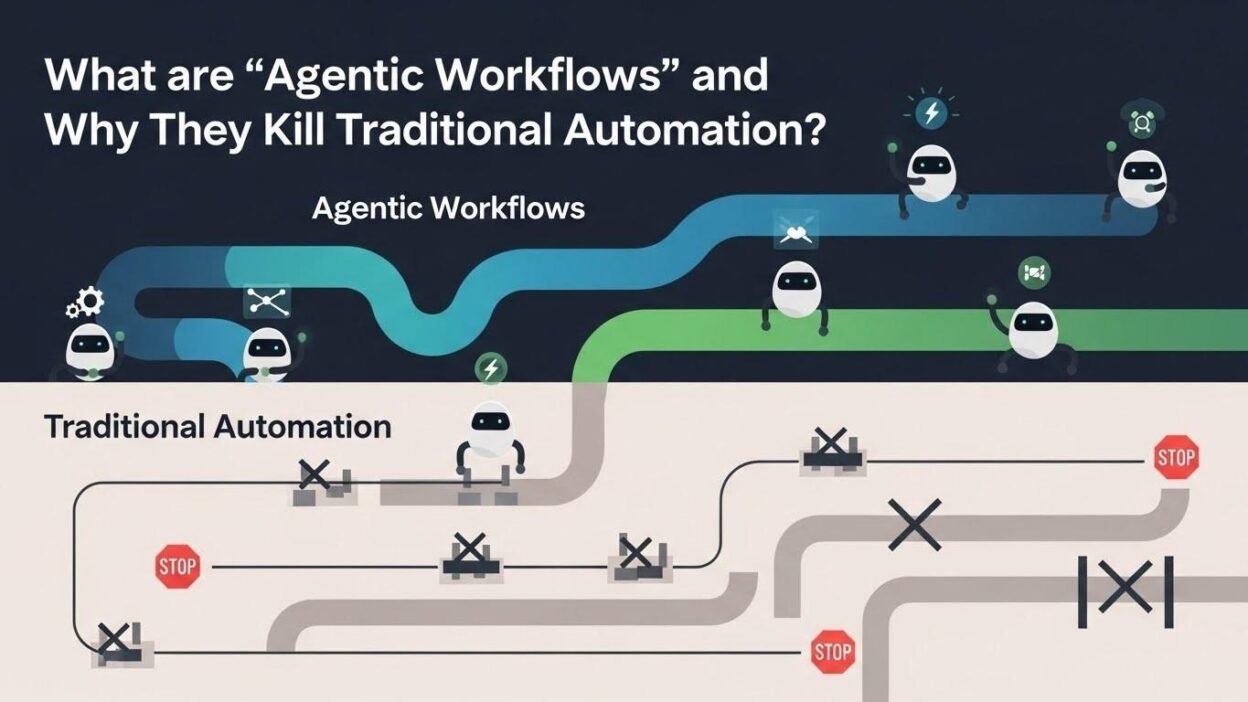
What are agentic workflows in AI automation becomes clear when examining their core characteristics. These systems operate autonomously toward defined goals without constant supervision. They break complex problems into manageable subtasks automatically. They execute each step while continuously evaluating progress and adjusting approaches. The intelligence embedded within them enables genuine problem-solving capabilities.
Traditional automation follows rigid if-then logic exclusively. A customer service chatbot using old technology runs through static decision trees. When an employee reports a Wi-Fi issue, it provides predefined responses. The system escalates to humans when predetermined paths run out. This approach handles basic scenarios but fails with complexity.
Agentic systems approach the same problem completely differently. An AI agent analyzes the Wi-Fi issue through multiple diagnostic steps. It checks network settings, router configurations, and device compatibility simultaneously. It runs tests to identify the actual root cause specifically. It implements solutions and verifies the fix worked properly. The entire process happens without human involvement unless truly necessary.
The underlying technology stack differs dramatically between these approaches. Agentic workflows leverage large language models for natural language understanding. Machine learning algorithms enable continuous improvement from experience. Integration capabilities allow interaction with multiple external systems seamlessly. These components work together to create adaptive intelligence.
Decision-making authority separates agents from basic automation fundamentally. Traditional systems can only execute actions humans explicitly programmed. Agentic systems evaluate options and choose optimal approaches independently. They consider multiple factors simultaneously before acting. This autonomy enables handling of novel situations never encountered before.
The Core Components That Power Agentic Intelligence
Every effective agentic system contains several essential building blocks working together. Natural language processing allows agents to understand human communication naturally. Machine learning models enable pattern recognition and continuous learning. Planning capabilities let agents decompose complex goals into actionable steps. Tool integration provides access to external systems and data sources.
Reasoning engines form the brain of agentic workflows. These components analyze situations and determine appropriate actions logically. They weigh trade-offs between different approaches systematically. They anticipate potential problems before they occur proactively. This cognitive capability transforms automation from mechanical to intelligent.
Memory systems give agents context awareness across interactions. Short-term memory tracks the current task and immediate history. Long-term memory stores patterns learned from past experiences. Vector databases enable semantic search across vast knowledge repositories. This memory architecture allows agents to learn and improve continuously.
What are agentic workflows in AI automation includes understanding their iterative nature. Agents work through plan-do-check-act cycles automatically. They design strategies to achieve objectives initially. They execute those strategies while monitoring progress constantly. They evaluate results and adjust approaches based on outcomes. This feedback loop drives continuous optimization.
Tool access differentiates capable agents from limited ones. Modern agentic systems connect to APIs, databases, and external services. They can search the web for current information when needed. They interact with CRM platforms, email systems, and business applications. This connectivity enables agents to accomplish real work rather than just analysis.
Why Traditional Automation Fails Modern Business Needs
The Limitations That Plague Rule-Based Systems
Traditional automation excels at repetitive, predictable tasks with fixed inputs. Data entry, invoice processing, and report generation work well. These processes follow identical patterns every single time. The rules governing them rarely change significantly. Automation handles millions of transactions reliably under these conditions.
Problems emerge when reality introduces variations from expected patterns. Input formats change slightly between vendors or departments. Exceptions require judgment calls that rules can’t cover. New regulations alter processing requirements unexpectedly. Traditional systems break down completely when facing these situations.
Maintenance costs for rule-based automation spiral out of control quickly. Every edge case requires new rules to be coded manually. Business process changes demand extensive reprogramming efforts. Integration updates break existing workflows regularly. IT teams spend more time maintaining automation than building new capabilities.
Scalability limitations become apparent as operations grow. Adding new processes requires duplicating complex rule logic. Each new integration multiplies potential failure points exponentially. Performance degrades as decision trees become increasingly convoluted. The system that promised efficiency becomes a bottleneck instead.
What are agentic workflows in AI automation highlights the flexibility advantage clearly. Agentic systems adapt to variations without reprogramming required. They handle exceptions through reasoning rather than explicit rules. They update their approaches as conditions change automatically. The contrast with traditional automation becomes stark in dynamic environments.
Customer experience suffers when rigid automation controls interactions. Customers asking non-standard questions receive irrelevant scripted responses. Simple issues escalate to humans because systems lack flexibility. Frustration builds as people repeat information multiple times. The automation meant to improve service actually damages satisfaction.
The Hidden Costs of Inflexible Systems
Organizations discover that cheap automation becomes expensive over time. Initial implementation costs seem reasonable compared to hiring staff. Reality sets in during the maintenance phase quickly. Studies show maintenance consumes 60-80% of total automation lifecycle costs. Companies pay far more than anticipated ultimately.
Opportunity costs from missed business chances add up significantly. Rigid systems can’t adapt to market changes requiring quick responses. Competitive advantages slip away while waiting for automation updates. Innovation stalls because existing systems can’t support new processes. The inflexibility costs more than money directly spent.
Employee morale suffers when automation fails to deliver promised benefits. Workers spend hours managing broken automated processes daily. They develop workarounds that defeat automation’s original purpose. Frustration grows as technology creates more work instead of reducing it. Turnover increases among staff tired of fighting systems.
Integration complexity multiplies costs exponentially in traditional automation environments. Each system requires custom connectors built and maintained separately. Changes to one system break connections to others unpredictably. Testing requirements expand geometrically with each new integration. Simple updates become month-long projects requiring extensive resources.
Data quality issues plague rule-based systems constantly. Automation expects perfectly formatted inputs every single time. Real-world data arrives messy, inconsistent, and incomplete regularly. Manual data cleaning becomes necessary before automation runs. The promised efficiency gains evaporate through preprocessing requirements.
Business agility disappears when automation controls critical processes. Changing market conditions demand quick operational pivots. Traditional automation requires months to reprogram for new workflows. Competitors using flexible systems capture opportunities during that delay. The automation advantage becomes a strategic disadvantage rapidly.
How Agentic Workflows Transform Business Operations
Autonomous Decision-Making That Actually Works
What are agentic workflows in AI automation centers on genuine autonomous operation. AI agents evaluate situations and choose appropriate actions independently. They analyze multiple data sources simultaneously before deciding. They consider context, history, and current conditions comprehensively. Human intervention only becomes necessary for truly exceptional circumstances.
Supply chain management demonstrates this capability powerfully. Traditional automation follows fixed reorder rules based on inventory levels. Agentic systems monitor supplier reliability, demand forecasts, and market conditions. They adjust procurement strategies dynamically as situations evolve. They reroute shipments automatically when delays occur unexpectedly. The autonomous intelligence optimizes costs while maintaining service levels.
Financial operations benefit tremendously from agentic decision-making capabilities. Agents detect unusual transaction patterns indicating potential fraud instantly. They analyze context to distinguish genuine anomalies from false positives. They initiate appropriate responses based on risk levels automatically. They learn from outcomes to improve detection accuracy continuously. Human analysts focus on complex cases requiring expert judgment.
IT service management showcases autonomous problem resolution effectively. Agents receiving trouble tickets diagnose root causes through systematic analysis. They check configurations, logs, and system status across multiple platforms. They implement fixes and verify solutions worked correctly. They document resolutions for future reference automatically. Resolution times drop from hours to minutes consistently.
Customer service transforms through intelligent autonomous agents handling inquiries. An agent understands customer intent regardless of how questions are phrased. It accesses order histories, product databases, and knowledge bases seamlessly. It provides personalized responses based on individual customer contexts. It escalates only when human empathy or authority becomes genuinely necessary. Satisfaction scores improve while support costs decline substantially.
Adaptive Learning That Improves Performance Over Time
Static automation remains frozen at its initial programming forever. Agentic systems get smarter through experience automatically. They analyze which approaches succeeded and which failed. They identify patterns in successful outcomes systematically. They adjust their strategies based on these insights continuously. Performance improves month over month without additional programming.
What are agentic workflows in AI automation includes this self-improvement capability fundamentally. Machine learning algorithms enable agents to recognize subtle patterns. They detect correlations between actions and outcomes across thousands of interactions. They optimize their decision-making based on accumulated evidence. The systems become experts in their specific domains over time.
Healthcare operations benefit from this adaptive learning significantly. Diagnostic agents improve accuracy by learning from patient outcomes. They identify which symptom combinations predict specific conditions reliably. They refine treatment recommendations based on effectiveness data. They discover insights human practitioners might miss in massive datasets. Medical quality improves while costs decrease through efficiency gains.
Marketing campaigns become increasingly effective through agentic optimization. Agents test different messaging approaches with various audience segments. They measure engagement, conversion, and revenue results precisely. They identify which combinations perform best for specific demographics. They adjust campaigns in real-time based on performance data. ROI improves dramatically compared to static campaign strategies.
Manufacturing quality control evolves through continuous agent learning. Systems monitoring production lines detect defect patterns early. They correlate process parameters with quality outcomes systematically. They recommend adjustments that prevent defects before they occur. They learn optimal settings for different product configurations automatically. Waste reduction and quality improvements compound over time.
Multi-Agent Collaboration That Mirrors Human Teams
Single AI agents handle focused tasks effectively. Complex workflows require coordination between multiple specialized agents. Modern agentic systems orchestrate teams of agents working together. Each agent brings specific expertise to the overall objective. They communicate, share information, and coordinate activities autonomously. The result mirrors how human teams collaborate naturally.
What are agentic workflows in AI automation encompasses this collaborative architecture. An orchestrator agent breaks down complex goals into subtasks. It assigns work to specialized agents best suited for each component. It monitors progress and coordinates handoffs between agents. It synthesizes individual outputs into cohesive final results. The whole becomes greater than the sum of parts.
Product development accelerates through multi-agent collaboration significantly. Research agents gather competitive intelligence and market trends. Design agents generate product concepts meeting identified needs. Testing agents evaluate prototypes against success criteria. Marketing agents develop positioning and messaging strategies. Development cycles compress from months to weeks through parallel autonomous work.
Legal document review becomes both faster and more accurate. One agent specializes in contract clause analysis. Another focuses on compliance requirement verification. A third identifies potential risks and liabilities. A coordinator agent assembles comprehensive reviews from specialist inputs. Large document sets get reviewed thoroughly in hours instead of days.
Financial planning leverages specialized agent expertise effectively. Risk assessment agents evaluate investment scenarios across multiple factors. Tax optimization agents identify strategies minimizing liabilities. Compliance agents ensure recommendations meet regulatory requirements. Portfolio agents balance allocations according to client objectives. Comprehensive financial plans emerge from coordinated agent collaboration.
Real-World Applications Transforming Industries
Enterprise Operations Getting Dramatic Improvements
Companies implementing agentic workflows report measurable transformation results. IT service desks using agentic systems resolve 95% of password resets automatically. Tickets that previously required 15-20 minutes complete in under one minute. Employee satisfaction improves while support costs drop by 40-60%. The business case becomes undeniable quickly.
Oracle Financial Services demonstrates agentic workflow capabilities in complex operations. Their systems process invoices, expense approvals, and compliance reports autonomously. Agents handle transactions in real-time while detecting anomalies instantly. They identify subtle patterns indicating potential fraud with high accuracy. Financial institutions report strong ROI and problem resolution at scale.
Supply chain management achieves new efficiency levels through agentic automation. Agents monitor inventory levels across global distribution networks continuously. They predict demand based on historical patterns and current market signals. They optimize reordering to balance costs against service levels. They reroute shipments dynamically when disruptions occur. Working capital requirements decrease 10-15% through intelligent optimization.
Salesforce’s AgentForce platform uses predictive analytics and automation across functions. Marketing agents personalize campaigns based on individual prospect behaviors. Sales agents qualify leads and schedule meetings automatically. Service agents resolve customer issues without human intervention mostly. Companies report dramatic productivity improvements and cost reductions.
What are agentic workflows in AI automation becomes clear through these implementations. Organizations achieve 20-30% faster workflow cycles consistently. Error rates decline because agents maintain consistent quality. Employee satisfaction improves as tedious work disappears. Customer experiences enhance through faster, more personalized service. The transformation touches every aspect of operations.
Customer Experience Reaching New Standards
Traditional automation made customer interactions more frustrating often. Rigid chatbots provided irrelevant answers to simple questions. Transfer loops left customers repeating information endlessly. Limited capabilities meant frequent escalation to overwhelmed human agents. Companies thought they improved service but actually damaged it.
Agentic customer service systems change this equation completely. Agents understand natural language regardless of phrasing variations. They access complete customer histories for personalized interactions. They resolve issues through multi-step problem-solving autonomously. They escalate only when genuine human judgment becomes necessary. Customer satisfaction scores improve while support costs decline.
Banking experiences transform through intelligent agentic assistance. A customer applying for a business loan interacts with agents throughout. The system gathers required information through natural conversation. It assesses creditworthiness by analyzing financial data automatically. It structures appropriate loan terms based on risk and customer profile. It routes complex cases to human underwriters with comprehensive analysis. Approval times drop from weeks to days or hours.
E-commerce operations benefit from personalized agentic shopping assistance. Agents learn individual customer preferences through interaction history. They recommend products matching specific needs and budgets. They answer detailed product questions accurately and helpfully. They facilitate purchases and handle post-sale support seamlessly. Conversion rates increase while return rates decrease through better matching.
Healthcare patient engagement improves dramatically with agentic support. Agents schedule appointments based on patient preferences and availability. They send personalized medication reminders with dosage instructions. They answer common health questions using verified medical knowledge. They triage symptoms and recommend appropriate care levels. Patient outcomes improve through better engagement and adherence.
Implementation Strategies for Maximum Success
Starting Your Agentic Transformation Journey
Organizations should begin with clear use case selection carefully. Identify processes that are complex but well-understood currently. Look for workflows requiring judgment rather than pure rule-following. Choose areas where improvement delivers measurable business value. Start with manageable scope to build confidence and demonstrate results.
Password resets and IT support represent ideal starting points. These processes consume significant helpdesk resources currently. They follow generally predictable patterns but require some judgment. Success metrics like resolution time and ticket volume are clear. Quick wins build organizational momentum for broader adoption.
What are agentic workflows in AI automation includes understanding implementation requirements. Organizations need quality training data from existing processes. They require clear objectives and success metrics defined upfront. They must establish governance frameworks for autonomous decision-making. They should plan for human oversight during initial deployment phases.
Technology infrastructure preparation proves essential before deployment. Modern agentic systems require APIs connecting to existing business applications. They need access to relevant databases and knowledge repositories. They demand adequate computing resources for AI model operation. Cloud platforms typically provide the best foundation for scalability.
Change management becomes critical for successful adoption. Employees need training on working alongside AI agents. They must understand when to trust agent decisions versus intervening. They should see agents as collaborative tools rather than replacement threats. Cultural acceptance determines whether technical capabilities deliver business value.
Pilot programs validate assumptions before full-scale deployment begins. Start with a small team using agentic workflows for specific tasks. Monitor performance closely and gather detailed feedback. Identify issues requiring adjustment before broader rollout. Successful pilots provide proof points convincing stakeholders to expand.
Measuring Success and Optimizing Performance
Clear metrics distinguish successful implementations from disappointing ones. Track cycle time reductions for processes agents handle. Measure error rate changes compared to previous approaches. Monitor employee productivity improvements in affected departments. Calculate cost savings from reduced manual effort. Quantify customer satisfaction changes through surveys and feedback.
Early adopters report impressive results across these dimensions. Workflow cycle times decrease 20-30% on average consistently. Error rates drop as agents maintain consistent quality standards. Employee productivity jumps 30-50% in departments using agents. Support costs decline 40-60% while service quality improves. Customer satisfaction scores increase 15-25 points typically.
What are agentic workflows in AI automation requires continuous optimization post-deployment. Monitor agent decision-making patterns to identify improvement opportunities. Analyze cases where human intervention was necessary and understand why. Refine training data and model parameters based on performance data. Expand agent capabilities gradually as confidence grows.
ROI calculations justify continued investment and expansion. Initial development costs range from $100,000 to $500,000 for enterprise implementations. Ongoing operational costs include computing resources and system maintenance. Benefits accumulate through labor savings, error reduction, and efficiency gains. Most organizations achieve positive ROI within 12-18 months.
Governance frameworks ensure agents operate within acceptable boundaries. Define decision authorities for different agent types clearly. Establish monitoring systems for continuous oversight and auditing. Create escalation paths when situations exceed agent capabilities. Maintain human accountability for all autonomous decisions ultimately.
Scaling strategies leverage initial successes into broader transformation. Expand successful use cases to additional departments systematically. Develop new agent capabilities for different process types. Build multi-agent systems for complex cross-functional workflows. The transformation accelerates as organizational capabilities mature.
Common Challenges and How to Overcome Them
Technical Hurdles That Slow Adoption
Legacy system integration poses significant challenges for many organizations. Older applications lack modern APIs enabling agent connectivity. Data formats vary inconsistently across different systems. Technical debt accumulated over decades resists easy modernization. Organizations must find pragmatic approaches overcoming these barriers.
AI middleware layers provide effective solutions for legacy integration challenges. Large language models can auto-generate APIs from old codebases. Agents can operate through existing user interfaces when necessary. Wrapper technologies enable modern automation of legacy workflows. Smart integration strategies deliver value without requiring full re-platforming.
Data quality issues undermine agentic system performance significantly. Agents require clean, structured information for optimal decision-making. Real-world data arrives messy, inconsistent, and incomplete regularly. Organizations must invest in data governance and quality improvement. This foundational work pays dividends across all AI initiatives.
What are agentic workflows in AI automation depends on skilled talent availability. AI prompt engineers design effective agent behaviors and instructions. Machine learning specialists tune models for specific use cases. Data engineers build pipelines feeding agents necessary information. Business translators map AI capabilities to workflow requirements. Most organizations underestimate these talent needs initially.
Security and compliance concerns require careful attention from start. Agents handling sensitive data need robust access controls. Audit trails must track all automated decisions for compliance. Privacy regulations like GDPR impose strict data handling requirements. Organizations must build security into agentic architectures fundamentally.
Organizational Resistance and Cultural Barriers
Employees fear job displacement from intelligent automation understandably. They worry agents will eliminate their roles entirely. They resist adopting tools they perceive as threatening. This anxiety undermines implementation success regardless of technical merit.
Clear communication addresses these concerns proactively and honestly. Explain that agents handle tedious work humans dislike doing. Emphasize that employees can focus on interesting, valuable activities. Show how agents augment human capabilities rather than replacing people. Demonstrate career growth opportunities in AI-augmented organizations.
Leadership commitment proves essential for cultural transformation success. Executives must champion agentic initiatives publicly and consistently. They should allocate adequate resources demonstrating genuine commitment. They need to celebrate wins and learn from failures transparently. Organizational culture follows leadership signals clearly.
Training programs prepare employees for AI-augmented work effectively. Teach people how to collaborate with agents productively. Show them when to trust agent recommendations versus questioning them. Develop skills in prompt engineering and agent oversight. Investment in human capability amplifies technology investments.
What are agentic workflows in AI automation requires patience during adoption phases. Organizations need time adjusting to autonomous systems. Teams must develop trust in agent capabilities gradually. Processes require refinement based on real-world experience. Rushing transformation creates resistance and undermines long-term success.
Incremental rollout strategies reduce risk and build confidence. Start with non-critical processes where failures cause minimal damage. Expand to more important workflows as expertise grows. Celebrate early wins to build organizational momentum. This measured approach delivers sustainable transformation over time.
The Future of Agentic Workflows
Emerging Capabilities on the Horizon
AI model improvements drive rapid capability expansion continuously. Foundation models grow more powerful with each generation. Context windows expand enabling agents to consider more information. Reasoning capabilities deepen through architectural innovations. Multi-modal processing integrates text, images, audio, and video. These advances unlock applications impossible today.
Hybrid systems combining deterministic and probabilistic approaches emerge. Rule-based automation handles fixed-format transactions reliably. Agentic intelligence provides flexibility for complex decision-making. Together they offer consistency with adaptability simultaneously. Financial services will particularly benefit from these hybrid architectures.
Agent specialization increases as frameworks mature and standardize. Domain-specific agents develop expertise in particular industries. They incorporate specialized knowledge and regulatory requirements. They understand industry-specific contexts and terminology. Custom agents deliver superior performance for targeted applications.
What are agentic workflows in AI automation will expand beyond enterprise applications. Physical AI agents operating robots and autonomous vehicles advance. Smart devices gain agency to optimize home and building operations. Drones and self-driving vehicles execute logistics tasks independently. The digital and physical worlds merge through agentic intelligence.
Platform standardization simplifies development and deployment significantly. Common frameworks enable faster agent creation and integration. Pre-built components reduce custom development requirements. Marketplace ecosystems emerge for sharing agent capabilities. Building agentic systems becomes accessible to more organizations.
Preparing for the Agentic Future
Organizations should start building capabilities today for tomorrow’s requirements. Invest in data infrastructure supporting AI workloads. Develop talent skilled in AI technologies and applications. Experiment with pilot projects building organizational experience. Create governance frameworks scaling with expanding capabilities.
Partnerships with AI platform providers accelerate capability development. ServiceNow, UiPath, and other vendors offer mature platforms. They provide tools reducing development complexity significantly. They offer support and training resources for successful implementation. Strategic partnerships multiply organizational capabilities effectively.
Industry standards for agentic systems will emerge over time. Regulatory frameworks will address autonomous decision-making accountability. Ethical guidelines will govern agent behavior and limitations. Organizations should participate in standard-setting discussions. Proactive engagement shapes regulations favorably versus reacting later.
Competitive dynamics favor early adopters increasingly. First movers gain experience advantages difficult for followers to overcome. They attract talent wanting cutting-edge technology exposure. They capture market share through superior operational efficiency. Delay becomes more expensive as others pull ahead.
What are agentic workflows in AI automation represents the future of business operations. Traditional automation serves specific purposes but faces fundamental limitations. Agentic systems overcome those limitations through intelligence and adaptability. Organizations embracing this transformation gain sustainable competitive advantages. The question isn’t whether to adopt but how quickly.
Read More:-Voice Workflow Automation Benefits for Sales Teams
Conclusion: Embracing the Agentic Revolution

Traditional automation dominated business technology for decades. It delivered value for repetitive, predictable processes reliably. Its limitations become insurmountable in dynamic, complex environments. Rigid rules break when facing variations and exceptions. Maintenance costs spiral as edge cases multiply endlessly. The promised productivity gains plateau frustratingly low.
What are agentic workflows in AI automation provides the answer to these limitations. Autonomous AI agents think rather than just execute instructions. They adapt to changing conditions instead of breaking down. They learn from experience and improve continuously over time. They collaborate like human teams to accomplish complex goals. The intelligence transforms automation fundamentally.
Real-world results prove the value conclusively. Organizations report 20-30% faster workflow cycles consistently. Error rates decline while quality improves measurably. Employee productivity jumps as tedious work disappears. Customer satisfaction increases through better, faster service. Cost savings range from 40-60% in many implementations. The business case becomes undeniable quickly.
Implementation requires careful planning and execution. Start with clear use cases delivering measurable value. Build necessary infrastructure and talent capabilities. Address cultural concerns through transparent communication. Measure results rigorously and optimize continuously. Scale successful pilots systematically across the organization.
Challenges exist but solutions are well-understood now. Legacy system integration uses middleware and wrapper technologies. Data quality improves through governance investments. Talent gaps fill through hiring and training programs. Security controls protect sensitive information appropriately. Organizational resistance dissolves as benefits become evident.
The future belongs to organizations mastering agentic workflows. AI capabilities advance rapidly with each passing month. Early adopters build experience advantages competitors can’t match. They attract talent and capture market share through superiority. They establish operational efficiency levels others struggle matching.
What are agentic workflows in AI automation represents more than incremental improvement. This technology fundamentally transforms how businesses operate and compete. It enables capabilities impossible with traditional approaches. It delivers results that seemed like science fiction recently. The transformation accelerates as technology and adoption mature.
Companies face a strategic choice requiring urgent attention. Embrace agentic workflows now and lead your industry. Wait and risk falling behind more aggressive competitors. The gap between leaders and laggards grows wider daily. Technology advantages compound into market position advantages rapidly.
Start your agentic journey today with a pilot project. Choose a process consuming significant resources currently. Implement an intelligent agent handling that workflow autonomously. Measure results against previous performance rigorously. Learn from the experience and expand systematically. Your competitive future depends on acting now.
Traditional automation had its era and served businesses well. That era ends as agentic intelligence emerges powerfully. The organizations thriving tomorrow are building capabilities today. What are agentic workflows in AI automation is the question defining competitive advantage. Understanding and implementing them separates winners from those left behind.