Introduction
TL;DR Typing slows down your workday significantly. Switching between applications wastes precious minutes. Manual task execution consumes hours you could spend on strategic work.
Voice task automation with AI agents changes everything about how you work. Your voice becomes the command center for complex workflows. AI understands context and executes multi-step processes instantly.
Most professionals still rely on keyboards and mice. They click through endless menus and forms. Productivity suffers unnecessarily. This guide shows you how to work smarter.
Understanding Voice Task Automation With AI Agents
Traditional voice assistants handle simple commands only. They set timers or play music. Complex business tasks remain beyond their capabilities.
Modern AI agents operate at an entirely different level. They comprehend nuanced instructions and business context. Natural language becomes a powerful automation interface.
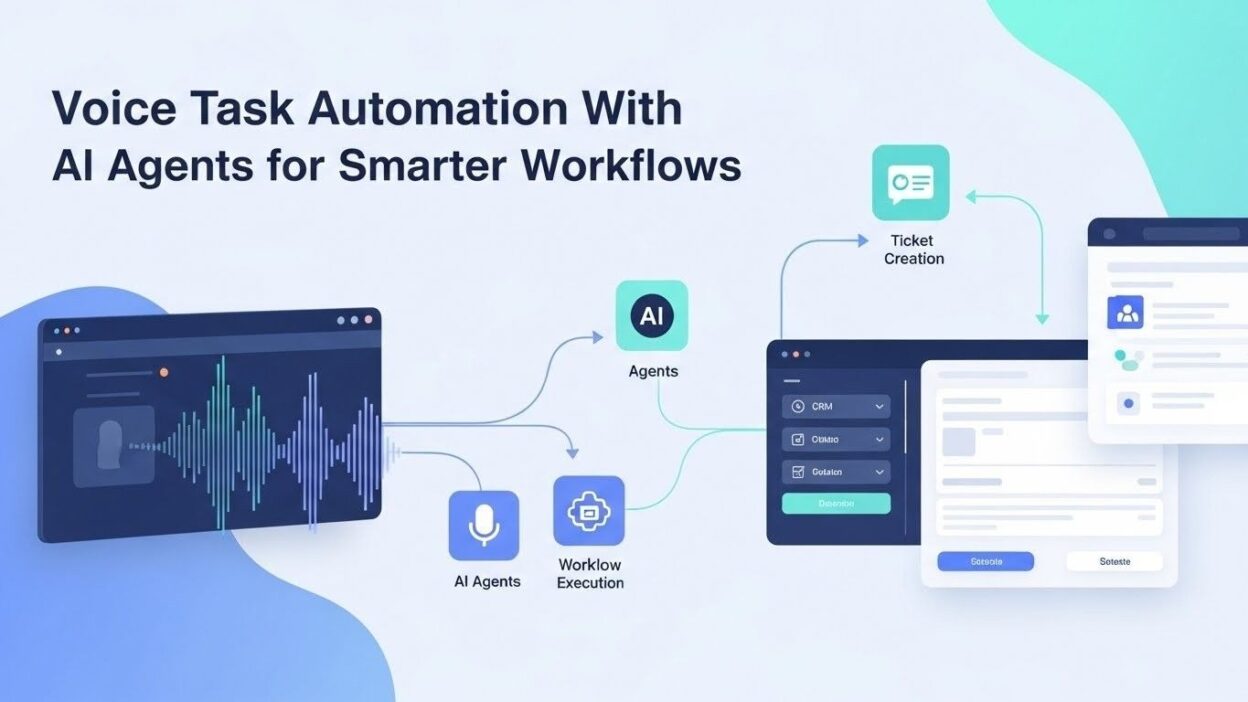
Voice task automation with AI agents transforms professional workflows fundamentally. You speak naturally and systems execute sophisticated processes. The technology bridges human communication and digital execution seamlessly.
How AI Voice Agents Differ From Basic Assistants
Consumer voice assistants follow rigid command structures. They recognize specific phrases only. Deviation from expected patterns causes failures.
AI agents understand intent rather than exact wording. They parse meaning from conversational language. Context awareness enables intelligent interpretation.
Voice task automation with AI agents includes learning capabilities. Systems improve through interaction patterns. Your unique vocabulary becomes familiar over time.
Integration depth separates agents from assistants. Agents connect with enterprise applications directly. They access databases, update records, and trigger workflows. Permissions and security protocols ensure appropriate access.
Core Technologies Powering Voice Automation
Natural language processing forms the foundation. Advanced models understand syntax and semantics. Ambiguity gets resolved through contextual analysis.
Speech recognition converts audio into accurate text. Neural networks handle accents and background noise. Recognition accuracy exceeds 95% in most environments.
Voice task automation with AI agents relies on machine learning algorithms. Training data teaches systems about specific domains. Industry terminology becomes part of the knowledge base.
Application programming interfaces enable action execution. APIs connect voice commands to software functions. RESTful services facilitate communication between systems. Authentication mechanisms maintain security throughout.
Key Capabilities of Modern Voice Agents
Multi-turn conversations feel natural and fluid. Agents remember previous exchanges within sessions. Follow-up questions reference earlier context automatically.
Complex task decomposition happens behind the scenes. Single commands trigger multi-step workflows. Dependencies get managed without user intervention.
Voice task automation with AI agents includes proactive assistance. Systems suggest next actions based on patterns. Predictive capabilities anticipate user needs. Notifications arrive at optimal moments.
Personalization adapts experiences to individual preferences. Learning algorithms track usage patterns. Frequent tasks become accessible through shortcuts. Customization happens organically through regular use.
Benefits of Voice Task Automation With AI Agents
Speed represents the most obvious advantage. Speaking works faster than typing always. Complex commands complete in seconds.
Hands-free operation enables multitasking effectively. You work while walking or driving. Physical location becomes less constraining. Productivity extends beyond traditional desk work.
Dramatic Time Savings
Manual data entry consumes enormous amounts of time. Forms require field-by-field completion. Voice input accelerates the process dramatically.
Meeting notes happen in real time through dictation. Transcription accuracy eliminates revision needs. Summaries generate automatically from voice recordings.
Voice task automation with AI agents handles routine administrative tasks. Scheduling, email management, and report generation require simple commands. Hours previously spent on busywork become available for strategic activities.
Context switching decreases substantially. You stay focused on primary work. Agents handle interruptions and secondary tasks. Cognitive load reduces while productivity increases.
Improved Accuracy and Consistency
Humans make mistakes during repetitive tasks. Fatigue increases error rates significantly. Attention lapses cause data entry problems.
AI agents execute tasks identically every time. Processes follow defined workflows precisely. Compliance requirements get met automatically.
Voice task automation with AI agents includes validation mechanisms. Systems verify information before committing changes. Warnings appear for unusual patterns. Error prevention happens proactively.
Data consistency improves across systems. Information flows between applications reliably. Duplicate entry disappears completely. Single source of truth becomes reality.
Enhanced Accessibility
Physical disabilities limit keyboard and mouse usage. Voice control removes these barriers entirely. Professional opportunities expand for everyone.
Temporary injuries don’t stop productivity. Broken wrists or carpal tunnel don’t prevent work. Voice becomes the primary interface naturally.
Voice task automation with AI agents supports multiple languages. Global teams work in their native tongues. Translation happens automatically when needed. Communication barriers disappear.
Visual impairments become less limiting. Screen readers work alongside voice agents. Audio feedback confirms actions. Independent work becomes more feasible.
Better Work-Life Integration
Voice control works from anywhere. Home offices gain full capabilities. Remote work becomes truly effective.
Mobile devices become powerful workstations. Smartphones handle complex business tasks. Commute time converts to productive hours.
Voice task automation with AI agents enables flexible scheduling. Work happens during optimal personal hours. Rigid 9-to-5 constraints loosen. Life balance improves measurably.
After-hours emergencies get handled efficiently. Quick voice commands resolve urgent issues. Extended disruptions become unnecessary. Personal time remains mostly protected.
Implementing Voice Task Automation in Your Workflow
Strategic planning ensures successful adoption. Random implementation creates confusion. Systematic approaches deliver better results.
Identifying Automation Opportunities
Document your current workflow in detail. Track how you spend each hour. Identify repetitive tasks consuming significant time.
Administrative activities make excellent candidates. Email management, calendar scheduling, and data entry work perfectly. Document creation and report generation benefit enormously.
Voice task automation with AI agents excels at information retrieval. Database queries happen through conversational commands. Complex searches complete in seconds. Research time decreases dramatically.
Customer service functions gain efficiency. Call logging, ticket creation, and follow-up scheduling automate completely. Representatives focus on customer relationships. System updates happen automatically.
Choosing the Right Platform
Evaluate platforms based on integration capabilities. Your chosen solution must connect with existing tools. CRM, project management, and communication systems need seamless linking.
Customization options determine long-term fit. Generic solutions rarely address specific needs. Look for platforms supporting custom workflows. API access enables extended functionality.
Voice task automation with AI agents requires robust security. Verify encryption standards and access controls. Compliance certifications matter for regulated industries. Data residency options affect global operations.
Scalability considerations impact growing organizations. User limits and processing capacity need evaluation. Cloud platforms typically scale more easily. Cost structures should align with expansion plans.
Designing Effective Voice Commands
Natural language works best for most users. Avoid forcing unnatural phrasing. Commands should feel conversational.
Consistency improves learning and adoption. Similar tasks should use similar command structures. Patterns help users remember options.
Voice task automation with AI agents benefits from clear naming conventions. Use descriptive labels for custom workflows. Avoid abbreviations that confuse speech recognition. Test commands with multiple users.
Context awareness reduces command verbosity. Agents should infer missing details when possible. Confirmation requests handle ambiguous situations. Error recovery feels helpful rather than frustrating.
Training Teams for Success
Introduce voice automation gradually. Overwhelming users guarantees resistance. Start with simple use cases.
Demonstrate time savings through real examples. Show before-and-after comparisons. Quantify benefits clearly. Excitement builds through visible results.
Voice task automation with AI agents requires practice. Provide sandbox environments for experimentation. Mistakes shouldn’t affect production systems. Confidence grows through safe exploration.
Create reference guides for common commands. Video tutorials supplement written documentation. Peer mentoring accelerates learning. Champions within teams drive broader adoption.
Advanced Voice Automation Capabilities
Basic command execution provides immediate value. Advanced features multiply benefits substantially. Sophisticated capabilities enable transformation.
Workflow Orchestration
Single voice commands trigger complex processes. Multiple systems execute coordinated actions. Dependencies get managed automatically.
Conditional logic adapts workflows dynamically. Business rules determine execution paths. Exceptions route to appropriate handlers.
Voice task automation with AI agents includes human-in-the-loop options. Critical decisions require approval. Notifications prompt reviews when needed. Automated processes pause for verification.
Parallel execution speeds complex workflows. Independent tasks run simultaneously. Coordination happens behind the scenes. Overall completion time decreases dramatically.
Intelligent Decision Support
AI agents analyze data during conversations. Insights appear as you discuss topics. Recommendations consider multiple factors.
Predictive analytics inform voice interactions. Future trends influence current decisions. Risk assessments highlight potential issues.
Voice task automation with AI agents surfaces relevant information proactively. Historical context appears without requests. Pattern recognition identifies similarities. Past experiences guide present actions.
What-if scenarios explore alternatives quickly. Verbal descriptions generate projections. Multiple options compare side by side. Decision confidence increases substantially.
Natural Language Reporting
Data visualization happens through voice commands. Request charts and graphs conversationally. Complex analytics become accessible to everyone.
Report generation requires simple instructions. Specify parameters verbally. Systems compile information automatically. Formatted documents arrive in seconds.
Voice task automation with AI agents enables ad-hoc analysis. Exploratory questions yield immediate answers. Follow-up queries drill deeper. Business intelligence democratizes across organizations.
Scheduled reports deliver via preferred channels. Email, messaging apps, or dashboards receive updates. Frequency and timing adapt to needs. Information arrives when most useful.
Cross-Platform Integration
Agents coordinate actions across multiple applications. Single commands affect several systems. Data synchronization happens automatically.
Legacy system access improves through voice interfaces. Older applications gain modern interaction methods. Technical debt becomes less limiting.
Voice task automation with AI agents bridges communication tools. Messages route to appropriate platforms. Video calls launch through voice commands. Contact information appears instantly.
IoT device control extends automation reach. Office equipment responds to voice instructions. Environmental adjustments happen hands-free. Physical and digital worlds connect seamlessly.
Industry-Specific Applications
Different sectors benefit in unique ways. Vertical solutions address specialized needs. Customization maximizes value.
Healthcare Applications
Clinical documentation consumes physician time. Voice dictation during patient visits maintains eye contact. Electronic health records update automatically.
Medication orders place through verbal instructions. Dosage calculations happen instantly. Drug interaction warnings appear immediately.
Voice task automation with AI agents schedules appointments efficiently. Patient preferences match provider availability. Reminder calls place automatically. No-show rates decrease measurably.
Diagnostic support provides treatment recommendations. Symptoms described verbally trigger research. Medical literature searches complete in seconds. Evidence-based decisions improve patient outcomes.
Legal Practice Enhancement
Case research accelerates through voice queries. Precedent searches span entire databases. Relevant citations appear within moments.
Document drafting begins with verbal outlines. Templates populate based on case type. Clause libraries insert through commands.
Voice task automation with AI agents handles client intake. Initial consultations capture details accurately. Case management systems update automatically. Conflict checks run without manual initiation.
Billing and time tracking happen continuously. Activities log as work occurs. Detailed records build throughout days. Revenue capture becomes comprehensive.
Financial Services Optimization
Market research happens through conversational queries. Real-time data flows to decision makers. Analysis completes during discussions.
Trade execution occurs via secure voice authentication. Multi-factor verification ensures legitimacy. Transaction confirmations arrive immediately.
Voice task automation with AI agents monitors portfolio performance. Alert thresholds trigger notifications. Rebalancing recommendations appear proactively. Client communications happen automatically.
Compliance reporting generates through simple commands. Regulatory requirements translate to automated workflows. Audit trails document every action. Risk management improves substantially.
Sales and Marketing Automation
CRM updates happen during customer conversations. Contact information captures automatically. Interaction history builds without data entry.
Lead qualification occurs through voice interviews. AI asks relevant questions systematically. Scoring updates in real time. Hot prospects route immediately.
Voice task automation with AI agents schedules follow-up activities. Reminders ensure timely outreach. Email sequences launch automatically. Pipeline management becomes effortless.
Campaign performance reviews happen verbally. Metrics discussions feel natural. Ad spend adjustments execute through commands. ROI optimization accelerates dramatically.
Measuring Success and ROI
Quantifiable metrics demonstrate value clearly. Stakeholders need concrete evidence. Data-driven proof justifies investments.
Time Savings Calculation
Track task completion times before implementation. Document baseline measurements carefully. Average durations provide comparison points.
Measure post-implementation speeds accurately. Voice task automation with AI agents typically reduces time by 40-70%. Specific tasks show even greater improvements.
Multiply time savings by hourly labor costs. Annual projections reveal substantial returns. Productivity gains often exceed technology costs within months.
Capacity increases enable more work. Revenue opportunities expand naturally. Growth happens without proportional headcount additions.
Quality Improvement Metrics
Error rates decrease with automation. Track defects before and after implementation. Quality improvements translate to cost savings.
Customer satisfaction scores typically improve. Response times decrease measurably. Issue resolution accelerates substantially.
Voice task automation with AI agents enhances compliance. Audit findings decrease in number. Regulatory risk reduces significantly. Fines and penalties become less likely.
Employee satisfaction increases measurably. Frustration with repetitive work disappears. Job fulfillment improves. Retention rates rise accordingly.
Adoption Rates Tracking
Monitor active user percentages monthly. High adoption indicates successful implementation. Low numbers suggest problems needing attention.
Command diversity shows sophistication. Basic usage provides limited value. Advanced feature adoption maximizes benefits.
Voice task automation with AI agents should integrate into daily routines. Frequency metrics reveal habit formation. Regular use indicates genuine value perception.
Support ticket analysis identifies pain points. Common issues require training or fixes. Resolution speeds affect user satisfaction. Ongoing improvement maintains momentum.
Overcoming Implementation Challenges
Every technology adoption faces obstacles. Preparation prevents most problems. Solutions exist for common issues.
Privacy and Security Concerns
Voice data contains sensitive information. Recording and transmission need protection. Encryption standards must meet industry requirements.
Access controls limit who hears recordings. Role-based permissions prevent unauthorized listening. Audit logs track every access attempt.
Voice task automation with AI agents requires clear policies. Data retention periods need definition. Deletion procedures must exist. Compliance frameworks guide policy creation.
Employee education addresses privacy concerns. Transparent practices build trust. Clear boundaries respect personal privacy. Professional use guidelines prevent misuse.
Accuracy and Reliability Issues
Background noise affects recognition quality. Quiet environments work best initially. Noise cancellation improves over time.
Accents and speech patterns vary widely. Training periods adapt to individuals. Patience during learning phases pays dividends.
Voice task automation with AI agents improves through corrections. Feedback mechanisms teach systems. Vocabulary expands with usage. Industry terminology becomes familiar.
Fallback options handle recognition failures. Text input provides backup methods. Hybrid approaches ensure task completion. Frustration decreases with alternatives.
Integration Complexity
Legacy systems lack modern APIs. Custom development becomes necessary. Integration projects require significant resources.
Data format inconsistencies create problems. Transformation layers translate between systems. Middleware platforms simplify connectivity.
Voice task automation with AI agents needs thorough testing. Integration bugs affect user experience. Comprehensive QA prevents production issues. Phased rollouts limit impact.
Vendor support matters enormously. Technical assistance accelerates problem resolution. Documentation quality affects implementation speed. Partnership approach benefits both parties.
Change Management Resistance
Employees fear job displacement. Automation anxiety affects morale. Clear communication addresses concerns.
Focus messaging on enhancement rather than replacement. Voice tools make work easier. Strategic tasks receive more attention. Career development opportunities improve.
Voice task automation with AI agents creates new roles. Bot trainers and automation specialists emerge. Skills evolution happens naturally. Growth mindset cultures adapt easily.
Executive sponsorship drives adoption. Leadership visibility signals importance. Resource allocation demonstrates commitment. Success stories cascade from top down.
Future Trends in Voice Automation
Technology evolution accelerates constantly. Emerging capabilities expand possibilities. Forward-thinking organizations prepare proactively.
Emotional Intelligence Integration
Future agents will detect emotional states. Voice tone reveals frustration or confusion. Responses adapt to emotional context.
Empathetic interactions improve experiences. Difficult conversations receive appropriate handling. Customer relationships deepen through understanding.
Voice task automation with AI agents will provide coaching. Communication feedback helps development. Soft skills improve through AI guidance. Professional growth accelerates.
Multilingual Capabilities Expansion
Real-time translation removes language barriers. Global teams collaborate effortlessly. Cultural differences become less limiting.
Accent adaptation improves continuously. Regional variations pose fewer challenges. Inclusive technology serves everyone equally.
Voice task automation with AI agents will support hundreds of languages. Market expansion opportunities grow. International operations simplify substantially. Global competitiveness increases.
Predictive Task Execution
Agents will anticipate needs proactively. Patterns predict required actions. Tasks complete before requests.
Contextual awareness reaches new levels. Calendar events trigger preparations. Meeting materials appear automatically. Productivity optimizes continuously.
Voice task automation with AI agents becomes truly assistive. Cognitive load decreases further. Focus intensity increases. Innovation time expands naturally.
Frequently Asked Questions
How accurate is voice task automation with AI agents?
Modern systems achieve 95-98% accuracy in normal conditions. Recognition improves through usage. Background noise affects performance. Quality microphones enhance results significantly.
What industries benefit most from voice automation?
Healthcare, legal, financial services, and sales see dramatic improvements. Any knowledge work involving repetitive tasks benefits substantially. Voice task automation with AI agents adapts to virtually any sector.
How long does implementation take?
Basic deployments complete in 2-4 weeks. Complex enterprise integrations require 3-6 months. Phased approaches deliver incremental value. Team size and technical complexity affect timelines.
What security measures protect voice data?
End-to-end encryption secures transmissions. Data centers meet compliance standards. Access controls limit exposure. Regular audits verify security posture.
Can voice agents work offline?
Some capabilities function without connectivity. Basic commands process locally. Complex workflows require cloud processing. Hybrid architectures balance capabilities and connectivity.
How much does voice automation cost?
Pricing varies by features and users. Small teams spend $20-50 per user monthly. Enterprise solutions cost more but deliver greater value. ROI typically occurs within 6-12 months.
Will voice automation replace human workers?
Voice task automation with AI agents augments rather than replaces. Technology handles routine work. Humans focus on judgment and creativity. Job roles evolve rather than disappear.
How do you ensure privacy with always-listening devices?
Wake words activate listening. Recording doesn’t happen continuously. Indicator lights show active status. Privacy controls enable selective usage.
Read More:-How to Choose Affordable AI Lead Qualification Software
Conclusion
Professional work demands constant efficiency improvements. Traditional methods limit productivity growth. Typing and clicking slow progress unnecessarily.
Voice task automation with AI agents represents the next productivity frontier. Natural communication becomes powerful automation. Complex workflows execute through simple speech.
Implementation requires strategic planning. Identify high-value automation opportunities. Choose platforms supporting your specific needs. Design intuitive voice commands carefully.
Training determines adoption success. Introduce capabilities gradually. Demonstrate tangible benefits early. Support teams through learning curves.
Advanced features multiply basic benefits. Workflow orchestration handles complex processes. Decision support improves choice quality. Cross-platform integration eliminates silos.
Industry-specific applications deliver specialized value. Healthcare documentation improves. Legal research accelerates. Financial analysis enhances. Sales productivity soars.
Measurable results justify investments clearly. Time savings compound daily. Quality improvements reduce costs. Adoption metrics prove acceptance.
Common challenges have proven solutions. Privacy concerns address through policies. Accuracy improves with usage. Integration complexity reduces through planning.
Voice task automation with AI agents will continue evolving. Emotional intelligence humanizes interactions. Multilingual support expands reach. Predictive execution anticipates needs.
Start your voice automation journey today. Assess current workflow inefficiencies. Research available platforms thoroughly. Plan phased implementation carefully.
The benefits compound over time. Early productivity gains fund expansion. Capabilities grow with experience. Competitive advantages multiply.
Your team deserves better tools. Repetitive work wastes human potential. Strategic thinking creates real value. Voice automation enables this focus.
Customers benefit from improved responsiveness. Faster service builds loyalty. Accuracy enhances trust. Relationships deepen naturally.
Voice task automation with AI agents democratizes advanced capabilities. Small teams gain enterprise power. Technical barriers disappear. Innovation accelerates universally.
The technology works reliably today. Thousands of organizations benefit currently. Proven ROI justifies adoption. Risk decreases with maturity.
Don’t let outdated methods hold you back. Productivity improvements await. Voice control offers natural interaction. AI agents execute reliably.
Take action this week. Identify one repetitive task. Automate through voice commands. Experience the difference personally.
Voice task automation with AI agents will define future work. Leading organizations adopt early. Competitive gaps widen quickly. Your decision matters significantly.
Transform how work happens. Speak naturally and systems respond. Complexity simplifies through conversation. Productivity reaches new levels.
The future of work is voice-enabled. AI agents handle execution details. Humans focus on what matters. Success becomes more achievable for everyone.