Introduction
TL;DR Generic AI tools dominated headlines for the past two years. ChatGPT, Claude, and other general-purpose models captured everyone’s attention. Businesses rushed to implement these technologies across operations. Many found the results disappointing. Generic solutions rarely address specific industry problems effectively.
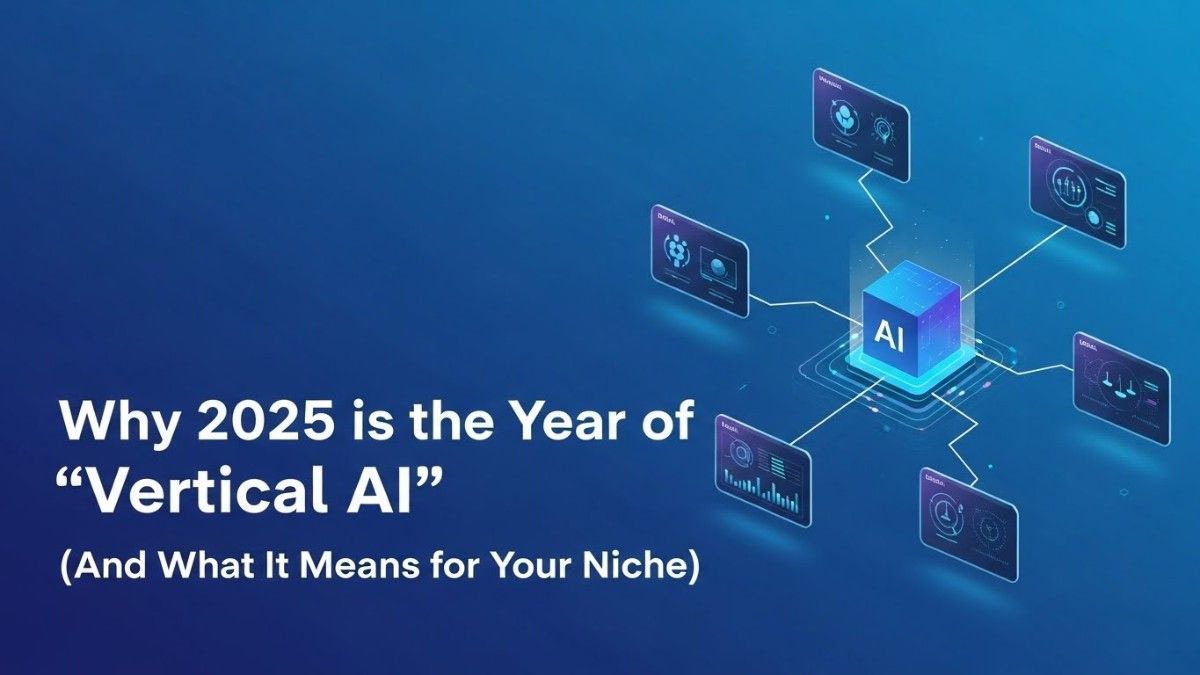
2025 marks a dramatic shift in the AI landscape. Vertical AI solutions target specific industries with specialized knowledge. These focused applications understand industry jargon, regulations, and workflows. They solve real problems rather than providing generic assistance. The transformation affects every business sector imaginable.
Understanding vertical AI use cases helps you position your business competitively. Companies ignoring this shift risk falling behind more agile competitors. Early adopters gain significant advantages in efficiency and customer satisfaction. This guide explores why vertical AI matters now and how it impacts your specific industry.
Table of Contents
Understanding Vertical AI and Its Rise
Vertical AI refers to artificial intelligence systems built for specific industries or use cases. Unlike general-purpose models, these solutions incorporate deep domain expertise. They understand context that generic AI cannot grasp. A vertical AI for healthcare knows medical terminology, treatment protocols, and compliance requirements.
The distinction matters tremendously for practical applications. General AI provides broad but shallow knowledge across all topics. Vertical AI offers deep, actionable intelligence for specific domains. It understands nuances that make the difference between helpful and useless.
Several factors drive the vertical AI revolution happening right now. General AI adoption revealed significant gaps in addressing industry-specific needs. Companies discovered generic chatbots couldn’t handle complex domain questions. Legal AI needs different capabilities than healthcare AI. Manufacturing requires distinct functionality from financial services.
Data availability within industries enables better vertical solutions. Companies accumulated years of domain-specific information. Training models on this specialized data creates superior performance. A legal AI trained on millions of contracts outperforms general models on legal tasks.
Regulatory pressure demands specialized solutions. Healthcare AI must comply with HIPAA. Financial AI needs SOC 2 compliance. Generic solutions struggle meeting industry-specific regulations. Vertical AI builds compliance into its foundation.
Investment patterns reveal the market shift clearly. Venture capital funding for vertical AI startups exploded in 2024. Investors recognize that sustainable AI businesses serve specific niches deeply. The era of “AI for everything” gave way to “AI for something specific.”
How Vertical AI Use Cases Differ from General AI
Generic AI attempts solving every problem with one approach. Vertical AI optimizes for specific tasks within defined domains. This specialization creates dramatically better results for targeted applications.
Consider the difference in training data. General models train on internet-wide information covering all human knowledge broadly. Vertical models train on curated domain-specific datasets. A radiology AI learns from millions of medical images with expert annotations. This focused training produces superior diagnostic accuracy.
Output quality varies substantially between approaches. General AI might provide technically correct but practically useless answers. Vertical AI delivers actionable insights formatted for industry workflows. A construction AI outputs information in formats contractors actually use daily.
Integration capabilities differ fundamentally. General AI exists as standalone tools requiring manual integration. Vertical AI embeds directly into existing industry software and workflows. Healthcare providers access AI within their electronic health records. Lawyers find AI built into their case management systems.
Accuracy matters more in specialized contexts. General AI might be 70% accurate across broad topics. Vertical AI achieves 95%+ accuracy in its specific domain. That accuracy difference determines whether professionals trust and adopt the technology.
Cost structures reflect the specialization. General AI charges per token or request uniformly. Vertical AI prices based on value delivered within specific workflows. A financial AI might charge per transaction processed rather than per API call.
User experience design targets specific professional needs. General AI interfaces work for anyone doing anything. Vertical AI interfaces match how professionals in that field actually work. The learning curve drops dramatically when AI speaks your industry’s language.
Vertical AI Use Cases Transforming Healthcare
Healthcare represents one of the most promising domains for specialized AI. The industry combines complex regulations, high stakes decisions, and massive data volumes. Generic AI tools fall short in this demanding environment.
Diagnostic imaging analysis showcases vertical AI’s power. Radiology AI systems analyze X-rays, MRIs, and CT scans with expert-level accuracy. These systems catch subtle abnormalities human eyes might miss. They prioritize urgent cases requiring immediate attention. Radiologists review more cases faster with greater confidence.
Clinical documentation automation saves physicians hours daily. Doctors spend more time typing notes than treating patients traditionally. Vertical AI listens to patient conversations and generates accurate clinical notes. The system understands medical terminology and documentation requirements. Physicians review and approve rather than typing from scratch.
Drug discovery acceleration compresses development timelines dramatically. Traditional drug development takes over a decade. AI models predict molecular interactions and potential drug candidates. Researchers focus experimental work on the most promising compounds. The technology potentially saves years in bringing new treatments to patients.
Patient monitoring systems predict complications before they become critical. ICU monitoring AI analyzes vital signs continuously. The system recognizes patterns indicating deterioration hours before traditional alerts. Nurses receive early warnings allowing preventive interventions. Mortality rates decrease when problems get caught earlier.
Administrative workflow automation reduces healthcare’s massive overhead costs. Medical coding AI assigns proper billing codes automatically. Insurance verification systems process claims without human review. Appointment scheduling AI optimizes provider calendars while accommodating patient preferences. These vertical AI use cases free staff for patient-focused work.
Legal Industry Vertical AI Applications
Legal professionals face overwhelming document volumes and complex research requirements. The industry remained resistant to technology for decades. Vertical AI finally provides tools matching lawyers’ actual needs.
Contract analysis systems review agreements with expert precision. Legal AI identifies risky clauses, missing provisions, and non-standard terms. The technology processes thousands of pages in minutes. Lawyers focus on strategy rather than document review drudgery. Contract negotiations proceed faster with AI-identified issues.
Legal research gets transformed by specialized AI. Traditional research requires hours searching databases and reading cases. Vertical AI understands legal reasoning and precedent relationships. It finds relevant cases even when they use different terminology. Research that took days now completes in minutes.
Due diligence automation accelerates merger and acquisition processes. Corporate transactions involve reviewing massive document collections. Legal AI categorizes documents, flags issues, and summarizes findings. Deal teams accomplish in weeks what previously required months. The thoroughness often exceeds manual review quality.
Litigation prediction models assess case outcomes based on historical data. Legal AI analyzes similar past cases and their results. Lawyers make more informed decisions about settlement versus trial. Clients receive realistic assessments of likely outcomes and costs.
Regulatory compliance monitoring keeps businesses current with changing laws. Regulations evolve constantly across jurisdictions. Vertical AI tracks changes affecting specific businesses. Companies receive alerts about new compliance requirements. The system suggests policy updates needed to maintain compliance.
Financial Services Vertical AI Use Cases
Financial institutions manage risk, detect fraud, and serve customers at massive scale. The industry generates and analyzes enormous data volumes. Specialized AI transforms how financial services operate.
Fraud detection systems protect customers and institutions from criminal activity. Traditional rules-based systems generate excessive false positives. Vertical AI learns normal behavior patterns for each customer. It flags genuinely suspicious transactions while reducing false alarms. Financial losses from fraud decrease while customer friction reduces.
Credit risk assessment models evaluate borrower reliability more accurately. Traditional credit scores miss important indicators and exclude many potential borrowers. AI models analyze alternative data sources and behavioral patterns. More creditworthy people gain access to capital. Lenders reduce default rates through better risk assessment.
Algorithmic trading systems execute sophisticated strategies at superhuman speed. Financial AI analyzes market conditions, news, and trading patterns continuously. It identifies opportunities and executes trades in milliseconds. Institutional investors gain edge through AI-powered trading systems.
Customer service automation handles routine inquiries instantly. Banking chatbots understand financial terminology and account-specific context. They process transactions, answer questions, and resolve issues without human agents. Customers get immediate assistance while costs decrease dramatically.
Investment advisory AI democratizes wealth management. Traditional financial advisors serve only wealthy clients profitably. Robo-advisors powered by vertical AI provide personalized investment advice at scale. Middle-class investors access sophisticated portfolio management previously unavailable to them.
Anti-money laundering systems detect illegal financial activity more effectively. Regulations require financial institutions to monitor and report suspicious transactions. Vertical AI identifies complex money laundering patterns across accounts and institutions. Compliance costs decrease while detection effectiveness improves.
Manufacturing and Supply Chain Applications
Manufacturing operations generate massive sensor data from equipment and processes. Supply chains involve coordinating thousands of suppliers, shipments, and inventory locations. Vertical AI brings intelligence to these complex physical systems.
Predictive maintenance prevents equipment failures before they occur. Manufacturing equipment sensors generate continuous operational data. AI models recognize patterns indicating impending failures. Maintenance teams receive advance warning allowing scheduled repairs. Unplanned downtime decreases dramatically with predictive maintenance.
Quality control automation catches defects human inspectors miss. Computer vision AI examines products at production line speed. The system identifies microscopic defects and inconsistencies. Defect rates drop while inspection costs decrease. Customers receive higher quality products consistently.
Supply chain optimization balances inventory, transportation, and demand dynamically. Vertical AI predicts demand fluctuations across products and locations. It optimizes inventory levels minimizing both stockouts and excess inventory. Transportation routing adapts to real-time conditions maximizing efficiency. Supply chain costs decrease while customer service improves.
Production scheduling AI maximizes factory output while minimizing costs. Traditional scheduling struggles with complex constraints and changing conditions. Vertical AI considers hundreds of variables simultaneously. It adapts schedules dynamically as conditions change. Factories produce more with existing equipment.
Supplier risk management identifies potential disruptions before they impact production. AI monitors supplier financial health, geopolitical risks, and operational indicators. Procurement teams receive early warning of potential problems. Companies maintain backup suppliers for critical components. Supply chain resilience improves through proactive risk management.
Retail and E-commerce Vertical AI Use Cases
Retail combines inventory management, customer behavior prediction, and personalization at scale. E-commerce generates detailed data about every customer interaction. Vertical AI transforms this data into competitive advantage.
Personalized recommendation engines drive substantial revenue increases. Generic recommendation algorithms suggest popular items. Vertical AI understands individual customer preferences, browsing patterns, and purchase history. Recommendations become eerily accurate. Customers discover products they genuinely want. Conversion rates and average order values increase significantly.
Dynamic pricing optimization balances revenue and competitiveness. Prices that maximize profit for one customer might drive away another. Vertical AI adjusts pricing based on demand, competition, inventory levels, and customer price sensitivity. Revenue increases without sacrificing customer satisfaction.
Inventory forecasting prevents both stockouts and overstock situations. Traditional forecasting relies on historical patterns and manual adjustments. AI models incorporate weather, trends, local events, and hundreds of other factors. Stores stock the right products in the right quantities. Working capital requirements decrease while availability improves.
Customer service chatbots handle product questions and order issues. Retail chatbots understand product catalogs, shipping policies, and return procedures. They resolve issues without human agents. Customer satisfaction remains high while support costs decrease dramatically.
Visual search enables customers to find products from images. Customers photograph items they like and search for similar products. Vertical AI understands visual similarity and product attributes. Customers find exactly what they want even without knowing product names.
Store layout optimization increases sales per square foot. AI analyzes traffic patterns and purchase behavior within physical stores. It recommends optimal product placement and store layouts. Customers find products easier while impulse purchases increase.
Real Estate Vertical AI Applications
Real estate involves complex transactions, market analysis, and property management. The industry remained relatively low-tech despite massive transaction values. Vertical AI brings sophistication to real estate operations.
Property valuation models assess market values more accurately than traditional appraisals. AI analyzes recent sales, property characteristics, neighborhood trends, and economic indicators. Valuations complete instantly rather than requiring days. Accuracy often exceeds human appraisers for standard properties.
Lead qualification systems identify serious buyers among casual browsers. Real estate agents waste time on unqualified leads traditionally. Vertical AI scores leads based on behavior, financial capacity, and buying signals. Agents focus effort on prospects most likely to transact. Conversion rates increase while wasted time decreases.
Property matching engines connect buyers with ideal properties. Traditional search relies on buyers specifying requirements. AI understands preferences from viewing behavior and feedback. It suggests properties buyers didn’t know to search for. Customer satisfaction increases through better matches.
Market trend analysis predicts neighborhood appreciation and decline. Real estate investors need accurate market timing. Vertical AI analyzes economic indicators, development plans, demographic shifts, and transaction patterns. Investment decisions improve through better market intelligence.
Property management automation handles routine landlord tasks. Tenant screening AI evaluates applications consistently and fairly. Maintenance request systems diagnose issues and schedule appropriate contractors. Rent collection automation reduces late payments. Property managers oversee more units efficiently.
Virtual staging and renovation visualization helps buyers see potential. AI generates realistic images showing how spaces could look furnished or renovated. Buyers envision possibilities in dated or empty properties. Properties sell faster at higher prices with effective visualization.
Education Technology Vertical AI Use Cases
Education faces challenges scaling personalized instruction. Teachers cannot customize learning for each student in large classes. Vertical AI enables personalization previously impossible at scale.
Adaptive learning platforms customize curriculum to individual student needs. The system assesses student knowledge and learning pace continuously. It adjusts difficulty and presentation style for optimal learning. Students master material faster with less frustration. Teachers identify students needing intervention earlier.
Automated grading systems provide immediate feedback on assignments. Teachers spend countless hours grading routine assignments. AI grades objective questions, essays, and even code submissions. Students receive instant feedback. Teachers focus on instruction rather than grading.
Tutoring chatbots provide on-demand homework help. Students struggle outside classroom hours without access to help. Vertical AI tutors answer questions and guide problem-solving. The system ensures students think through problems rather than just getting answers. Every student gains access to unlimited tutoring support.
Curriculum development AI helps educators create effective learning materials. Creating quality educational content requires substantial time and expertise. Vertical AI suggests lesson structures, practice problems, and assessment questions. Teachers develop better materials in less time.
Student intervention systems identify struggling students before they fail. Traditional early warning systems rely on lagging indicators like grades. AI analyzes engagement patterns, assignment completion, and learning pace. Counselors reach out to students showing concerning patterns. Dropout rates decrease through timely intervention.
Language learning applications provide immersive practice. Learning languages requires extensive conversation practice. AI conversation partners speak naturally and correct errors. Students practice without embarrassment. Language acquisition accelerates through unlimited practice.
Agriculture and Farming Vertical AI Applications
Agriculture combines biology, weather, economics, and operations management. Farmers make countless decisions affecting crop yields and profitability. Vertical AI brings data-driven decision making to farming.
Crop health monitoring identifies plant diseases and stress before visible symptoms appear. Drones and satellites capture multispectral images of fields. AI detects subtle changes indicating problems. Farmers treat affected areas before disease spreads. Crop losses decrease through early intervention.
Precision agriculture optimizes inputs like water, fertilizer, and pesticides. Traditional farming applies inputs uniformly across fields. Soil conditions and crop needs vary significantly within fields. AI creates application maps optimizing inputs at meter-scale resolution. Yields increase while input costs and environmental impact decrease.
Harvest timing optimization maximizes crop quality and market value. Harvesting too early or late reduces quality and value. Vertical AI considers crop maturity, weather forecasts, and market prices. Farmers harvest at optimal times. Revenue increases through better timing.
Livestock monitoring tracks animal health and behavior continuously. Wearable sensors measure activity, temperature, and rumination. AI detects illness and stress before obvious symptoms appear. Farmers intervene earlier improving animal welfare and productivity.
Commodity price forecasting helps farmers make planting and marketing decisions. Agricultural markets fluctuate based on weather, geopolitics, and demand. Vertical AI analyzes factors affecting prices. Farmers make more informed decisions about what to plant and when to sell.
Equipment automation increases productivity while reducing labor requirements. Autonomous tractors, harvesters, and sprayers operate with AI guidance. The equipment works longer hours with consistent precision. Farms produce more with less labor.
Building Your Vertical AI Strategy
Understanding vertical AI use cases matters only if you act on that knowledge. Developing a strategy for your specific industry requires systematic thinking.
Start by identifying your industry’s highest-value problems. Which tasks consume disproportionate time or resources? Where do errors carry serious consequences? What decisions require expertise your organization lacks? These pain points represent opportunities for vertical AI.
Assess available solutions in your specific vertical. Research startups building AI for your industry. Evaluate whether established vendors added AI capabilities. Test multiple solutions with pilot projects. Real-world testing reveals whether marketing matches reality.
Consider building versus buying vertical AI solutions. Building requires data science expertise and substantial investment. Buying provides faster deployment but less customization. Most companies should buy initially and build only for unique competitive advantages.
Evaluate your data readiness for AI implementation. Vertical AI requires quality data in accessible formats. Assess what data you collect currently. Identify gaps preventing effective AI deployment. Start collecting missing data types now.
Plan for change management and training. AI adoption fails when users resist new tools. Involve end users in selection and testing. Provide comprehensive training. Emphasize how AI makes their jobs easier rather than threatening them.
Establish metrics measuring AI impact. Define success criteria before deployment. Track relevant KPIs measuring efficiency, quality, or revenue impact. Quantifying value justifies continued investment and expansion.
Start small and scale gradually. Begin with focused pilot projects in specific departments. Prove value before organization-wide deployment. Learn from initial implementations before expanding scope. Successful pilots build organizational confidence.
Preparing for the Vertical AI Future
Vertical AI adoption accelerates rapidly throughout 2025. Companies embracing this technology gain significant competitive advantages. Those delaying adoption risk falling behind irreversibly.
Competitive dynamics shift in favor of AI-enabled companies. Early adopters process work faster with better quality. They serve customers more effectively at lower costs. These advantages compound over time. Late adopters struggle catching up.
Talent requirements evolve as AI handles routine work. Professionals need skills complementing AI rather than competing with it. Focus on judgment, creativity, and complex problem-solving. Technical skills around working with AI become essential. Invest in training existing staff for this transition.
Business models transform as AI changes economics. Services previously requiring extensive labor become dramatically cheaper. Companies need new pricing approaches reflecting changed cost structures. Some traditional revenue streams disappear while new opportunities emerge.
Ethical considerations require serious attention. Vertical AI makes consequential decisions affecting people’s lives. Bias in training data can perpetuate or amplify discrimination. Companies deploying AI need robust governance frameworks. Transparency and accountability become competitive advantages.
Regulatory landscapes evolve rapidly addressing AI deployment. Industry-specific regulations will govern AI use in sensitive domains. Stay informed about emerging regulations affecting your vertical. Build compliance into AI strategy from the start. Retroactively achieving compliance costs far more.
Partnership ecosystems develop around vertical AI platforms. No single vendor provides complete solutions. Integration between specialized vertical AI tools creates comprehensive capabilities. Build relationships with key vendors in your space. Collaborative ecosystems accelerate everyone’s progress.
Frequently Asked Questions
What exactly makes vertical AI different from regular AI?
Vertical AI gets trained specifically on industry data and optimized for domain tasks. Regular AI learns from general internet data covering all topics broadly. Vertical AI understands industry terminology, regulations, and workflows deeply. This specialization produces dramatically better results for specific use cases. A legal AI understands contracts better than general AI ever could. The training data and optimization focus create the meaningful difference.
Which industries benefit most from vertical AI?
Industries with complex regulations, specialized knowledge, and high-stakes decisions benefit most. Healthcare, legal, financial services, and manufacturing see the largest impacts currently. Any industry with substantial domain expertise and data volumes can benefit. The key factors are complexity, available data, and value of improved decisions. Even traditionally low-tech industries like agriculture now deploy sophisticated vertical AI successfully.
How much does implementing vertical AI cost?
Costs vary enormously based on deployment scale and customization needs. SaaS vertical AI solutions start at hundreds monthly for small businesses. Enterprise deployments cost tens of thousands monthly. Custom development runs hundreds of thousands to millions. Most companies start with affordable SaaS solutions. Costs often decrease over time as technology matures and competition increases. Focus on ROI rather than absolute costs.
Can small businesses access vertical AI or just large enterprises?
Small businesses increasingly access vertical AI through affordable SaaS solutions. Many vertical AI startups target small business markets explicitly. Cloud-based delivery makes sophisticated technology accessible. Small businesses often adopt AI faster than large enterprises. Less legacy infrastructure and bureaucracy enable quicker deployment. The playing field levels as powerful AI becomes available to all company sizes.
How do I know if my industry has vertical AI solutions available?
Search for “AI for [your industry]” to discover available solutions. Industry conferences and trade publications increasingly cover AI applications. Ask technology vendors serving your industry about AI capabilities. Join industry associations and discussion groups to learn what peers use. Vertical AI solutions exist for most industries now. The question becomes which solution fits your specific needs best.
What risks come with adopting vertical AI?
Data security and privacy concerns top the risk list. Vendor dependency creates potential lock-in. AI errors could have serious consequences in some domains. Implementation might disrupt existing workflows temporarily. Training and change management require investment. Regulations might change affecting AI usage. These risks require management but rarely outweigh benefits when addressed properly. Pilot projects minimize risk during initial adoption.
How long before vertical AI impacts my specific industry?
Vertical AI already impacts most industries currently. Adoption timelines vary by sector. Heavily regulated industries like healthcare adopt more slowly. Technology and financial services adopt rapidly. Your specific industry likely has AI solutions available now. The question is how quickly competitors adopt rather than when solutions become available. Delaying exploration means competitors potentially gain advantages.
Do I need data scientists to implement vertical AI?
Modern vertical AI solutions require minimal technical expertise. SaaS platforms provide user-friendly interfaces. Most solutions integrate with existing software easily. Data scientists help with custom development but not standard implementations. Your industry expertise matters far more than data science skills. Focus on understanding your problems and evaluating solutions. Technical vendors handle the complex parts.
Will vertical AI replace workers in my industry?
Vertical AI augments workers rather than replacing them in most cases. AI handles routine tasks allowing humans to focus on complex judgment. Some roles transform significantly while new roles emerge. Industries using AI typically expand rather than contract. Productivity increases enable growth. The transition requires workforce adaptation through training. Companies managing this transition well gain advantages through both AI and human capital.
Read More:-Bubble vs. FlutterFlow vs. Traditional Code: Building AI Apps Without Developers
Conclusion

2025 represents an inflection point in artificial intelligence deployment. The era of generic AI gives way to specialized vertical solutions. These focused applications understand specific industries deeply. They solve real problems rather than providing generic assistance.
Understanding vertical AI use cases positions your business for competitive success. Early adopters gain efficiency advantages that compound over time. They serve customers better while reducing operational costs. The technology enables capabilities previously impossible at any cost.
Every major industry now has vertical AI solutions available. Healthcare AI improves diagnostics and reduces administrative burden. Legal AI transforms research and document review. Financial services AI detects fraud and personalizes services. Manufacturing AI predicts failures and optimizes production. Retail AI personalizes experiences and manages inventory. The applications span every sector imaginable.
The shift from general to vertical AI accelerates throughout 2025. Investments pour into industry-specific solutions. Startups and established vendors race to serve specific niches. Generic AI platforms remain useful but specialized tools deliver greater value for focused applications.
Your vertical AI strategy should begin immediately. Identify high-value problems in your specific operations. Research available solutions targeting your industry. Start with pilot projects proving value before scaling. Involve end users ensuring adoption success. Measure results demonstrating ROI.
Competitive dynamics favor companies embracing vertical AI quickly. The technology advantages compound over time. Early adopters set standards competitors struggle matching. Delaying adoption means falling behind potentially irreversibly. The question is not whether to adopt but how quickly.
Workforce implications require thoughtful planning. AI handles routine tasks freeing humans for complex judgment. Some roles transform while new opportunities emerge. Invest in training preparing your team for AI-augmented work. Companies managing this transition well gain advantages through both technology and talent.
Ethical deployment matters for long-term success. Vertical AI use cases often involve consequential decisions. Bias and errors carry serious implications. Build governance frameworks ensuring responsible AI use. Transparency and accountability become competitive advantages.
Regulatory landscapes evolve addressing industry-specific AI deployment. Stay informed about emerging requirements in your sector. Build compliance into AI strategy from the beginning. Proactive compliance prevents expensive retrofitting later.
Partnership ecosystems accelerate vertical AI benefits. No single vendor provides complete solutions. Integration between specialized tools creates comprehensive capabilities. Build relationships with key vendors in your space. Collaborative approaches benefit all participants.
The vertical AI revolution transforms every industry fundamentally. Companies recognizing and acting on this shift gain substantial advantages. Those ignoring the trend risk competitive obsolescence. 2025 marks the year vertical AI moves from emerging technology to competitive necessity.
Start exploring vertical AI use cases relevant to your business today. Test available solutions. Learn from pilots. Scale what works. The future belongs to organizations combining human expertise with specialized AI capabilities. Your competitive position depends on embracing this transformation now.