Introduction
TL;DR Search has changed more in the past two years than in the previous decade combined. Google processes billions of queries every day. Its algorithm no longer just matches keywords to pages. It evaluates intent, context, depth, authority, and experience. The rules have shifted.
Marketers and content teams are caught in the middle. Many still follow traditional SEO playbooks. Keyword density. Meta tag optimization. Backlink counts. Header structure. These tactics built empires of organic traffic for years.
Now a new approach is gaining ground. AI-optimized content promises efficiency, scale, and semantic richness. It generates structured, relevant content at speed. Brands using it see real gains in visibility and click-through rates.
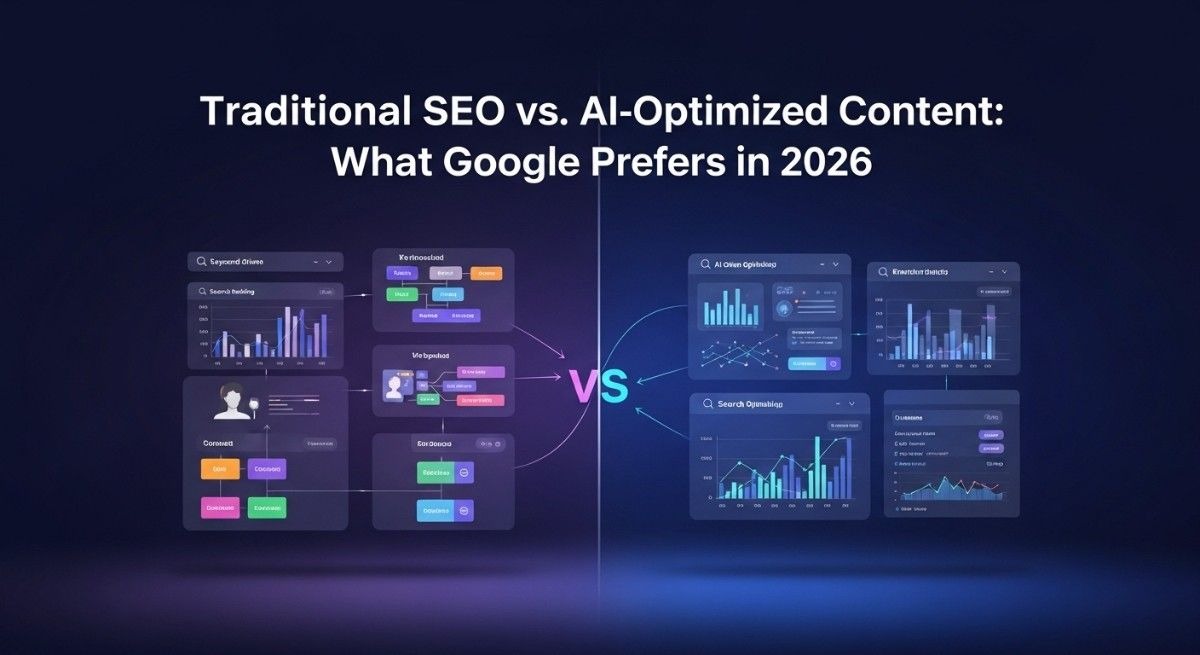
But which approach actually wins in today’s search landscape? The debate around traditional SEO vs AI-optimized content Google prefers 2026 is not theoretical. It has direct impact on rankings, traffic, revenue, and brand credibility.
This blog cuts through the noise. It examines what each approach involves, where each one performs, where each one falls short, and what Google’s current signals tell us about the future of search visibility.
Understanding traditional SEO vs AI-optimized content Google prefers 2026 is not optional for anyone serious about digital marketing right now. The stakes are high. Rankings are competitive. The difference between first page and page two can mean millions in revenue. Let’s break it all down.
Table of Contents
What Traditional SEO Actually Involves
Traditional SEO is built on a set of principles that emerged with search engines themselves. The goal has always been the same. Help search engines understand your content so they can rank it for the right queries.
The foundations of traditional SEO include keyword research, on-page optimization, technical performance, and link building. Each pillar plays a specific role in how a page earns visibility.
Keyword research drives content strategy. Marketers identify terms their audience searches. They map those terms to pages. They track rankings and adjust. This process creates a structured content map tied directly to demand.
On-page optimization puts keywords in the right places. Title tags. H1 headers. Meta descriptions. First paragraphs. Image alt text. These placements signal relevance to crawlers. They help Google match a page to specific queries.
Technical SEO ensures crawlability and performance. Page speed. Mobile-friendliness. Core Web Vitals. Structured data markup. Clean URL structures. Canonical tags. These elements do not drive rankings alone but they remove barriers that prevent rankings.
Link building earns authority. When reputable websites link to your content, Google interprets that as a vote of confidence. Domain authority grows. Pages rank for more competitive terms. This remains one of the strongest ranking signals in traditional SEO.
Traditional SEO excels at structure and measurability. Every tactic produces data. Rankings are trackable. Link acquisition is auditable. Page performance is measurable. This makes traditional SEO a reliable, repeatable discipline for teams with clear processes.
The limitation of traditional SEO is its rigidity. It optimizes for signals. It does not always optimize for experience. A page can rank well while delivering mediocre value to the reader. Google has been working hard for years to close that gap. Understanding traditional SEO vs AI-optimized content Google prefers 2026 starts with knowing where that rigidity creates vulnerability.
What AI-Optimized Content Actually Means
AI-optimized content is frequently misunderstood. Many assume it means content written entirely by AI. That definition is too narrow. AI-optimized content uses artificial intelligence tools to improve relevance, structure, depth, and alignment with how search engines process language.
This includes using AI for semantic keyword clustering. Instead of targeting one primary keyword, AI tools identify related terms, questions, and concepts that surround a topic. Content built around this cluster satisfies broader intent. It covers a topic comprehensively rather than narrowly.
AI-optimized content also uses natural language generation for drafting at scale. Product descriptions, category pages, FAQ sections, and structured summaries benefit from AI-assisted drafting. Human editors refine the output. The combination is faster than pure human writing and more reliable than pure AI output.
Content gap analysis powered by AI identifies what competitors cover that your site does not. It surfaces opportunities to fill those gaps. Pages built from this analysis tend to rank well because they address real demand that existing content ignores.
Search intent alignment is another dimension of AI optimization. Tools analyze the top-ranking pages for a query. They identify content format preferences, depth expectations, and structural patterns. Content built to match those patterns performs better from launch.
The rise of AI-generated content has created a problem, though. Low-effort, generic content at scale flooded search results. Google responded. Its helpful content updates targeted pages with poor experience signals, shallow depth, and no genuine expertise.
This is the core tension in traditional SEO vs AI-optimized content Google prefers 2026. AI-optimized content done well outperforms traditional SEO. AI-generated content done lazily gets penalized. The distinction is critical.
How Google’s Algorithm Has Evolved in 2026
The Shift Toward Experience and Expertise Signals
Google’s algorithm in 2026 is more sophisticated than any previous version. It evaluates content across dimensions that simple keyword optimization cannot satisfy. E-E-A-T — Experience, Expertise, Authoritativeness, and Trustworthiness — has moved from guidelines language into measurable ranking weight.
Experience signals come from demonstrating first-hand knowledge. A review written by someone who actually used a product outperforms a review compiled from other reviews. A tutorial written by someone who encountered the actual problems and solved them outperforms a generic walkthrough.
Google can now detect surface-level content more accurately. Pages that lack specific detail, original perspective, or clear authorial experience rank lower than they once did. This hits poorly executed AI content particularly hard. It also rewards deeply researched traditional content.
Expertise is verified through author profiles, credentials visible on-page, and the breadth of quality content attributed to a given author. Topical authority across a domain matters. A site consistently producing expert-level content on one subject outranks a site producing adequate content across many subjects.
The Rise of AI Overviews and Zero-Click Results
Google’s AI Overviews feature changes the competitive landscape significantly. A large portion of search queries now receive an AI-generated summary at the top of results. This pulls from content Google deems most authoritative and comprehensive.
Pages that contribute to AI Overviews gain brand exposure even without a direct click. Pages that get cited in AI Overviews build authority signals that feed back into traditional rankings. The two systems are connected.
To appear in AI Overviews, content needs clear structure, direct answers to specific questions, and verifiable accuracy. This pushes traditional SEO vs AI-optimized content Google prefers 2026 into new territory. Optimization is no longer just about rank positions. It is about contributing to AI-generated answers.
Core Web Vitals and Page Experience as Ranking Floors
Google now treats page experience metrics as ranking floors, not ranking factors. If your page falls below performance thresholds, you compete at a disadvantage regardless of content quality. Passing these thresholds does not boost you. Failing them holds you back.
This means technical SEO excellence is no longer a differentiator. It is a baseline requirement. The competitive advantage lies in what happens after you meet the technical floor — the quality, depth, and genuine usefulness of your content.
Where Traditional SEO Still Wins
Traditional SEO retains clear advantages in specific contexts. Dismissing it entirely would be a strategic mistake. Understanding where it excels helps you allocate effort intelligently.
Technical optimization is still foundational. No amount of AI-assisted content strategy helps a site that loads slowly, has crawl errors, or lacks proper internal linking. The technical layer supports everything built on top of it. Traditional SEO expertise is essential here.
Local SEO is another area where traditional approaches dominate. Google Business Profile optimization, local citation building, review management, and location-specific keyword targeting follow traditional SEO principles. AI optimization adds less value in local contexts where proximity, consistency, and genuine reviews drive results.
Link building remains one of the most powerful ranking levers available. No AI content tool generates editorial backlinks from authoritative domains. That requires relationship building, digital PR, original research, and outreach. Traditional SEO practitioners who excel at this drive durable authority gains.
Exact-match intent targeting still performs strongly for transactional queries. Someone searching “buy red leather wallet online” has a clear intent. A product page optimized for that exact term with strong conversion signals ranks and converts well. Traditional keyword targeting handles these cases reliably.
Structured data markup is a traditional SEO discipline delivering increasingly powerful results. Rich snippets, FAQ schema, how-to schema, and product markup improve click-through rates substantially. These technical implementations are traditional SEO at its most impactful.
Traditional SEO vs AI-optimized content Google prefers 2026 is not a zero-sum debate. Traditional SEO wins on technical foundations, link authority, local presence, and structured data. These strengths do not diminish.
Where AI-Optimized Content Wins
AI-optimized content outperforms traditional approaches in content depth, semantic coverage, and intent alignment at scale.
Topical authority building benefits enormously from AI-assisted content strategy. Mapping every question, subtopic, and related concept around a subject produces comprehensive content clusters. These clusters signal deep topical expertise. Google rewards sites that cover topics thoroughly with ranking positions across entire subject areas rather than individual keywords.
Semantic SEO is a discipline traditional approaches handle poorly. Optimizing for a single keyword misses the related terms, implied concepts, and co-occurring language that modern algorithms analyze. AI tools surface these semantic relationships. Content built around full semantic fields consistently outperforms content built around isolated keywords.
Content freshness at scale is impossible with traditional human workflows alone. AI-assisted updating of existing content — refreshing statistics, expanding thin sections, adding new context — keeps pages current without full rewrites. Freshness signals matter for competitive topics where information evolves quickly.
Search intent matching improves with AI analysis. Traditional keyword research tells you what people search. AI analysis of top-ranking content tells you how they want that information delivered — as a comparison table, a step-by-step guide, a listicle, a long-form narrative, or a concise direct answer. Matching format to intent drives engagement metrics that feed ranking signals.
Content personalization at scale becomes possible with AI-driven content frameworks. Different audience segments receive content pitched at their level of expertise, in language that resonates with their context. This improves time-on-page, reduces bounce rates, and signals quality to Google.
For content-heavy sites producing hundreds or thousands of pages, AI-optimized content workflows are the only practical path to quality at scale. Traditional writing simply cannot match the volume demands of modern content strategies.
This is where the real advantage lies in traditional SEO vs AI-optimized content Google prefers 2026. AI-optimized content scales depth, breadth, and relevance in ways traditional production cannot.
What Google Has Said and Shown About AI Content
Google has been explicit on one key point. It does not penalize AI-generated content for being AI-generated. It penalizes content for being unhelpful, low-quality, or manipulative. The source of the words is not the issue. The value delivered to the reader is.
This distinction matters for understanding traditional SEO vs AI-optimized content Google prefers 2026. Google’s documentation consistently emphasizes people-first content. Content should serve the reader’s genuine need. It should demonstrate expertise. It should provide something the reader cannot easily find elsewhere.
Google’s helpful content system evaluates pages based on signals of genuine value. Does the page provide original information? Does it demonstrate first-hand knowledge? Does it offer depth beyond surface-level coverage? Would a reader feel satisfied or would they immediately search again?
Pages failing these tests lose rankings regardless of keyword optimization. Pages passing these tests gain rankings regardless of whether a human or an AI wrote the first draft. The practical implication is clear. AI-generated content reviewed, refined, and enriched by genuine human expertise performs well. AI-generated content published without that human layer performs poorly.
Google’s spam policies specifically target content generated at scale purely to manipulate rankings. Mass-produced thin content, whether written by humans or AI, violates these policies. The intent and quality matter. The production method is secondary.
Building a Strategy That Combines Both Approaches
The most effective content strategies in 2026 do not choose between traditional SEO and AI-optimized content. They combine the strengths of each.
Start with traditional SEO infrastructure. Complete a thorough technical audit. Fix crawl issues. Optimize site speed. Build a clean internal linking architecture. Implement structured data markup. This foundation does not need AI. It needs systematic technical expertise.
Layer keyword strategy on that foundation. Use traditional keyword research to identify demand. Group keywords by intent. Map them to existing content or identify gaps requiring new content. This structured mapping remains one of the most valuable exercises in any SEO program.
Bring AI tools into content planning. Use semantic analysis to expand keyword groups into full topic clusters. Use competitor gap analysis to identify coverage opportunities. Use SERP analysis to understand format preferences for target queries. This is where AI planning tools add disproportionate value.
Use AI-assisted drafting for scale. Let AI tools produce first drafts for structured content types — FAQs, product descriptions, comparison pages, how-to guides. These content types have predictable structures that AI handles well. Human editors review for accuracy, tone, and genuine expertise signals.
Reserve full human authorship for high-stakes content. Original research, expert analysis, case studies, thought leadership, and sensitive topics all benefit from genuine human expertise and voice. These content types carry the strongest authority signals. No AI-optimized workflow fully replaces them.
Build feedback loops. Track performance of AI-assisted content versus human-authored content across comparable queries. Learn where each approach performs. Allocate effort accordingly.
Traditional SEO vs AI-optimized content Google prefers 2026 resolves not as a competition but as a collaboration. Technical SEO infrastructure supports AI-optimized content strategies. Human expertise elevates AI-generated drafts. Link building amplifies topically authoritative content. Each layer strengthens the others.
Mistakes That Kill Rankings in 2026
Publishing AI Content Without Human Review
The fastest way to lose rankings in 2026 is publishing unreviewed AI-generated content at scale. Google’s classifiers have improved. Generic, shallow content with no genuine expertise signals gets filtered from competitive ranking positions.
Every piece of AI-assisted content needs human review. Accuracy checking. Experience enrichment. Voice consistency. Fact verification. Without this layer, AI content contributes to the exact problem Google’s helpful content updates were built to address.
Ignoring E-E-A-T Signals
Many sites optimize keywords expertly but neglect authorship, credentials, and experience signals. In 2026, these signals carry real ranking weight for YMYL topics — health, finance, legal, and safety content especially.
Adding author bios is not enough. Author profiles need depth. They need external validation — mentions on other authoritative sites, published work elsewhere, credentials visible and verifiable. Building genuine author authority takes time but delivers durable ranking advantages.
Chasing AI Overviews Without Building Real Authority
Some teams now optimize purely to appear in AI Overviews. They structure content to match summary patterns without building genuine topical authority. Google’s systems identify this mismatch. Sites without deep topical authority do not sustain AI Overview citations.
The path to AI Overview inclusion runs through genuine expertise and comprehensive coverage. Traditional SEO vs AI-optimized content Google prefers 2026 both point toward the same destination — real authority on real topics.
FAQs: Traditional SEO vs AI-Optimized Content Google Prefers 2026
Does Google penalize AI-written content in 2026?
Google does not penalize content for being AI-written. It penalizes content for being low-quality, unhelpful, or manipulative. AI content reviewed and enriched by human expertise performs well. Unreviewed, generic AI content ranks poorly. Quality is the standard, not authorship.
Is traditional SEO still worth investing in during 2026?
Absolutely. Technical SEO, link building, structured data, and local SEO remain essential. These disciplines provide the infrastructure that AI-optimized content strategies need to perform. Traditional SEO is the foundation. AI optimization is the content layer built on top.
What is semantic SEO and why does it matter?
Semantic SEO optimizes content for related terms, concepts, and questions surrounding a topic rather than a single keyword. Modern algorithms analyze the full semantic field of a page. Content covering a topic comprehensively performs better than content optimized for isolated keywords.
How do I appear in Google’s AI Overviews?
Build genuine topical authority through comprehensive, accurate, well-structured content. Use clear headers, direct answers to specific questions, and verifiable factual claims. Sites with strong domain authority on relevant topics earn AI Overview citations more consistently.
What content types should humans always write?
Original research, expert analysis, case studies, thought leadership, and any content requiring first-hand experience should always involve genuine human authorship. These content types carry the strongest authority and experience signals that Google’s E-E-A-T evaluation rewards most heavily.
What is the biggest SEO mistake marketers make in 2026?
Publishing AI-generated content at scale without human review and expertise enrichment. This approach produces volume without value. Google’s helpful content systems identify and filter this content from competitive positions. Quality over quantity remains the most reliable path to sustainable rankings.
Read More:-Human Customer Support vs. Multi-Agent AI Support: Performance Metrics
Conclusion

The debate between traditional SEO and AI-optimized content is real. The answer to what wins is not simple. Both approaches have genuine strengths. Both have specific weaknesses. The most successful content strategies in 2026 leverage both intelligently.
Traditional SEO delivers the technical infrastructure every site needs. It builds the link authority that amplifies content performance. It handles local presence, structured data, and crawlability with precision that AI tools do not replicate.
AI-optimized content delivers depth, semantic coverage, and scale that human-only production cannot match. It aligns content with search intent efficiently. It identifies gaps and opportunities systematically. It accelerates topical authority building across broad content programs.
The real question in traditional SEO vs AI-optimized content Google prefers 2026 is not which one to use. It is how to use each one where it performs best.
Google rewards genuine expertise. It rewards original perspective. It rewards content that satisfies real human needs rather than gaming algorithmic signals. Both traditional SEO and AI-optimized content can serve those goals. Both can undermine them when applied poorly.
The marketers and content teams winning in 2026 understand this balance. They do not abandon technical SEO fundamentals. They do not fear AI tools. They combine structured optimization with genuine expertise. They let AI handle scale and structure. They let human intelligence handle authority and experience.
That combination is what traditional SEO vs AI-optimized content Google prefers 2026 ultimately points toward. Master both. Deploy each wisely. Build content that earns its rankings because it genuinely deserves them.