Introduction
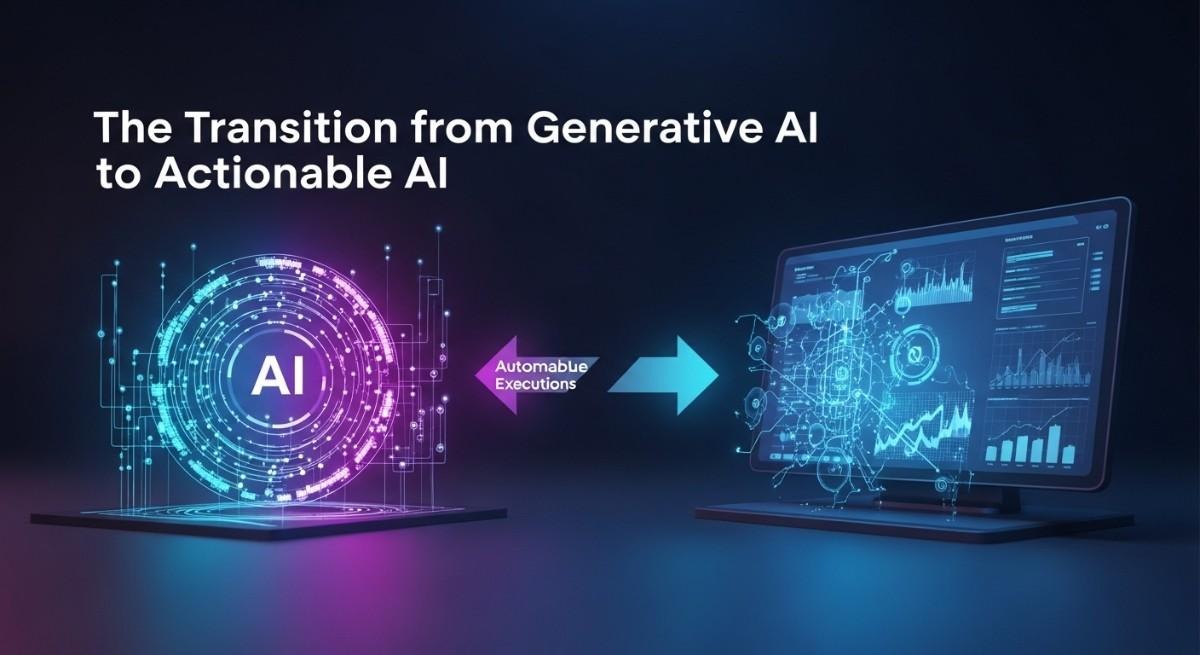
TL;DR Something fundamental shifted in AI development between 2023 and 2026. The first wave of large language model excitement centered on generation. AI could write. It could summarize. It could explain. It could create images, code, and marketing copy at speeds no human could match. Organizations adopted these tools and saw genuine productivity gains. Then the ceiling appeared. Generating better content did not fix broken workflows. Producing faster drafts did not complete tasks. The transition from generative AI to actionable AI is the response to that ceiling — and it is reshaping how businesses and developers think about what AI is actually for.
This blog examines what that transition means in concrete terms. You will understand what separates generative AI from actionable AI at a technical and conceptual level. You will see where the business value lives in actionable systems. You will get a realistic view of the implementation challenges and how leading organizations are navigating them. Whether you build AI systems or deploy them, this shift matters directly to your work.
Table of Contents
What Generative AI Actually Delivered
To understand the transition from generative AI to actionable AI, you need an honest accounting of what the generative phase accomplished and where it fell short. The accomplishments were real. So were the limitations.
Generative AI models — GPT-4, Claude 2, Gemini, and their contemporaries — delivered a genuine breakthrough in natural language capability. They could read and produce text at human quality levels across a remarkable range of domains. Legal professionals used them to draft contract language. Marketers used them to produce content at scale. Developers used them to accelerate coding. Customer service teams used them to draft response templates. These were not trivial improvements. They saved millions of hours of human effort globally.
Where Generative AI Hit Its Ceiling
Generative AI tools are fundamentally reactive. You give them a prompt. They produce an output. The output lives inside the conversation window or gets copied into another tool. Nothing changes in any real system as a result. The AI generates. The human acts. The human is still the bridge between AI output and real-world consequence.
This reactive architecture limits value in two important ways. First, it requires continuous human involvement to translate AI outputs into actions. Second, it cannot complete multi-step tasks that depend on intermediate results. You can ask a generative AI to write an email. You cannot ask it to research the recipient, draft the email, send it, track whether it was opened, and follow up if it was not. That entire workflow requires a system that can act, not just generate.
The transition from generative AI to actionable AI addresses exactly this gap. The question shifts from what can AI produce to what can AI accomplish.
The Gap Between Generation and Value
Organizations discovered a pattern after adopting generative AI tools at scale. Initial productivity gains were strong. Then they plateaued. The AI was producing more content, but much of it required significant human editing before use. The AI was drafting faster, but human review, approval, and execution still consumed comparable time to the old process.
The gap between generation and organizational value became visible. A better draft is only more valuable if the rest of the workflow is not the bottleneck. In most organizations, generation was never the bottleneck. Execution, coordination, and follow-through were. Actionable AI targets these bottlenecks directly.
Defining Actionable AI: What Makes It Different
The transition from generative AI to actionable AI involves more than adding execution capability to existing models. It represents a different architecture for how AI systems relate to the world around them.
From Output to Outcome
Generative AI produces outputs. Actionable AI pursues outcomes. This distinction sounds simple but carries significant architectural implications. A generative AI asked to help with a sales outreach campaign produces copy. An actionable AI system asked to run a sales outreach campaign researches prospects, personalizes messages, sends them, tracks responses, logs results to a CRM, flags interested prospects for human follow-up, and reports on campaign performance.
The outcome orientation requires the AI to maintain a goal across multiple steps, make decisions at each step based on intermediate results, call external tools and systems, and know when the goal is achieved. No generative model alone can do this. It requires an agent architecture built around the model.
The Role of Tool Use and External Connectivity
Actionable AI systems connect to the real world through tools. A tool is any external capability the AI can call — a web search, a database query, an API call to a business system, a file read or write, a form submission, a message send. Tool use is what makes AI actions real rather than simulated.
The transition from generative AI to actionable AI is in large part a story about tool integration. When AI models gained reliable tool-calling capability, the door opened to systems that could affect real state in real systems rather than just producing text that described what such effects might look like.
Modern actionable AI systems use tool libraries that can include dozens or hundreds of specific capabilities. Send an email. Query a database. Update a CRM record. Trigger a webhook. Post to a social platform. Each tool is a connection between the AI’s reasoning and actual change in the world.
Memory and State Across Time
Generative AI models have no persistent memory by default. Every conversation starts fresh. This statelessness is acceptable for a tool that generates content. It is crippling for a system that manages ongoing workflows.
Actionable AI systems maintain persistent memory about users, tasks, decisions made, and results achieved. They know what they did last time. They know what commitments were made. They know what still remains incomplete. This continuity transforms AI from a tool you visit into a system that works on your behalf between visits.
The transition from generative AI to actionable AI requires solving the memory problem at a technical level. Approaches include vector database storage for semantic retrieval, structured key-value stores for factual state, and conversation summarization techniques that compress history into accessible context. Each approach has tradeoffs that system architects must navigate thoughtfully.
Goal Persistence and Autonomous Execution
Perhaps the most consequential difference between generative and actionable AI is goal persistence. Generative AI fulfills a single request and stops. Actionable AI holds a goal and continues working toward it until the goal is achieved or human intervention is required.
This persistence enables workflows that extend over hours, days, or weeks. An AI system tasked with monitoring a vendor contract for renewal triggers three months before the renewal date, researches current market rates, drafts a negotiation brief, and schedules a meeting with the procurement team — all without anyone prompting it at each step. The goal was set once. The system pursued it autonomously.
The Technical Architecture of Actionable AI Systems
Understanding the transition from generative AI to actionable AI requires familiarity with the architectural components that make actionable systems work. These components work together to create AI capability that extends beyond conversation.
The Agent Loop
The core of any actionable AI system is the agent loop. The loop begins with a goal. The AI reasons about what action to take next given the goal and current state. It executes that action using an available tool. It observes the result. It updates its understanding of the current state. It reasons about the next action. The loop continues until the goal is achieved or a defined stopping condition occurs.
This reason-act-observe cycle is what enables multi-step task completion. Each iteration moves the task forward. The AI does not need to know the complete solution path upfront. It adapts its approach based on what it learns from each action’s result. This adaptive quality is essential for operating in real-world environments where outcomes are unpredictable.
Orchestration and Planning
Complex tasks require breaking a goal into subtasks and coordinating their execution in the right sequence. Orchestration is the capability that manages this decomposition and sequencing. An orchestrator agent receives a high-level goal, creates a plan with identified subtasks and dependencies, assigns subtasks to specialized worker agents or executes them directly, and assembles results into a final output.
The transition from generative AI to actionable AI includes developing robust orchestration capabilities. Early agents handled only simple linear task sequences. Modern orchestrators manage branching workflows, parallel execution paths, conditional logic, and dynamic replanning when intermediate results contradict initial assumptions.
Evaluator and Critic Systems
Actionable AI systems that take real actions in real systems need quality checks before those actions execute. Evaluator systems assess whether a planned action is appropriate given the current context, aligns with defined policies, and is likely to advance the goal. Critic systems review outputs before they are used as inputs to subsequent steps.
These evaluation layers reduce error propagation and prevent AI systems from taking inappropriate actions based on misunderstood instructions or unexpected intermediate states. The transition from generative AI to actionable AI requires building these safeguards into system architecture. Without them, autonomous action capability creates unacceptable operational risk.
Human-in-the-Loop Design Patterns
Fully autonomous AI action is appropriate for some tasks and inappropriate for others. Actionable AI system design involves explicit decisions about where human oversight, approval, or intervention is required. These human checkpoints are design choices, not failures of automation.
Common human-in-the-loop patterns include approval gates for irreversible actions, review windows for high-value decisions, exception escalation for situations the AI cannot confidently handle, and periodic audits of AI-executed action logs. Well-designed actionable AI systems define these checkpoints explicitly rather than treating human involvement as a failure mode.
Business Applications of Actionable AI
The transition from generative AI to actionable AI unlocks a new category of business application. The distinguishing characteristic of these applications is that they complete workflows rather than contributing to them.
Autonomous Customer Operations
Customer service has long been a target for AI automation. Generative AI improved the quality of AI-drafted responses. Actionable AI completes customer service workflows end-to-end. When a customer submits a return request, an actionable AI system verifies purchase history, checks return eligibility against policy, issues a return label, updates inventory systems, initiates the refund process, sends the customer a confirmation, and closes the ticket — all without human involvement for standard eligible returns.
The economics of this shift are significant. Generative AI reduced drafting time. Actionable AI reduces ticket handling time and enables far higher volume without proportional staffing increases. The transition from generative AI to actionable AI in customer operations changes the unit economics of customer service fundamentally.
Automated Financial Operations
Finance functions run on repetitive, rule-based workflows that are expensive to staff manually at scale. Invoice processing, expense categorization, vendor payment scheduling, and reconciliation all follow defined rules that actionable AI systems can execute reliably.
An actionable AI system in accounts payable receives invoices, extracts key fields, matches them against purchase orders, routes exceptions for human review, schedules approved payments within defined cash flow windows, posts journal entries, and updates vendor records. This end-to-end execution replaces a workflow that previously required multiple handoffs between AP staff members.
Research and Intelligence Operations
Knowledge work that requires gathering, analyzing, and synthesizing information from multiple sources is a natural fit for actionable AI. Market research, competitive intelligence, due diligence, and regulatory monitoring all follow a pattern of search, collect, verify, analyze, and synthesize.
An actionable AI system tasked with competitive monitoring tracks defined competitor signals, collects relevant news and product updates, analyzes implications for the client’s strategic position, drafts a weekly intelligence briefing, and delivers it to defined recipients on schedule. The transition from generative AI to actionable AI in research operations produces continuously updated intelligence rather than periodic point-in-time reports.
IT Operations and Infrastructure Management
IT operations centers have long sought automation for routine monitoring and remediation tasks. Generative AI improved documentation and procedure writing. Actionable AI executes those procedures. When a monitoring agent detects a defined infrastructure anomaly, an actionable AI system diagnoses the root cause using defined playbooks, executes the remediation steps, verifies that the resolution succeeded, logs the incident details, and notifies the relevant team with a complete incident report.
Mean time to resolution drops dramatically when AI handles routine incident response. Human engineers focus on novel problems, architectural improvements, and escalated issues that require contextual judgment. The transition from generative AI to actionable AI in IT operations reduces operational burden while improving system reliability.
Sales and Revenue Operations
Sales workflows involve extensive administrative work that consumes time salespeople would rather spend selling. Research, CRM updates, follow-up scheduling, proposal drafting, and pipeline reporting all take time away from customer interaction.
Actionable AI systems handle this administrative layer. After a sales call, the AI transcribes notes, extracts action items, updates CRM fields, drafts a follow-up email for salesperson review, schedules the next touch, and updates the pipeline forecast. The salesperson reviews AI-prepared materials rather than preparing them from scratch. Sales capacity increases without headcount growth.
Implementation Challenges in the Actionable AI Transition
The transition from generative AI to actionable AI is not technically simple. Organizations that underestimate implementation complexity face delays and cost overruns. Understanding the real challenges enables better planning and more realistic timelines.
Tool Integration Complexity
Every tool an AI agent uses requires a reliable, well-documented integration. Enterprise environments contain dozens of systems — CRMs, ERPs, HR platforms, marketing tools, communication systems — each with its own API, authentication requirements, and rate limits. Building and maintaining a comprehensive tool library for an actionable AI system requires significant engineering investment.
Integration failures cause agent failures. When a tool returns an unexpected error, the agent must handle it gracefully without corrupting task state or taking inappropriate compensatory actions. Robust error handling in tool integrations is unglamorous work that directly determines whether actionable AI systems perform reliably in production.
Reliability and Error Rate Requirements
Generative AI systems that produce imperfect outputs have limited immediate consequences. A human reviews the output and corrects it. Actionable AI systems that execute imperfectly create real-world consequences that may be difficult or impossible to reverse. A sent email cannot be unsent. A database record that gets incorrect data requires cleanup. An order that gets placed incorrectly requires cancellation.
The reliability bar for actionable AI is significantly higher than for generative AI. Error rates that are acceptable in a content generation tool are unacceptable in a system that takes autonomous actions. The transition from generative AI to actionable AI requires investing in testing infrastructure, validation systems, and monitoring that most generative AI deployments did not require.
Governance and Accountability Frameworks
When humans make decisions, accountability is clear. When AI systems make decisions that lead to actions, accountability becomes more complex. Who is responsible when an actionable AI system takes an incorrect action? How are decisions logged and auditable? What policies govern which decisions AI can make autonomously?
Organizations navigating the transition from generative AI to actionable AI must establish governance frameworks before deploying autonomous systems at scale. These frameworks define the scope of AI decision authority, the audit trail requirements for AI-executed actions, the escalation procedures for out-of-scope situations, and the review processes for AI action logs.
Security Considerations for Autonomous Systems
Actionable AI systems that can call APIs, send messages, and modify records create a larger attack surface than passive generative tools. Prompt injection attacks attempt to hijack AI agent behavior by embedding malicious instructions in data the agent processes. A compromised agent with broad tool access can do significant damage before detection.
Security architecture for actionable AI must include principle of least privilege for tool access, input validation at every tool boundary, anomaly detection for unusual action patterns, and rate limiting on consequential actions. These security requirements are additional implementation complexity that organizations must plan for explicitly during the transition from generative AI to actionable AI.
Measuring the Value of Actionable AI Deployments
Measuring ROI for generative AI focused on productivity metrics — time saved, content volume produced, cost per piece of content. Measuring ROI for actionable AI requires different metrics that capture workflow completion and outcome quality.
Process Completion Metrics
The primary metric for actionable AI is whether workflows complete successfully, completely, and without requiring unplanned human intervention. Track the percentage of initiated tasks that reach successful completion without escalation. Track the average number of human intervention points per completed task. Track the time from task initiation to completion compared to the pre-AI baseline.
These metrics reveal whether your actionable AI system is genuinely autonomous or is actually a human-assisted semi-automation that requires constant supervision. Genuine actionable AI improves all three metrics simultaneously over time as the system learns and its tool integrations mature.
Error Rate and Correction Cost Tracking
Track how frequently actionable AI systems produce outputs or take actions that require human correction. Calculate the cost of identifying and correcting those errors. Compare this correction cost against the labor cost of performing the workflow manually.
The transition from generative AI to actionable AI succeeds economically when the combination of AI execution cost plus correction cost is lower than pure human execution cost. This calculation should account for the full cost of corrections including downstream effects of errors that propagate before detection.
Capacity and Scale Metrics
One of the most compelling value dimensions of actionable AI is scale. Track how many workflow instances your AI system handles per day compared to what your human team could process. Measure whether throughput scales with task volume or whether the system degrades under load.
Capacity metrics reveal the competitive advantage dimension of actionable AI adoption. An organization whose AI system handles 10 times the customer interactions, 5 times the research tasks, or 20 times the routine financial transactions of a comparable human team has a structural operational advantage that compounds over time.
Frequently Asked Questions
What is the key difference between generative AI and actionable AI?
Generative AI produces outputs — text, images, code, summaries — in response to prompts. Actionable AI pursues outcomes by taking sequences of actions in real systems until a goal is achieved. The transition from generative AI to actionable AI shifts the focus from what AI can produce to what AI can accomplish. Generative AI requires humans to translate its outputs into actions. Actionable AI executes actions autonomously using tools connected to real business systems. This architectural difference is fundamental, not incremental.
Is actionable AI safe for business-critical processes?
Actionable AI is safe for business-critical processes when deployed with appropriate governance, human oversight checkpoints, and conservative autonomy scopes. Starting with lower-stakes workflows and expanding AI autonomy as reliability is demonstrated is the proven approach. The transition from generative AI to actionable AI does not require choosing between safety and capability. Well-designed systems define clearly which decisions AI makes autonomously, which require human approval, and what audit trails exist for all AI-executed actions. Safety is a design outcome, not a constraint on capability.
What technical infrastructure does actionable AI require?
Actionable AI systems require a foundation of reliable tool integrations connecting the AI to business systems, a persistent memory layer for task state and user context, an orchestration capability for multi-step workflow management, monitoring and logging infrastructure for all agent actions, and human escalation pathways for out-of-scope situations. Organizations with modern API-accessible business systems are better positioned for actionable AI deployment than those running legacy systems with limited integration capabilities. Data infrastructure quality significantly affects how quickly actionable AI can be deployed and how reliably it performs.
Which industries are furthest along in the transition from generative AI to actionable AI?
Financial services leads adoption because its workflows are highly structured, rule-based, and digitized — ideal conditions for actionable AI. Customer operations functions across industries have moved quickly because the ROI from automating high-volume, repetitive customer interactions is immediately measurable. IT operations has seen strong actionable AI adoption for infrastructure monitoring and incident response. Legal technology companies are actively deploying actionable AI for document review, contract analysis, and regulatory monitoring workflows. Healthcare administration is advancing with actionable AI for prior authorization, scheduling, and claims processing despite regulatory complexity.
How long does it take to implement an actionable AI system?
Implementation timelines for actionable AI vary widely based on scope, integration complexity, and organizational readiness. A single workflow automation using existing integrations and a capable agent platform can go from concept to production in four to eight weeks. A comprehensive actionable AI program covering multiple business functions with extensive custom integrations typically requires twelve to twenty-four months for full deployment. The transition from generative AI to actionable AI is best approached as a phased program starting with a high-value, lower-risk workflow and expanding from there as the team builds implementation experience.
Will actionable AI eliminate jobs?
Actionable AI will eliminate specific job functions that consist primarily of executing routine, rule-based workflows. It will not eliminate jobs that require contextual judgment, relationship management, creative problem-solving, and adaptation to novel situations. The transition from generative AI to actionable AI is creating new roles alongside eliminating routine ones — AI system designers, agent workflow architects, AI output auditors, and AI operations managers are emerging as significant job categories. Organizations that help employees develop skills to work alongside and manage actionable AI systems experience more positive workforce transitions than those who deploy AI without accompanying human development investment.
Read More:-Why 2026 Is the Year of the Personal AI Assistant
Conclusion

The transition from generative AI to actionable AI is not a future prediction. It is a present reality reshaping how organizations build and deploy AI capability. The generative phase delivered genuine value and set the stage for what comes next. The actionable phase delivers value of a different and larger kind.
Generative AI improved the quality and speed of human work. Actionable AI extends the scope of what AI can accomplish independently. Generative AI made humans more productive. Actionable AI creates new categories of autonomous work that did not require human time at all previously.
The technical components exist. Agent frameworks, tool integration standards, persistent memory systems, and orchestration platforms have matured to the point where actionable AI deployment is an engineering project, not a research project. The implementation challenges are real but solvable with proper planning, governance investment, and appropriate sequencing of deployment scope.
The business case is concrete. Process completion rates improve. Human intervention requirements decrease. Scale separates from headcount. Error costs decrease as systems mature. Organizations that capture these benefits early build structural operational advantages that compound over time.
The governance and safety requirements are non-negotiable. Actionable AI systems that take real actions in real systems require audit trails, accountability frameworks, human oversight at appropriate checkpoints, and security architectures that protect against misuse and attack. These are not optional extras. They are prerequisites for responsible deployment at scale.
The transition from generative AI to actionable AI is the defining shift in enterprise AI adoption for this period. Organizations that understand this transition, plan for it thoughtfully, and execute it with appropriate discipline are building capabilities that define competitive position for the decade ahead. The generative era showed what AI could produce. The actionable era will demonstrate what AI can accomplish. That distinction will matter enormously for every organization that competes on operational excellence, speed, and scale.