Introduction
TL;DR The AI gold rush produced a predictable wave of products. A slick interface on top of GPT-4. A chat window connected to Claude. A prompt engineering layer dressed up as a SaaS tool. These are wrapper apps. They are everywhere. Most of them will not survive.
The reason is simple. Wrapper apps rent value from foundation model providers. Agents create value independently. The advice is clear for anyone building in AI right now: stop building wrapper apps start building AI agents.
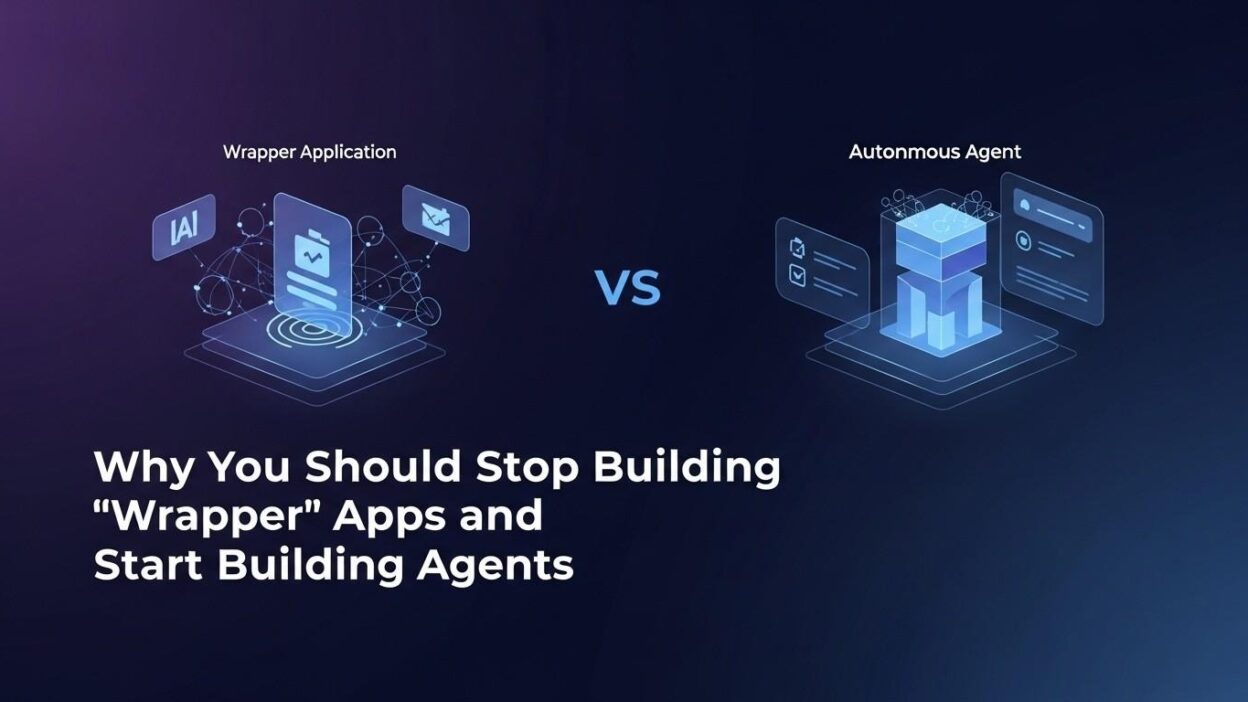
The distinction matters more than most founders and product teams realize. A wrapper app is a thin layer. It adds UI, prompt management, and branding on top of someone else’s model. An agent is an autonomous system that perceives its environment, takes actions, uses tools, manages memory, and pursues goals across multiple steps.
This blog explains the difference in concrete terms. It covers why wrapper apps are structurally fragile businesses. It shows what agents can do that wrappers cannot. It gives practical guidance on where to start when you decide to stop building wrapper apps start building AI agents for real.
Table of Contents
What Is a Wrapper App and Why Is It a Dead End?
A wrapper app takes a foundation model API and adds a user interface. It might include a custom system prompt. It might offer domain-specific templates. It might charge a subscription that is higher than the API costs it passes through. That is the entire business model.
The structural problem is obvious once you name it. The entire value proposition depends on the foundation model provider not adding the same features to their native product. OpenAI, Anthropic, and Google all ship consumer and business products built on their own models. Every feature a wrapper app adds is a product roadmap item for the underlying model provider.
ChatGPT added custom GPTs. Anthropic ships Claude Projects with custom instructions and persistent context. Google Gemini has workspace integration. The attack surface for wrapper app features shrinks with every model provider product release. Founders who stop building wrapper apps start building AI agents make this competitive reality central to their product strategy.
Margin compression is the other structural problem. Wrapper apps sell at a small multiple of their API costs. Model providers continuously reduce API pricing. The margin that looked healthy at launch gets thinner every time the provider drops prices. Wrapper apps cannot build defensible pricing power because their core capability is not proprietary.
User switching costs for wrapper apps are nearly zero. Users who find a cheaper or better-prompted wrapper switch instantly. There is no persistent state, no accumulated knowledge, no deep workflow integration, and no network effect that creates genuine lock-in. The product is interchangeable.
The market is demonstrating this reality already. Hundreds of wrapper apps that launched in 2023 have shut down. Many more are struggling to retain users past their first month. The investors who funded them have stopped. The venture market has moved decisively toward the stop building wrapper apps start building AI agents thesis.
The Feature Parity Trap for Wrapper App Builders
Wrapper app builders fall into a specific product development trap. They add features to stay ahead of foundation model provider native products. Each feature adds complexity. The complexity increases operating costs. The model provider eventually ships the same feature natively. The cycle repeats.
PDF upload was a major differentiator for wrapper apps in early 2023. ChatGPT added native PDF support. The differentiator evaporated. Image generation integration was another wrapper app value proposition. Every major model provider now ships native image generation. Voice mode was a premium feature for wrapper chat apps. OpenAI shipped Advanced Voice Mode.
The stop building wrapper apps start building AI agents imperative emerged from watching this pattern repeat. Founder energy spent chasing feature parity with model provider native products is founder energy wasted. The correct strategic response is to build capability that model providers structurally cannot or will not build: deep workflow integration, persistent context, multi-step autonomous execution, and system-level tool access.
What AI Agents Actually Are: The Architecture Difference
Understanding why you should stop building wrapper apps start building AI agents requires understanding what an agent actually is at an architectural level. The difference is fundamental, not cosmetic.
A wrapper app processes a single turn. User sends input. The app constructs a prompt. The model generates a response. The app displays the response. The interaction ends. Each turn is independent. Nothing persists. Nothing accumulates.
An agent operates across multiple steps toward a goal. It perceives its environment through sensors and data inputs. It reasons about what actions to take. It executes actions using tools. It observes the results of those actions. It updates its plan based on new information. It continues until the goal is achieved or it encounters a situation requiring human input.
The core architectural components of an agent include the LLM as the reasoning engine, a tool registry that gives the agent capabilities, a memory system that maintains context across steps and sessions, an orchestration layer that manages task planning and execution flow, and feedback loops that let the agent observe the results of its actions.
Tools are what transform a reasoning model into an acting agent. A web search tool lets the agent retrieve current information. A code execution tool lets the agent write and run programs. A file system tool lets the agent read and modify documents. A database tool lets the agent query and update structured data. An email tool lets the agent send and receive communications. An API tool lets the agent interact with external services.
When developers stop building wrapper apps start building AI agents, they shift from building a better chat interface to building a system that can actually accomplish work autonomously. The technical complexity increases significantly. The value created increases exponentially.
Memory Architecture: The Foundation of Agent Persistence
Memory is what separates an agent that compounds value over time from a wrapper app that starts from zero on every interaction. Agents without persistent memory cannot learn, cannot accumulate context, and cannot improve with use.
Working memory holds the context of the current task execution. It contains the active plan, the results of recent tool calls, and the current state of task completion. Most LLM context windows serve as working memory for single-session agent tasks.
Episodic memory stores records of past interactions and completed tasks. An agent with episodic memory remembers that it processed a specific invoice last week, that a particular workflow failed and required human intervention, and that a user prefers a specific output format. This accumulated experience makes the agent more useful over time.
Semantic memory stores facts and knowledge that the agent has acquired. It contains information about the user’s domain, preferences, business rules, and frequently used resources. Semantic memory gives the agent the domain knowledge that makes its actions appropriate to the specific context it operates in.
Procedural memory stores learned patterns for task execution. An agent that has successfully completed a specific workflow dozens of times builds procedural knowledge about what sequences of actions work reliably. This procedural learning is what makes agents genuinely improve with use rather than remaining static like wrapper apps.
The Business Case: Why Agents Build Defensible Value
The stop building wrapper apps start building AI agents argument is not only technical. The business case for agents over wrapper apps is equally compelling and more immediately relevant for product strategy.
Agents create switching costs that wrapper apps cannot. An agent that has processed 10,000 customer support tickets for your organization has accumulated deep knowledge of your product, your customers, and your resolution patterns. Switching to a different agent means losing that accumulated knowledge. The agent becomes more valuable with every task it completes. That compounding value creates genuine lock-in that protects the business.
Workflow integration creates a second layer of switching cost. An agent embedded in your document review process, connected to your specific software stack, and trained on your specific document conventions becomes deeply embedded in your operations. Replacing it requires rebuilding the integrations, retraining the context, and relearning your operational patterns. The replacement cost grows with every month of use.
Agents command significantly higher prices than wrapper apps. A wrapper app justifies a five to twenty dollar monthly subscription. An agent that autonomously processes accounts payable, manages customer support queues, or executes research workflows justifies pricing based on the value it replaces: human labor, error rates, and processing speed. Agent pricing in the hundreds to thousands of dollars per month is common for productivity gains that deliver ten to one hundred times that value in efficiency.
Investors value agents very differently from wrapper apps. The stop building wrapper apps start building AI agents shift is visible in venture funding patterns. Agentic AI companies raised billions in 2024 while wrapper app companies struggled to close follow-on rounds. The structural defensibility of agents, their accumulated value, and their proprietary workflow integration all create the competitive moats that investors require.
Network effects emerge in multi-agent and multi-user agent deployments. An agent that learns from every user in an organization improves for all users simultaneously. An agent network where specialized agents collaborate on complex workflows becomes more capable as the network grows. These network effects are simply not available to wrapper app architectures.
Vertical AI Agents: The Highest-Value Stop Building Wrapper Apps Start Building AI Agents Application
Vertical AI agents target specific industries with deep domain expertise, specialized tool access, and workflow integration tailored to the exact processes of that industry. They are the category where the stop building wrapper apps start building AI agents thesis produces the highest business returns.
Legal AI agents do more than answer legal questions. They review contracts clause by clause, flag non-standard terms against company playbooks, draft redlines according to legal team preferences, track negotiation history across document versions, and coordinate review workflows across legal teams. A wrapper app answers legal questions. A legal agent manages legal workflows.
Healthcare AI agents integrate with electronic health record systems, review patient histories before appointments, flag drug interactions, draft clinical documentation, manage prior authorization workflows, and coordinate care team communications. The depth of system integration and workflow automation creates value that no chat interface could approach.
Financial analysis agents monitor market data continuously, execute research workflows on demand, generate structured reports according to specific investment committee formats, maintain model portfolios, and flag portfolio events requiring attention. They operate autonomously between human checkpoints and accumulate institutional knowledge about firm-specific investment approaches over time.
Each of these vertical agent applications represents a stop building wrapper apps start building AI agents execution that creates durable competitive advantage through deep domain specialization and workflow integration that takes months to build and years to replicate.
The Technical Stack for Building AI Agents
Choosing to stop building wrapper apps start building AI agents requires understanding the technical components involved. The agent stack is more complex than a wrapper app stack but increasingly well-supported by mature frameworks and platforms.
Orchestration frameworks manage the core agent loop: perceive, plan, act, observe, repeat. LangChain and LangGraph provide flexible orchestration with extensive tool integrations and support for complex multi-agent topologies. CrewAI organizes agents into role-based crews that collaborate on tasks through defined workflows. AutoGen enables multi-agent conversations and task delegation patterns. Semantic Kernel provides enterprise-grade orchestration with strong Microsoft ecosystem integration.
Tool calling capability in modern LLMs is the technical foundation that makes capable agents possible. GPT-4o, Claude 3.5 Sonnet, Gemini 1.5 Pro, and Llama 3.1 all support structured function calling that allows agents to reliably invoke tools with correctly formatted parameters. The quality of function calling determines how reliably an agent can use its tools without hallucinating incorrect parameters.
Vector databases provide the semantic memory layer that agents use for long-term context and knowledge retrieval. Pinecone, Weaviate, Qdrant, and Chroma all support the embeddings-based retrieval that lets agents query their accumulated knowledge efficiently. Choosing a vector database with strong metadata filtering supports the hybrid retrieval patterns that production agents require.
Structured output generation ensures that agent reasoning produces machine-readable decisions that orchestration layers can process reliably. Pydantic models, JSON schema validation, and structured output modes in modern LLM APIs all help agents produce outputs that downstream components can process without parsing errors.
Evaluation frameworks measure agent performance on task completion, accuracy, tool use efficiency, and error recovery. Ragas, Braintrust, and LangSmith all provide evaluation infrastructure specific to agentic AI systems. Teams that stop building wrapper apps start building AI agents need evaluation systems that measure multi-step task performance, not just single-response quality.
Multi-Agent Systems: Coordination at Scale
Single agents work well for focused tasks. Complex workflows benefit from multi-agent architectures where specialized agents collaborate under orchestrator coordination. Multi-agent systems represent the most sophisticated expression of the stop building wrapper apps start building AI agents philosophy.
Orchestrator agents decompose complex goals into subtasks and delegate them to specialized worker agents. The orchestrator tracks overall progress, integrates results from multiple worker agents, handles failures and retries, and determines when the overall goal is complete. The orchestrator does not execute tasks directly. It coordinates the agents that do.
Specialist agents develop deep capability in specific domains. A research specialist agent excels at information gathering and synthesis. A code specialist agent handles programming tasks with high reliability. A data analysis specialist processes structured data efficiently. A communication specialist handles email drafting and coordination. Each specialist is optimized for its specific function.
Critic and verifier agents check the outputs of other agents before those outputs reach users or downstream systems. A critic agent reviews generated content for accuracy, tone, and policy compliance. A verifier agent tests generated code against requirements and executes it to confirm correct behavior. Quality assurance agents catch errors before they propagate through multi-step workflows.
The stop building wrapper apps start building AI agents evolution reaches its fullest expression in well-designed multi-agent systems that handle complex real-world workflows with appropriate specialization, coordination, and quality control. These systems create value that fundamentally exceeds anything a wrapper app architecture could achieve.
Common Objections to the Stop Building Wrapper Apps Start Building AI Agents Shift
Developers and founders considering whether to stop building wrapper apps start building AI agents raise predictable objections. Addressing these objections honestly helps teams make sound product decisions.
The complexity objection: agents are too hard to build reliably. This was a serious concern in 2022. It is much less valid in 2025. Orchestration frameworks have matured. LLM function calling reliability has improved dramatically. Evaluation tools for agent workflows are readily available. The complexity of building agents has decreased while the competitive necessity of building them has increased.
The cost objection: agents run more LLM calls and cost more to operate. This is true for naive implementations. Well-designed agents use LLM calls strategically. They apply lighter models for classification and routing decisions. They cache frequent retrieval results. They use deterministic code for tasks that do not require reasoning. Thoughtfully designed agents run efficiently at costs that their value delivered easily justifies.
The reliability objection: agents fail unpredictably on complex tasks. This is a real challenge that requires engineering effort rather than a reason to avoid agents entirely. Human-in-the-loop checkpoints catch failures before they cascade. Comprehensive evaluation frameworks measure failure rates systematically. Retry logic and fallback strategies handle recoverable failures automatically. The goal is not a perfect agent. The goal is an agent whose reliability meets the threshold for the specific use case.
The timing objection: the market is not ready for autonomous AI agents. Salesforce Einstein agents are in production at enterprise scale. ServiceNow AI agents handle IT service management at major companies. Intercom’s Fin agent resolves customer support tickets autonomously. The market is ready. Early builders in specific verticals establish first-mover advantages that compound over time.
The skills objection: my team knows how to build wrapper apps, not agents. The skill transfer is more direct than it appears. Developers who understand API integration, prompt engineering, and LLM output handling have most of the foundational skills for agent building. The additional skills required, orchestration design, tool integration, and memory architecture, are learnable through focused study and practical experimentation. The stop building wrapper apps start building AI agents shift is a skill development investment with clear payoff.
When Wrapper Apps Are Actually the Right Choice
Intellectual honesty requires acknowledging that stop building wrapper apps start building AI agents is not a universal rule. There are specific contexts where wrapper apps remain appropriate.
Rapid market validation benefits from wrapper app speed. A founder testing whether a specific audience wants an AI-powered tool can build a wrapper app in days and validate demand before investing weeks in agent architecture. If demand validates, rebuild as an agent. If demand fails to materialize, the wrapper app minimized wasted investment.
Highly regulated industries with strict controls on autonomous action may require wrapper app architectures where every AI output receives mandatory human review before acting. Healthcare clinical decision support, financial trading recommendations, and legal advice applications all face regulatory constraints that limit autonomous agent action in specific contexts.
Feature additions to existing products sometimes take the form of AI-powered enhancements that do not require agent architecture. Adding AI-generated summaries to an existing document management tool or AI-assisted search to an existing knowledge base may be better implemented as targeted enhancements than as full agent rebuilds.
The key distinction is whether the business is wrapper-as-product or wrapper-as-feature. Stop building wrapper apps start building AI agents applies to founders building AI-first products where the AI capability is the core value proposition. Teams adding AI features to existing products with established value propositions are making different architectural decisions that do not always require agent architecture.
Practical Steps to Stop Building Wrapper Apps and Start Building AI Agents
Understanding why to stop building wrapper apps start building AI agents matters less than knowing how to execute the transition. Here is a practical framework for teams making this shift.
Start with a narrow, high-value workflow. Do not attempt to build a general-purpose agent. Identify one specific workflow in a domain you understand deeply that currently requires significant human time, produces errors at meaningful rates, or requires coordination across multiple systems. The more painful the workflow, the higher the value of automating it successfully.
Map the workflow exhaustively before writing a single line of agent code. Document every step a human takes when completing the workflow. Identify every decision point. List every data source accessed. Name every system interacted with. Enumerate every output produced. This workflow map becomes your agent design specification.
Define the tool set your agent needs to complete the workflow. Each system interaction in your workflow map corresponds to a tool. Each data access corresponds to a retrieval tool or API integration. Build the simplest possible version of each tool that reliably executes its function. Tool reliability determines agent reliability. Spend most of your initial engineering effort on tools, not on the orchestration layer.
Implement the orchestration layer with explicit state management. Know exactly what state your agent needs to track at each step of the workflow. Make state transitions explicit and observable. Log every tool call, every reasoning step, and every state change. This observability is essential for debugging agent failures and improving agent performance over time.
Build evaluation infrastructure before deploying to production. Create a dataset of representative workflow scenarios with known correct outcomes. Measure your agent’s success rate, accuracy, and tool use efficiency against this evaluation set. Set a minimum performance threshold for production deployment. The stop building wrapper apps start building AI agents transition succeeds when agents are reliable enough to deliver their value proposition, not when they are theoretically possible.
Add human-in-the-loop checkpoints at the decision points with the highest error cost. Early agent deployments will encounter edge cases they handle incorrectly. Design graceful human escalation for these cases rather than attempting to handle all edge cases autonomously from day one. Human escalation data becomes the training signal that improves agent performance on edge cases over time.
Measuring Agent Success: Metrics That Matter
Teams that successfully stop building wrapper apps start building AI agents need measurement frameworks that reflect agent performance accurately. Single-response quality metrics from wrapper app evaluation are insufficient for agents that execute multi-step workflows.
Task completion rate measures what percentage of assigned tasks the agent completes successfully without human intervention. This is the primary indicator of agent reliability. A task completion rate below 70 percent signals that the agent requires significant improvement before delivering production value. Rates above 90 percent indicate production-ready reliability for most use cases.
Step efficiency measures how many steps the agent takes to complete a task relative to the optimal path. Agents that take unnecessarily long paths waste compute resources and introduce additional opportunities for errors. Step efficiency improvements over time indicate that the agent is developing better task execution strategies.
Error recovery rate measures how often the agent successfully recovers from tool call failures, unexpected outputs, and plan failures without requiring human intervention. High error recovery rates indicate that the agent’s reasoning about failures and its fallback strategies are working well.
Value delivered per task provides the business justification for agent investment. Measure the time savings, error reduction, or throughput improvement that the agent delivers on each completed task. This metric makes the stop building wrapper apps start building AI agents business case concrete and quantifiable for stakeholders who need to see ROI evidence.
Frequently Asked Questions: Stop Building Wrapper Apps Start Building AI Agents
What exactly makes an app a “wrapper app” versus an AI agent?
A wrapper app adds UI and prompt management on top of a foundation model API. It processes single turns and produces single responses. It creates no persistent state, accumulates no knowledge, and takes no actions beyond generating text. An AI agent maintains state across multiple steps, uses tools to take actions in the world, manages memory that compounds over time, and pursues goals through multi-step execution. The stop building wrapper apps start building AI agents distinction is fundamentally about single-turn versus multi-step autonomous action.
Is it too late to start building AI agents now?
The agent market is in early innings. Most industries have not yet deployed production AI agents that handle their specific workflows. The vertical-specific agent market for legal, healthcare, finance, logistics, and manufacturing workflows is largely uncaptured. First movers in specific verticals establish data advantages, workflow integration depth, and customer relationship capital that create compounding competitive advantages. The stop building wrapper apps start building AI agents opportunity is significant for teams moving now.
What are the best frameworks for building AI agents in 2025?
LangGraph provides the most flexible orchestration for complex multi-step agent workflows with built-in state management and human-in-the-loop support. CrewAI offers role-based multi-agent coordination with clean abstractions for team workflows. AutoGen enables powerful multi-agent conversation patterns with strong research community backing. For enterprise deployments, Microsoft Semantic Kernel provides production-grade orchestration with strong security and compliance features. Choose based on your specific workflow requirements rather than framework popularity.
How much does it cost to run AI agents versus wrapper apps?
Agent costs scale with task complexity rather than with simple request volume. A complex research agent task might consume fifty LLM calls at a cost of two to five cents per task. A routine document processing task might consume five LLM calls at a fraction of a cent per document. Well-designed agents use lightweight models for routing and classification, reserve expensive frontier models for complex reasoning, and cache frequent retrievals. Agent operating costs are typically higher per session than wrapper apps but are readily justified by the value delivered per completed task.
What skills do developers need to stop building wrapper apps and start building AI agents?
Developers transitioning to agent development need proficiency in LLM function calling and structured output generation, familiarity with at least one orchestration framework, understanding of vector database integration for memory systems, experience with async programming patterns for tool execution, and knowledge of evaluation frameworks for measuring multi-step agent performance. Most developers with LLM API experience have two to three of these skills already. The additional skills are learnable through focused study of framework documentation and hands-on project work.
How do I convince stakeholders to invest in agents instead of a wrapper app?
Frame the stop building wrapper apps start building AI agents case around competitive defensibility and value accumulation. Show stakeholders how wrapper app features are being absorbed into foundation model provider native products. Demonstrate how agents create switching costs through workflow integration and accumulated knowledge. Calculate the value delivered per task compared to the human labor costs of equivalent manual work. Present competitor examples of vertical agents already deployed in your target industry. The business case becomes obvious when stakeholders see both the structural fragility of wrapper apps and the compounding value potential of agents.
What secondary keywords support this topic for SEO?
Closely related secondary keywords include building AI agents vs AI wrappers, why wrapper apps fail, agentic AI product development, AI agent architecture tutorial, multi-agent system design, LLM orchestration frameworks, autonomous AI workflow automation, and vertical AI agent development. These secondary topics attract developers and product leaders at different stages of understanding the stop building wrapper apps start building AI agents transition and support comprehensive topical coverage for search engine authority.
Adjacent Topics That Complete the Agent Versus Wrapper Picture
A comprehensive content strategy around the stop building wrapper apps start building AI agents topic benefits from coverage of adjacent subtopics that capture related search intent from different audience segments.
AI agent monetization strategies attract founders who understand the agent versus wrapper distinction but need guidance on pricing, packaging, and go-to-market approaches for agent products. This highly searched topic connects directly to the stop building wrapper apps start building AI agents business case discussion and serves founders at the product strategy stage.
AI agent reliability and testing frameworks attract developers who have started building agents and encounter the real-world challenge of making agents reliable enough for production deployment. This technical subtopic serves a motivated audience actively solving a concrete problem.
Human-in-the-loop AI design patterns address the practical question of where to place human checkpoints in automated agent workflows. This topic attracts product designers, engineers, and operations leaders who need to balance automation ambition with reliability requirements in production agent deployments.
AI agent security and access control covers the enterprise concerns around giving agents access to sensitive systems, data, and actions. Security is a primary adoption barrier for enterprise agent deployments. Content addressing agent security architecture attracts enterprise decision-makers evaluating agent deployment risks.
Evaluating AI agent performance for production deployment covers the measurement frameworks, evaluation datasets, and acceptance criteria that teams need to determine when agents are ready for production use. This topic serves the technical teams implementing the stop building wrapper apps start building AI agents decision and needing concrete quality gates for their deployments.
Read More:-The Future of Open Source in an AI-Dominated World
Conclusion

The market has spoken. Wrapper apps are fragile businesses built on borrowed value from foundation model providers who will eventually absorb every wrapper feature into their native products. The stop building wrapper apps start building AI agents message is not a theoretical preference. It is the practical conclusion of watching hundreds of wrapper apps fail to build defensible businesses while agentic AI companies attract substantial investment and customer adoption.
AI agents create what wrapper apps cannot: compounding value through accumulated knowledge, deep workflow integration through specialized tool access, genuine switching costs through embedded operational context, and pricing power through measurable value delivery that replaces human labor.
The technical path to building agents is clearer today than it has ever been. Orchestration frameworks handle the complexity of multi-step execution. LLM function calling reliability supports sophisticated tool use. Vector databases provide production-ready memory infrastructure. Evaluation frameworks measure agent performance systematically.
The competitive window for vertical agent deployment is open now. Most industries have not yet deployed agents that deeply understand their specific workflows, connect to their specific systems, and accumulate knowledge of their specific operational patterns. The teams that stop building wrapper apps start building AI agents in specific verticals today will establish the data advantages, workflow integrations, and customer relationships that create durable competitive moats.
Stop building wrapper apps start building AI agents is not a criticism of where the industry has been. It is a clear direction for where it must go. The founders and developers who internalize this shift and act on it now are building the products that will define the next era of software.
Build agents. Build them in specific domains. Build them for specific workflows. Make them accumulate knowledge, use tools, and take meaningful actions. That is the product that creates lasting value in an AI-dominated market.