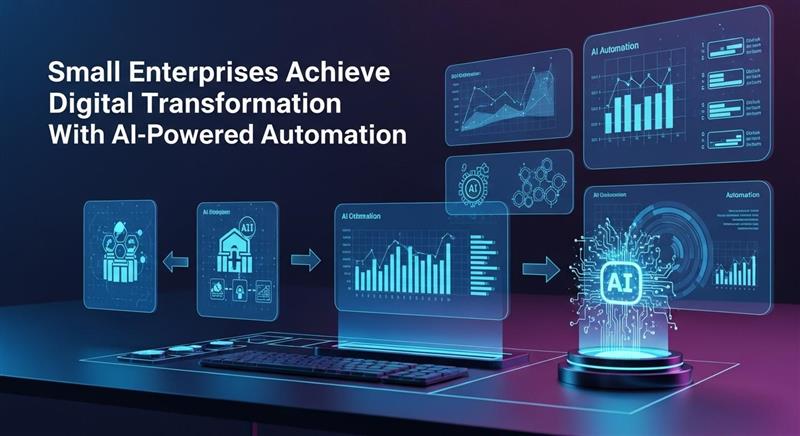
TL;DR Digital innovation shapes every corner of modern business. Small enterprises digital transformation has become less of a luxury and more of a necessity. AI-powered automation now drives this change faster than ever before.
Your small business deserves the same technological advantages that large corporations enjoy. The gap between enterprise-level tools and small business capabilities continues to shrink. Affordable AI solutions bring powerful automation within reach of companies with limited budgets.
This transformation creates opportunities you might not have imagined five years ago. Customer service becomes instant through chatbots. Data analysis happens in seconds instead of days. Manual tasks disappear from your daily workflow.
Table of Contents
Understanding Digital Transformation for Small Businesses
Digital transformation means more than buying new software. It represents a fundamental shift in how your business operates. Technology becomes woven into every aspect of your company’s DNA.
Traditional business models relied heavily on manual processes and paper-based systems. Modern enterprises leverage digital tools to streamline operations. This shift affects everything from customer interactions to inventory management.
Small businesses face unique challenges during this transition. Limited resources make every investment decision critical. Your team may lack technical expertise to implement complex systems. Budget constraints force careful prioritization of digital initiatives.
Yet small enterprises digital transformation offers incredible competitive advantages. You gain agility that larger companies struggle to match. Quick decision-making becomes your superpower. Rapid implementation of new technologies happens without bureaucratic delays.
Why Digital Transformation Matters Now
Market dynamics have changed dramatically in recent years. Customers expect instant responses to inquiries. Online presence determines whether potential clients discover your business. Digital payment options have become standard requirements rather than nice-to-have features.
Your competitors are already embracing these changes. Businesses that resist digital adoption risk becoming obsolete. Consumer behavior has shifted permanently toward digital-first interactions.
The pandemic accelerated trends that were already in motion. Remote work became mainstream overnight. E-commerce grew exponentially across all industries. Digital communication tools replaced face-to-face meetings.
Traditional Challenges Small Businesses Face
Manual data entry consumes countless hours each week. Employees spend time on repetitive tasks that machines could handle. Error rates increase when humans perform monotonous work.
Customer relationship management becomes chaotic without proper systems. Important leads slip through the cracks. Follow-up communications get forgotten in busy schedules.
Financial tracking through spreadsheets creates headaches during tax season. Inventory management turns into guesswork. Marketing efforts lack measurable results.
Communication breakdowns happen frequently in growing teams. Information silos develop between departments. Decision-makers lack real-time visibility into operations.
The Role of AI in Modern Business Operations
Artificial intelligence has evolved from science fiction to practical business tool. Machine learning algorithms now handle tasks that once required human intelligence. AI systems learn from data patterns and improve performance over time.
Natural language processing enables computers to understand human speech and text. Computer vision allows machines to interpret images and videos. Predictive analytics forecasts future trends based on historical data.
Small businesses can now access these capabilities through user-friendly platforms. Cloud-based AI services eliminate the need for expensive hardware. Subscription models make advanced technology affordable for tight budgets.
How AI Automation Works
AI automation combines artificial intelligence with workflow automation. The system identifies patterns in your business processes. It then executes tasks based on predefined rules and learned behaviors.
Machine learning algorithms analyze your historical data. They identify correlations and trends humans might miss. The system adapts its responses based on outcomes.
Integration with existing tools happens through APIs and connectors. Your current software continues working while AI enhances capabilities. Data flows seamlessly between different platforms.
The technology operates 24/7 without breaks or vacations. Processing speeds exceed human capabilities by orders of magnitude. Accuracy improves as the system accumulates more training data.
Key AI Technologies for Small Enterprises
Chatbots handle customer inquiries around the clock. They answer common questions instantly. Complex issues get routed to human staff members.
Predictive analytics forecast sales trends and inventory needs. You make informed decisions based on data rather than gut feelings. Resource allocation becomes more efficient.
Document processing AI extracts information from invoices and receipts. Data entry happens automatically without manual typing. Financial records stay organized and searchable.
Email automation personalizes communication at scale. Marketing messages reach customers at optimal times. Response rates improve through intelligent targeting.
Image recognition streamlines quality control processes. Visual inspection happens faster and more consistently. Defect detection rates improve significantly.
Core Areas Where AI Automation Transforms Small Businesses
Small enterprises digital transformation touches every department in your organization. AI automation delivers measurable improvements across multiple functions. Strategic implementation creates compound benefits over time.
Customer Service Excellence Through AI
Customer expectations continue rising year after year. People want instant answers regardless of the time. Your team cannot stay available 24/7 without AI assistance.
AI-powered chatbots provide immediate responses to common inquiries. They handle password resets and order status checks. Frequently asked questions get answered without human intervention.
Sentiment analysis monitors customer satisfaction in real-time. The system detects frustration in messages and escalates issues appropriately. Positive feedback gets captured for testimonials and case studies.
Personalized recommendations increase customer engagement. AI analyzes purchase history and browsing behavior. Product suggestions match individual preferences accurately.
Response times drop from hours to seconds. Customer satisfaction scores improve measurably. Support costs decrease while service quality increases.
Sales and Marketing Automation
Lead generation becomes systematic rather than random. AI identifies potential customers based on behavioral signals. Marketing budgets get allocated to high-performing channels.
Email campaigns automatically segment audiences by interests and behaviors. Subject lines get optimized through A/B testing. Send times adjust to individual recipient patterns.
Social media management tools schedule posts for maximum engagement. Content suggestions align with trending topics in your industry. Performance metrics get tracked automatically.
Sales forecasting accuracy improves through machine learning algorithms. Pipeline management becomes visual and intuitive. Follow-up reminders ensure no opportunity gets neglected.
Customer lifetime value predictions guide retention strategies. Churn risk scores highlight accounts needing attention. Upsell opportunities surface at the right moments.
Financial Management and Accounting
Expense tracking happens automatically through receipt scanning. Categories get assigned based on learned patterns. Reimbursement processing accelerates dramatically.
Invoice generation and sending become automated workflows. Payment reminders go out on schedule. Late payments trigger escalation sequences.
Cash flow forecasting provides early warning of potential shortfalls. Budget variance reports generate automatically. Financial dashboards update in real-time.
Tax preparation becomes less stressful with organized digital records. Deduction opportunities get identified throughout the year. Compliance requirements get tracked systematically.
Bank reconciliation happens automatically each day. Discrepancies get flagged immediately for investigation. Month-end closing takes hours instead of days.
Inventory and Supply Chain Optimization
Stock levels adjust automatically based on demand forecasts. Reorder points trigger purchase orders without manual intervention. Seasonal variations get factored into inventory planning.
Supplier performance tracking identifies reliability issues early. Alternative vendors get evaluated automatically. Negotiation leverage increases through data-driven insights.
Warehouse operations optimize through AI-powered routing. Picking sequences minimize travel time. Packing efficiency improves through smart suggestions.
Demand prediction accuracy reduces overstock and stockouts. Carrying costs decrease while product availability improves. Customer satisfaction increases when items stay in stock.
Shipping logistics optimize for cost and speed. Carrier selection happens automatically based on multiple factors. Tracking information flows to customers without manual updates.
Practical AI Automation Tools for Small Enterprises
Technology selection can feel overwhelming given countless options. The right tools depend on your specific business needs and current systems. Start with problems that cause the most pain or lost revenue.
Customer Relationship Management Systems
Modern CRM platforms embed AI capabilities throughout their interfaces. Salesforce Einstein provides predictive lead scoring and opportunity insights. HubSpot offers automated email sequences and contact enrichment.
Zoho CRM delivers AI predictions about deal closure likelihood. Pipedrive uses automation to move deals through stages. Freshsales provides AI-powered phone and email capabilities.
These systems centralize customer information in one accessible location. Communication history remains visible to your entire team. Follow-up tasks get created automatically based on interactions.
Integration capabilities connect your CRM to other business tools. Marketing automation platforms sync with sales data. Accounting software receives customer information automatically.
Marketing Automation Platforms
Mailchimp uses AI to optimize send times and subject lines. Campaign Monitor provides predictive analytics for email performance. ActiveCampaign offers sophisticated automation workflows.
Content creation gets assisted through AI writing tools. Jasper generates marketing copy based on your input. Copy.ai produces social media posts and ad variations.
Social media scheduling tools like Buffer and Hootsuite use AI for optimal posting times. Engagement prediction helps prioritize content. Hashtag suggestions increase post visibility.
SEO tools powered by AI identify content opportunities. Surfer SEO analyzes top-ranking pages for optimization guidance. Clearscope ensures your content covers topics comprehensively.
Accounting and Finance Software
QuickBooks Online incorporates AI for expense categorization and cash flow predictions. Xero provides smart reconciliation and invoice management. FreshBooks automates time tracking and project profitability analysis.
Receipt scanning apps like Expensify use AI to extract transaction details. Categories get assigned automatically based on learned patterns. Mileage tracking happens through GPS integration.
Bookkeeping services like Bench combine AI automation with human expertise. Financial statements generate monthly without your involvement. Tax-ready records stay current throughout the year.
Payment processing platforms like Stripe use AI for fraud detection. Subscription billing automates recurring revenue collection. Failed payment recovery improves through smart retry logic.
Project Management and Collaboration Tools
Asana uses AI to predict project completion dates. Task dependencies get identified automatically. Resource allocation suggestions optimize team capacity.
Monday.com provides automation recipes for common workflow patterns. Status updates flow through connected boards. Bottlenecks surface through visual analytics.
Trello power-ups add AI capabilities to simple boards. Due date suggestions prevent deadline conflicts. Card assignments optimize based on team member workloads.
Slack channels organize team communication around topics. AI-powered search finds information across conversations. Workflow automation connects discussions to actionable tasks.
Step-by-Step Implementation Strategy
Small enterprises digital transformation succeeds through methodical planning and execution. Rushing into technology adoption often leads to wasted money and frustrated teams. A structured approach maximizes return on investment.
Assess Your Current State
Document your existing business processes in detail. Map out how work flows from start to finish. Identify pain points where delays or errors occur frequently.
Evaluate your current technology stack objectively. List all software tools your team currently uses. Note integration gaps between different systems.
Calculate time spent on repetitive manual tasks. Employee surveys reveal hidden inefficiencies. Customer feedback highlights service improvement opportunities.
Review your financial metrics and operational KPIs. Establish baseline measurements for future comparison. Identify areas where performance lags behind industry standards.
Define Clear Transformation Goals
Specific objectives drive successful implementation better than vague aspirations. Quantify desired outcomes whenever possible. Set realistic timelines based on resource availability.
Revenue growth might top your priority list. Customer satisfaction improvements could be equally important. Operational cost reduction may be necessary for profitability.
Choose three to five focus areas rather than trying to transform everything simultaneously. Quick wins build momentum and team confidence. Successes in one area fund investments in others.
Align transformation goals with your overall business strategy. Digital initiatives should support your competitive positioning. Technology becomes a means to an end rather than an end itself.
Choose the Right AI Tools
Research solutions designed specifically for small businesses. Enterprise software often includes unnecessary complexity and cost. Read reviews from companies similar to yours.
Request demos from multiple vendors before making decisions. Test platforms with real scenarios from your business. Involve team members who will use the tools daily.
Evaluate integration capabilities carefully. Standalone tools create data silos and duplicate work. Seamless connections between systems multiply efficiency gains.
Consider scalability in your selection criteria. Your business will grow and needs will evolve. Changing platforms later costs more than choosing wisely upfront.
Calculate total cost of ownership beyond initial subscription fees. Implementation time has real monetary value. Training requirements affect adoption success.
Train Your Team Effectively
Technology only delivers value when people use it correctly. Invest adequate time in comprehensive training programs. Ongoing education matters as much as initial onboarding.
Create role-specific training materials rather than generic overviews. Employees need to understand features relevant to their responsibilities. Practical examples resonate better than theoretical explanations.
Designate power users who can assist colleagues with questions. Peer-to-peer learning often proves more effective than formal training. Champions within teams drive adoption through enthusiasm.
Celebrate small wins during the learning curve. Recognize team members who embrace new tools. Address resistance through empathy rather than mandates.
Provide accessible documentation and video tutorials. People learn at different paces and through different methods. Multiple resource formats accommodate diverse learning styles.
Monitor Progress and Optimize
Track metrics that directly relate to your transformation goals. Dashboard visibility keeps priorities front and center. Regular review meetings maintain accountability.
Collect feedback from team members using new tools. Frontline insights reveal practical improvement opportunities. Adjust implementations based on real-world experience.
Analyze usage data to identify underutilized features. Additional training may unlock hidden value. Some capabilities might not fit your actual workflows.
Compare performance against baseline measurements established earlier. Quantify improvements in concrete terms. Share success stories across your organization.
Iterate continuously rather than treating implementation as one-time project. Business needs evolve and technology capabilities improve. Small enterprises digital transformation is an ongoing journey.
Real-World Success Stories
Concrete examples demonstrate the tangible impact of AI automation. Small businesses across industries have achieved remarkable results. Their experiences provide valuable lessons for your own transformation journey.
Retail Business Transformation
A boutique clothing store struggled with inventory management and customer engagement. Manual stock tracking led to frequent overstock situations. Customer data existed in disconnected systems.
The owner implemented an AI-powered retail management platform. Inventory predictions reduced overstock by 40% within six months. Automated reordering prevented stockouts of popular items.
Email marketing automation increased repeat purchase rates by 35%. Personalized product recommendations drove higher average order values. Customer lifetime value improved significantly.
Social media posting automation freed up 10 hours weekly. Engagement rates doubled through optimal timing. The owner redirected time toward strategic planning and vendor relationships.
Professional Services Efficiency
A marketing consultancy faced administrative burdens that limited billable hours. Proposal creation consumed entire days. Client communication happened through scattered email threads.
Project management software with AI capabilities centralized all client work. Proposal templates with smart content suggestions cut creation time by 60%. Automated status updates kept clients informed without manual effort.
Time tracking automation captured billable hours accurately. Financial reports generated automatically for each project. Profitability analysis identified which service offerings performed best.
The firm increased billable utilization from 55% to 75%. Revenue grew 40% without adding staff. Client satisfaction scores reached all-time highs.
Manufacturing Process Improvement
A small manufacturing business struggled with quality control and maintenance scheduling. Visual inspections missed defects occasionally. Equipment breakdowns disrupted production schedules.
Computer vision AI systems performed visual quality checks automatically. Defect detection rates improved while inspection time decreased. Customer complaints dropped by 80%.
Predictive maintenance algorithms analyzed equipment sensor data. Maintenance schedules optimized to prevent breakdowns without excessive downtime. Production efficiency increased by 25%.
Inventory management automation reduced raw material carrying costs. Just-in-time ordering improved cash flow. Supply chain visibility prevented production delays.
Overcoming Common Implementation Challenges
Small enterprises digital transformation encounters predictable obstacles. Anticipating challenges allows proactive solutions. Many barriers prove less daunting than they initially appear.
Budget Constraints
Limited financial resources represent the most common concern. AI automation tools range from free to expensive. Strategic selection maximizes impact within budget realities.
Start with free trials and freemium versions of popular platforms. Many vendors offer generous free tiers for small businesses. Prove value before committing to paid subscriptions.
Calculate return on investment for each potential tool. Time savings translate directly to labor cost reductions. Revenue improvements justify technology investments.
Implement changes incrementally rather than all at once. Phased approaches spread costs over longer periods. Early wins fund subsequent investments.
Negotiate with vendors for small business discounts. Many software companies offer special pricing. Annual payment plans typically cost less than monthly subscriptions.
Technical Expertise Gaps
Your team may lack IT backgrounds or technical training. Modern AI tools emphasize user-friendliness specifically for non-technical users. Vendors provide extensive support resources.
Choose platforms with strong customer support and training materials. Live chat assistance resolves issues quickly. Video tutorials enable self-service learning.
Consider hiring consultants for initial setup if budget allows. One-time implementation costs prevent ongoing frustration. Expert configuration ensures optimal performance from day one.
Join online communities around the tools you select. Other small business users share solutions to common problems. Peer knowledge accelerates your learning curve.
Partner with technology-focused managed service providers. Outsourced IT support provides expertise without full-time salaries. Predictable monthly costs simplify budgeting.
Change Management Resistance
Team members often resist changes to familiar workflows. Fear of job displacement concerns some employees. Comfort with current methods creates inertia.
Communicate the vision behind digital transformation clearly. Explain how automation enhances rather than replaces human work. Emphasize benefits like reduced tedious tasks.
Involve employees in tool selection and implementation planning. Ownership increases buy-in and enthusiasm. Frontline insights improve implementation decisions.
Provide adequate training and ongoing support. Frustration with new tools breeds resistance. Competence builds confidence and acceptance.
Start with eager early adopters rather than forcing universal adoption immediately. Success stories convince skeptics more effectively than mandates. Momentum builds organically through positive experiences.
Address concerns about job security openly and honestly. Redeploy time savings toward higher-value activities. Frame automation as growth enabler rather than cost-cutting measure.
Data Security and Privacy
Digital transformation increases your cybersecurity responsibilities. Customer data protection carries legal and ethical obligations. Small businesses increasingly face cyber threats.
Choose vendors with strong security certifications and practices. SOC 2 compliance and data encryption should be standard. Read privacy policies carefully before committing.
Implement basic cybersecurity hygiene across your organization. Strong passwords and multi-factor authentication prevent most breaches. Regular backups protect against ransomware.
Train employees on security best practices. Human error causes most data breaches. Awareness reduces risky behaviors.
Develop clear data handling policies. Employees need to understand proper procedures. Regular reminders maintain vigilance.
Consider cyber insurance to mitigate financial risks. Coverage costs less than potential breach consequences. Policy requirements may improve your security posture.
Measuring Return on Investment
Quantifying the business impact of small enterprises digital transformation justifies ongoing investment. Concrete metrics demonstrate value to stakeholders. Data-driven decisions optimize resource allocation.
Key Performance Indicators to Track
Revenue per employee measures overall productivity improvements. AI automation typically increases this ratio significantly. Compare pre and post-implementation figures.
Customer acquisition cost reflects marketing efficiency gains. Automation typically reduces expenses while improving results. Lower CAC improves profitability directly.
Customer lifetime value increases through better service and engagement. AI-powered personalization drives loyalty and repeat purchases. Track CLV trends over time.
Employee satisfaction scores often improve with automation. Removing tedious tasks boosts morale. Higher engagement correlates with better business outcomes.
Error rates decrease when AI handles repetitive tasks. Quality improvements reduce rework and customer complaints. Defect tracking reveals automation impact.
Time-to-market accelerates for new products and services. Streamlined processes enable faster execution. Competitive advantages flow from speed.
Calculating Cost Savings
Labor cost reductions emerge from automation of manual tasks. Calculate hours saved weekly across all employees. Multiply by hourly rates to quantify savings.
Error correction costs decline with improved accuracy. Estimate expenses from mistakes in your pre-automation baseline. Track reduction in rework and customer service issues.
Inventory carrying costs decrease through better demand prediction. Calculate savings from reduced overstock situations. Factor in decreased stockouts and lost sales.
Marketing spend efficiency improves through better targeting. Track customer acquisition cost trends. Higher conversion rates reduce waste.
Operational overhead expenses often decline. Paper costs disappear with digital workflows. Physical storage needs decrease.
Long-Term Strategic Benefits
Scalability becomes possible without proportional cost increases. Your business can grow faster with existing team size. Capacity constraints ease significantly.
Market responsiveness improves through faster data analysis. You identify and react to trends quicker than competitors. Strategic agility becomes a competitive advantage.
Employee retention may improve when work becomes more interesting. Reduced turnover saves recruitment and training costs. Institutional knowledge remains within your organization.
Customer satisfaction improvements lead to organic growth. Referrals increase without additional marketing spend. Reputation benefits compound over time.
Innovation capacity expands when routine tasks disappear. Creative energy focuses on strategic initiatives. Your business evolves rather than stagnates.
Future Trends in AI Automation for Small Businesses
Technology evolution continues accelerating year after year. Understanding emerging trends helps position your business advantageously. Early adopters gain disproportionate competitive advantages.
Generative AI Integration
Large language models like GPT create content across multiple formats. Marketing copy generation happens in seconds instead of hours. Product descriptions write themselves based on specifications.
Custom chatbots with natural conversation abilities become affordable. Customer service quality improves while costs decrease. Complex inquiries get handled without human intervention.
Design tools generate visual assets from text descriptions. Marketing materials creation accelerates dramatically. Professional quality becomes accessible without expensive agencies.
Code generation assists with software customization. Technical implementation barriers lower significantly. Non-programmers build useful business applications.
Voice and Conversational Interfaces
Voice-activated business tools eliminate typing requirements. Multitasking becomes easier during routine tasks. Accessibility improves for team members with different abilities.
Phone system AI handles inbound call routing intelligently. Customers reach appropriate departments without frustrating menus. Common requests complete without human involvement.
Meeting transcription and summary generation saves countless hours. Action items extract automatically from discussions. Follow-up accountability improves through automated reminders.
Hyper-Personalization at Scale
AI analyzes customer behavior at individual level. Product recommendations match personal preferences precisely. Marketing messages address specific needs and interests.
Dynamic pricing optimization maximizes revenue and competitiveness. Algorithms adjust in real-time based on multiple factors. Conversion rates improve through strategic price points.
Content delivery adapts to individual consumption patterns. Email timing optimizes for each recipient. Website experiences customize based on visitor behavior.
No-Code and Low-Code Platforms
Visual workflow builders enable non-technical staff to create automation. Drag-and-drop interfaces replace programming requirements. Business logic implementation becomes accessible to everyone.
Pre-built templates accelerate deployment dramatically. Industry-specific solutions reduce customization needs. Best practices get embedded in starting configurations.
Integration marketplaces connect thousands of applications seamlessly. Data flows between systems without custom development. Ecosystems expand as vendors prioritize connectivity.
Edge AI and Real-Time Processing
Processing happens on devices rather than distant servers. Response times become nearly instantaneous. Privacy improves when sensitive data stays local.
Offline capabilities ensure business continuity during connectivity issues. Critical operations continue without internet dependency. Reliability increases across all conditions.
Sensor data from physical operations gets analyzed immediately. Anomaly detection happens in real-time. Intervention occurs before small issues become major problems.
Read more:-Full-Stack Development in 2025: Technologies That Actually Matter
Conclusion

Small enterprises digital transformation through AI-powered automation represents opportunity rather than threat. Technology democratization places powerful capabilities within reach of every business. Competitive advantages once reserved for corporations now scale to any size.
Your journey begins with understanding your unique business needs. Strategic tool selection matches solutions to specific challenges. Methodical implementation builds momentum through early successes.
Budget constraints should not prevent progress. Free and affordable options exist across every business function. Return on investment justifies additional spending as value becomes clear.
Team members adapt when leadership communicates vision effectively. Training and support convert skeptics into advocates. Change management succeeds through empathy and involvement.
Results manifest quickly in most implementations. Time savings appear immediately with automation. Revenue improvements build over several months.
The businesses thriving today embrace small enterprises digital transformation actively. They view technology as competitive advantage rather than necessary evil. Innovation mindsets permeate their organizational cultures.
Your competitors are making these investments right now. Waiting guarantees falling behind in rapidly evolving markets. The best time to start was yesterday.
The second best time is today.
Start small but start now. Choose one pain point causing the most frustration. Implement one tool that addresses that specific challenge.
Measure results objectively and celebrate improvements. Build on success with additional implementations. Momentum compounds over time.
AI-powered automation transforms small enterprises into agile competitors. Technology amplifies human creativity rather than replacing it. Your business potential multiplies through strategic digital investments.
The future belongs to businesses combining human insight with machine efficiency. Small enterprises digital transformation positions you for sustainable growth. That future starts with decisions you make today.