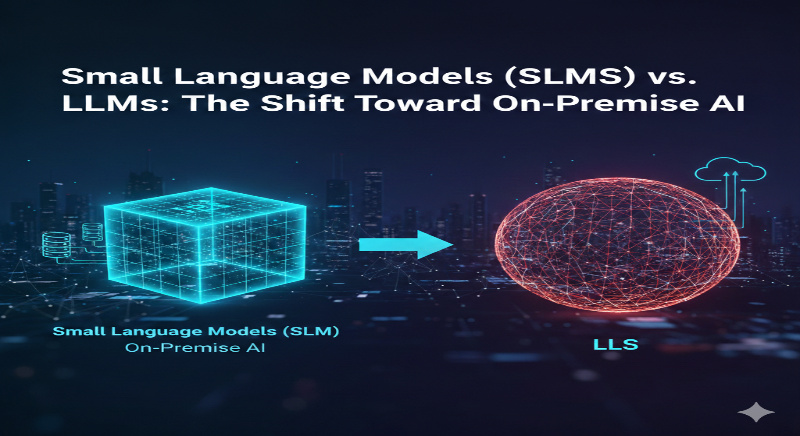
TL;DR The artificial intelligence landscape experiences a fundamental transformation. Organizations question the necessity of massive language models for every task. A new paradigm emerges around efficiency and practicality.
SLMs vs LLMs represents more than a technical comparison. This debate shapes how businesses deploy AI solutions strategically. Companies reconsider their infrastructure investments and operational approaches.
Large language models dominated headlines for the past two years. GPT-4, Claude, and Gemini showcased remarkable capabilities. These systems required enormous computational resources and cloud dependencies.
Small language models challenge this bigger-is-better mentality. Models under 10 billion parameters demonstrate surprising effectiveness. Specific tasks often need focused intelligence rather than general knowledge.
On-premise deployment gains traction across industries. Data privacy concerns drive this shift fundamentally. Regulatory requirements force organizations to rethink cloud reliance.
This comprehensive guide explores the evolving AI deployment landscape. You’ll understand when small models outperform their larger counterparts. We examine cost implications, performance metrics, and strategic considerations.
Table of Contents
Understanding Large Language Models: Capabilities and Constraints
Large language models revolutionized natural language processing completely. These systems learn from vast internet-scale datasets. Billions or trillions of parameters capture nuanced language patterns.
GPT-4 contains an estimated 1.7 trillion parameters. Claude 3 Opus operates at similar massive scales. PaLM 2 from Google demonstrates comparable complexity.
Training these models costs millions of dollars. NVIDIA H100 GPU clusters run for months continuously. Energy consumption rivals small cities during training phases.
The Power of Scale in Language Models
LLMs excel at general-purpose language understanding. They handle diverse tasks without specific training. Translation, summarization, and creative writing occur seamlessly.
Few-shot learning capabilities distinguish large models significantly. Providing three examples enables new task performance. This adaptability creates tremendous business value.
Reasoning abilities improve with model size generally. Chain-of-thought prompting unlocks complex problem-solving. Mathematical calculations and logical deductions become possible.
Contextual understanding reaches impressive depths in LLMs. These models grasp subtle implications and nuances. Cultural references and idiomatic expressions pose minimal challenges.
Infrastructure Demands of Large Models
Deploying LLMs requires substantial infrastructure investments. Single inference calls consume gigabytes of GPU memory. Batching requests improves efficiency but adds complexity.
Cloud deployment dominates the LLM landscape currently. OpenAI, Anthropic, and Google provide API access. Organizations pay per token for model interactions.
Latency concerns arise with cloud-based inference. Network round trips add hundreds of milliseconds. Real-time applications suffer from these delays.
Data leaves organizational boundaries during cloud inference. Privacy-sensitive industries face compliance challenges. Healthcare and finance regulations restrict external data transmission.
Cost Structures of LLM Operations
Token-based pricing models govern LLM usage. GPT-4 costs $0.03 per 1,000 input tokens. Output generation adds additional expenses per response.
High-volume applications accumulate substantial costs quickly. Customer service bots handling millions of queries drain budgets. Financial modeling requires careful cost-benefit analysis.
Training custom LLMs remains prohibitively expensive. Few organizations possess necessary computational resources. Domain adaptation through fine-tuning costs tens of thousands.
Operational expenses extend beyond direct API costs. Engineering teams manage integrations and monitoring. Unexpected usage spikes create budget unpredictability.
Introducing Small Language Models: Efficiency Meets Practicality
Small language models operate under 10 billion parameters typically. Many effective SLMs contain 1-7 billion parameters only. These compact architectures deliver focused capabilities.
Microsoft’s Phi-3 demonstrates SLM potential powerfully. The model contains just 3.8 billion parameters. Performance rivals much larger models on specific benchmarks.
Google’s Gemma family provides open-source SLM options. Models range from 2 billion to 7 billion parameters. Customization and deployment flexibility attract developers.
Meta’s Llama 3.2 includes optimized small variants. The 1 billion and 3 billion parameter versions run on smartphones. Edge deployment becomes genuinely practical.
Architectural Innovations in SLMs
Small models employ advanced training techniques. Knowledge distillation transfers capabilities from larger teachers. Student models learn efficiently from expert demonstrations.
Mixture of Experts architectures maximize parameter efficiency. Only relevant expert networks activate per query. Computational costs decrease while maintaining quality.
Quantization reduces model size dramatically. 4-bit and 8-bit representations shrink memory requirements. Inference speed improves on consumer hardware.
Pruning eliminates redundant neural connections. Sparse models maintain performance with fewer parameters. Storage and computation needs drop substantially.
Performance Characteristics of Small Models
Task-specific SLMs often outperform general LLMs. Focused training data improves domain accuracy. Medical coding models exceed GPT-4 on specialized tasks.
Inference speed advantages distinguish small models clearly. Millisecond response times enable real-time applications. User experience improves through reduced latency.
Resource requirements drop by orders of magnitude. Single CPU cores run many SLMs adequately. GPU acceleration provides blazing performance.
Fine-tuning costs become accessible to smaller organizations. Training completes in hours rather than weeks. Domain adaptation proceeds quickly and affordably.
The Case for On-Premise AI Deployment
On-premise deployment shifts AI infrastructure to organizational control. Models run on local servers or edge devices. External dependencies disappear almost entirely.
Data sovereignty concerns drive on-premise adoption aggressively. European GDPR regulations restrict data transfers. Chinese cybersecurity laws mandate local processing.
Financial institutions embrace on-premise AI enthusiastically. Customer transaction data never leaves secure environments. Regulatory compliance becomes significantly simpler.
Healthcare organizations protect patient information rigorously. HIPAA requirements complicate cloud AI usage. On-premise deployment eliminates many compliance headaches.
Privacy and Security Advantages
Local inference prevents data leakage fundamentally. Sensitive information stays within organizational firewalls. Attack surfaces shrink compared to cloud dependencies.
Audit trails become simpler with on-premise systems. Data flow monitoring occurs entirely internally. Compliance reporting gains clarity and completeness.
Intellectual property remains protected better locally. Proprietary algorithms and data never transmit externally. Competitive advantages stay secure.
Third-party risks vanish with on-premise deployment. Cloud provider breaches cannot expose your data. Security control remains entirely internal.
Operational Control and Customization
On-premise models allow unlimited fine-tuning freedom. Proprietary data trains models without external exposure. Competitive differentiation through custom AI becomes possible.
Performance tuning occurs without external constraints. Hardware configurations optimize for specific workloads. Latency reaches absolute minimum levels.
Version control stays under organizational management. Updates deploy on your schedule exclusively. Breaking changes never surprise critical systems.
Integration with internal systems proceeds smoothly. Network latency to databases disappears completely. Real-time processing pipelines achieve maximum efficiency.
Economic Considerations for On-Premise AI
Initial infrastructure costs require careful evaluation. GPU servers represent significant capital expenditure. Amortization over years changes cost calculations.
Operational expenses become predictable and fixed. Usage spikes don’t trigger surprise bills. Budgeting accuracy improves substantially.
High-volume applications favor on-premise economics strongly. Per-token cloud costs exceed infrastructure amortization. ROI calculations demonstrate clear advantages.
Hybrid deployments balance cost and capability. Sensitive tasks run locally while general queries use cloud. Cost optimization through strategic placement.
SLMs vs LLMs: Head-to-Head Performance Analysis
Comparing SLMs vs LLMs requires nuanced evaluation frameworks. Raw benchmark scores tell incomplete stories. Real-world application performance matters most.
General Knowledge and Reasoning Tasks
LLMs dominate broad knowledge question answering. GPT-4 achieves 86% on MMLU benchmarks. General reasoning capabilities exceed smaller models.
SLMs perform adequately on focused knowledge domains. Phi-3 reaches 69% on MMLU despite smaller size. Specific professional domains show competitive results.
Mathematical reasoning favors larger models currently. Chain-of-thought prompting works better with scale. Complex multi-step problems challenge small architectures.
Creative writing quality correlates with model size. LLMs produce more nuanced and varied outputs. Storytelling and poetry generation favor larger systems.
Domain-Specific Task Performance
Specialized SLMs outperform general LLMs frequently. Medical diagnosis models trained on clinical data excel. Legal document analysis benefits from focused training.
Customer service applications show interesting dynamics. Fine-tuned 7B models match GPT-3.5 performance. Response quality meets business requirements fully.
Code generation capabilities vary by complexity. LLMs handle diverse programming languages better. SLMs excel at specific framework implementations.
Sentiment analysis and classification favor SLMs. Task-specific training achieves 95%+ accuracy easily. Inference costs drop dramatically compared to LLMs.
Speed and Efficiency Metrics
Inference latency differs dramatically between model sizes. SLMs respond in 10-50 milliseconds typically. LLMs require 200-1000 milliseconds per query.
Throughput advantages favor small models overwhelmingly. Single GPUs serve thousands of SLM requests simultaneously. LLM batching limits concurrent processing significantly.
Energy consumption per query drops substantially. SLMs use 10-100x less power than LLMs. Environmental and operational costs decrease proportionally.
Memory footprint enables different deployment scenarios. SLMs run on smartphones and IoT devices. Edge computing becomes genuinely practical.
Cost Efficiency Across Workloads
Low-volume applications favor cloud-based LLMs initially. Infrastructure costs exceed API expenses. Simplicity benefits outweigh economic considerations.
Medium-volume deployments show interesting economics. SLM infrastructure costs amortize quickly. Break-even points occur at thousands of daily queries.
High-volume scenarios strongly favor on-premise SLMs. Millions of queries make infrastructure trivial. SLMs vs LLMs cost differences reach 100x or more.
Development and maintenance costs factor significantly. SLM fine-tuning requires less expertise. Operational complexity decreases compared to LLM integrations.
Industry-Specific Applications and Use Cases
Different industries evaluate SLMs vs LLMs through unique lenses. Regulatory environments shape deployment decisions heavily. Business requirements determine optimal approaches.
Healthcare and Medical Applications
Patient data privacy drives on-premise SLM adoption. HIPAA compliance simplifies with local processing. Medical record analysis occurs securely.
Clinical decision support benefits from specialized models. Disease-specific SLMs outperform general medical LLMs. Diagnostic accuracy improves through focused training.
Medical coding and billing suit SLMs perfectly. ICD-10 classification achieves high accuracy cheaply. Processing millions of claims becomes cost-effective.
Drug discovery research employs both approaches strategically. LLMs explore broad chemical spaces creatively. SLMs optimize specific molecular properties efficiently.
Financial Services and Banking
Transaction monitoring requires real-time processing. On-premise SLMs detect fraud milliseconds faster. Customer data never leaves secure environments.
Regulatory compliance reports demand data sovereignty. Financial authorities require local processing. SLM deployment satisfies regulatory requirements.
Customer service chatbots balance cost and quality. Fine-tuned 7B models handle routine inquiries. Complex cases escalate to human agents.
Risk assessment models leverage proprietary data. Custom-trained SLMs incorporate internal historical patterns. Competitive advantages stay protected.
Manufacturing and Industrial IoT
Edge deployment enables predictive maintenance. SLMs run on factory floor devices. Network connectivity becomes unnecessary.
Quality control inspection uses computer vision SLMs. Real-time defect detection occurs locally. Production lines maintain maximum efficiency.
Supply chain optimization employs specialized models. Demand forecasting SLMs train on company data. Inventory management improves substantially.
Safety monitoring systems require ultra-low latency. On-premise SLMs respond within milliseconds. Worker protection systems achieve reliability.
Legal and Professional Services
Document review and analysis favor specialized SLMs. Contract-specific models identify clauses accurately. Processing costs drop dramatically.
Legal research balances both model types. LLMs explore broad precedent databases. SLMs focus on jurisdiction-specific regulations.
E-discovery operations handle massive document volumes. On-premise SLMs maintain client confidentiality. Processing stays within law firm infrastructure.
Compliance monitoring requires customization. Regulation-specific SLMs track changing requirements. Alert systems operate continuously.
Technical Implementation Strategies
Deploying SLMs successfully requires careful planning. Infrastructure choices impact performance significantly. Strategic decisions shape long-term success.
Hardware Requirements and Options
Modern CPUs run small models adequately. Intel Xeon and AMD EPYC processors handle inference. GPU acceleration provides performance boosts.
Consumer GPUs enable cost-effective deployments. NVIDIA RTX 4090 runs 7B models smoothly. Cost per query drops to negligible levels.
Specialized AI accelerators offer efficiency gains. Apple Silicon M-series chips excel at SLM inference. Qualcomm Snapdragon powers mobile deployments.
Memory bandwidth matters more than raw compute. Fast RAM enables larger batch processing. SSD caching extends effective memory capacity.
Optimization Techniques for SLM Deployment
Model quantization reduces size by 75% easily. INT8 or INT4 precision maintains quality. Memory requirements drop proportionally.
ONNX Runtime optimizes inference across platforms. Cross-platform deployment becomes straightforward. Performance improves through automatic optimizations.
TensorRT compilation accelerates NVIDIA GPU inference. Kernel fusion and precision optimization help. Latency decreases by 2-5x typically.
Batch processing maximizes hardware utilization. Grouping requests improves throughput substantially. Real-time requirements guide batch sizing.
Integration Patterns and Architectures
REST APIs provide standard integration interfaces. FastAPI and Flask frameworks work excellently. Microservice architectures enable scaling.
Streaming responses improve user experience. Token-by-token generation shows progress. Perceived latency decreases significantly.
Caching layers reduce redundant computation. Semantic similarity matching identifies duplicate queries. Response time drops for common questions.
Load balancing distributes requests across instances. Horizontal scaling handles traffic spikes. High availability architectures ensure reliability.
Monitoring and Maintenance Practices
Performance metrics guide optimization efforts. Latency percentiles identify bottlenecks. Throughput monitoring ensures capacity planning.
Quality assurance requires ongoing evaluation. A/B testing compares model versions. Regression detection prevents quality degradation.
Model versioning enables safe updates. Blue-green deployments minimize downtime. Rollback capabilities provide safety nets.
Security scanning protects against vulnerabilities. Regular updates patch discovered issues. Penetration testing validates defenses.
Hybrid Approaches: Combining SLMs and LLMs
The SLMs vs LLMs debate often presents false dichotomies. Hybrid architectures leverage complementary strengths. Strategic model selection optimizes outcomes.
Routing Strategies for Mixed Deployments
Query classification directs requests intelligently. Simple questions route to fast SLMs. Complex reasoning tasks escalate to LLMs.
Confidence scoring guides routing decisions. SLM uncertainty triggers LLM consultation. Accuracy improves while controlling costs.
User tier systems balance cost and experience. Premium customers access LLM capabilities. Free tier users interact with SLMs.
Domain detection enables specialized routing. Customer service queries use fine-tuned SLMs. General knowledge questions leverage LLMs.
Cascading Model Architectures
Initial SLM processing filters most queries. Routine requests complete without LLM involvement. Cost savings reach 80-90% easily.
LLM verification checks critical decisions. High-stakes outputs receive secondary validation. Accuracy improves for important tasks.
Iterative refinement combines model strengths. SLMs draft initial responses quickly. LLMs polish outputs for quality.
Ensemble approaches blend multiple predictions. Voting mechanisms select best responses. Reliability increases through redundancy.
Cost Optimization Through Strategic Selection
Usage pattern analysis identifies optimization opportunities. High-frequency queries justify SLM fine-tuning. Rare complex tasks use LLM APIs.
Dynamic pricing models adjust based on demand. Off-peak LLM usage reduces costs. SLMs handle peak traffic locally.
Geographic distribution optimizes infrastructure placement. Regional SLM deployments reduce latency. Centralized LLMs serve specialized needs.
Continuous evaluation refines model selection. Performance metrics guide infrastructure decisions. ROI tracking validates strategy effectiveness.
Future Trends in AI Model Development
The landscape of SLMs vs LLMs continues evolving rapidly. Research advances reshape deployment economics. Emerging technologies unlock new possibilities.
Advances in Model Compression Techniques
Distillation methods improve dramatically. Teacher models transfer knowledge more efficiently. Student SLMs approach teacher performance closely.
Neural architecture search discovers efficient designs. Automated optimization finds optimal structures. Parameter efficiency increases continuously.
Sparse models activate fewer parameters per query. Dynamic routing selects relevant neural pathways. Computational costs decrease substantially.
Pruning algorithms identify redundant connections. Iterative removal maintains performance levels. Model size shrinks without quality loss.
Edge AI and Distributed Intelligence
Smartphones run increasingly capable models. On-device processing protects user privacy. Network dependency vanishes completely.
IoT devices embed specialized SLMs. Sensor data processing occurs locally. Real-time responsiveness improves dramatically.
Federated learning trains models across devices. Decentralized data never centralizes. Privacy preservation becomes inherent.
Collaborative inference distributes computation. Multiple devices share processing tasks. Resource-constrained environments become viable.
Regulatory Impact on AI Deployment
Data sovereignty regulations multiply globally. Local processing requirements increase. On-premise SLMs satisfy compliance naturally.
AI transparency laws demand explainability. Smaller models offer interpretability advantages. Audit requirements favor local deployment.
Industry-specific regulations shape architectures. Healthcare and finance lead compliance evolution. Model selection reflects regulatory landscapes.
Export controls affect model distribution. Smaller open-source models avoid restrictions. International deployment proceeds smoothly.
Open Source Ecosystem Growth
Community-developed SLMs proliferate rapidly. Llama, Mistral, and Gemma lead innovation. Commercial restrictions decrease steadily.
Fine-tuning datasets become widely available. Domain-specific training data democratizes. Specialized model development accelerates.
Tooling ecosystems mature substantially. Hugging Face and LangChain simplify deployment. Developer productivity increases continuously.
Hardware support expands across platforms. Apple, Qualcomm, and Intel optimize inference. Cross-platform performance improves.
Making the Right Choice for Your Organization
Selecting between SLMs vs LLMs requires comprehensive evaluation. Your specific context determines optimal approaches. Strategic thinking beats following trends.
Assessment Framework for Model Selection
Define your primary use cases clearly. Task complexity drives model requirements. Simple classification favors SLMs strongly.
Evaluate data sensitivity and compliance needs. Regulatory requirements often mandate local processing. Privacy concerns favor on-premise SLMs.
Analyze volume and cost projections carefully. High-volume applications favor SLM economics. Low-volume scenarios suit LLM APIs.
Consider latency and performance requirements. Real-time applications need local inference. Batch processing tolerates cloud delays.
Building Internal AI Capabilities
Start with limited scope deployments. Proof-of-concept projects minimize risk. Learning occurs before major commitments.
Develop fine-tuning expertise gradually. Internal teams master domain adaptation. Competitive advantages emerge from customization.
Invest in infrastructure strategically. Scalable architectures accommodate growth. Overbuilding wastes resources unnecessarily.
Create evaluation frameworks early. Metrics guide continuous improvement. Quality monitoring becomes systematic.
Risk Mitigation Strategies
Maintain vendor optionality through standards. Avoid proprietary lock-in mechanisms. Migration paths stay available.
Build hybrid capabilities from inception. Flexibility enables adaptation. Market changes don’t force architecture overhauls.
Implement robust testing procedures. Quality assurance catches issues early. User satisfaction remains high.
Plan for model updates and iterations. AI capabilities improve continuously. Deployment pipelines enable evolution.
Timeline and Resource Planning
Pilot projects complete in weeks typically. SLM deployment moves faster than LLM integration. Quick wins build organizational momentum.
Production readiness requires months usually. Infrastructure setup takes time. Security reviews add necessary delays.
Ongoing optimization never truly ends. Continuous improvement drives value. Resource allocation must continue.
Team skills develop through experience. Training investments pay long-term dividends. Expertise becomes organizational assets.
Frequently Asked Questions About SLMs vs LLMs
What defines a small language model versus a large one?
Parameter count determines the primary distinction. Models under 10 billion parameters qualify as SLMs typically. Large language models exceed 10 billion parameters. Some definitions set the threshold at 7 billion. The boundary remains somewhat flexible. Capabilities matter more than arbitrary cutoffs ultimately.
Can small language models match LLM performance?
Task-specific SLMs often outperform general LLMs. Focused training data improves domain accuracy dramatically. Customer service fine-tuned SLMs rival GPT-3.5 quality. General knowledge tasks still favor LLMs. Complex reasoning challenges smaller architectures. The SLMs vs LLMs performance gap narrows continuously.
How much does on-premise AI infrastructure cost?
Initial investments range from $10,000 to $100,000+. Single GPU servers start around $10,000. Enterprise clusters cost substantially more. Operational expenses remain predictable monthly. High-volume applications recoup costs within months. Break-even analysis guides investment decisions.
What are the privacy benefits of on-premise SLMs?
Data never leaves organizational boundaries. External breaches cannot expose sensitive information. Compliance requirements simplify substantially. Audit trails stay entirely internal. Regulatory agencies appreciate local processing. Customer trust increases through privacy protection.
Which industries benefit most from small models?
Healthcare gains tremendously from on-premise SLMs. Financial services prioritize data sovereignty. Manufacturing employs edge deployment extensively. Legal firms protect client confidentiality. Any regulated industry evaluates SLMs seriously. Privacy-sensitive applications favor local processing.
How difficult is it to fine-tune SLMs?
Modern tools simplify fine-tuning substantially. Hugging Face libraries handle technical complexity. Training completes in hours on single GPUs. Domain expertise matters more than ML knowledge. Hundreds rather than thousands of examples suffice. Smaller organizations deploy custom models successfully.
Do SLMs work on mobile devices?
Yes, modern smartphones run 1-3 billion parameter models. Apple Silicon and Snapdragon chips enable efficient inference. On-device processing protects user privacy completely. Response times reach acceptable levels. Battery consumption remains reasonable. Mobile AI applications proliferate rapidly.
What are the maintenance requirements for on-premise models?
Regular updates address security vulnerabilities. Performance monitoring identifies optimization opportunities. Model retraining maintains accuracy over time. Infrastructure maintenance follows standard IT practices. Cloud deployments require similar attention. Complexity levels remain comparable.
How do hybrid architectures work in practice?
Query routers direct requests to appropriate models. Simple questions use fast local SLMs. Complex reasoning tasks call external LLM APIs. Cost optimization occurs automatically. User experience remains seamless. The SLMs vs LLMs decision happens behind the scenes.
Will SLMs replace LLMs eventually?
Complete replacement seems unlikely currently. Both model types serve distinct purposes effectively. SLMs handle focused tasks efficiently. LLMs provide broad general capabilities. Hybrid approaches leverage complementary strengths. The ecosystem accommodates both architectures.
Read More:-7 AI Tools Every SaaS Founder Needs to Automate Growth
Conclusion

The SLMs vs LLMs landscape reshapes enterprise AI strategy fundamentally. Organizations gain viable alternatives to cloud-dependent large models. On-premise deployment becomes practical and economical.
Small language models deliver impressive task-specific performance. Models under 7 billion parameters handle specialized domains excellently. Cost efficiencies enable previously impossible applications.
Privacy and compliance concerns accelerate SLM adoption. Regulated industries embrace on-premise deployment enthusiastically. Data sovereignty requirements favor local processing.
Large language models retain important advantages. General knowledge and complex reasoning capabilities remain superior. Broad task coverage justifies higher costs for some applications.
Hybrid architectures combine both approaches strategically. Routing logic directs queries to optimal models. Cost optimization occurs without sacrificing capabilities.
Infrastructure decisions carry long-term implications. Initial investments require careful economic analysis. High-volume applications favor on-premise SLM deployment.
Technical capabilities advance rapidly across both categories. Open-source ecosystems democratize access. Smaller organizations deploy sophisticated AI solutions.
The shift toward on-premise AI accelerates continuously. Edge computing unlocks new application possibilities. Real-time processing becomes standard rather than exceptional.
Evaluate your specific requirements honestly. Task complexity, data sensitivity, and volume guide decisions. Cookie-cutter approaches rarely optimize outcomes.
Start small and iterate based on results. Pilot projects validate assumptions before major commitments. Learning occurs through practical experience.
Build internal expertise gradually and deliberately. Fine-tuning capabilities create competitive differentiation. Domain-adapted models outperform generic alternatives.
Monitor the evolving SLMs vs LLMs landscape closely. Research breakthroughs shift economics rapidly. Flexibility enables adaptation to changing conditions.
The future of enterprise AI embraces diversity. Multiple model types coexist productively. Strategic selection optimizes business outcomes.
Your organization controls its AI destiny increasingly. On-premise SLMs provide autonomy and efficiency. Cloud LLMs offer breadth and convenience.
Make informed decisions based on comprehensive analysis. Both architectures serve valuable purposes. Success comes from matching capabilities to needs.
The democratization of AI accelerates through SLMs. Smaller budgets deploy sophisticated solutions. Innovation flourishes across organizational sizes.
Deploy AI thoughtfully and strategically. The tools exist to solve real problems. Your implementation determines ultimate success.