Introduction
TL;DR Software bugs cost companies billions annually. Developers spend roughly 50% of their time debugging rather than building new features. Every production incident means lost revenue, frustrated users, and emergency fixes at 2 AM. The promise of self-healing code with AI sounds like science fiction becoming reality.
Imagine software that detects its own bugs and fixes them automatically. Your application crashes, identifies the problem, patches itself, and resumes operation. No human intervention required. No emergency meetings. No lost customers. This vision drives massive investment in AI-powered development tools.
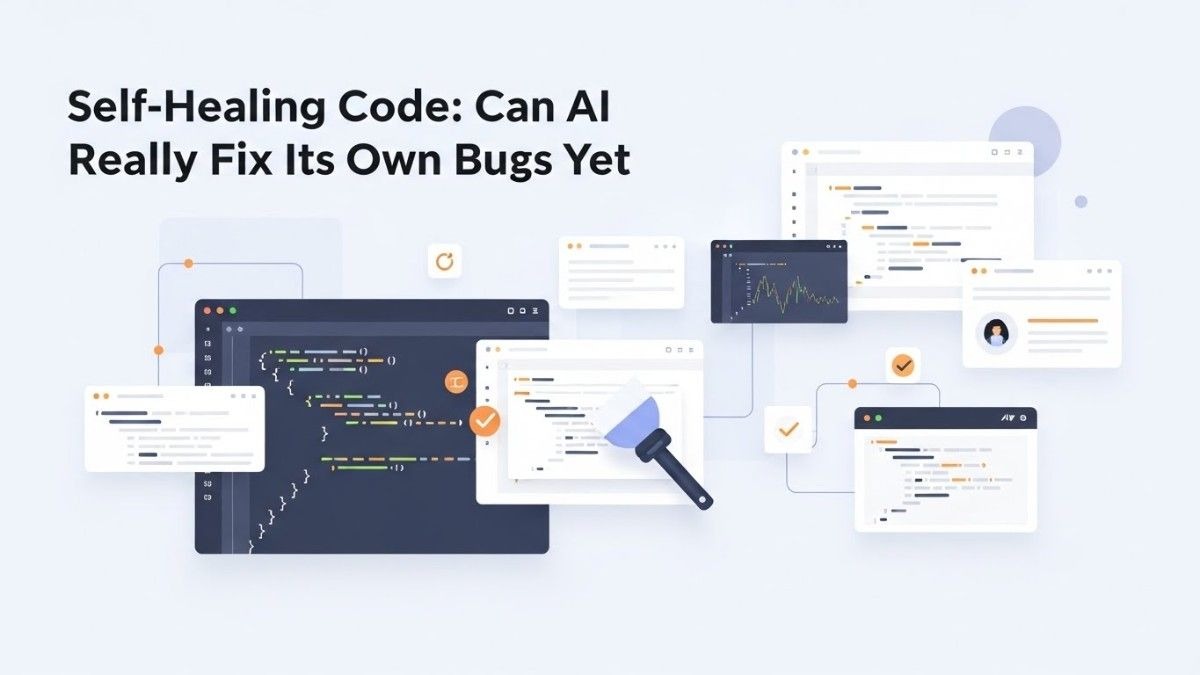
The technology exists today in limited forms. Production systems already use AI to detect anomalies and trigger automated responses. Code generation models write increasingly sophisticated programs. The question is not whether AI can help fix bugs but how close we are to truly autonomous self-healing systems. This guide examines the current state, limitations, and future of self-healing code with AI.
Table of Contents
What Self-Healing Code Actually Means
Self-healing code refers to software systems that detect, diagnose, and repair their own defects automatically. The concept extends beyond simple error handling. Traditional error handling anticipates specific failures and follows predetermined responses. Self-healing systems adapt to unexpected problems without explicit programming for each scenario.
The term encompasses several distinct capabilities. Detection means recognizing when something goes wrong. Diagnosis involves understanding the root cause of failures. Remediation requires implementing appropriate fixes. Verification confirms the fix actually solved the problem without creating new issues.
Human developers follow this same process manually. A bug report arrives describing strange behavior. The developer reproduces the issue in a test environment. They trace through code identifying the problematic logic. They implement a fix, test it thoroughly, and deploy the solution. Self-healing code with AI attempts automating this entire workflow.
Different levels of autonomy exist along the spectrum. Basic systems detect problems and alert humans. Intermediate systems attempt automatic fixes for common issues. Advanced systems handle novel problems without human guidance. Current technology clusters around the basic and intermediate levels.
The boundary between error handling and self-healing blurs at the edges. Retry logic for failed network requests represents basic self-healing. Circuit breakers that route around failing services show more sophistication. AI-powered systems that rewrite problematic code sections approach true self-healing. The distinction lies in adaptability and scope.
Current State of AI in Bug Detection
AI excels at pattern recognition across massive codebases. Modern tools analyze millions of lines of code identifying suspicious patterns. They learn from historical bugs what code smells indicate potential problems. Detection accuracy improves dramatically compared to traditional static analysis.
Static analysis tools powered by machine learning find bugs traditional linters miss. These tools understand context and code semantics beyond syntax rules. They recognize that certain coding patterns frequently precede bugs. DeepCode, Snyk, and similar tools catch issues human reviewers typically miss during code review.
Runtime anomaly detection monitors production systems for unusual behavior. AI baselines normal application performance across thousands of metrics. Deviations from baseline patterns trigger alerts. Memory leaks, performance degradation, and abnormal error rates get detected before users notice problems.
Log analysis AI finds patterns indicating emerging issues. Modern applications generate gigabytes of logs daily. Human analysis of this volume proves impossible. Machine learning models identify log patterns preceding incidents. They alert teams to problems developing gradually over days.
Code review AI suggests improvements and catches potential bugs. GitHub Copilot, Amazon CodeWhisperer, and similar tools understand code context deeply. They flag logic errors, security vulnerabilities, and performance issues during development. The suggestions often catch bugs before code reaches production.
Mutation testing AI validates test suite effectiveness. The AI introduces deliberate bugs into code. It verifies that existing tests catch these mutations. Uncaught mutations reveal gaps in test coverage. Developers write additional tests for scenarios their current suite misses.
How Self-Healing Code With AI Works Today
Current implementations of self-healing code with AI operate within narrow domains. They handle specific failure types reliably but struggle with novel problems. Understanding their operation reveals both capabilities and limitations.
Automated rollback systems detect deployment failures and revert automatically. AI monitors key metrics during deployments. Error rates, latency, or resource utilization exceeding thresholds trigger automatic rollback. The system returns to the last known good state without human intervention. This approach prevents bad deployments from affecting users broadly.
Auto-scaling responds to resource exhaustion dynamically. AI predicts resource needs based on traffic patterns and system behavior. It provisions additional capacity before performance degrades. Conversely, it scales down during low-traffic periods reducing costs. The system heals resource-related issues through elastic infrastructure.
Database query optimization AI rewrites inefficient queries automatically. Slow queries tank application performance. AI analyzes query execution plans and data access patterns. It suggests or automatically implements optimized versions. Application performance improves without code changes from developers.
Configuration healing detects and corrects invalid settings. Applications fail when configuration values fall outside valid ranges. AI learns valid configuration spaces from successful deployments. It identifies problematic settings and suggests or applies corrections. Configuration-related incidents decrease dramatically.
Dependency version resolution AI fixes compatibility issues. Modern applications depend on hundreds of libraries. Version conflicts create subtle bugs. AI understands compatibility matrices across dependency trees. It suggests version combinations that work together correctly.
Memory leak mitigation AI detects and works around resource leaks. Perfect memory management proves difficult in complex applications. AI identifies memory leak patterns and triggers garbage collection proactively. It restarts affected components before leaks cause system failures.
Real-World Examples of Self-Healing Systems
Several production systems already implement self-healing capabilities successfully. Examining real deployments reveals practical benefits and remaining challenges.
Netflix’s Chaos Engineering platform includes self-healing components. The system intentionally injects failures testing resilience. Self-healing capabilities detect these failures and trigger remediation. Circuit breakers route around failing services. Load balancers shift traffic to healthy instances. Cache layers serve stale data temporarily. The platform maintains service availability despite component failures.
Google’s Production Monitoring system uses AI for automatic remediation. The system handles routine incidents without human operators. Traffic gets redistributed away from overloaded servers. Database connections get recycled when connection pools exhaust. Misbehaving batch jobs get killed automatically. Human operators only see alerts for novel problems requiring judgment.
Microsoft Azure’s self-healing capabilities restart failed virtual machines automatically. The system detects VMs entering error states. It attempts standard remediation procedures. Failed VMs get restarted on different physical hardware. Persistent failures escalate to human operators. Customers experience less downtime from transient hardware issues.
Amazon Web Services auto-healing for EC2 instances maintains fleet health. CloudWatch monitors instance health continuously. Unhealthy instances get terminated and replaced automatically. Auto Scaling groups maintain desired capacity. Applications stay available despite individual instance failures.
Kubernetes self-healing features maintain desired application state. The orchestrator continuously monitors pod health. Failed pods get restarted automatically. Pods failing health checks stop receiving traffic. The system maintains application availability without manual intervention. Developers describe desired state, and Kubernetes maintains it.
Facebook’s automated remediation system handles millions of incidents monthly. The majority resolve without human involvement. The system recognizes incident patterns from historical data. It applies known fixes to recurring problems. Novel incidents route to human engineers. The automation frees engineers for genuinely complex problems.
Limitations of Current Self-Healing Code With AI
Despite impressive capabilities, significant limitations constrain current systems. Understanding these boundaries helps set realistic expectations about what self-healing code with AI can accomplish today.
Narrow domain scope limits applicability. Systems excel at problems they’ve encountered before. Novel bugs require human intelligence and creativity. AI struggles with unique failure modes it hasn’t learned from training data. Truly unexpected problems still need human developers.
Root cause identification remains challenging. Detecting that something went wrong proves easier than understanding why. Symptoms often mislead about underlying causes. AI might apply symptomatic fixes that don’t address root problems. The same issue recurs until humans identify the true cause.
Complex bugs with multiple contributing factors confuse current AI. Real-world bugs often result from interactions between components. Timing issues, race conditions, and state corruption create subtle failures. AI trained on simple, isolated bugs struggles with these complex scenarios.
Unintended consequences create new problems. Automated fixes sometimes introduce different bugs. Changing one part of the system affects other parts unexpectedly. AI lacks comprehensive understanding of system architecture and dependencies. Conservative approaches limit fix scope reducing both effectiveness and risk.
Verification challenges prevent confirming fixes actually work. Running comprehensive test suites takes time. Production verification risks exposing users to partially fixed problems. AI struggles determining whether a fix truly resolved the issue versus just changing symptoms.
Security implications worry many organizations. Automated code changes could introduce vulnerabilities. Malicious inputs might manipulate self-healing systems. Organizations resist letting AI modify production code without human review. Security concerns limit deployment of aggressive self-healing.
Explainability gaps undermine trust. Engineers want to understand what fixes were applied and why. Black box AI decisions create uncomfortable uncertainty. Debugging problems becomes harder when AI previously modified code. Transparency requirements often conflict with AI capabilities.
The Technology Stack Behind Self-Healing Systems
Multiple technologies combine enabling self-healing capabilities. Understanding the stack helps developers implement these features.
Large language models power code generation and modification. GPT-4, Claude, and similar models write increasingly sophisticated code. They understand programming languages, common patterns, and best practices. These models generate fix candidates for detected bugs. The quality approaches human developer output for routine problems.
Reinforcement learning trains systems through trial and error. RL agents attempt various fixes and observe outcomes. Successful fixes get reinforced. Failed attempts get discouraged. Over time, the system learns effective remediation strategies. The approach works well for problems with clear success metrics.
Anomaly detection algorithms identify deviations from normal behavior. Autoencoders, isolation forests, and statistical methods establish baselines. They flag measurements outside expected ranges. These detections trigger self-healing workflows. False positive rates determine system practicality.
Automated testing frameworks verify fix effectiveness. Unit tests, integration tests, and end-to-end tests validate changes. The testing runs automatically before applying fixes. Only changes passing all tests get deployed. This gating reduces risks from automated modifications.
Feature flags enable safe deployment of automated fixes. Changes deploy disabled initially. AI monitors impact on subset of traffic. Successful changes roll out gradually. Problems trigger immediate rollback. This gradual deployment limits blast radius.
Observability platforms provide data driving self-healing decisions. Metrics, logs, and traces feed into AI models. The platforms aggregate data from distributed systems. Rich telemetry enables accurate problem detection and verification.
Container orchestration manages application lifecycle automatically. Kubernetes, Docker Swarm, and similar platforms restart failed containers. They maintain desired replica counts. The orchestration provides infrastructure-level self-healing. Application-level healing builds on this foundation.
Building Self-Healing Capabilities Into Your Applications
Developers can implement self-healing features in their applications today. Start with proven patterns before attempting advanced AI-driven approaches.
Implement comprehensive health checks throughout your application. Every component needs endpoints reporting its health status. Include dependencies like databases and external APIs in health checks. Orchestration systems use these checks for automated remediation. Dead code paths nobody monitors can’t self-heal.
Design for failure from the beginning. Assume every component will fail eventually. Build redundancy into critical paths. Implement circuit breakers preventing cascade failures. Design stateless services that restart cleanly. Architecture choices enable or prevent self-healing capabilities.
Add extensive observability before implementing healing. You can’t heal what you can’t see. Instrument code with metrics, logs, and traces. Establish baselines for normal behavior. Anomalies only become apparent against baselines. Observability forms the foundation for self-healing.
Start with simple remediation rules for common problems. Restart components consuming too much memory. Scale up when latency increases. Rotate logs approaching disk limits. These deterministic responses handle frequent issues. Prove value before attempting AI-driven approaches.
Gradually introduce ML-based anomaly detection. Begin by alerting on detected anomalies. Build confidence in the detection accuracy. Tune thresholds reducing false positives. Eventually automate responses to high-confidence detections. Incremental deployment manages risk.
Implement automated rollback for deployments. Monitor key metrics during rollouts. Automatically revert if metrics degrade. This safety net prevents bad deployments from affecting users. It represents accessible self-healing for most teams.
Create runbooks for common incidents. Document remediation steps engineers follow manually. Automate these runbooks gradually. Start with read-only operations progressing to automated fixes. This approach builds organizational trust in automation.
Security Considerations for Self-Healing Code With AI
Security implications require careful consideration when implementing self-healing systems. Automated code modification introduces attack vectors and trust challenges.
Code review requirements conflict with automated fixes. Security-conscious organizations require human review of all code changes. Self-healing systems make changes autonomously. Organizations must balance security with self-healing benefits. Many limit self-healing to specific low-risk changes.
Audit trails become critical for automated modifications. Every change needs comprehensive logging. The logs must capture what changed, why, and what outcome resulted. Security investigations and compliance require this traceability. Missing audit trails make self-healing unacceptable for regulated industries.
Permission models need careful design. Self-healing systems require privileges to modify production code and configuration. Least privilege principles suggest minimal permissions. Sufficient permissions for healing suggest broad access. The tension requires thoughtful permission design.
Adversarial manipulation concerns worry security teams. Could malicious inputs trick self-healing systems? Attackers might craft inputs causing problematic “fixes.” Input validation becomes critical. Sandboxing limits potential damage from compromised self-healing.
Supply chain security matters for AI models. Self-healing depends on ML models trained on code datasets. Poisoned training data could create vulnerabilities. Model provenance and validation become security requirements. Organizations need confidence in their AI systems.
Verification and testing prevent insecure fixes. Automated security scanning should validate all changes. The scanning must run before deploying fixes. Only changes passing security checks should apply. This gating maintains security posture.
Rollback capabilities provide safety nets. All automated changes need quick rollback mechanisms. Security incidents might require reverting recent fixes. Immutable infrastructure and version control enable reliable rollback. These capabilities limit damage from compromised self-healing.
The Future of Self-Healing Code With AI
Current technology provides valuable but limited self-healing capabilities. Ongoing research and development promise more sophisticated systems.
Foundation models continue improving at code understanding and generation. GPT-5 and future models will write more sophisticated code. They will understand subtle bugs current models miss. Better code generation enables more effective automated fixes. The improvement trajectory suggests significant gains ahead.
Multimodal AI will understand systems more holistically. Future systems will analyze code, logs, metrics, and documentation simultaneously. They will correlate information across data sources humans struggle to connect. This comprehensive understanding enables better problem diagnosis.
Formal verification combined with AI promises provably correct fixes. AI suggests fixes while formal methods verify correctness. The combination provides confidence current approaches lack. Organizations could trust automated fixes for critical systems. The merger of techniques addresses current reliability concerns.
Continuous learning systems will improve from experience. Each bug and fix trains the system further. Organizations will develop self-healing systems customized to their specific applications. Generic models will combine with organization-specific learning. Performance will improve continuously.
Hardware advances enable more sophisticated AI. Faster processors and specialized AI chips reduce inference latency. Self-healing systems will analyze problems and generate fixes in seconds rather than minutes. Reduced latency makes self-healing practical for more scenarios.
Standardization efforts will emerge. Organizations will define interfaces for self-healing systems. Common frameworks will simplify implementation. Best practices will crystallize from early deployments. The ecosystem will mature beyond current fragmented state.
Regulatory frameworks will address autonomous code modification. Governments will establish requirements for safety-critical systems. Compliance standards will define acceptable levels of automation. These frameworks will provide clarity for conservative industries.
Evaluating Self-Healing Solutions for Your Organization
Many vendors offer self-healing capabilities today. Evaluating these solutions requires looking beyond marketing claims.
Assess the scope of problems each solution addresses. Some tools handle infrastructure failures. Others focus on application-level bugs. Understand what failures the system can actually fix. Match capabilities to your most frequent incidents.
Examine detection accuracy in realistic scenarios. False negatives mean missed problems. False positives waste resources and erode trust. Request benchmark data on detection performance. Test solutions against historical incidents from your systems.
Understand the remediation approaches taken. Does the system restart components, modify configuration, or change code? Conservative approaches provide safety but limited effectiveness. Aggressive approaches fix more but risk introducing problems. Match aggressiveness to your risk tolerance.
Evaluate integration requirements. Self-healing systems need deep integration with your stack. Assess compatibility with your infrastructure, languages, and frameworks. Integration complexity affects deployment timelines. Some solutions require extensive customization.
Consider observability and audit capabilities. You need visibility into what the system does. Comprehensive logging enables debugging and compliance. Black box systems create unacceptable risks. Transparency should be non-negotiable.
Test with realistic scenarios from your environment. Vendors demonstrate capabilities on cherry-picked examples. Test against your actual bugs and incidents. Success on vendor examples doesn’t guarantee success on your problems. Proof of concept deployments reveal practical effectiveness.
Analyze cost structures carefully. Self-healing tools price based on various metrics. Per-incident pricing, per-host pricing, and percentage-of-infrastructure pricing all exist. Calculate costs for your scale. Factor in reduced incident costs and engineer time savings.
Starting Your Self-Healing Journey
Organizations can begin implementing self-healing capabilities incrementally. Start small, prove value, and expand gradually.
Begin with comprehensive monitoring and observability. Self-healing requires seeing problems clearly. Invest in metrics, logging, and tracing. Establish baselines for normal behavior. This foundation enables all subsequent work.
Automate incident response runbooks. Document how engineers handle common incidents manually. Translate documented procedures into automated scripts. Start with read-only operations building confidence. Progress to automated remediation for low-risk issues.
Implement infrastructure-level self-healing first. Container orchestration provides built-in capabilities. Configure health checks and automatic restarts. Set up auto-scaling based on metrics. These proven patterns deliver immediate value.
Deploy anomaly detection for alerting. Use AI to identify unusual patterns. Begin by alerting humans about anomalies. Build confidence in detection accuracy. Tune thresholds minimizing false positives. Eventually progress to automated responses.
Pilot application-level healing in non-critical systems. Choose applications where issues have limited blast radius. Implement self-healing features and monitor closely. Learn from successes and failures. Apply lessons to more critical systems.
Build organizational comfort with automation gradually. Cultural resistance often exceeds technical challenges. Demonstrate value in controlled scenarios. Include engineering teams in developing automation. Address concerns transparently and incrementally.
Measure and communicate impact. Track metrics like mean time to recovery, incident frequency, and engineer time savings. Quantify the business value of self-healing. Use data to justify expanding investment. Success stories build momentum.
Frequently Asked Questions
Can AI really fix bugs autonomously right now?
AI can fix certain categories of bugs autonomously today. Simple logic errors, configuration problems, and common patterns AI has learned from training data yield good results. Novel bugs, complex interactions, and edge cases still require human developers. The technology excels at routine problems while struggling with unique challenges. Organizations deploy self-healing code with AI for specific use cases rather than general bug fixing. Capabilities improve rapidly but remain limited.
What types of bugs can self-healing systems handle?
Self-healing systems handle infrastructure failures, configuration errors, resource exhaustion, and simple logic errors most effectively. Container failures, memory leaks, and performance degradation from load spikes represent common targets. Systems struggle with complex business logic bugs, race conditions, and security vulnerabilities. The scope centers on operational issues rather than fundamental design flaws. Each self-healing solution targets specific problem categories.
How much does self-healing code technology cost?
Costs vary dramatically based on approach and scale. Open-source frameworks like Kubernetes provide basic self-healing free. Commercial observability platforms with healing features cost thousands monthly. Enterprise self-healing solutions reach tens of thousands monthly. Custom development using AI APIs costs based on usage. ROI calculations should factor in reduced downtime and engineering time. Many organizations find the investment justified by operational improvements.
Will self-healing code replace developers?
Self-healing code augments rather than replaces developers. The technology handles routine operational issues developers currently address manually. Developers spend less time on repetitive debugging and incident response. They focus more on building features and solving complex problems. New roles emerge around training and maintaining self-healing systems. Overall developer demand continues growing despite automation. Creative problem-solving and system design remain distinctly human activities.
How reliable are AI-generated fixes?
Reliability varies significantly by problem type and system sophistication. Simple, well-understood problems yield reliable fixes. Complex, novel issues produce unreliable results. Success rates range from 30% to 90% depending on the scenario. Organizations implement verification and rollback to manage risks. Testing all AI-generated fixes before deployment remains standard practice. Reliability improves continuously as models and systems evolve.
What risks come with self-healing code with AI?
Security vulnerabilities from automated changes represent significant concerns. AI-generated fixes might introduce new bugs worse than original problems. Cascading failures occur if self-healing creates unexpected side effects. Organizations lose understanding of their systems when AI makes frequent changes. Debugging becomes harder with extensive automated modifications. Malicious actors might manipulate self-healing behavior. These risks require careful mitigation through testing, monitoring, and rollback capabilities.
How do I convince my organization to adopt self-healing?
Start with quantifiable pain points like incident response time and downtime costs. Pilot projects in non-critical systems demonstrate value with limited risk. Present case studies from similar organizations. Calculate ROI based on reduced engineering time and improved uptime. Address security and control concerns with gradual deployment plans. Include engineering teams in planning and implementation. Show rather than tell through successful proofs of concept. Data-driven business cases overcome organizational resistance.
Can self-healing work in regulated industries?
Regulated industries implement self-healing within compliance constraints. The key is comprehensive audit trails and human approval gates for high-risk changes. Self-healing handles operational issues while humans review code modifications. Many organizations limit automation to infrastructure layer. Compliance teams work with engineers defining acceptable automation boundaries. Healthcare, finance, and other regulated sectors successfully deploy bounded self-healing. Regulatory requirements slow but don’t prevent adoption.
What skills do developers need for self-healing systems?
Developers need strong observability and monitoring expertise. Understanding machine learning concepts helps but deep expertise isn’t required. Infrastructure as code skills become increasingly important. Testing and verification knowledge ensures safe automation. Developers should understand AI capabilities and limitations. Incident response experience guides automation priorities. Most importantly, developers need comfort with systems making autonomous decisions. Teams adapt through training and gradual exposure.
Read More:-The CEO’s Guide to Implementing “Agentic Workflows” Without Chaos
Conclusion
Self-healing code with AI exists today in limited but valuable forms. Production systems already use AI to detect issues, diagnose problems, and implement fixes automatically. The technology handles routine operational problems effectively. Complex bugs and novel situations still require human developers.
Current capabilities center on infrastructure and operational issues. Container orchestration restarts failed services automatically. Auto-scaling responds to resource constraints. Configuration healing corrects invalid settings. These applications deliver measurable benefits through reduced downtime and faster incident response.
Application-level self-healing remains less mature. AI detects code-level bugs increasingly well. Autonomous fixing of those bugs works for simple cases. Complex logic errors, architectural issues, and subtle bugs require human judgment. The gap between detection and fixing remains substantial.
Organizations can implement self-healing capabilities today. Start with comprehensive observability providing necessary visibility. Automate incident response runbooks for common problems. Deploy infrastructure-level healing using container orchestration. Add AI-powered anomaly detection for alerting. Progress gradually to autonomous remediation for low-risk issues.
Security considerations require careful attention. Automated code changes introduce risks. Comprehensive audit trails, testing, and rollback capabilities mitigate concerns. Organizations balance self-healing benefits against security requirements. Many limit automation scope to maintain security posture.
The technology trajectory points toward more sophisticated capabilities. Foundation models improve continuously at code understanding and generation. Better models enable more effective autonomous fixes. Organizations accumulate experience implementing self-healing successfully. Best practices emerge from early deployments.
Self-healing will augment rather than replace developers. The technology handles routine operational issues developers currently address manually. Developers focus on complex problems, feature development, and system design. New roles emerge around training and maintaining self-healing systems. Developer demand continues growing despite automation.
Evaluating self-healing solutions requires looking beyond vendor claims. Test solutions against your actual incidents and bugs. Assess detection accuracy, remediation scope, and integration requirements. Understand cost structures and verify ROI calculations. Proof of concept deployments reveal practical effectiveness.
The journey toward self-healing code with AI requires cultural change alongside technology adoption. Engineers need comfort with autonomous systems making decisions. Organizations need tolerance for occasional automation mistakes. Gradual deployment builds confidence through demonstrated success. Change management often challenges more than technical implementation.
Measurements matter for justifying continued investment. Track mean time to recovery, incident frequency, and engineering time savings. Quantify business impact of reduced downtime. Use data communicating value to stakeholders. Success stories build organizational momentum.
The promise of truly autonomous self-healing code remains partially unfulfilled. Current technology delivers real value within constraints. It reduces operational burden and improves system reliability. The vision of software that maintains itself perfectly requires further advances. Incremental progress toward that vision continues steadily.
Start implementing self-healing capabilities now. The technology offers practical benefits today. Waiting for perfect solutions means missing current advantages. Organizations learning and adapting now position themselves for future capabilities. Self-healing code with AI represents the future of software operations. That future arrives gradually through continuous improvement rather than sudden revolution.