Introduction
TL;DR The demand for AI automation has exploded across industries. Companies deploy intelligent agents to handle everything from customer service to data analysis. Managing a handful of these agents seems straightforward enough. The real challenge emerges when you need to coordinate hundreds or thousands simultaneously.
Scaling AI agents from pilot projects to enterprise-wide deployment requires fundamental architectural changes. Your infrastructure must handle massive concurrent operations without breaking. Performance, cost, and reliability all need careful consideration at scale.
Most organizations hit walls around 50-100 concurrent agents. System crashes, exploding costs, and unpredictable behavior plague early scaling attempts. These problems stem from architecture decisions made during small-scale testing.
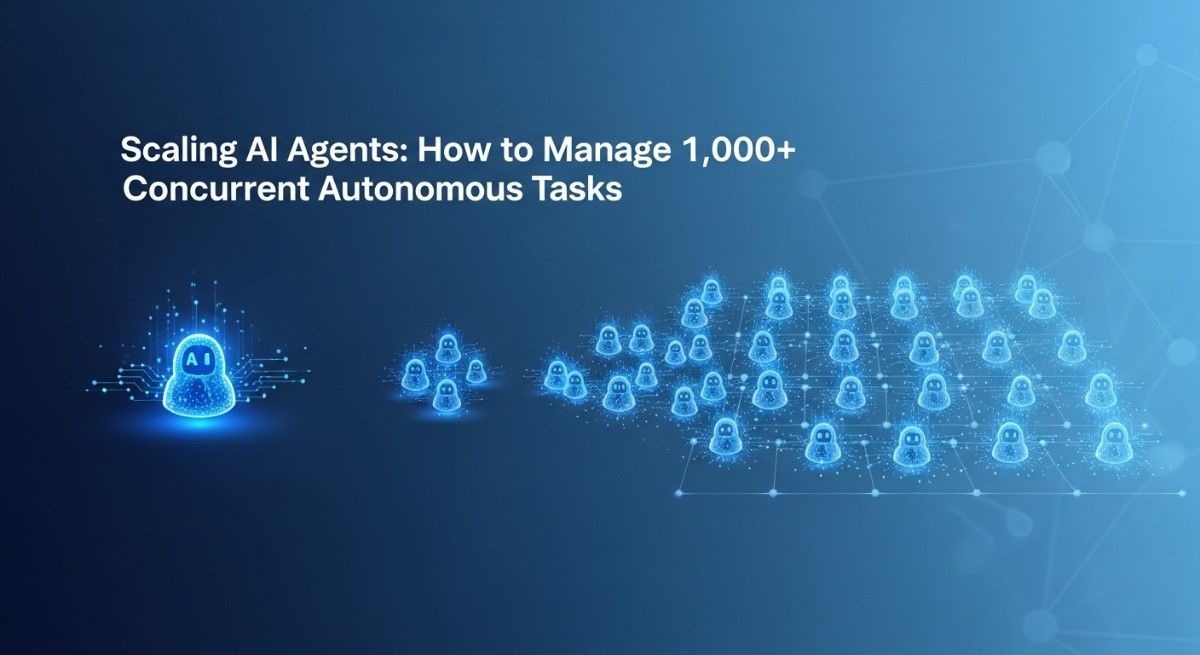
This comprehensive guide reveals proven strategies for managing 1,000+ autonomous AI tasks concurrently. You’ll discover infrastructure patterns, monitoring approaches, and cost optimization techniques. The insights come from real-world implementations across various industries.
Table of Contents
Understanding AI Agent Architecture at Scale
AI agents operate differently than traditional software applications. Each agent makes decisions independently based on environmental inputs. This autonomy creates unique scaling challenges.
Single-threaded execution works fine for small deployments. One agent completes its task before the next begins. This sequential approach becomes impossibly slow at scale.
Parallel execution enables multiple agents to work simultaneously. Your system processes hundreds of tasks at once. Computing resources get utilized efficiently across the agent fleet.
Stateless agents simplify scaling significantly. Each task execution contains all necessary context. No shared memory or persistent connections complicate deployment.
Stateful agents maintain information across multiple interactions. Customer service bots remember conversation history. This memory requirement complicates horizontal scaling strategies.
Event-driven architectures suit AI agent deployments perfectly. Agents respond to triggers rather than running continuously. Resources get consumed only when actual work needs completion.
Message queues decouple agent execution from triggering systems. Work requests accumulate in queues during high-demand periods. Agents process tasks as capacity becomes available.
Microservices patterns enable independent scaling of different agent types. Customer service agents scale separately from data processing agents. Resource allocation matches actual demand patterns.
Infrastructure Requirements for Scaling AI Agents
Proper infrastructure forms the foundation of successful scaling. Inadequate resources cause performance degradation and system failures.
Compute Resources
Processing power demands scale with agent count and complexity. Simple decision-making agents need minimal CPU. Complex reasoning tasks require significant computational capacity.
GPU acceleration benefits certain AI workloads tremendously. Natural language processing and computer vision both leverage parallel processing. Cost per task decreases with appropriate hardware selection.
Serverless computing platforms match agent workload patterns well. Functions execute only when triggered by events. You pay for actual computation time rather than idle capacity.
Container orchestration platforms manage agent deployment efficiently. Kubernetes and similar systems handle scaling automatically. Resource allocation adjusts dynamically based on demand.
Memory requirements vary dramatically across agent types. Text processing agents need modest RAM. Agents manipulating large datasets require substantial memory allocation.
Storage Systems
Database selection impacts scaling success significantly. Relational databases struggle with high-concurrency write operations. NoSQL alternatives handle distributed workloads better.
Object storage serves AI agent needs economically. Large files and datasets live in S3-compatible systems. Costs remain low even with massive data volumes.
Caching layers reduce database load dramatically. Frequently accessed data lives in Redis or Memcached. Response times improve while backend stress decreases.
Vector databases enable semantic search capabilities. Agent memory and knowledge retrieval benefit from these specialized systems. Similarity searches happen quickly at scale.
Network Infrastructure
Bandwidth constraints throttle scaling efforts unexpectedly. Agents transferring large files consume network capacity quickly. Adequate provisioning prevents mysterious slowdowns.
API rate limits create bottlenecks for external service calls. Your agents may hit provider restrictions during peak periods. Request throttling and retry logic become essential.
Load balancers distribute incoming requests across agent instances. Even distribution prevents individual server overload. Health checks route traffic away from failing instances.
Content delivery networks accelerate global agent deployments. Geographically distributed agents reduce latency significantly. User experience improves through proximity-based routing.
Core Challenges in Scaling AI Agents
Specific obstacles appear reliably when expanding agent deployments. Understanding these challenges enables proactive mitigation.
Coordination and Orchestration
Thousands of agents need centralized coordination mechanisms. Work distribution must happen fairly and efficiently. No single agent should remain idle while work awaits.
Task dependencies complicate simple distribution strategies. Some agents must complete before others begin. Dependency graphs guide execution ordering at scale.
Deadlock scenarios emerge in complex agent interactions. Two agents waiting for each other create permanent stalls. Detection and resolution mechanisms become mandatory.
Resource contention occurs when agents compete for limited services. Database connections, API quotas, and file locks all create bottlenecks. Queuing and reservation systems manage access fairly.
Cost Management
API costs scale linearly with agent activity. GPT-4 calls for 1,000 agents consume budgets rapidly. Cost containment requires strategic optimization.
Model selection impacts expenses dramatically. Smaller, cheaper models handle simple tasks adequately. Reserve expensive models for complex reasoning requirements.
Token optimization reduces language model costs significantly. Concise prompts achieve identical results with fewer tokens. Careful prompt engineering delivers substantial savings.
Caching responses eliminates redundant API calls. Similar queries return cached results instantly. Cost and latency both improve through intelligent caching.
Monitoring and Observability
Traditional monitoring approaches fail with autonomous agents. You can’t manually review every agent action. Automated systems must detect problems proactively.
Distributed tracing tracks requests across multiple systems. Each agent’s journey through infrastructure becomes visible. Performance bottlenecks get identified quickly.
Centralized logging aggregates events from all agents. Pattern detection reveals systemic issues. Individual failures emerge from noise automatically.
Real-time alerting notifies teams of critical problems. Thresholds trigger warnings before complete failures. Response happens minutes rather than hours after issues begin.
Strategies for Scaling AI Agents Successfully
Proven patterns enable reliable scaling from dozens to thousands of agents. These approaches work across different industries and use cases.
Implementing Work Queues
Message queues form the backbone of scalable agent systems. Work items enter queues as requests arrive. Agents pull tasks and process them independently.
RabbitMQ, Apache Kafka, and AWS SQS all serve this purpose. Each offers different performance and reliability characteristics. Selection depends on specific requirements and existing infrastructure.
Priority queues ensure important tasks get processed first. Critical customer requests jump ahead of routine maintenance. Business value drives execution order.
Dead letter queues capture permanently failed tasks. Failed items get routed for manual review. System health remains unaffected by problematic work.
Horizontal Scaling Patterns
Adding more agent instances handles increased load naturally. Ten agents become one hundred through simple replication. Linear scaling delivers predictable capacity growth.
Auto-scaling adjusts agent count based on queue depth. More work triggers automatic instance creation. Costs decrease during low-demand periods.
Geographic distribution reduces latency for global operations. Agents deploy in multiple regions simultaneously. Users interact with nearby instances automatically.
Resource Pooling
Connection pooling prevents database exhaustion. Agents share a limited set of database connections. New connections aren’t created for every task.
Thread pooling manages concurrent execution efficiently. Fixed thread counts prevent resource overconsumption. Work queues up when all threads stay busy.
API client pooling reuses HTTP connections. Connection establishment overhead disappears for repeat calls. Throughput increases significantly through reuse.
Circuit Breakers
External service failures shouldn’t cascade through your system. Circuit breakers detect failing dependencies automatically. Requests stop flowing to unhealthy services.
Open circuits fail fast rather than timing out slowly. Agents receive immediate errors instead of waiting. User experience improves through quick failure responses.
Half-open states test service recovery periodically. Occasional requests check whether services have recovered. Normal operation resumes once health returns.
Rate Limiting and Throttling
Protecting downstream systems prevents cascading failures. Your agents might overwhelm external APIs unintentionally. Throttling limits request rates systematically.
Token bucket algorithms smooth request bursts. Short spikes get accommodated without limit violations. Sustained high rates get throttled appropriately.
Per-agent limits prevent individual runaways. Single misbehaving agents can’t consume all quotas. Fair distribution ensures system-wide stability.
Technical Architecture for 1,000+ Agents
Specific architectural patterns enable massive scale deployments. These designs have proven themselves in production environments.
Event-Driven Architecture
Events trigger agent execution rather than continuous polling. Agents sleep until work requires attention. Resource efficiency improves dramatically through this approach.
Event sourcing captures all system state changes. Complete audit trails emerge naturally from this pattern. Debugging and compliance both benefit tremendously.
CQRS separates read and write operations. Different scaling strategies apply to each concern. Optimization happens independently for queries and commands.
Microservices Design
Different agent types deploy as separate services. Scaling happens independently for each service type. Resource allocation matches specific agent requirements.
API gateways provide unified external interfaces. Internal complexity stays hidden from consumers. Routing logic adapts as architecture evolves.
Service mesh technology manages inter-agent communication. Observability, security, and reliability all improve. Cross-cutting concerns get handled consistently.
Data Architecture
Polyglot persistence uses optimal databases for different needs. Time-series data lives in InfluxDB or TimescaleDB. Document data resides in MongoDB or Cosmos DB.
Read replicas distribute query load across multiple databases. Write operations target primary instances. Read scalability improves without impacting write performance.
Sharding partitions data across multiple database instances. Each shard handles a subset of total data. Horizontal database scaling becomes possible.
Cost Optimization for Large-Scale AI Deployments
Expenses grow quickly when scaling AI agents without careful management. Strategic optimization maintains capabilities while controlling costs.
Model Selection Strategy
Use the smallest model capable of handling each task. GPT-3.5 costs significantly less than GPT-4. Many tasks don’t require frontier model capabilities.
Local model deployment eliminates per-call API costs. Open-source models like Llama run on your infrastructure. High volumes justify self-hosting investments.
Fine-tuned models perform better on specific tasks. Smaller fine-tuned models often outperform larger general models. Training costs get amortized across millions of inferences.
Prompt Engineering
Concise prompts reduce token consumption dramatically. Remove unnecessary context and verbose instructions. Every eliminated token saves money at scale.
System prompts get reused across multiple requests. One-time costs amortize over many agent executions. Effective system prompts improve consistency too.
Few-shot learning reduces the need for fine-tuning. Example-driven prompts guide model behavior. Dynamic example selection improves relevance further.
Caching Strategies
Semantic caching returns similar responses for similar queries. Exact matches aren’t required for cache hits. Significant cost reduction happens through this approach.
Time-based expiration balances freshness and savings. Frequently requested data stays cached longer. Rarely accessed items expire quickly.
Cache warming preloads frequently needed data. Agents find information ready when needed. Cold start penalties disappear through proactive loading.
Infrastructure Optimization
Spot instances provide massive compute discounts. Interruption-tolerant workloads run at fraction of on-demand costs. Agent tasks suit spot instances well.
Reserved instances offer savings for predictable workloads. One or three-year commitments reduce costs by 30-70%. Baseline capacity uses reserved instances.
Right-sizing eliminates waste from over-provisioned resources. Actual usage patterns guide resource allocation. Unused capacity costs disappear through proper sizing.
Monitoring and Observability at Scale
Understanding system behavior becomes critical when managing thousands of agents. Comprehensive observability enables proactive problem resolution.
Key Metrics to Track
Task completion rate reveals overall system health. Successful completions should exceed 95% consistently. Declining success rates indicate emerging problems.
Latency percentiles show user experience accurately. P50, P95, and P99 metrics reveal outlier behavior. Averages mask critical performance problems.
Error rates by type enable targeted troubleshooting. Authentication failures differ from timeout errors. Category-specific metrics guide investigation priorities.
Cost per task enables ROI tracking. Expenses divided by completed work shows efficiency trends. Optimization efforts get validated through this metric.
Queue depth indicates demand versus capacity. Growing queues signal insufficient agent capacity. Shrinking queues suggest over-provisioning opportunities.
Logging Best Practices
Structured logging enables automated analysis. JSON-formatted logs support programmatic parsing. Pattern detection becomes trivial with structured data.
Correlation IDs track requests across distributed systems. Single identifiers follow work through entire pipelines. End-to-end visibility emerges through correlation.
Log levels balance detail with storage costs. Debug logs stay disabled in production normally. Critical events always get captured regardless.
Centralized aggregation collects logs from all agents. Elasticsearch, Splunk, or CloudWatch gather everything. Single pane of glass simplifies investigation.
Alerting Strategy
Threshold-based alerts catch obvious problems. Error rates above 5% trigger immediate notifications. Simple rules handle common failure modes.
Anomaly detection identifies subtle issues. Machine learning baselines establish normal behavior. Deviations trigger investigation even without threshold violations.
Alert fatigue undermines on-call effectiveness. Excessive notifications get ignored eventually. Careful tuning ensures alerts demand attention.
Escalation policies ensure critical issues get addressed. Primary responders have limited time to acknowledge. Backup teams get notified automatically if needed.
Security Considerations for Scaled AI Systems
Security requirements intensify when managing thousands of autonomous agents. Compromised agents can cause significant damage at scale.
Access Control
Role-based permissions limit agent capabilities. Each agent type gets minimum necessary privileges. Compromised agents can’t exceed defined boundaries.
API key rotation happens automatically and regularly. Stale credentials get revoked systematically. Breach windows close quickly through frequent rotation.
Network segmentation isolates agent infrastructure. Compromised agents can’t pivot to other systems. Blast radius stays contained through isolation.
Data Protection
Encryption at rest protects stored sensitive information. Database and file storage use strong encryption. Physical media theft doesn’t expose data.
Encryption in transit prevents network eavesdropping. TLS protects all inter-service communication. Man-in-the-middle attacks become ineffective.
Data minimization reduces exposure risk. Agents receive only information necessary for tasks. Unnecessary data never enters agent systems.
Audit and Compliance
Comprehensive audit logs track all agent actions. Every decision and data access gets recorded. Forensic investigation becomes possible when needed.
Compliance monitoring validates regulatory adherence. GDPR, HIPAA, and other requirements get checked automatically. Violations trigger immediate remediation.
Real-World Implementation Examples
Actual deployments reveal practical considerations that theory overlooks. These examples provide concrete guidance.
Customer Service Automation
A large e-commerce company deployed 2,000+ customer service agents. Each agent handled different customer interaction types. Chat, email, and phone support all got automated.
Queue-based architecture distributed customer inquiries. Priority routing ensured VIP customers got immediate attention. Standard inquiries processed during normal capacity.
Hybrid human-AI teams handled complex escalations. Agents resolved 80% of inquiries independently. Remaining cases got routed to human specialists.
Cost per resolution dropped 65% after full deployment. Customer satisfaction scores actually improved slightly. Response times decreased from hours to minutes.
Data Processing Pipeline
A financial services firm processes millions of transactions daily. AI agents detect fraud patterns and anomalies. Real-time processing prevents fraudulent transactions.
Event streaming architecture ingested transaction data continuously. Agents analyzed each transaction within milliseconds. Suspicious patterns triggered immediate holds.
Horizontal scaling handled daily volume fluctuations. Month-end processing demanded 5x normal capacity. Auto-scaling accommodated peaks automatically.
False positive rates decreased through continuous learning. Agent models improved from feedback loops. Detection accuracy increased quarterly.
Troubleshooting Common Scaling Problems
Specific issues appear frequently during scaling efforts. Recognizing symptoms accelerates problem resolution.
Performance Degradation
Symptoms include increasing latency and declining throughput. Response times grow gradually over days or weeks. User complaints about slowness increase.
Database connection exhaustion often causes this problem. Connection pooling configuration may need adjustment. Monitoring reveals connection pool depletion.
Memory leaks in long-running agents create similar symptoms. Garbage collection pauses increase over time. Restarting agents temporarily resolves issues.
Cascading Failures
One component failure triggers widespread system problems. Agents unable to connect begin retrying aggressively. Retry storms overwhelm recovering services.
Circuit breakers prevent this cascade pattern. Failing fast stops retry amplification. Systems recover faster through controlled degradation.
Bulkhead patterns isolate failures to specific subsystems. Critical functions remain operational during partial outages. Total system failures become rare.
Cost Overruns
Monthly bills exceed projections significantly. Usage patterns don’t match financial models. Budget exhaustion threatens project continuation.
Unoptimized prompts waste tokens unnecessarily. Prompt engineering review often finds quick savings. Token usage can drop 40-60% through optimization.
Inefficient caching causes redundant API calls. Cache hit rates below 70% indicate problems. Configuration tuning improves rates substantially.
Future-Proofing Your AI Agent Infrastructure
Technology landscapes evolve constantly. Architecture decisions today should accommodate tomorrow’s requirements.
Build abstraction layers around external dependencies. Model providers can swap without code changes. Vendor lock-in gets avoided through careful design.
Implement feature flags for gradual rollouts. New capabilities deploy to subsets of agents. Production testing happens safely through controlled exposure.
Design for multi-tenancy from the start. Serving multiple customers or business units becomes possible. Isolated environments prevent cross-contamination.
Plan for regulatory compliance proactively. Data residency and privacy requirements tighten over time. Architecture accommodates restrictions without major rework.
Frequently Asked Questions
What infrastructure costs should I expect for 1,000 agents?
Monthly costs range from $10,000 to $100,000 depending on complexity. API calls to language models represent the largest expense. Compute and storage costs remain relatively modest.
How long does scaling from 10 to 1,000 agents take?
Timeline varies from 3-6 months typically. Infrastructure changes require careful implementation. Testing and optimization consume significant time.
Can I scale AI agents on a limited budget?
Yes, through careful model selection and optimization. Open-source models eliminate per-call costs. Strategic caching reduces expensive API usage.
What team size is needed for large-scale deployment?
Teams of 5-10 people manage 1,000+ agent systems. DevOps, backend engineering, and AI expertise all contribute. Smaller teams work with managed services.
How do I prevent one bad agent from affecting others?
Resource isolation and rate limiting provide protection. Each agent operates within defined boundaries. Monitoring detects misbehavior quickly.
What happens when external APIs go down?
Circuit breakers prevent cascade failures. Agents fail gracefully rather than hanging. Alternative workflows activate automatically.
How accurate do agents remain at scale?
Accuracy often improves through larger training datasets. Feedback loops enable continuous learning. Monitoring ensures quality standards get maintained.
Should I build or buy agent orchestration platforms?
Buy for most organizations. Building takes years and significant resources. Commercial platforms mature faster than custom solutions.
Read More:-Beyond Chatbots: Why 2026 is the Year of the Autonomous Agent
Conclusion

Scaling AI agents from pilot to production demands fundamental architecture changes. Simple approaches that work for dozens of agents fail at hundreds. Proper infrastructure, monitoring, and optimization enable reliable operation at massive scale.
Queue-based architectures distribute work efficiently across agent fleets. Event-driven designs consume resources only when needed. These patterns handle variable load gracefully.
Cost management requires continuous attention at scale. Model selection, prompt optimization, and caching all contribute savings. Uncontrolled expenses derail projects despite technical success.
Monitoring and observability become essential rather than optional. Thousands of autonomous agents require automated oversight. Manual monitoring becomes physically impossible at scale.
Security considerations intensify with agent count. Compromised agents pose greater risks in large deployments. Defense in depth protects against various threat vectors.
Start small but design for scale from day one. Architecture decisions made during pilots constrain future growth. Rework costs exceed thoughtful initial design.
Learn from others who have scaled successfully. Common problems have proven solutions. Avoid reinventing wheels that others have perfected.