Introduction
TL;DR Companies rush to implement AI automation everywhere. Marketing promises sound incredible and transformative. Your organization spent thousands or millions on AI tools. The critical question remains unanswered: is it actually working?
Understanding the ROI of AI Automation separates successful implementations from expensive mistakes. Many businesses deploy AI without proper measurement frameworks. Money disappears into projects with unclear returns. Your stakeholders deserve concrete answers about value creation.
The hype surrounding AI creates dangerous blind spots. Leaders assume automation automatically saves money. Reality proves far more nuanced and complex. Measuring true return on investment requires systematic approaches. This guide provides the framework you need.
Table of Contents
Why Measuring AI ROI Matters More Than Ever
The AI investment landscape has changed dramatically. Organizations pour billions into automation technologies annually. Executive teams demand accountability for these expenditures. Your career might depend on proving value.
The Current State of AI Investment
Global AI spending reached $154 billion in 2023. Projections show continued exponential growth ahead. Your competitors likely already deployed AI solutions. Falling behind creates competitive disadvantages quickly.
Small businesses now access enterprise-grade AI tools. Cloud platforms democratized advanced capabilities. The barrier to entry dropped significantly. This accessibility increases pressure to adopt rapidly.
Venture capital flows heavily into AI startups. The market expects returns eventually. Scrutiny increases as the honeymoon period ends. Investors want proof beyond theoretical benefits.
Common Misconceptions About AI Savings
Many leaders believe AI automatically reduces headcount. This assumption creates unrealistic expectations immediately. Successful automation often shifts roles rather than eliminating them. Your team might redeploy to higher-value work.
The “set it and forget it” mentality causes failures. AI systems require ongoing maintenance and refinement. Models drift as data patterns change. Continuous investment proves necessary for sustained value.
Some executives expect immediate positive returns. AI implementations take time to mature fully. Learning curves affect early performance significantly. Patience becomes essential for long-term success.
The Cost of Not Measuring Properly
Organizations waste money on ineffective AI projects. Without measurement, you cannot identify underperforming systems. Resources continue flowing to failed initiatives. Opportunity costs multiply as time passes.
Team morale suffers when results remain invisible. Employees question leadership decisions without proof. Skepticism grows around future AI investments. Your culture becomes resistant to innovation.
Competitors who measure effectively gain advantages. They optimize faster and allocate resources better. Market position erodes gradually then suddenly. The gap becomes difficult to close later.
Establishing Your AI ROI Baseline
Accurate measurement starts before AI implementation. Your baseline captures current performance levels. This foundation enables meaningful comparison later. Skipping this step dooms measurement efforts.
Document Current Process Costs
Calculate labor costs for processes targeted for automation. Include salaries, benefits, and overhead expenses. Your accounting team can provide detailed breakdowns. Hidden costs often surprise initial estimates.
Measure time spent on repetitive tasks. Time-tracking software reveals actual versus perceived duration. Your employees might underestimate manual work hours. Detailed logs provide objective data.
Identify error rates and quality issues. Mistakes cost money through rework and customer dissatisfaction. Your quality metrics establish improvement targets. These baselines prove crucial later.
Account for opportunity costs of current processes. What valuable work gets delayed by manual tasks? Your team could pursue strategic initiatives instead. This represents significant hidden value.
Identify All AI Implementation Costs
Software licensing fees form the obvious expense. SaaS subscriptions charge monthly or annually. Your budget must account for multi-year commitments. Discounts might apply for longer contracts.
Hardware infrastructure costs can exceed software. GPU servers demand substantial capital investment. Cloud computing bills scale with usage. Your technical team estimates these requirements.
Integration expenses often surpass initial estimates. Connecting AI to existing systems requires development work. Your IT department needs time and resources. Third-party consultants might become necessary.
Training costs affect every employee touched by AI. People need time to learn new workflows. Your productivity dips during transition periods. Budget for comprehensive education programs.
Set Realistic Timeframes for ROI
Simple automation projects might show returns within months. Complex AI implementations take years to mature. Your expectations must align with project scope. Unrealistic timelines create disappointment and cancellations.
Account for learning curve periods realistically. Early adoption brings mistakes and inefficiencies. Your team experiments to find optimal approaches. This investment period precedes positive returns.
Consider maintenance and improvement cycles. AI systems require ongoing refinement efforts. Your data scientists continuously optimize performance. Factor these recurring costs into projections.
Plan for scaling phases carefully. Pilot programs expand gradually to full deployment. Your rollout strategy affects when benefits materialize. Phased approaches reduce risk but delay returns.
Key Metrics for Calculating ROI of AI Automation
Effective measurement requires the right metrics. Different AI applications demand different measurements. Your specific use case determines which indicators matter most. A comprehensive dashboard tracks multiple dimensions.
Direct Cost Savings Metrics
Labor hour reduction represents the most obvious metric. Compare time spent before and after automation. Your time-tracking data reveals actual changes. Multiplying saved hours by labor costs gives dollar values.
Error reduction translates directly to savings. Calculate costs of mistakes before AI implementation. Your quality assurance team measures improvement rates. Fewer errors mean less rework and waste.
Processing speed improvements create capacity gains. Faster task completion enables higher throughput. Your operations can handle more volume without adding staff. This scalability represents significant value.
Material and resource savings apply to physical processes. AI optimization reduces waste in manufacturing. Your supply chain becomes more efficient. These tangible savings appear clearly in accounting.
Revenue Impact Measurements
Customer acquisition improvements deserve close tracking. AI-powered marketing increases conversion rates. Your analytics platform shows attribution clearly. Higher conversion directly boosts revenue.
Customer retention rates often improve with AI. Personalization keeps customers engaged longer. Your churn metrics reveal retention improvements. Lifetime value calculations show long-term impact.
Upsell and cross-sell opportunities increase through AI recommendations. Smart systems identify promising prospects automatically. Your sales team closes more deals efficiently. Revenue per customer climbs measurably.
Market expansion becomes possible through automation. AI enables serving new segments economically. Your addressable market grows without proportional cost increases. This strategic value compounds over time.
Productivity and Efficiency Indicators
Employee satisfaction scores matter for sustainable ROI. Automation should reduce frustration and tedious work. Your surveys reveal morale improvements. Happy employees stay longer and perform better.
Throughput metrics show how much work gets completed. Compare output volumes before and after AI. Your operational dashboards track these changes. Increased throughput without added headcount proves value.
Quality scores demonstrate improvement beyond error rates. AI often enhances overall output quality. Your customer feedback reflects these improvements. Higher quality strengthens brand reputation.
Innovation capacity increases when teams escape mundane tasks. Creative problem-solving requires uninterrupted time. Your employees pursue strategic initiatives more frequently. This qualitative benefit eventually becomes quantitative.
Customer Experience Improvements
Response time reductions delight customers immediately. AI-powered support answers questions faster. Your help desk metrics show decreased wait times. Speed improvements drive satisfaction scores up.
Personalization quality enhances customer relationships. AI analyzes behavior patterns for tailored experiences. Your engagement metrics improve across channels. Customers feel understood and valued.
Consistency across touchpoints builds trust. AI ensures uniform quality regardless of volume. Your brand experience becomes more reliable. This consistency creates competitive advantages.
Proactive service anticipates customer needs. Predictive AI identifies issues before customers notice. Your support team resolves problems preemptively. This approach transforms customer perception dramatically.
Practical Framework for Measuring ROI of AI Automation
Theory means nothing without implementation guidance. A practical framework translates concepts into action. Your organization needs step-by-step processes. This structure ensures consistent measurement across projects.
Create a Measurement Dashboard
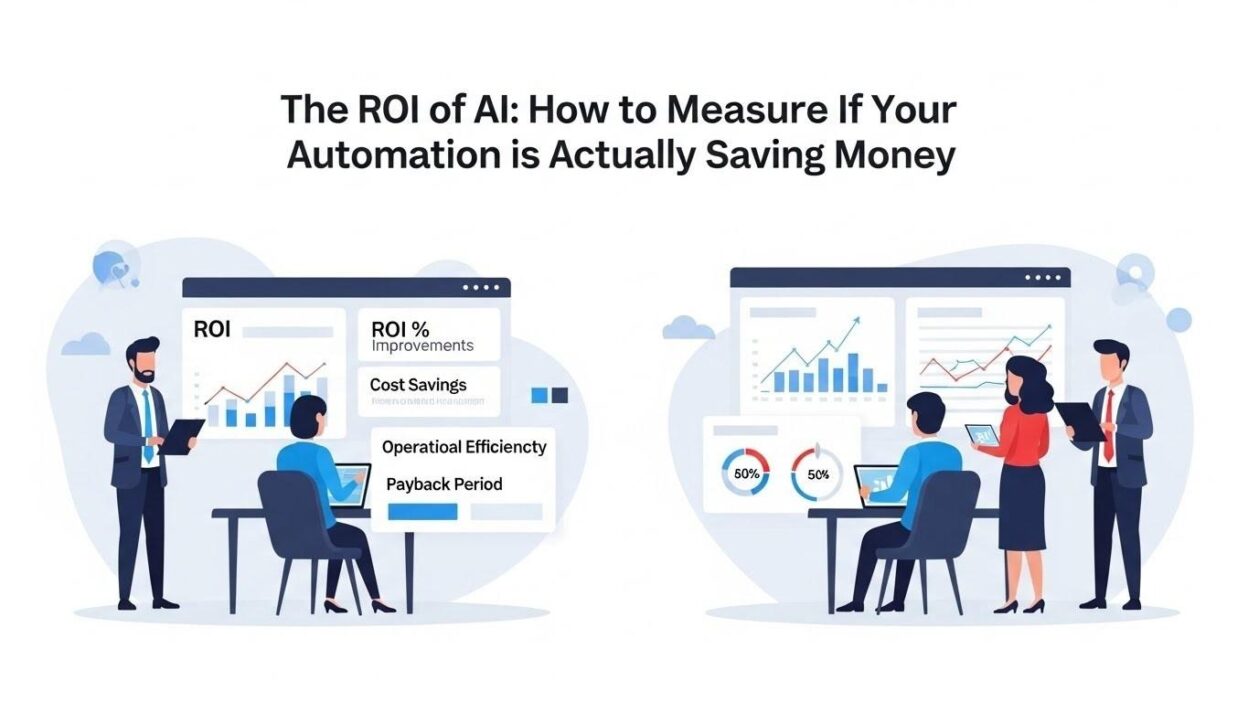
Design dashboards showing real-time AI performance. Visual displays make metrics accessible to stakeholders. Your executive team understands pictures better than spreadsheets. Regular updates maintain visibility and accountability.
Include both leading and lagging indicators. Leading metrics predict future performance trends. Your lagging indicators confirm actual results. This combination provides complete pictures.
Segment data by department and use case. Different AI applications require different views. Your marketing automation metrics differ from manufacturing. Tailored dashboards serve specific audiences better.
Enable drill-down capabilities for detailed analysis. Summary views satisfy executives initially. Your analysts need granular data for optimization. Flexible reporting serves both needs.
Implement Continuous Tracking Systems
Automated data collection eliminates manual reporting burdens. Integration between systems enables seamless tracking. Your AI tools should export metrics automatically. This reduces errors and saves time.
Establish regular review cycles for measurement accuracy. Monthly reviews catch issues early. Your team adjusts tracking as needed. Quarterly deep dives inform strategic decisions.
Create alerts for significant performance changes. Automated notifications flag problems immediately. Your team responds faster to degradation. This proactive approach prevents small issues from growing.
Document assumptions and calculation methods clearly. Future team members need to understand metrics. Your documentation ensures consistency over time. Methodology changes require careful consideration.
Calculate Total Cost of Ownership
Include all direct expenses in TCO calculations. Software, hardware, and labor costs add up. Your finance team tracks these systematically. Hidden costs often emerge over time.
Factor in indirect costs like training and support. Change management requires substantial investment. Your HR department measures these impacts. Cultural resistance has real financial consequences.
Account for opportunity costs of resources. Capital deployed in AI can’t fund other initiatives. Your strategic planning considers alternative investments. Comparison reveals relative value.
Project maintenance costs over the system lifecycle. AI tools require updates and improvements. Your IT budget must cover ongoing expenses. These recurring costs affect long-term ROI significantly.
Compare Against Alternative Solutions
Evaluate what non-AI automation could achieve. Traditional software might solve some problems. Your analysis should consider all options. AI isn’t always the optimal answer.
Benchmark against keeping current manual processes. The status quo represents a valid choice sometimes. Your cost-benefit analysis includes doing nothing. This honest comparison prevents wasteful spending.
Research outsourcing as an alternative approach. Third-party services might cost less initially. Your strategic goals determine optimal solutions. Control versus cost tradeoffs require evaluation.
Consider hybrid approaches combining AI with other methods. Partial automation might deliver better ROI initially. Your implementation can evolve gradually. Flexibility keeps options open.
Industry-Specific ROI Considerations
Different sectors experience unique AI impacts. Generic metrics miss important nuances. Your industry context shapes measurement approaches. Tailored frameworks deliver more accurate results.
Manufacturing and Production
Downtime reduction generates massive value. AI predicts equipment failures before occurrence. Your maintenance becomes proactive rather than reactive. This prevents costly production stoppages.
Quality control improvements reduce defect rates. Computer vision inspects products faster than humans. Your consistency increases while costs decrease. Customer complaints drop measurably.
Supply chain optimization cuts inventory costs. AI forecasts demand more accurately. Your working capital requirements shrink. Cash flow improvements appear quickly.
Energy efficiency gains reduce operational expenses. AI optimizes machine settings continuously. Your utility bills decrease noticeably. Environmental benefits accompany financial savings.
Customer Service and Support
Ticket resolution speed increases dramatically. AI handles routine inquiries without human intervention. Your agents focus on complex issues. Customer satisfaction improves while costs drop.
First-contact resolution rates climb. AI provides agents with better information instantly. Your customers avoid frustrating transfers. This efficiency reduces call volumes.
24/7 availability eliminates time zone limitations. Chatbots never sleep or take breaks. Your global customers receive instant help. This capability would cost enormously with human staff.
Agent productivity metrics show clear improvements. AI assists human representatives effectively. Your team handles more contacts per hour. Training time for new agents decreases.
Marketing and Sales
Campaign ROI becomes easier to calculate. AI attribution models track customer journeys. Your marketing team sees which efforts work. Budget allocation improves based on data.
Lead quality improvements boost sales efficiency. AI scores prospects more accurately. Your sales team wastes less time on dead ends. Close rates increase measurably.
Content personalization drives engagement higher. AI tailors messages to individual preferences. Your conversion rates climb across channels. Revenue per contact improves.
Market segmentation becomes more sophisticated. AI discovers hidden customer patterns. Your targeting precision increases dramatically. Acquisition costs decrease while volume grows.
Healthcare and Medical Services
Diagnostic accuracy improvements save lives and money. AI assists physicians with pattern recognition. Your error rates drop significantly. Malpractice insurance costs might decrease.
Administrative burden reduction frees medical staff. AI handles scheduling, billing, and documentation. Your clinicians spend more time with patients. Satisfaction scores improve for everyone.
Resource allocation optimization reduces waste. AI predicts patient volumes accurately. Your staffing matches actual demand better. Overtime costs decrease while care quality maintains.
Treatment personalization improves outcomes. AI analyzes patient data for tailored approaches. Your recovery rates and patient satisfaction rise. Better outcomes reduce readmission costs.
Common Pitfalls in Measuring AI ROI
Many organizations make predictable mistakes. Understanding these pitfalls helps you avoid them. Your measurement accuracy improves through learning. Awareness prevents costly errors.
Confirmation Bias in Data Analysis
Teams naturally seek evidence supporting AI investments. Cherry-picking favorable metrics creates false pictures. Your analysis must include negative indicators honestly. Intellectual honesty serves long-term interests.
Selective timeframes can distort results. Showing only the best-performing periods misleads. Your reporting should span sufficient durations. Seasonal variations require full-cycle analysis.
Ignoring indirect costs inflates apparent ROI. The true total cost of ownership includes everything. Your calculations must be comprehensive. Hidden expenses eventually surface anyway.
Comparing against unrealistic baselines creates illusions. Overstating pre-AI inefficiency makes improvements look larger. Your baseline measurements need rigorous validation. Honest starting points enable meaningful measurement.
Failing to Account for Implementation Costs
Initial deployment expenses often exceed budgets. Scope creep affects most AI projects. Your contingency planning should be generous. Underestimating costs leads to negative surprises.
Training represents a major hidden expense. Employee learning curves affect productivity temporarily. Your calculation must include this transition period. Short-term dips in performance are normal.
Integration complexity drives up technical costs. Legacy systems resist modern AI connections. Your IT team spends more time than anticipated. Budget overruns become common without padding.
Change management requires dedicated resources. People naturally resist new workflows. Your success depends on effective communication and support. These soft costs add up quickly.
Measuring Too Soon
AI systems need time to reach full potential. Early measurements show incomplete pictures. Your patience must extend through learning periods. Premature evaluation leads to wrong conclusions.
Data collection requires sufficient volume. Statistical significance demands adequate sample sizes. Your metrics stabilize only after time passes. Initial volatility misleads decision-makers.
User adoption follows predictable curves. Full organizational embrace takes months or years. Your ROI improves as usage increases. Early measurements miss this growth trajectory.
Model optimization continues post-deployment. Initial configurations rarely prove optimal. Your data science team refines approaches continuously. Benefits compound as improvements accumulate.
Ignoring Qualitative Benefits
Some AI value defies easy quantification. Employee morale improvements matter but resist measurement. Your culture benefits from reduced drudgery. This intangible value eventually becomes tangible.
Competitive positioning strengthens through AI adoption. Market perception affects customer acquisition. Your brand appears more innovative and modern. This reputational value grows over time.
Risk reduction provides insurance-like value. AI prevents problems that never occur. Your organization avoids costs that don’t materialize. These negative events are hard to measure.
Strategic flexibility increases with automation. AI enables rapid response to market changes. Your adaptability represents significant option value. This agility proves valuable during disruptions.
Advanced ROI Optimization Strategies
Basic measurement reveals whether AI works. Optimization maximizes the returns you achieve. Your continuous improvement mindset drives better results. These advanced techniques separate good from great.
A/B Testing AI Implementations
Run controlled experiments comparing AI versus manual processes. Half your team uses automation while others don’t. Your results show true incremental impact. This eliminates confounding variables.
Test different AI configurations against each other. Not all settings produce equal results. Your optimization finds the best approaches. Small tweaks sometimes yield large improvements.
Segment testing by customer or product types. AI might work better for certain categories. Your targeting becomes more precise. Resource allocation improves based on data.
Document learnings from every experiment. Institutional knowledge compounds over time. Your organization becomes smarter about AI. Future implementations benefit from past experience.
Iterative Improvement Cycles
Establish regular optimization reviews. Monthly sessions identify improvement opportunities. Your team implements changes systematically. Continuous refinement beats one-time deployment.
Analyze edge cases and failure modes. Understanding where AI struggles guides improvements. Your developers address weaknesses specifically. Overall performance climbs steadily.
Solicit user feedback constantly. Frontline employees spot issues executives miss. Your improvement priorities should reflect actual pain points. This bottom-up input proves invaluable.
Track improvement trends over time. ROI should increase as systems mature. Your learning curve generates compounding returns. Flat performance suggests deeper problems.
Leveraging AI to Measure AI
Use analytics tools to track AI performance. Meta-analysis reveals optimization opportunities automatically. Your measurement becomes more sophisticated. This recursive approach accelerates improvement.
Deploy monitoring AI to watch operational AI. Anomaly detection flags performance degradation. Your team responds to issues faster. Automated oversight reduces management overhead.
Apply machine learning to ROI data itself. Predictive models forecast future returns. Your planning becomes more accurate. Resource allocation decisions improve.
Create feedback loops between measurement and operation. Performance data should inform AI behavior automatically. Your systems become self-improving. This automation of optimization multiplies benefits.
Frequently Asked Questions
How long does it typically take to see positive ROI from AI automation?
ROI timelines vary dramatically by use case and complexity. Simple automation projects show returns within three to six months. Complex implementations might require 18 to 24 months before breaking even. Your specific situation depends on implementation costs and benefit magnitude. Pilot projects often demonstrate value faster than enterprise-wide deployments. Realistic expectations prevent premature project cancellations. Many organizations see incremental benefits during implementation phases. Full ROI typically materializes after systems mature and users adapt fully.
What’s a good ROI percentage to expect from AI investments?
Industry benchmarks suggest 15% to 40% annual returns for successful AI projects. Top-performing implementations achieve 100% or higher returns. Your actual results depend on baseline efficiency and use case fit. Customer-facing AI often delivers higher ROI than internal automation. Marketing and sales applications frequently exceed 50% returns. Manufacturing and operations typically see 20% to 30% improvements. Failed projects obviously return negative values. Diversifying across multiple AI initiatives reduces overall risk.
Should I include employee salary savings in ROI calculations?
Include salary savings only when headcount actually decreases. Redeployed employees to higher-value work creates different benefits. Your calculation should reflect actual cash savings versus productivity improvements. Many successful AI implementations shift rather than eliminate roles. This still creates value through increased output or quality. Be honest about whether people costs truly decrease. Overstating savings damages credibility when reality emerges. Strategic value from redeployment sometimes exceeds direct cost reduction.
How do I measure ROI when AI prevents problems rather than solving them?
Preventive AI requires estimating avoided costs. Calculate historical problem frequency and average cost. Your baseline shows what would have happened without AI. This counterfactual analysis involves some assumption. Industry benchmarks help validate estimates. Document your methodology clearly for stakeholders. Compare predicted versus actual incident rates. The difference represents prevented costs. This approach works for fraud detection, equipment maintenance, and risk management.
What if my AI project shows negative ROI initially?
Negative early ROI is common during learning phases. Examine whether trajectory trends toward positive returns. Your long-term projections should show eventual profitability. Consider whether implementation issues are fixable. Poor vendor selection might require switching solutions. Inadequate training could be addressed through education. Some projects genuinely fail and deserve cancellation. Honest assessment prevents throwing good money after bad. Pivot quickly when fundamental assumptions prove wrong.
How often should I recalculate ROI for ongoing AI systems?
Monthly tracking provides tactical visibility into performance. Quarterly deep dives inform strategic decisions. Your annual reviews assess long-term trends and total impact. Continuous monitoring through dashboards enables real-time awareness. Major system changes require immediate ROI reassessment. Market condition shifts might affect value calculations. Regular measurement prevents drift from going unnoticed. Consistency in calculation methodology enables valid comparisons over time.
Can AI ROI be negative even when the technology works well?
Yes, working technology can still lose money. Implementation costs might exceed achievable benefits. Your use case selection matters enormously. Solving low-value problems with expensive AI destroys value. Opportunity costs of capital and resources affect calculations. Better alternative investments might exist elsewhere. Technology success doesn’t guarantee business success. Strategic fit and economic fundamentals determine ultimate ROI. Some organizations implement AI for competitive necessity despite negative returns.
How do I account for AI improving over time in ROI projections?
Model improvement curves based on historical data. AI systems typically gain efficiency as they learn. Your projections should reflect this growth trajectory. Conservative estimates assume slower improvement than hoped. Factor in planned optimization cycles and upgrades. Technology advances make future AI more capable. Your long-term models incorporate these improvements. Discount future benefits appropriately for present value. This creates realistic multi-year ROI expectations.
Read More:-
Conclusion

Measuring the ROI of AI Automation separates speculation from reality. Your organization deserves concrete answers about investment returns. This comprehensive framework provides the tools you need. Implementation requires discipline and honest analysis.
Start with solid baselines before deploying AI. Document current costs and performance levels thoroughly. Your comparison points determine measurement validity. Skipping this foundation undermines all future calculations.
Choose metrics matching your specific use cases. Different AI applications require different measurements. Your dashboard should track multiple dimensions simultaneously. Comprehensive visibility prevents blind spots and surprises.
Account for all costs honestly in your calculations. Implementation expenses often exceed initial estimates. Your total cost of ownership includes obvious and hidden factors. Underestimating costs leads to disappointment and failed projects.
Allow adequate time for AI systems to mature. Premature measurement produces misleading results. Your patience through learning curves pays dividends. Most successful implementations show improving returns over time.
Avoid common pitfalls that distort ROI analysis. Confirmation bias skews data interpretation dangerously. Your intellectual honesty serves long-term interests. Negative findings deserve attention just like positive ones.
Optimize continuously rather than deploying once. AI systems improve through refinement and learning. Your commitment to iteration drives superior results. Stagnant implementations gradually lose competitive value.
Industry context shapes what good ROI looks like. Manufacturing metrics differ from customer service measurements. Your benchmarks should reflect sector-specific realities. Comparison against peers provides useful perspective.
The ROI of AI Automation ultimately determines technology success. Working AI that loses money serves nobody well. Your measurement discipline creates accountability and learning. Data-driven decisions beat enthusiasm-driven investments consistently.
Start measuring your AI investments properly today. Implement the frameworks outlined in this guide. Your stakeholders will appreciate the transparency and rigor. Clear ROI proof enables confident future AI expansion.
Remember that some AI value resists quantification. Strategic positioning and competitive necessity matter too. Your calculations should acknowledge qualitative benefits appropriately. Balanced assessment considers both numbers and narratives.
The organizations winning with AI measure relentlessly. They optimize based on data rather than assumptions. Your competitive position improves through systematic ROI tracking. This discipline transforms AI from expense to investment.
Take action now to establish measurement frameworks. The effort required pays for itself many times over. Your AI initiatives deserve the same rigor as any major investment. Proper ROI measurement turns automation promises into proven performance.