Introduction
TL;DR Artificial intelligence has revolutionized how we access and process information. Large language models answer questions impressively. These AI systems sometimes provide incorrect or outdated information. Businesses need reliable AI responses grounded in facts.
Retrieval-Augmented Generation solves the accuracy problem elegantly. This technology combines information retrieval with AI text generation. The approach ensures responses contain verified information. Companies can trust the outputs for critical business decisions.
Understanding RAG requires no advanced technical knowledge. This guide explains the concept using everyday examples. You’ll discover how the technology works step-by-step. Real-world applications demonstrate practical business value.
Organizations across industries implement RAG systems successfully. Customer service teams provide accurate answers instantly. Research departments access vast knowledge bases efficiently. Legal firms retrieve relevant case precedents automatically.
The technology democratizes access to specialized knowledge. Employees find information without memorizing everything. AI becomes a reliable research assistant. Productivity increases while maintaining accuracy standards.
Table of Contents
What is Retrieval-Augmented Generation?
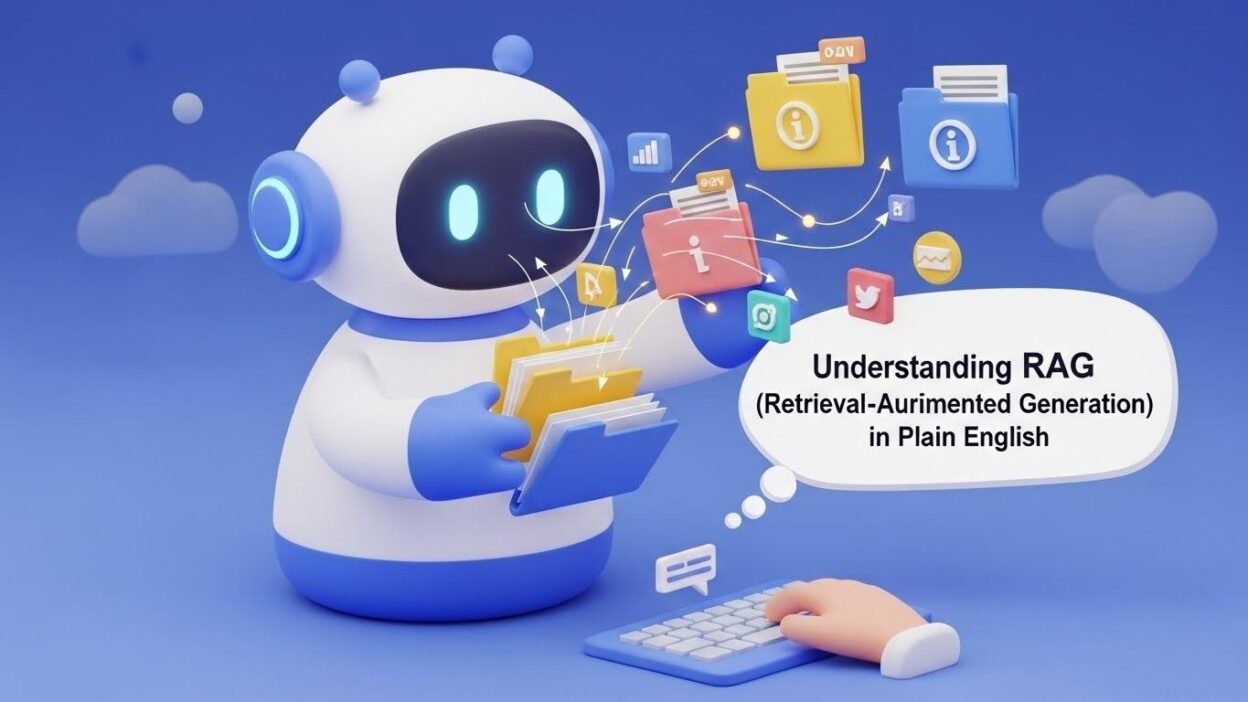
Retrieval-Augmented Generation represents a breakthrough in AI accuracy. The technology enhances language models with external knowledge sources. AI responses come from verified documents and databases. Hallucinations and incorrect information decrease dramatically.
The Basic Concept Explained
Imagine asking a very smart friend for advice. Your friend doesn’t know everything from memory. They check reliable sources before answering your question. The response combines their intelligence with verified information.
RAG works exactly this way for AI systems. The AI receives your question first. It searches through approved documents and databases. Relevant information returns to the AI. The system crafts an answer using retrieved facts.
Traditional AI models rely solely on training data. This data becomes outdated quickly. Companies cannot update models frequently enough. Retrieval-Augmented Generation solves this limitation completely.
Why Traditional AI Falls Short
Large language models learn from massive text datasets. Training happens once during model development. New information emerging after training remains unknown. The model cannot access current data automatically.
ChatGPT trained on data through a specific cutoff date. Questions about recent events receive uninformed responses. The model might confidently state incorrect information. Users cannot distinguish accurate from fabricated answers easily.
Business documents change constantly throughout operations. Product specifications update with new releases. Company policies evolve with regulatory changes. Pricing information adjusts based on market conditions.
Training custom models on company data proves expensive. The process requires significant computational resources. Updates demand retraining the entire model repeatedly. Small businesses cannot afford this approach realistically.
How RAG Provides the Solution
Retrieval-Augmented Generation keeps AI responses current automatically. Your latest documents become immediately queryable. No model retraining happens when information changes. The system accesses fresh data in real-time.
The technology separates knowledge from intelligence. Documents store factual information externally. The language model provides reasoning and communication skills. Updates affect only the document repository.
Accuracy improves because responses cite actual sources. The AI cannot fabricate information from imagination. Answers must come from retrieved documents exclusively. Verification becomes straightforward through source checking.
Cost efficiency makes RAG accessible to all businesses. Document updates require no expensive retraining. Existing language models work without modifications. Implementation costs remain reasonable for most organizations.
The Three Core Components of RAG
Retrieval-Augmented Generation systems contain three essential elements. Each component performs specific functions. Understanding these parts clarifies how everything works together.
The Knowledge Base
Your knowledge base stores all relevant information. Company documents, manuals, and databases live here. The system searches this repository when answering questions. Content quality directly impacts response accuracy.
Documents can include various formats easily. PDFs, Word files, and web pages all work. Spreadsheets and databases integrate seamlessly. The system extracts text from all sources.
Organization within the knowledge base matters significantly. Well-structured information retrieves more effectively. Proper tagging and categorization improve search results. Metadata adds context to document content.
Regular updates keep information current automatically. New documents upload to the system instantly. Outdated content removes or archives appropriately. Version control tracks document changes over time.
The Retrieval System
The retrieval component searches your knowledge base intelligently. It converts questions into searchable formats. Semantic understanding finds relevant information accurately. Results rank by relevance to the query.
Vector databases power modern retrieval systems. Documents convert into mathematical representations called embeddings. These embeddings capture semantic meaning effectively. Similar concepts cluster together in vector space.
Search happens through similarity matching. The question converts into a vector representation. The system finds document vectors with similar meanings. Relevant passages return for the generation phase.
Speed matters for real-time applications. Retrieval must complete in milliseconds typically. Optimized indexes enable fast searching. Caching frequently accessed information improves performance further.
The Generation Component
Language models generate natural responses from retrieved information. The AI receives both your question and relevant passages. It synthesizes information into coherent answers. The response reads naturally while staying factually accurate.
Modern large language models handle generation excellently. GPT-4, Claude, and similar models work effectively. The model doesn’t need special training. Standard pretrained models suffice for most applications.
Prompt engineering guides the generation process. Instructions tell the model how to use retrieved information. The system knows to cite sources appropriately. Formatting requirements ensure consistent output style.
Quality control mechanisms prevent incorrect responses. The AI acknowledges when information seems insufficient. Confidence scores indicate answer reliability. Users understand response trustworthiness clearly.
How Retrieval-Augmented Generation Works Step-by-Step
Understanding the RAG workflow reveals its power and simplicity. The process follows logical steps from question to answer. Each stage builds upon the previous one.
Step 1: User Asks a Question
Someone submits a question to the RAG system. The query can use natural everyday language. Technical jargon isn’t required for effective searches. The system understands context and intent.
Questions might seek specific facts directly. Users could ask for comparisons between options. Some queries request explanations of complex topics. The system handles all question types effectively.
The interface accepts various input methods. Text entry works through web forms or chat. Voice input converts to text automatically. Integration with existing tools maintains familiar workflows.
Step 2: Query Processing and Understanding
The system analyzes the question before searching. Natural language processing extracts key concepts. Synonyms and related terms expand search coverage. Ambiguous phrasing gets clarification when needed.
Query expansion improves retrieval effectiveness significantly. A question about “returns” might mean product returns or financial returns. Context clues help disambiguate the intended meaning. The system searches for the most likely interpretation.
User history informs query understanding. Previous questions provide conversational context. The system maintains session continuity naturally. Follow-up questions reference earlier exchanges automatically.
Step 3: Searching the Knowledge Base
The retrieval system searches your document repository thoroughly. Semantic search finds conceptually relevant information. Exact keyword matches aren’t strictly necessary. Meaning matters more than specific wording.
Multiple retrieval strategies combine for better results. Dense retrieval uses vector similarity matching. Sparse retrieval employs traditional keyword search. Hybrid approaches leverage both methods’ strengths.
Results ranking prioritizes the most relevant passages. Machine learning algorithms learn from user feedback. Popular documents might receive slight ranking boosts. Recency can factor into relevance scoring.
The system retrieves multiple relevant passages typically. Five to twenty passages provide sufficient context. Too many passages confuse the generation model. Too few risk missing important information.
Step 4: Generating the Response
Retrieved passages flow to the language model. The model receives clear instructions about its task. It must answer using only the provided information. Fabrication receives explicit prohibition in prompts.
The AI reads through all retrieved passages carefully. It identifies information directly answering the question. Supporting details and context get included appropriately. Irrelevant information gets filtered out naturally.
Response generation happens within seconds typically. The model writes in clear accessible language. Technical concepts receive plain English explanations. The tone matches your specified requirements.
Citations connect answers to source documents. Each claim links to its original passage. Users can verify information independently. Trust builds through transparent sourcing.
Step 5: Response Delivery and Refinement
The complete answer returns to the user. Formatting makes the response easy to read. Source citations appear clearly and accessibly. Additional context enhances understanding when helpful.
Users can ask follow-up questions immediately. The system maintains conversational context naturally. Clarification requests receive quick responses. The interaction feels like talking with a knowledgeable colleague.
Feedback mechanisms improve future performance. Users indicate answer quality with ratings. Problematic responses get flagged for review. The system learns from every interaction continuously.
Real-World Applications of RAG
Retrieval-Augmented Generation transforms numerous business functions. The technology applies wherever information retrieval matters. These examples illustrate practical implementations across industries.
Customer Support and Service
Customer service teams answer thousands of questions daily. Product information, troubleshooting steps, and policies require quick access. Retrieval-Augmented Generation provides instant accurate responses.
Support agents query the RAG system during customer conversations. Answers appear within seconds with source citations. Agents verify information before sharing with customers. Response quality improves while handle time decreases.
Chatbots leverage RAG for autonomous customer service. The system answers routine questions without human involvement. Complex issues escalate to human agents appropriately. Customers receive immediate help regardless of time.
Knowledge base consistency improves across all channels. Every agent accesses the same current information. Phone, email, and chat support provide identical answers. Brand consistency strengthens through standardized responses.
Internal Knowledge Management
Large organizations struggle with information fragmentation. Important documents scatter across multiple systems. Employees waste hours searching for needed information. Retrieval-Augmented Generation centralizes knowledge access.
HR departments handle countless policy questions. Employee handbooks contain hundreds of pages. RAG systems answer questions about benefits, leave, and procedures. HR staff focuses on complex issues requiring human judgment.
IT support teams reference extensive technical documentation. System configurations, troubleshooting guides, and vendor manuals fill repositories. Engineers find solutions faster with intelligent search. Problem resolution accelerates significantly.
Sales teams need product information during customer conversations. Feature comparisons, pricing details, and technical specifications matter. RAG provides instant answers without interrupting the sales flow. Deal velocity increases with better information access.
Research and Analysis
Researchers spend enormous time reviewing literature. Academic papers, reports, and studies number in thousands. Retrieval-Augmented Generation accelerates the research process dramatically.
Legal professionals review case law and precedents constantly. Relevant cases might exist across decades of rulings. RAG systems find applicable precedents in seconds. Attorneys spend more time on legal strategy.
Financial analysts track company filings and market reports. Earnings calls, SEC filings, and analyst reports contain crucial data. Querying this information manually proves time-consuming. RAG extracts insights across multiple documents simultaneously.
Medical professionals reference clinical guidelines and research. Treatment protocols evolve with new evidence constantly. Doctors query RAG systems for current best practices. Patient care improves with access to latest knowledge.
Content Creation and Marketing
Content teams repurpose existing materials creatively. Blog posts, whitepapers, and case studies contain valuable information. Retrieval-Augmented Generation helps writers leverage this content.
Marketing departments maintain brand voice consistency. Style guides, approved messaging, and product descriptions need adherence. RAG ensures all content aligns with guidelines. Brand integrity maintains across all materials.
Product documentation requires accuracy and completeness. Technical writers reference specifications and engineering documents. RAG pulls correct information from authoritative sources. Documentation quality improves while production time decreases.
Building Your Own RAG System
Implementing Retrieval-Augmented Generation requires careful planning. The process involves several key decisions and steps. Organizations can start small and expand gradually.
Defining Your Use Case
Identify specific problems RAG will solve. Customer support automation might be the priority. Internal knowledge management could drive implementation. Clear objectives guide design decisions appropriately.
Understand your users and their needs thoroughly. Support agents have different requirements than executives. Technical accuracy matters more in some contexts. User research informs system design effectively.
Assess the information you need to include. Existing documentation provides the knowledge base foundation. Databases and structured data enhance capabilities. Missing information needs creation before launch.
Preparing Your Knowledge Base
Gather all relevant documents and data sources. Digital files convert more easily than paper documents. OCR technology handles scanned materials when necessary. Quality input ensures quality output consistently.
Clean and organize your content systematically. Remove outdated or incorrect information immediately. Standardize formatting for consistent processing. Metadata tags improve retrieval accuracy significantly.
Structure documents for optimal retrieval. Clear headings help with passage extraction. Logical organization aids in finding information. Short paragraphs work better than long blocks of text.
Selecting Technology Components
Choose a vector database for document storage. Pinecone, Weaviate, and Qdrant represent popular options. Evaluate based on scale, performance, and budget. Cloud and self-hosted options both exist.
Select an embedding model for vectorization. OpenAI, Cohere, and open-source models all work. Embedding quality impacts retrieval accuracy directly. Test different options with your content.
Pick a language model for response generation. GPT-4 delivers excellent quality at higher cost. Claude offers strong performance with safety features. Open-source models like Llama provide cost-effective alternatives.
Integration platforms simplify system assembly. LangChain and LlamaIndex provide RAG frameworks. These tools handle much technical complexity. Development time decreases substantially with frameworks.
Testing and Optimization
Create test questions covering common scenarios. Include edge cases and difficult queries. Evaluate system responses against quality criteria. Iterate based on testing results continuously.
Measure retrieval accuracy through manual review. Check whether relevant passages return for queries. Adjust retrieval parameters to improve results. Different settings suit different content types.
Assess response quality systematically. Accuracy, completeness, and clarity all matter. User feedback provides valuable quality signals. A/B testing compares different approaches objectively.
Monitor performance metrics in production. Response time, user satisfaction, and query volume need tracking. Identify patterns in successful and unsuccessful queries. Continuous improvement becomes systematic.
Common Challenges and Solutions
Implementing Retrieval-Augmented Generation involves overcoming obstacles. Understanding common challenges prepares you better. Practical solutions exist for most problems.
Handling Incomplete Information
The knowledge base might lack answers to some questions. Users ask about topics outside documented scope. The system must acknowledge these limitations honestly.
Design responses that admit uncertainty gracefully. “I don’t have information about that in my knowledge base” works. Offer to escalate to human experts when appropriate. Avoid fabricating answers under any circumstances.
Identify knowledge gaps through query analysis. Frequent unanswerable questions reveal documentation needs. Prioritize creating content for common gaps. The system improves as content coverage expands.
Maintaining Document Freshness
Information becomes outdated quickly in dynamic environments. Product specs change with new releases. Policies update with regulatory changes. Stale information causes accuracy problems.
Implement automated document update processes. Content management systems can push changes automatically. Version control tracks document evolution over time. Deprecation dates trigger content reviews.
Schedule regular content audits systematically. Subject matter experts review their domain areas. Outdated information removes or archives appropriately. Update frequency depends on change rate.
Balancing Retrieval Breadth and Precision
Retrieving too few passages risks missing important information. Retrieving too many passages overwhelms the language model. Finding the right balance requires experimentation.
Start with moderate retrieval counts around ten passages. Monitor answer quality across various questions. Increase count if answers seem incomplete. Decrease if responses become confused or contradictory.
Adjust retrieval based on query complexity. Simple factual questions need fewer passages. Complex analytical questions benefit from more context. Dynamic adjustment improves overall performance.
Managing Costs at Scale
Cloud-based language models charge per API call. High query volumes accumulate costs quickly. Cost optimization becomes essential for sustainability.
Cache frequent queries to reduce API calls. Identical or similar questions return cached responses. Cache hit rates above 30% save significantly. Implement cache invalidation for updated content.
Use smaller models for simpler queries. Not every question requires GPT-4 capabilities. Route queries intelligently based on complexity. Cost per query decreases with smart routing.
Consider self-hosted open-source models for high volume. Initial setup requires more effort. Operating costs prove lower at scale. Quality tradeoffs require careful evaluation.
Measuring RAG System Success
Retrieval-Augmented Generation implementations require performance tracking. Metrics guide optimization efforts effectively. Success means different things in different contexts.
Accuracy and Quality Metrics
Response accuracy measures factual correctness. Human reviewers evaluate sample responses regularly. Accuracy above 95% represents excellent performance. Lower accuracy requires system improvements.
Completeness assesses whether answers address questions fully. Partial answers frustrate users significantly. Complete responses include all relevant information. Follow-up question rates indicate completeness issues.
Relevance measures how well responses match questions. Tangential answers provide little value. High relevance means users find responses helpful. Relevance scores come from user feedback.
Source citation quality matters for trust. Every claim should link to original documents. Citation accuracy builds user confidence. Regular audits verify citation correctness.
User Experience Metrics
Response time directly impacts user satisfaction. Answers should appear within three seconds ideally. Delays frustrate users and reduce adoption. Performance optimization maintains acceptable speeds.
User satisfaction surveys reveal overall experience quality. Regular feedback collection identifies pain points. Net Promoter Score tracks recommendation likelihood. Satisfaction trends guide improvement priorities.
Task completion rates show practical effectiveness. Users should accomplish their goals efficiently. High abandonment rates signal usability problems. Workflow analysis identifies friction points.
Business Impact Metrics
Cost savings quantify financial benefits. Calculate time saved across all users. Value employee hours at appropriate rates. Support ticket reduction represents direct savings.
Productivity improvements demonstrate business value. Measure tasks completed before and after implementation. Time-to-resolution for support tickets decreases. Research time for knowledge workers drops.
Quality improvements reduce errors and rework. Better information access prevents mistakes. Compliance risks decrease with accurate policy information. Customer satisfaction increases with correct support.
Frequently Asked Questions
What makes Retrieval-Augmented Generation different from regular AI?
Regular AI relies solely on training data. Retrieval-Augmented Generation accesses external knowledge bases. Responses ground in verified documents rather than memorized patterns. Accuracy improves dramatically with source-based answers.
Can small businesses implement RAG systems?
Small businesses absolutely can implement RAG successfully. Cloud-based solutions require minimal technical expertise. Costs scale with usage appropriately. Many affordable options exist for limited budgets.
How much does a RAG system cost?
Costs vary based on scale and choices. Small implementations start under $500 monthly. Enterprise deployments might cost thousands monthly. Self-hosted options reduce ongoing expenses significantly.
Do I need technical expertise to use RAG?
End users need no technical knowledge whatsoever. Implementation requires some technical capability. Many no-code platforms simplify setup dramatically. Consultants can handle implementation for non-technical organizations.
How accurate are RAG system responses?
Accuracy depends on knowledge base quality. Well-maintained systems achieve 95%+ accuracy. Poor documentation produces poor results predictably. Regular audits maintain high accuracy standards.
Can RAG systems work with existing tools?
RAG integrates with most business software easily. APIs enable connections to various platforms. Slack, Teams, and CRM systems all work. Integration adapts to your existing workflows.
What types of documents work with RAG?
Nearly all document formats work effectively. PDFs, Word documents, and web pages all process. Spreadsheets and databases integrate successfully. Even scanned images work with OCR preprocessing.
How long does RAG implementation take?
Basic implementations complete in 2-4 weeks. Complex enterprise deployments need 2-3 months. The timeline depends on scope and resources. Iterative approaches deliver value faster.
Read More:-Top 5 Open Source AI Agents You Can Deploy on Your Own Server Today
Conclusion

Retrieval-Augmented Generation represents a fundamental advancement in AI capability. The technology bridges the gap between language models and factual accuracy. Organizations gain reliable AI assistants grounded in verified information.
Understanding RAG requires no advanced technical knowledge. The concept combines retrieval with generation logically. Information searches happen before response creation. Answers come from documents rather than model memory.
Implementation costs remain accessible for most organizations. Cloud-based solutions eliminate infrastructure complexity. Self-hosted options provide control and cost savings. Small businesses benefit as much as enterprises.
Real-world applications span every business function. Customer support delivers faster accurate responses. Knowledge management centralizes organizational intelligence. Research accelerates with intelligent information access.
The three core components work together seamlessly. Knowledge bases store your verified information. Retrieval systems find relevant passages quickly. Generation models create natural responses from facts.
Success requires careful planning and execution. Define clear use cases before implementation. Prepare quality knowledge base content thoroughly. Select appropriate technology components for your needs.
Common challenges have proven solutions. Incomplete information receives honest acknowledgment. Document freshness maintains through systematic updates. Cost optimization happens through smart architecture choices.
Measuring success guides continuous improvement. Accuracy metrics ensure response quality. User experience tracking reveals satisfaction levels. Business impact metrics demonstrate financial value.
Retrieval-Augmented Generation democratizes access to specialized knowledge. Employees find information without extensive training. AI becomes a trustworthy research partner. Productivity increases while maintaining accuracy standards.
The technology continues evolving rapidly. New models improve response quality constantly. Retrieval techniques become more sophisticated. Implementation tools grow easier to use.
Your organization should explore RAG opportunities now. Start with a small focused pilot project. Learn from initial implementation experiences. Expand gradually based on demonstrated value.
The future of business AI centers on Retrieval-Augmented Generation. Companies gain competitive advantages through better information access. Accuracy requirements no longer compromise AI adoption. Trust in AI systems grows with verifiable sources.
Begin your RAG journey with clear objectives. Identify specific problems needing solutions. Gather relevant documentation and data sources. Select appropriate technology partners carefully.
The investment delivers returns quickly and sustainably. Retrieval-Augmented Generation transforms how organizations leverage knowledge. Your team accesses information more efficiently. Business outcomes improve through better-informed decisions.