Introduction
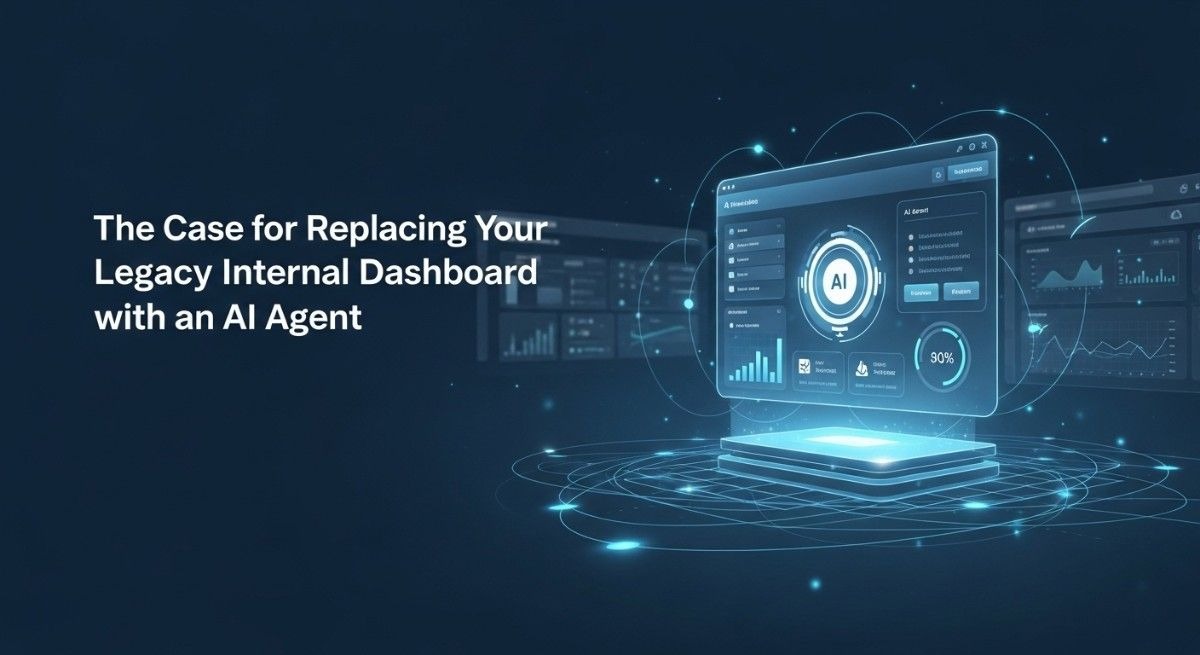
TL;DR Most internal dashboards were built for a world that no longer exists. They show numbers. They display charts. They sit there, static and passive, waiting for someone to log in, make sense of the data, and decide what to do next. The intelligence part still belongs entirely to the human. That division of labor made sense in 2010. In 2026, it is a bottleneck. Replacing legacy internal dashboards with AI agents is no longer a speculative idea for forward-thinking technology teams. It is a practical, measurable improvement that operations leaders are making right now.
This blog makes the case for that replacement. You will understand exactly what is broken about legacy dashboards. You will see what AI agents do differently. You will get a realistic picture of the transition process, the benefits, the risks, and how leading organizations are approaching this shift with confidence.
Table of Contents
What Is Actually Wrong With Legacy Internal Dashboards
Legacy dashboards are not failing because the data is bad. They are failing because the interface between data and decision has not evolved. The dashboard shows you what happened. It does not tell you what it means. It does not tell you what to do. It does not act on your behalf. All of that cognitive work still falls on the human sitting in front of the screen.
This model made sense when dashboards were the best tool available for making data accessible. They replaced manual reports and spreadsheet reviews. They put information in front of decision-makers faster than before. For their era, they were genuinely innovative. That era is over.
The Passive Display Problem
A dashboard displays information. It does not interpret it. A sales dashboard shows that conversion rates dropped 12 percent this week. It does not tell you whether that drop is statistically significant. It does not identify which customer segment drove the decline. It does not flag that a similar pattern preceded a major client churn event six months ago. The human has to do all of that analysis manually, often without the time or context to do it well.
This passivity compounds across organizations. Every manager looking at a dashboard performs the same manual analysis independently. They reach different conclusions from the same data. They miss the same patterns. They make inconsistent decisions. Replacing legacy internal dashboards with AI agents eliminates this passive display problem by making the intelligence layer part of the tool itself.
The Alert Fatigue Trap
Most legacy dashboards evolved to include alert systems. Threshold-based alerts fire when a metric crosses a defined limit. These alerts seemed like progress. In practice, they created a new problem: alert fatigue.
When every minor metric fluctuation triggers an alert, teams stop trusting the alert system. They dismiss notifications without reading them. They miss the alerts that actually matter buried inside the noise. A system that alerts constantly provides no more useful signal than no alert system at all.
Legacy dashboards cannot distinguish between a metric fluctuation that requires immediate action and one that is normal variance. AI agents make that distinction. This is a core reason why replacing legacy internal dashboards with AI agents delivers operational value that threshold-based alerting never could.
The Context Blindness Problem
Legacy dashboards display data without context. They show you that support ticket volume is up 40 percent today. They do not know that the marketing team launched a new campaign yesterday. They do not know that your largest customer had a system outage this morning. They cannot connect those events to the metric spike and give you a diagnosis.
Context blindness forces humans to maintain mental models of interconnected systems and events across their organization. That is an unreasonable cognitive burden. The more complex the business, the more impossible this becomes. Decision quality degrades as complexity grows beyond what any human can hold in working memory.
The Maintenance Cost Nobody Talks About
Legacy dashboards require constant maintenance. Every time a data schema changes, dashboard queries break. Every time a new data source appears, someone must manually connect it. Every time business requirements shift, a developer must update the dashboard definition. This maintenance burden consumes engineering capacity that organizations can rarely afford to allocate.
Many organizations end up with dashboards that are perpetually slightly wrong. Queries that were accurate six months ago reference renamed database columns. Metrics that leadership depends on have stale definitions. The dashboard shows numbers that look plausible but do not reflect current reality. Replacing legacy internal dashboards with AI agents eliminates much of this maintenance burden because agents adapt to schema changes and new data sources dynamically.
What AI Agents Do Differently
An AI agent is not a smarter dashboard. It is a fundamentally different kind of tool. Understanding that difference is essential for making the case for replacing legacy internal dashboards with AI agents to stakeholders who have only seen dashboards in action.
Agents Interpret, Not Just Display
When an AI agent observes that conversion rates dropped 12 percent this week, it does not stop there. It queries the data warehouse for segmentation breakdowns. It checks whether the trend holds across all channels or concentrates in one. It pulls historical patterns to assess whether this magnitude of change is unusual. It surfaces a diagnosis rather than a number.
This interpretation layer transforms data from information into insight. The human receiving the agent’s output does not need to perform analysis. They receive the analysis completed, along with the reasoning behind it. Decision quality improves because the interpretation is systematic and consistent rather than dependent on individual analyst skill and availability.
Agents Act, Not Just Alert
The most significant difference between dashboards and AI agents is action. A dashboard alerts. An agent acts. When an inventory agent detects that stock for a high-velocity product will hit zero in four days, it does not just trigger an alert. It checks supplier availability. It drafts a purchase order. It routes the draft to the procurement manager for approval. It follows up if the approval does not arrive within the defined window.
This autonomous action capacity is what makes replacing legacy internal dashboards with AI agents a business transformation rather than a technology upgrade. Time from detection to resolution collapses. Human attention focuses on decisions that require judgment rather than on mechanical response workflows.
Agents Operate Proactively
Dashboards are reactive. You look at them. They show you the past. AI agents operate proactively. They monitor data continuously. They identify developing patterns before they reach critical thresholds. They surface issues while there is still time to intervene effectively.
A sales agent watching pipeline data does not wait for the quarter to end to show you that you will miss your number. It identifies probability shifts in deals three weeks before the period closes. It gives you time to act rather than information to explain failure. This proactive posture fundamentally changes the relationship between data and decision-making.
Agents Learn From Feedback
Legacy dashboards do not learn. The same threshold triggers the same alert regardless of how many times a human dismissed it as irrelevant. AI agents improve with feedback. When a manager marks an agent-generated alert as not actionable, the agent incorporates that signal. It learns to distinguish patterns that require attention from patterns that do not.
This learning capability means the agent becomes more valuable over time. It calibrates to your organization’s specific context. It understands which anomalies matter in your environment and which are normal variance. No legacy dashboard delivers this kind of improving accuracy. Replacing legacy internal dashboards with AI agents gives you a tool that gets better the longer you use it.
The Business Case: Where the ROI Actually Comes From
Replacing legacy internal dashboards with AI agents requires investment. Stakeholders want to see a clear return on that investment before approving the transition. The ROI comes from several distinct sources that compound across the organization.
Analyst Time Recapture
Data analysts in organizations with legacy dashboards spend significant portions of their week on repetitive analysis tasks. They pull the same report variants. They apply the same segmentation logic to identify what drove metric changes. They prepare the same weekly digests for leadership. These tasks are important but mechanical.
AI agents perform these mechanical tasks continuously and automatically. Analysts shift their attention to novel analyses, strategic questions, and work that requires human judgment and creativity. An organization with five analysts effectively gains the equivalent of two additional analysts when AI agents absorb the repetitive workload. This capacity recapture often funds the entire AI agent investment on its own.
Faster Response to Operational Issues
Time-to-detection and time-to-response are critical metrics in operations, customer service, security, and infrastructure management. Legacy dashboards depend on human vigilance. Someone must be watching when an issue develops. In practice, issues frequently develop overnight, on weekends, or during periods when the responsible person is in meetings.
AI agents monitor continuously without breaks. They detect issues and initiate response workflows immediately. The difference between detecting an infrastructure issue at 3am and detecting it at 9am when someone finally opens their dashboard can mean the difference between a minor incident and a major outage. Replacing legacy internal dashboards with AI agents reduces mean time to detection dramatically in operational contexts.
Decision Quality Improvements
Better information leads to better decisions. Agents provide better information than dashboards because they provide interpreted, contextualized insight rather than raw data displays. Decision quality improvements compound across every manager, every week, every decision influenced by internal data.
Quantifying decision quality improvement is harder than quantifying analyst time savings. The impact is real nonetheless. Organizations with better operational visibility make better inventory decisions, better staffing decisions, better marketing spend decisions, and better customer service priority decisions. These improvements accumulate into financial outcomes that are measurable at the organizational level even when individual decision improvements are hard to isolate.
Maintenance Cost Elimination
Dashboard maintenance is an ongoing operational cost that organizations often undercount. Developer time spent updating queries, fixing broken connections, and adding new metrics to legacy dashboards is rarely tracked separately. It appears in engineering backlogs and project delays rather than in a dedicated maintenance line item.
AI agents reduce this maintenance burden significantly. Schema changes require configuration updates rather than query rewrites. New data sources integrate through defined connectors rather than custom development. Business requirement changes translate into prompt and configuration updates rather than dashboard redesign projects. Replacing legacy internal dashboards with AI agents converts ongoing maintenance cost into a lower and more predictable operational expense.
Real-World Applications Across Business Functions
The case for replacing legacy internal dashboards with AI agents becomes concrete when you examine specific function-by-function applications. Each business function has distinct monitoring needs that AI agents address better than static dashboards.
Sales Operations
Sales dashboards show pipeline health metrics, deal stage distributions, and revenue forecasts. They display the current state. Sales AI agents do significantly more. They monitor individual deal progression and flag deals where velocity has slowed below historical norms. They identify rep performance patterns that predict quarterly attainment. They surface coaching opportunities before deals are lost rather than after.
A sales AI agent watching 500 active deals simultaneously never misses a stalled deal. It does not have good days and bad days. It does not prioritize deals based on manager relationships. It applies consistent criteria to every deal and surfaces the ones that need attention based on objective patterns. Replacing legacy internal dashboards with AI agents in sales operations reliably improves forecast accuracy and pipeline health.
Customer Success and Support
Support dashboards show ticket volumes, resolution times, and satisfaction scores. These metrics are useful. They do not tell you which customers are at risk of churn before they submit a cancellation. They do not identify the support pattern that precedes attrition in your specific customer base.
A customer success AI agent analyzes support interaction history, product usage data, and sentiment signals together. It identifies at-risk customers weeks before they signal intent to leave. It drafts personalized outreach for the customer success manager to review and send. It tracks whether the intervention changed the trajectory. This proactive capability is simply impossible to replicate with a legacy dashboard regardless of how many metrics it displays.
Finance and Procurement
Finance dashboards show budget versus actual, variance reports, and cash flow projections. Finance AI agents monitor spending in real time, flag anomalies against historical patterns, identify upcoming payment obligations that may strain cash position, and surface optimization opportunities in vendor spending.
A procurement AI agent monitoring supplier performance tracks delivery reliability, quality metrics, and pricing trends simultaneously. It flags when a supplier’s performance trajectory suggests risk to supply continuity. It identifies when contract terms are approaching renewal dates in advance, giving procurement teams time to negotiate rather than scrambling to renew under pressure. Replacing legacy internal dashboards with AI agents in finance gives organizations continuous, intelligent oversight of financial operations rather than periodic human reviews.
IT Operations and Security
IT dashboards show server performance metrics, error rates, and uptime statistics. Security dashboards display event logs and alert counts. The problem with both is the same: the volume of data makes human monitoring impractical and the threshold-based alerting creates noise without actionable signal.
IT operations AI agents monitor infrastructure continuously, correlate events across systems, and distinguish real incidents from normal variance before human attention is required. Security AI agents analyze behavioral patterns and flag anomalies that match threat indicators rather than simple threshold violations. The mean time to respond to real issues drops dramatically when AI agents do the monitoring work that legacy dashboards assigned to human vigilance.
Human Resources and Workforce Analytics
HR dashboards show headcount, attrition rates, and engagement scores. These metrics describe the workforce state at a point in time. HR AI agents monitor workforce dynamics continuously and surface early signals of engagement degradation, flight risk by team, and productivity pattern changes that precede voluntary attrition.
An HR AI agent that identifies a team where engagement signals are declining six weeks before attrition spikes gives HR and line managers time to investigate and intervene. Legacy dashboard reviews typically occur monthly or quarterly, well after the early intervention window has passed. Replacing legacy internal dashboards with AI agents in workforce analytics shifts HR from reactive reporting to proactive talent retention.
Navigating the Transition: A Practical Approach
Replacing legacy internal dashboards with AI agents is a meaningful technical and organizational undertaking. Organizations that approach the transition systematically achieve strong outcomes. Those that rush it create new problems rather than solving existing ones.
Start With Your Highest-Pain Dashboard
Every organization has one or two dashboards that people complain about most consistently. These are the dashboards where analysts spend the most time on manual analysis, where decision-makers express the most frustration with information lag, or where operational issues most frequently develop undetected.
Start your AI agent replacement program with this highest-pain dashboard. The improvement will be most visible. The business case will be most concrete. The organizational enthusiasm generated by a successful first deployment funds and accelerates subsequent replacements. Replacing legacy internal dashboards with AI agents works best as a sequenced rollout rather than an organization-wide simultaneous transition.
Define What the Agent Should Do, Decide, and Escalate
Before building or deploying an AI agent to replace a dashboard, define three things clearly. What monitoring and analysis tasks should the agent perform autonomously? What decisions should the agent make on its own without human review? What situations require the agent to escalate to a human before acting?
These definitions shape your agent’s configuration and governance model. Starting with a conservative escalation policy and expanding agent autonomy as trust builds is more successful than granting broad autonomy upfront. Most organizations begin with agents that diagnose and recommend while humans authorize all actions, then graduate to agents that execute defined action types autonomously as performance proves reliable.
Preserve Institutional Knowledge During Transition
Legacy dashboards, whatever their limitations, encode institutional knowledge. The metrics tracked, the segmentations applied, and the thresholds set all reflect years of organizational learning about what matters in your specific business context. Do not discard this knowledge during the transition.
Document what your legacy dashboard tracks and why each metric was included. Translate this knowledge into your AI agent’s configuration. The agent should monitor everything the dashboard monitored plus the additional intelligence and action capabilities that justify replacing legacy internal dashboards with AI agents in the first place.
Train Your Team on How to Work With Agents
AI agents change how people interact with operational data. Managers accustomed to opening a dashboard and scanning charts must learn to engage with agent-generated insights and recommendations instead. This is a behavioral change that requires explicit support.
Run training sessions that show people how to interpret agent outputs, how to provide feedback that improves agent performance, and how to escalate situations where they disagree with agent recommendations. Teams that understand how to work with AI agents extract more value from them. Teams left to figure it out independently often revert to legacy habits.
Addressing Common Objections
Stakeholders considering replacing legacy internal dashboards with AI agents raise predictable objections. Addressing these objections with honest, evidence-based responses builds the internal support needed to move forward.
The Explainability Objection
Some stakeholders worry that AI agent recommendations are black boxes. They do not trust recommendations they cannot trace to a clear logical chain. This is a legitimate concern that good agent implementations address directly.
Well-designed AI agents show their reasoning. They explain which data points drove a recommendation and why. They cite the historical patterns they are referencing. They express confidence levels that help users calibrate how much weight to give any specific recommendation. Explainability is a design requirement, not an inherent limitation. Require it from your implementation.
The Data Security Objection
Agents that access sensitive operational data raise security concerns. Who can see what the agent sees? How is agent access audited? Can the agent expose sensitive data through its recommendations?
These concerns are addressable through proper implementation. AI agents should operate within role-based access controls that mirror human user permissions. Agent actions should log to audit trails. Data handling should comply with your organization’s existing data governance policies. Replacing legacy internal dashboards with AI agents does not require relaxing security standards. It requires applying those standards to a new type of tool.
The Vendor Lock-In Objection
Organizations worry about building operational processes around a specific AI vendor’s platform and then facing difficult switching costs. This concern reflects real experience with previous technology investments that created unwanted dependencies.
Mitigate vendor risk through architecture choices rather than avoiding AI agents entirely. Build integration layers that abstract away vendor-specific APIs. Choose agents that work with your existing data infrastructure rather than requiring data migration to proprietary platforms. Maintain human-readable documentation of agent configurations so that rebuilding on a different platform remains feasible if needed.
Frequently Asked Questions
How long does it take to replace a legacy dashboard with an AI agent?
Replacing a single legacy internal dashboard with an AI agent typically takes six to sixteen weeks depending on dashboard complexity, data source accessibility, and organizational approval processes. A simple operational dashboard monitoring a few data sources can be replaced in six to eight weeks. A complex cross-functional dashboard with many data sources, multiple stakeholder groups, and sophisticated analytical requirements may take twelve to sixteen weeks. Replacing legacy internal dashboards with AI agents across an entire organization typically takes one to three years as a phased program.
Do AI agents require more data infrastructure than legacy dashboards?
AI agents typically require similar data infrastructure to legacy dashboards but use it differently. They need reliable, low-latency access to the same data sources your dashboards already connect to. They benefit from event streaming infrastructure that enables real-time monitoring, whereas dashboards often batch-refresh data on schedules. Organizations with modern data infrastructure find agent deployments straightforward. Organizations running legacy data infrastructure may need to address data access reliability and freshness before deploying agents that depend on timely data.
Can AI agents make mistakes that cost the business money?
Yes, AI agents can make mistakes and those mistakes can have consequences. This is why starting with conservative autonomy configurations is important. Agents that recommend without acting cannot cause direct harm from a wrong recommendation. Agents that act autonomously can make costly errors if their decision logic is misconfigured or if they encounter data situations their training did not anticipate. Human approval workflows for consequential actions, especially early in deployment, provide a safety net. Replacing legacy internal dashboards with AI agents requires thoughtful governance, not unlimited agent autonomy.
What happens to analysts whose jobs focused on manual dashboard analysis?
Analysts whose work centered on pulling routine reports and creating standard weekly summaries will see those tasks absorbed by AI agents. Forward-thinking organizations redirect these analysts to higher-value work: designing agent monitoring logic, evaluating agent output quality, performing novel analyses that agents cannot yet handle, and translating business questions into agent configurations. The demand for human analytical judgment does not disappear when agents handle routine analysis. It shifts toward work that is more interesting and more strategically valuable.
How do you measure whether the AI agent replacement was successful?
Define success metrics before the transition begins. Measure time analysts spend on routine reporting tasks before and after. Measure mean time to detection and mean time to response for operational issues. Track the percentage of agent-generated recommendations that humans act on without modification. Survey stakeholders on information quality and decision confidence. Compare operational outcomes such as inventory levels, customer retention, and incident rates across comparable periods. Replacing legacy internal dashboards with AI agents should produce measurable improvements across all of these dimensions within six to twelve months of full deployment.
Is there a type of business or team where AI agents are not the right choice?
AI agents for internal monitoring are less well-suited to highly creative, qualitative work where data metrics do not capture the most important signals. Brand strategy, product vision, and organizational culture are not well served by agent monitoring. Teams with very small data volumes may not generate enough signal for agents to add interpretive value beyond what a simple dashboard provides. Regulatory environments where all automated recommendations require human attestation before any action may limit the autonomy advantage agents provide. For the vast majority of operational business functions involving measurable metrics and recurring decision types, replacing legacy internal dashboards with AI agents delivers clear value.
Read More:-Calculating the Break-Even Point for Your AI Automation Investment
Conclusion

The legacy internal dashboard served a purpose. It made data visible when data was hard to access. It put numbers in front of decision-makers who previously had none. For its era, it was a genuine advancement. That era ended.
Today, the bottleneck is not data access. It is the intelligence layer between data and decision. Legacy dashboards leave that layer entirely to humans who are time-constrained, cognitively limited, and inconsistent across days and individuals. AI agents move that intelligence layer into the tool itself.
Replacing legacy internal dashboards with AI agents is not about removing humans from decision-making. It is about giving humans better information faster, in a more actionable form, with less manual effort required to produce it. Decisions improve. Response times shrink. Analyst capacity redirects to work that requires human creativity and judgment rather than mechanical report generation.
The business case is concrete. Analyst time recapture, faster operational response, better decision quality, and reduced maintenance costs together produce a return that justifies the investment for most mid-size and enterprise organizations. The organizations making this transition now build a durable operational intelligence advantage over those waiting for the technology to mature further.
Start with your highest-pain dashboard. Define agent scope carefully. Preserve institutional knowledge during the transition. Train your team to work with agents effectively. Measure outcomes against defined baselines. Replacing legacy internal dashboards with AI agents works best as a deliberate, phased program rather than a wholesale overnight change.
The intelligence your organization needs to operate at its best is already in your data. Legacy dashboards show you that data and leave the rest to you. AI agents do the analysis, surface the insight, and take the action. That is the future of internal operational intelligence. The transition starts with a decision to begin.