Introduction
TL;DR Chatbots and voice AI systems have become essential business tools. They handle customer inquiries, process transactions, and provide 24/7 support. The success of these systems depends entirely on their ability to understand what users want.
Real-time intent detection metrics provide the data you need to evaluate performance. These measurements reveal whether your AI actually comprehends user requests. They show where improvements are necessary and highlight what’s working well.
Most companies deploy chatbots without proper metrics in place. They assume the AI works correctly because it responds to queries. This assumption costs them money through poor customer experiences and missed opportunities.
Understanding which metrics matter transforms how you approach conversational AI. You gain visibility into system performance. You identify problems before they impact large user populations. You make data-driven decisions about improvements.
This guide explores the critical metrics every organization should track. We’ll examine what each measurement reveals about your system. You’ll learn how to interpret the data and take action based on findings.
Table of Contents
Why Real-Time Intent Detection Metrics Matter
Intent detection represents the foundation of conversational AI effectiveness. The system must identify what users want before it can respond appropriately. A chatbot that misunderstands requests frustrates users and damages your brand.
Real-time measurement provides immediate feedback about performance. You don’t wait for end-of-month reports to discover problems. Issues surface as they occur, allowing quick responses to emerging patterns.
The Business Impact of Poor Intent Detection
Misunderstood intents create terrible user experiences. Customers repeat themselves multiple times. They feel ignored and unheard. Many abandon the interaction entirely, seeking human support instead.
Each failed interaction carries real costs. Support ticket volume increases when chatbots fail. Customers who receive wrong answers may make incorrect decisions. Sales opportunities disappear when purchase intent goes unrecognized.
Brand reputation suffers from repeated failures. Social media amplifies negative experiences. One viral complaint about a poorly performing chatbot reaches thousands of potential customers.
Employee productivity drops when AI systems underperform. Support agents spend time fixing chatbot mistakes instead of handling complex issues. Development teams constantly fight fires rather than building new features.
How Metrics Drive Continuous Improvement
Real-time intent detection metrics create a feedback loop for optimization. Each measurement points toward specific improvement opportunities. You know exactly where to focus engineering resources.
A/B testing becomes possible with proper metrics. Deploy different intent detection models to user subsets. Compare performance using objective measurements. Roll out the winner to all users.
Training data quality improves through metric analysis. Low-confidence predictions highlight where your models lack examples. Add training data targeting these specific gaps to boost accuracy.
Stakeholder communication becomes easier with concrete numbers. Executives understand “95% intent detection accuracy” better than vague claims about system quality. Metrics justify additional investment in AI capabilities.
Accuracy: The Foundation Metric
Accuracy measures how often your system correctly identifies user intent. This real-time intent detection metric provides the most fundamental performance indicator.
Calculate accuracy by dividing correct predictions by total predictions. A system handling 1,000 requests with 950 correct identifications achieves 95% accuracy.
Understanding Accuracy Limitations
Accuracy alone doesn’t tell the complete story. A chatbot with 95% accuracy might perform terribly on important intents while excelling at trivial ones.
Class imbalance skews accuracy measurements. If 90% of requests share one intent, predicting that intent every time yields 90% accuracy despite never correctly handling other intents.
Cost sensitivity varies across intents. Misidentifying a purchase intent costs more than misunderstanding a greeting. Raw accuracy treats all errors equally regardless of business impact.
Edge cases reveal accuracy weaknesses. Unusual phrasings, typos, and ambiguous requests often get misclassified. These scenarios matter more than they appear in aggregate statistics.
Improving Intent Detection Accuracy
Training data volume directly impacts accuracy. More examples of each intent help models learn variations in how users express requests. Aim for hundreds of examples per intent minimum.
Data quality matters more than quantity. Clean, correctly labeled examples outperform large datasets with errors. Regular audits catch labeling mistakes before they corrupt model training.
Feature engineering enhances model capabilities. Extract relevant information from user messages beyond raw text. Previous conversation history, user profile data, and temporal context all improve predictions.
Ensemble approaches combine multiple models. Different algorithms make different mistakes. Aggregating their predictions often yields better results than any single model.
Confidence Scores: Understanding Prediction Certainty
Confidence scores indicate how certain the system feels about intent predictions. Real-time intent detection metrics should always include confidence alongside the predicted intent itself.
Models assign numerical confidence values to predictions. A score of 0.95 suggests high certainty. A score of 0.45 indicates the model is essentially guessing.
Setting Confidence Thresholds
Low-confidence predictions require special handling. Routing these requests to human agents prevents incorrect automated responses. This protects user experience while gathering training data.
Threshold selection balances automation against quality. Higher thresholds send more requests to humans, ensuring accuracy but reducing automation benefits. Lower thresholds maximize automation while accepting more errors.
Intent-specific thresholds optimize performance. Some intents are easier to detect reliably. Set higher thresholds for critical intents like cancellations or refunds. Accept lower thresholds for simple informational requests.
Adaptive thresholds respond to changing conditions. Monitor error rates in real-time. Automatically increase thresholds when accuracy drops. This dynamic approach maintains quality during unusual situations.
Confidence Calibration
Well-calibrated models align confidence scores with actual accuracy. When the model reports 80% confidence, it should be correct approximately 80% of the time.
Poorly calibrated models create operational challenges. Overconfident models make mistakes while reporting high certainty. Underconfident models send too many correct predictions to human review.
Calibration techniques adjust raw model outputs. Platt scaling and isotonic regression are common approaches. These methods map scores to true probability estimates using validation data.
Regular recalibration maintains accuracy. Model performance drifts over time as language patterns evolve. Quarterly recalibration using recent data keeps confidence scores meaningful.
Precision and Recall: Balancing Performance
Precision measures how many predicted intents are correct. Recall measures how many actual instances of an intent the system detects. These complementary real-time intent detection metrics reveal different performance aspects.
High precision means few false positives. When the system predicts a specific intent, that prediction is usually correct. Low precision creates user frustration through inappropriate responses.
High recall means few false negatives. The system catches most instances of each intent. Low recall causes users to repeat themselves in different ways hoping for recognition.
The Precision-Recall Tradeoff
Improving one metric often hurts the other. Stricter intent matching increases precision but decreases recall. Looser matching does the opposite.
Business requirements determine optimal balance. Customer support scenarios prioritize recall to avoid missing requests. Sales scenarios might prioritize precision to avoid recommending wrong products.
F1 score combines both metrics into a single number. It represents the harmonic mean of precision and recall. This provides a balanced view when both matter equally.
Intent-specific targets reflect varying importance. Critical intents might require 95% precision and 90% recall. Less important intents might accept lower thresholds.
Calculating Per-Intent Metrics
Aggregate metrics hide intent-level problems. Overall accuracy might look great while specific important intents perform terribly.
Per-intent precision reveals which intents generate false positives. These intents need more distinctive training examples. The model currently confuses them with other similar intents.
Per-intent recall shows which intents the system misses. Users expressing these intents get matched to wrong categories. Additional training data with varied phrasings helps.
Confusion matrices visualize intent detection patterns. Rows represent actual intents while columns show predictions. Off-diagonal cells reveal which intents the system confuses most frequently.
Response Time: Speed Matters
Users expect instantaneous responses from chatbots and voice AI. Real-time intent detection metrics must track how quickly the system identifies intents.
Measure response time from when a message arrives until intent prediction completes. Include all processing steps: preprocessing, model inference, and post-processing.
User Tolerance for Latency
Human conversation sets expectations for acceptable delays. Pauses exceeding two seconds feel unnatural in voice interactions. Text chatbots have slightly more latitude.
Context influences tolerance. Users accept longer waits for complex questions. Simple greetings demand instant responses.
Perceived speed differs from actual speed. Showing typing indicators or thinking animations makes waits feel shorter. Users know the system is working rather than frozen.
Progressive responses improve perceived performance. Display partial information while processing continues. This keeps users engaged during necessary computation time.
Optimizing Intent Detection Speed
Model architecture significantly impacts speed. Transformer models offer high accuracy but slower inference. Simpler models like logistic regression respond faster with potentially lower accuracy.
Quantization reduces model size and increases speed. Lower precision calculations run faster on hardware. Modern quantization techniques maintain accuracy while dramatically improving performance.
Caching frequent intents eliminates redundant computation. Many users ask identical or very similar questions. Store results for common queries and return them instantly.
Batch processing improves throughput. Process multiple requests simultaneously rather than sequentially. This maximizes hardware utilization for better overall system capacity.
Fallback Rate: Measuring the Unknown
Fallback rate tracks how often the system cannot confidently identify intent. The user gets routed to a fallback response or human agent. This real-time intent detection metric highlights coverage gaps.
Calculate fallback rate by dividing low-confidence predictions by total requests. A system with 100 requests and 15 fallbacks has a 15% fallback rate.
Interpreting Fallback Rates
High fallback rates indicate insufficient training data. The model encounters many requests it hasn’t learned to handle. Users experience poor service as a result.
Acceptable fallback rates vary by use case. New chatbots might see 30-40% fallback rates initially. Mature systems should achieve single-digit percentages.
Spikes in fallback rate signal problems. Sudden increases suggest changing user behavior or system issues. Immediate investigation prevents widespread user impact.
Intent-specific fallback analysis reveals gaps. Some intents may have adequate training while others lack coverage. Focus data collection efforts on high-fallback intents.
Reducing Fallback Occurrences
Active learning identifies valuable training examples. The system flags low-confidence predictions for human review. Experts label these examples and add them to training data.
Synthetic data generation expands coverage. Paraphrase existing training examples to create variations. Use language models to generate additional realistic examples.
Intent hierarchy reduces fallback needs. Create broad parent intents with specific child intents. The system can match parent intent even when unsure about specific child intent.
Clarification dialogs handle ambiguity. When confidence is low, ask users to clarify their request. Present multiple options corresponding to likely intents.
User Correction Rate: Learning from Mistakes
User correction rate measures how often people manually fix incorrect intent detections. This real-time intent detection metric provides direct feedback about real-world performance.
Track explicit corrections where users select the correct intent from alternatives. Monitor implicit corrections where users rephrase requests after receiving wrong responses.
Capturing Correction Data
Explicit correction mechanisms give users control. Display detected intent with an option to change it. Power users appreciate this transparency and provide valuable feedback.
Implicit corrections appear in conversation patterns. Users who immediately rephrase after a response likely received the wrong answer. Detect these patterns through dialog analysis.
Negative feedback buttons indicate problems. When users click “not helpful” or similar options, the intent detection may have failed. Correlate feedback with predictions to identify patterns.
Conversation abandonment suggests severe failures. Users who disconnect immediately after a response probably got something completely wrong. These interactions deserve special attention.
Acting on Correction Data
Priority corrections improve high-impact intents first. Weight corrections by intent frequency and business value. Fix problems affecting many users or important scenarios.
Root cause analysis determines why corrections occur. Examine the original messages alongside correct intents. Identify patterns in what the model misses.
Automated retraining incorporates corrections. Add corrected examples to training datasets automatically. Retrain models regularly to benefit from accumulated corrections.
Correction trends reveal systemic issues. Increasing correction rates on specific intents might indicate emerging user needs. Your intent taxonomy may need expansion.
Slot Filling Accuracy: Beyond Intent
Intent detection alone isn’t enough. Systems must extract specific information from user messages. Slot filling accuracy measures extraction performance for these real-time intent detection metrics.
A booking intent needs dates, locations, and preferences. A customer inquiry needs account numbers and issue descriptions. Correct slots are as important as correct intents.
Measuring Extraction Quality
Exact match accuracy demands perfect extraction. The system must identify all required slots with completely correct values. This stringent metric highlights serious problems.
Partial match scoring credits incomplete extractions. Getting three of five required slots earns partial credit. This reveals whether the system is completely confused or just missing details.
Slot-level metrics break down overall performance. Each slot type gets separate accuracy measurement. This identifies which information types the system struggles to extract.
Required versus optional slots deserve different treatment. Missing optional slots causes minor problems. Missing required slots prevents successful task completion.
Improving Slot Extraction
Named entity recognition models extract common slot types. Pretrained models identify dates, locations, names, and other standard entities. Fine-tuning adapts them to your specific domain.
Regular expressions handle structured data. Phone numbers, email addresses, and IDs follow predictable patterns. Rule-based extraction works perfectly for these cases.
Context improves extraction accuracy. Previous conversation turns provide clues about ambiguous references. “Tomorrow” means different things depending on current date.
Validation prompts confirm uncertain extractions. When confidence is low, ask users to verify extracted information. This catches errors before they cause problems.
Intent Confusion Matrix: Identifying Problem Patterns
Confusion matrices visualize which intents the system confuses most frequently. This powerful real-time intent detection metric reveals specific improvement opportunities.
Rows represent actual user intents while columns show system predictions. Diagonal cells contain correct predictions. Off-diagonal cells show errors.
Reading Confusion Patterns
Large off-diagonal values indicate systematic confusion. The system consistently mistakes one intent for another. These intent pairs need better differentiation.
Symmetric confusion suggests truly ambiguous intents. The system confuses Intent A for Intent B and vice versa roughly equally. These intents might need merging or clearer definitions.
Asymmetric confusion reveals directional problems. Intent A gets mistaken for Intent B frequently, but not vice versa. Intent A needs more distinctive training examples.
Scattered errors across many intents indicate undertrained models. The system makes random-seeming mistakes rather than systematic ones. More training data across all intents helps.
Using Confusion Matrices for Improvement
Intent taxonomy refinement addresses structural problems. Frequently confused intents might be too similar. Consider combining them or making definitions more distinct.
Targeted training data collection focuses on confused pairs. Add examples that clearly distinguish between commonly confused intents. Emphasize the differences in phrasing and context.
Feature engineering highlights distinguishing characteristics. Identify words or patterns that separate confused intents. Create features that make these differences explicit to models.
Hierarchical intent structures can reduce confusion. Group similar intents under parent categories. The system first identifies the general category then determines specific intent.
Coverage: Handling User Intent Diversity
Coverage measures what percentage of real user intents your system can handle. This real-time intent detection metric reveals whether your intent taxonomy matches actual needs.
Perfect coverage means every user request maps to a defined intent. Poor coverage leaves many requests falling into fallback categories.
Measuring Intent Coverage
Manual conversation sampling provides coverage insights. Review random interactions regularly. Classify each request as matching an existing intent or representing a gap.
Fallback conversation analysis reveals missing intents. Examine requests that triggered fallback responses. Group similar requests to identify candidate new intents.
User goal completion rates indicate coverage quality. Users who accomplish their objectives likely encountered covered intents. Those who abandon probably hit gaps.
Seasonal patterns affect coverage needs. Holiday shopping creates temporary intent spikes. Tax season generates accounting questions. Your coverage must adapt to these cycles.
Expanding Intent Coverage
User research identifies unmet needs. Interview customers about their goals. Observe support interactions to see what people actually need.
Log analysis surfaces frequent unhandled patterns. Mine conversation logs for common phrases in fallback responses. These represent potential new intents worth supporting.
Competitive analysis reveals gaps. Examine what competitor chatbots handle. Users may expect similar capabilities from your system.
Incremental rollout manages complexity. Don’t add dozens of intents simultaneously. Add a few high-value intents, measure performance, and iterate.
Session Success Rate: End-to-End Performance
Session success rate measures complete conversation outcomes. This real-time intent detection metric evaluates whether users accomplish their goals.
Intent detection contributes to success but doesn’t guarantee it. Correct intent identification followed by poor response generation still fails users.
Defining Success Criteria
Explicit goal completion provides clear signals. Users who complete purchases, book appointments, or resolve issues succeeded. Track these concrete outcomes.
Implicit satisfaction indicators supplement explicit metrics. Conversation length, message count, and tone suggest satisfaction levels. Very short or very long conversations often indicate problems.
User surveys capture subjective success. Ask users whether they got what they needed. Simple yes/no questions work better than complex rating scales.
Return behavior reveals long-term success. Users who return to the chatbot trust it helped previously. One-time users who never return likely had poor experiences.
Connecting Intent Detection to Success
Intent detection quality directly impacts session success. Misunderstood intents lead to irrelevant responses. Users must repeat themselves or abandon their goals.
Early intent detection errors compound. Each misunderstanding confuses subsequent turns. Users become frustrated and conversation quality degrades rapidly.
Recovery from intent errors determines ultimate outcomes. Systems that recognize confusion and adapt can salvage sessions. Rigid systems that persist with wrong assumptions fail.
Intent transition analysis reveals conversation patterns. Successful sessions follow certain intent sequences. Failed sessions show different patterns suggesting where problems occur.
Multi-Intent Detection Accuracy
Users often express multiple intents in single messages. “I want to cancel my order and request a refund” contains two distinct intents. Real-time intent detection metrics must account for this complexity.
Single-intent models miss this nuance. They force systems to choose one intent, ignoring others. This creates incomplete responses.
Measuring Multi-Intent Performance
All-or-nothing accuracy demands detecting all intents. The system must identify both cancellation and refund requests. Missing either counts as failure.
Partial credit metrics acknowledge partial success. Detecting one of two intents is better than detecting none. Weight scoring by intent importance.
Intent ordering matters in some contexts. Processing a refund before cancellation causes errors. The system must detect intents in logical sequences.
Implicit versus explicit multi-intent cases differ. Some users clearly state multiple requests. Others imply secondary intents through context. Both deserve proper handling.
Improving Multi-Intent Detection
Model architecture determines multi-intent capability. Binary classification for each intent works well. The system can predict multiple positive labels simultaneously.
Training data must include multi-intent examples. Single-intent examples don’t teach models to recognize multiple simultaneous intents. Collect and label compound requests.
Intent relationship modeling improves accuracy. Some intent pairs commonly occur together. Others never combine logically. Models should learn these patterns.
Clarification strategies handle ambiguous cases. When detecting possible multiple intents, ask users to confirm. This prevents incorrect assumptions.
Contextual Intent Detection: Understanding Conversation Flow
Conversations develop context over multiple turns. Real-time intent detection metrics should measure how well systems use this context.
“What about large sizes?” only makes sense after discussing a specific product. The system must maintain context to interpret correctly.
Context Window Performance
Recent conversation history provides critical context. Track how many previous turns the system considers. Wider windows capture more context but increase complexity.
Coreference resolution accuracy measures pronoun understanding. “I want to return it” requires knowing what “it” refers to. Poor resolution causes intent detection failures.
Topic consistency across turns indicates good context handling. The system should recognize when users continue previous topics versus starting new ones.
Context reset detection identifies topic changes. Users often switch subjects abruptly. Systems must recognize these transitions to avoid applying stale context.
Improving Contextual Understanding
Memory mechanisms store conversation state. Transformer models with attention can reference previous turns. Explicit memory modules track entities and topics across long conversations.
Entity tracking maintains reference continuity. When users mention “my order,” the system should know which specific order. Link references to concrete entities.
Dialog state tracking formalizes context. Maintain structured representation of conversation status. Update this representation as each turn progresses.
Context-aware training data teaches proper usage. Include multi-turn conversations in training sets. Show models how context disambiguates otherwise unclear intents.
Real-Time Monitoring Dashboard Requirements
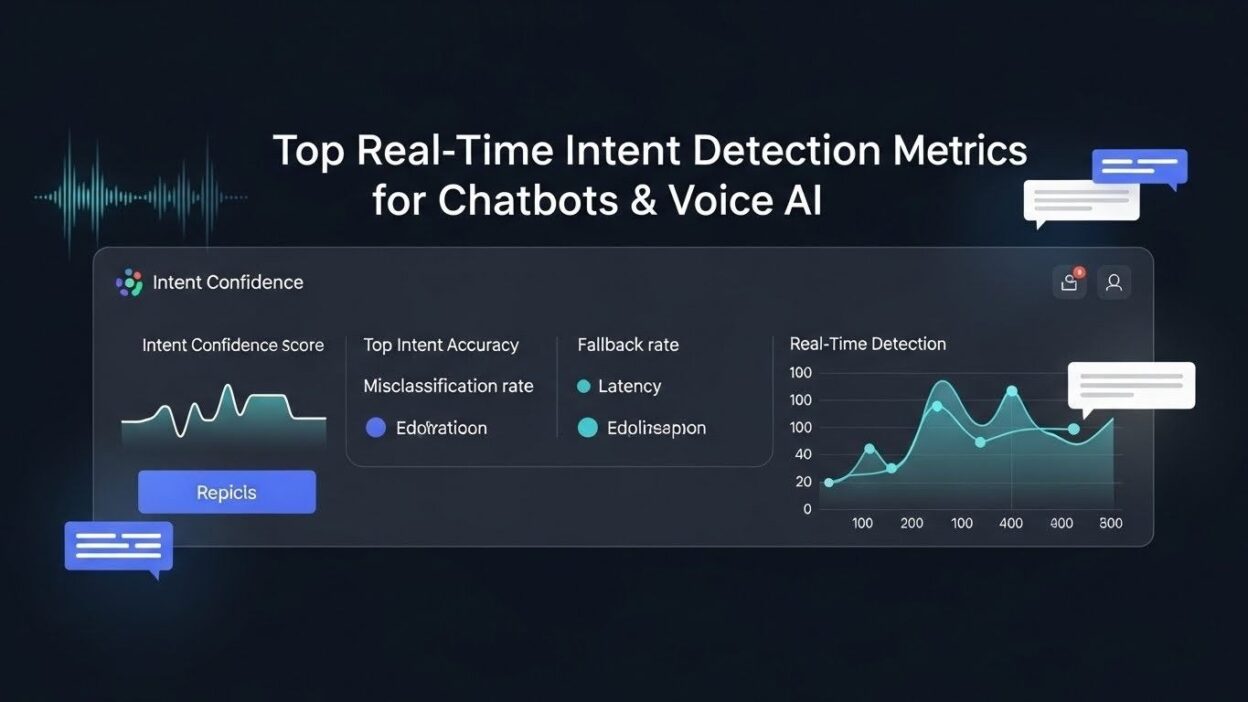
Real-time intent detection metrics need proper visualization. Dashboards transform raw data into actionable insights.
Effective dashboards surface problems immediately. Engineers spot issues within minutes of occurrence rather than discovering them in weekly reports.
Essential Dashboard Components
Live metric streams show current performance. Display key metrics with 1-minute refresh rates. Color coding highlights values outside acceptable ranges.
Trend charts reveal patterns over time. Hourly, daily, and weekly views show how metrics evolve. Spot gradual degradation before it becomes critical.
Alerting thresholds trigger notifications. Set bounds on acceptable metric values. Alert appropriate teams when values exceed limits.
Drill-down capabilities enable investigation. Click aggregate metrics to see underlying details. Examine specific intents, time ranges, or user segments.
Metric Selection for Dashboards
Top-level dashboards show critical metrics only. Display accuracy, response time, fallback rate, and session success. Avoid overwhelming viewers with dozens of numbers.
Intent-level dashboards provide detailed views. Show per-intent accuracy, confidence, and volume. Teams working on specific intents focus here.
Comparison views highlight changes. Show current metrics alongside previous periods. Immediately visible improvements or regressions guide decisions.
Custom views serve different stakeholders. Executives see business metrics like goal completion. Engineers see technical metrics like latency and error rates.
Benchmarking and Goal Setting
Understanding good performance requires context. Real-time intent detection metrics mean more when compared against targets and industry standards.
Arbitrary goals without grounding create false expectations. “99% accuracy” sounds great but may be impossible for your use case.
Establishing Realistic Targets
Baseline current performance before setting goals. Measure your system’s actual metrics over representative time periods. Understand where you’re starting from.
Industry benchmarks provide context. Research typical accuracy rates for similar applications. Conversational AI conferences and papers share performance data.
Competitive analysis reveals what’s possible. Test competitor chatbots systematically. Measure their performance on standard queries. Aim to match or exceed their capabilities.
Incremental improvement goals maintain momentum. Don’t expect quantum leaps. Target 2-5% accuracy improvements per quarter. Consistent progress compounds.
Adjusting Targets Over Time
Early-stage systems have lower expectations. A new chatbot reaching 80% accuracy deserves celebration. Mature systems should achieve 95%+ on core intents.
Complexity affects achievable performance. Systems handling hundreds of intents face greater challenges than those with ten. Adjust expectations accordingly.
Domain difficulty influences targets. Medical diagnosis conversations are harder than weather information queries. Factor domain complexity into goals.
User tolerance varies by context. Entertainment chatbots can be quirky. Banking chatbots must be precise. Set standards matching user expectations.
Read More:-Speech AI Security Risks in Voice Bots & Call Automation
Conclusion

Real-time intent detection metrics separate successful conversational AI implementations from failures. Without proper measurement, you’re flying blind.
Accuracy provides the foundational performance indicator. Track how often the system correctly identifies user intents. Break this down per intent to spot specific weaknesses.
Confidence scores reveal prediction certainty. Use these values to route uncertain requests appropriately. Well-calibrated confidence enables smart automation decisions.
Precision and recall balance different error types. High precision avoids false positives. High recall catches all instances. Optimize based on business requirements.
Response time ensures acceptable user experiences. Voice interactions demand sub-second latency. Chatbots need responses within two seconds maximum.
Fallback rates highlight coverage gaps. High fallback percentages indicate insufficient training data. Monitor these values to guide data collection priorities.
User corrections provide direct feedback. When people fix your system’s mistakes, you learn exactly what went wrong. Build mechanisms to capture and act on this information.
Slot filling accuracy extends beyond intent. Extracting correct information is as critical as identifying what users want. Measure extraction performance for all required data points.
Confusion matrices expose systematic problems. Visualizing which intents get confused guides targeted improvements. Address the most problematic confusion pairs first.
Coverage metrics ensure your intent taxonomy matches reality. Users express diverse needs. Your system must handle the requests they actually make, not just those you anticipated.
Session success rates evaluate end-to-end performance. Individual real-time intent detection metrics matter less than whether users accomplish goals. Track this ultimate measure of value.
Multi-intent detection handles realistic complexity. Users often express several intents simultaneously. Your metrics must account for this common pattern.
Contextual understanding improves conversation quality. Measure how well your system uses previous turns. Good context handling dramatically improves accuracy.
Dashboard design makes metrics actionable. Real-time visualization surfaces problems immediately. Proper displays enable quick responses to emerging issues.
Benchmarking provides essential context. Know what performance levels are realistic for your domain. Set goals that challenge your team without being impossible.
Start measuring today if you haven’t already. Implement basic accuracy and response time tracking immediately. Expand to more sophisticated real-time intent detection metrics as your system matures.
Review metrics regularly with your team. Weekly sessions examining trends catch problems early. Monthly deep dives identify optimization opportunities.
Let data drive development priorities. Fix intents with the worst metrics first. Invest engineering time where measurements show the greatest impact.
Remember that metrics serve your users ultimately. All these measurements exist to ensure people get helpful, accurate responses. Never lose sight of that fundamental purpose.
The conversational AI field continues evolving rapidly. New measurement approaches emerge regularly. Stay informed about best practices through conferences, papers, and vendor resources.
Your journey toward excellent intent detection never truly ends. Language evolves. User needs change. Your system must adapt continuously. Proper metrics make this evolution manageable and measurable.
Invest time in measurement infrastructure now. The insights you gain will guide improvements for years. Real-time intent detection metrics transform conversational AI from guesswork into engineering.