Introduction
TL;DR Retrieval-augmented generation swept through the AI industry like a revelation. For the first time, large language models could reach beyond their training data and pull in fresh, specific, domain-relevant information at query time. Enterprises adopted RAG rapidly. AI assistants became more factual. Hallucination rates dropped. Product teams celebrated.
Then the hard cases started arriving. The system gave accurate individual facts but missed the relationships between them. It retrieved relevant documents but could not explain how three separate policies interacted to affect a compliance decision. It answered straightforward questions confidently but fell apart on anything requiring multi-hop reasoning across connected entities.
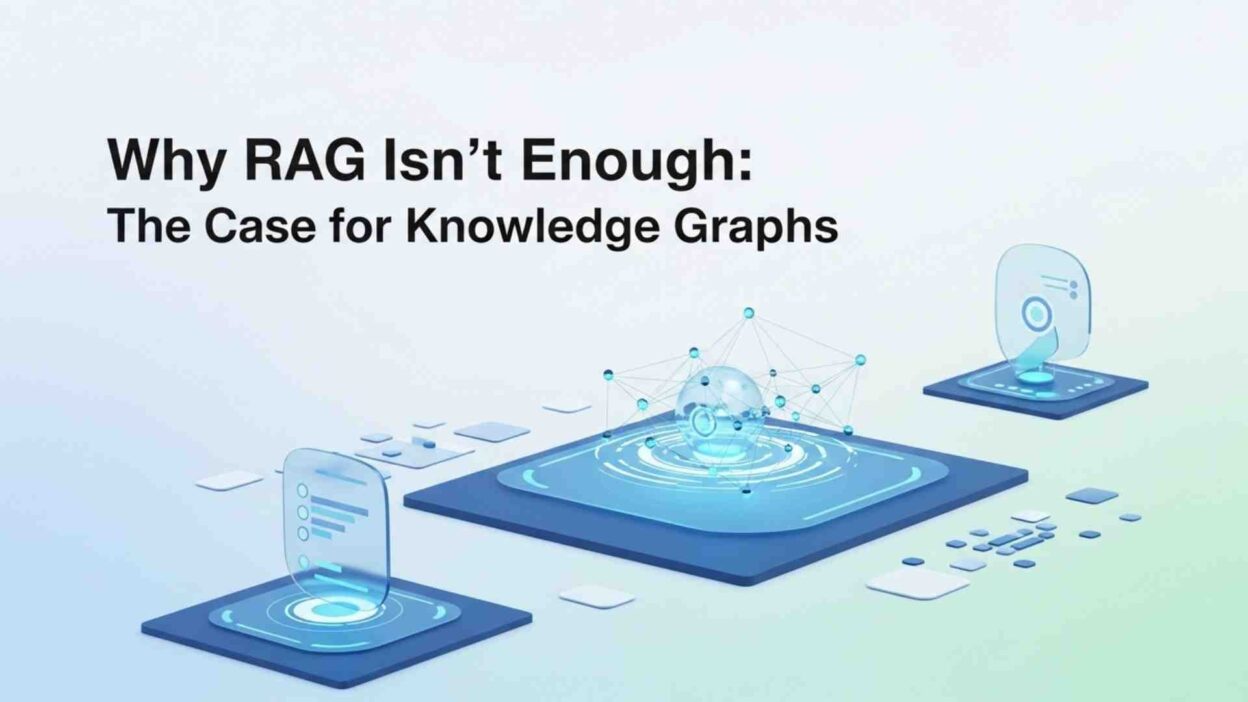
RAG vs knowledge graphs is the debate that emerged from these failures. RAG solves the knowledge currency problem. Knowledge graphs solve the knowledge structure problem. Understanding the difference between these two approaches determines whether your AI system handles complex reasoning tasks effectively or collapses under the weight of interconnected information.
Table of Contents
What RAG Actually Does and Where It Excels
The Mechanics of Retrieval-Augmented Generation
RAG systems work in two stages. The indexing stage converts documents into numerical embeddings that capture semantic meaning. These embeddings store in a vector database alongside the original text chunks. The retrieval stage converts a user query into the same embedding space, searches for the most similar chunks, and pulls the top results into the language model’s context window alongside the original query.
The language model then generates a response using both its parametric knowledge from training and the retrieved context. The retrieved context grounds the response in specific, current information. This grounding reduces hallucinations significantly compared to a model generating answers from memory alone.
RAG vs knowledge graphs comparisons often undervalue what RAG genuinely does well. RAG handles semantic search brilliantly. A user asks a question using different words than appear in the source document, and RAG still finds the relevant content. Keyword search would miss it. Vector similarity finds it. This semantic flexibility makes RAG far more useful than traditional keyword retrieval for knowledge management applications.
RAG also excels at surfacing relevant passages from large document collections quickly. An enterprise with ten thousand documents benefits enormously from RAG. A user asking about a specific topic receives the most relevant passages from across the entire corpus without the user knowing where those passages live. The retrieval system handles the search complexity invisibly.
Document summarization within RAG pipelines adds another strength. A retrieved passage provides the model with grounded factual content to summarize, analyze, or restate in response to the query. The combination of retrieval and generation handles a wide range of straightforward knowledge access tasks effectively. RAG vs knowledge graphs is not a debate about which technology is better in general. It is a debate about which handles which class of problem better.
The Specific Failure Modes That RAG Cannot Overcome
RAG fails in predictable ways that practitioners discover quickly after initial deployment. Each failure mode reveals a structural limitation in the retrieval-then-generate approach.
Multi-hop reasoning is RAG’s most significant weakness. A user asks which company executives have experience with the supplier that delivered defective components last quarter. Answering this requires connecting the defective component to a supplier, connecting that supplier to contracts, connecting those contracts to relationships, and connecting those relationships to executive backgrounds. Each hop requires information from different documents. RAG retrieves chunks based on similarity to the query. It does not traverse a graph of relationships. It retrieves the most semantically similar text, which may not include all the intermediate steps needed for multi-hop reasoning.
Implicit relationship inference exposes another gap. Two documents might discuss the same entity with different names. One calls a company by its full legal name. Another uses an abbreviation. A third uses a colloquial industry nickname. RAG treats these as separate entities unless sophisticated entity resolution preprocessing links them. Knowledge graphs resolve this through explicit entity linking during construction. RAG vs knowledge graphs in entity-rich domains almost always favors knowledge graphs for this reason.
Consistency across a query session breaks down in RAG when the same question rephrased slightly retrieves different chunks. The model gives different answers based on which chunks it received. Users lose confidence in the system. In domains where consistency matters, like legal or medical applications, this inconsistency creates real risk.
Knowledge Graphs: Structure as a First-Class Citizen
What a Knowledge Graph Actually Contains
A knowledge graph models information as a network of entities and relationships. Every entity gets a unique identifier. Every relationship between entities gets a defined type. An entity representing a person has relationships of specific types to organizations they belong to, locations where they work, roles they hold, and other people they report to. This structured representation makes relationships explicit and queryable rather than implicit and inferred.
The foundational data model for knowledge graphs is the triple: subject, predicate, object. A triple like Drug A treats Condition B expresses a relationship explicitly. The predicate treats defines the nature of the connection precisely. A large knowledge graph contains millions or billions of such triples. Together they form a rich, traversable map of an entire knowledge domain.
RAG vs knowledge graphs at the data model level shows a fundamental difference in representation philosophy. RAG represents knowledge as text chunks with associated embedding vectors. Relationships between pieces of knowledge exist only implicitly in the text. Knowledge graphs represent knowledge as typed entities with typed relationships. Every connection is explicit, labeled, and traversable.
Ontologies give knowledge graphs their semantic power. An ontology defines the types of entities and relationships that the graph contains. A medical ontology might define entity types like Drug, Disease, Gene, Protein, and ClinicalTrial. It defines relationship types like treats, causes, interacts with, and expressed in. These type definitions allow queries to reason across entity types in principled ways. A query asking for all drugs that treat diseases caused by a specific gene traverses the graph using ontology-defined relationship types.
Inference engines add another dimension. Many knowledge graph systems support reasoning rules that derive new facts from existing ones. If the graph knows that Drug A treats Disease X and Drug B has the same mechanism as Drug A, an inference rule can derive that Drug B also likely treats Disease X. This automated inference expands the knowledge available in the graph beyond what explicit statements contain. RAG vs knowledge graphs in domains requiring inference almost uniformly favors knowledge graphs. RAG cannot perform logical inference. It can only retrieve what was explicitly stated.
Querying Knowledge Graphs vs Querying Vector Databases
Knowledge graphs use graph query languages designed to traverse networks of relationships. SPARQL is the standard for RDF-based knowledge graphs. Cypher is the query language for property graph databases like Neo4j. These languages express complex multi-hop traversals that return precisely the entities connected by exactly the specified relationship types.
A SPARQL query asking for all suppliers of components used in products that received quality complaints in the past six months expresses that multi-hop traversal explicitly. The query engine follows the relationships exactly. It returns a precise result set that includes exactly the entities matching the specified relationship pattern. No ambiguity. No similarity threshold. Exact structural matching.
Vector database queries use approximate nearest neighbor search. They return the chunks most similar to the query vector by cosine similarity or equivalent metric. The results are probabilistic rather than exact. High similarity scores indicate likely relevance, not guaranteed relevance. Different queries with different embeddings return different results even when the underlying informational need is identical.
RAG vs knowledge graphs in query precision shows this distinction clearly. Knowledge graphs deliver deterministic, exact results for relationship-based queries. Vector databases deliver probabilistic, approximate results for semantic similarity queries. The right choice depends on whether the query is fundamentally about semantic similarity or structural relationship traversal.
The Real-World Failures That Drive Organizations to Knowledge Graphs
Enterprise Knowledge Management at Scale
Large enterprises accumulate knowledge across decades of operation. Products have complex component hierarchies. Customers have relationship networks spanning subsidiaries, parent companies, and affiliated entities. Employees have expertise profiles, reporting structures, and project histories. Regulations have jurisdiction-specific applicability rules that interact with product characteristics and customer locations.
RAG handles a portion of this complexity. Users can search for relevant documents and receive helpful summaries. But the relationships that define enterprise knowledge cannot be captured in document similarity alone. A question like which of our customers in regulated markets use our product version that has an open safety recall requires traversing four distinct relationship types across at least three entity categories. RAG cannot reliably answer this question. A knowledge graph answers it precisely and instantly.
RAG vs knowledge graphs in enterprise contexts shows another pattern. RAG systems degrade as the document corpus grows beyond a certain scale. Retrieval precision drops because more documents compete for the top similarity positions. Knowledge graphs scale differently. Graph query performance depends on the depth and pattern of the query, not the total size of the graph. A well-indexed knowledge graph containing one billion triples answers specific relationship queries faster than a RAG system searching across millions of loosely related documents.
Compliance and regulatory applications illustrate this scaling behavior. A pharmaceutical company needs to track which clinical trials support each drug indication, which regulatory submissions reference which trials, which adverse event reports are associated with which trial participants, and which physicians reported those events. This web of relationships is exactly the structure knowledge graphs model naturally. RAG systems struggle with this level of relational complexity regardless of how well the underlying documents are chunked and indexed.
Healthcare and Life Sciences: Where RAG Falls Short
Healthcare and life sciences generate enormous volumes of structured relational knowledge. Drug-disease-gene relationships form a dense network of medically significant connections. Clinical guidelines specify treatment sequences that depend on patient characteristics, comorbidities, prior treatments, and contraindications. These sequential, conditional relationships are precisely what knowledge graphs model and what RAG cannot navigate reliably.
A clinical decision support system based on RAG might retrieve the right document about a drug’s contraindications. But it might miss that this patient’s combination of three comorbidities creates an interaction risk that no single document describes explicitly. The risk emerges from traversing the graph of condition-drug-interaction relationships. Knowledge graphs surface this emergent insight. RAG does not.
RAG vs knowledge graphs in life sciences research shows a clear winner for complex reasoning tasks. Knowledge graphs underlie the most sophisticated drug discovery platforms. Systems like Healx’s drug repurposing platform and Benevolent AI’s research tools use knowledge graphs to identify non-obvious connections between existing drugs and understudied diseases. These connections require traversing paths through protein interaction networks, gene expression data, clinical outcome data, and published research simultaneously. No RAG system achieves this.
GraphRAG and Hybrid Architectures: The Best of Both Approaches
What GraphRAG Adds to Standard RAG
Microsoft Research introduced GraphRAG in 2024 as a hybrid approach that combines knowledge graph structure with RAG’s retrieval capabilities. GraphRAG processes the document corpus differently from standard RAG. Instead of simply chunking documents and embedding them, GraphRAG extracts entities and relationships from the text and builds a graph structure from those extractions. This graph enables retrieval that follows relationship paths rather than just similarity scores.
GraphRAG excels at global summarization tasks that standard RAG handles poorly. When a user asks for a comprehensive overview of how different concepts in a document corpus relate to each other, standard RAG retrieves specific chunks and misses the big picture. GraphRAG traverses community structures in its graph to identify the most important entities and relationships at a higher level of abstraction. The response reflects the structure of the entire corpus rather than specific retrieved chunks.
RAG vs knowledge graphs in the context of GraphRAG reveals a third option. GraphRAG is not a full knowledge graph. It builds a lightweight graph from document text rather than from curated, semantically typed ontological knowledge. The entity types and relationship types are less precisely defined than in a purpose-built domain knowledge graph. But GraphRAG delivers significantly better multi-hop reasoning than standard RAG without requiring the full investment of knowledge graph construction and maintenance.
For organizations that cannot justify the cost of building and maintaining a formal knowledge graph, GraphRAG offers meaningful improvement over standard RAG on reasoning tasks. For organizations with genuinely complex, structured domain knowledge requirements, GraphRAG is a stepping stone rather than a destination. It improves on RAG but does not replace the precision and inferential power of a properly constructed domain knowledge graph.
When to Use RAG, When to Use Knowledge Graphs, When to Use Both
Choosing between RAG vs knowledge graphs starts with analyzing the nature of the queries the system must answer. Query type drives architecture selection more reliably than any other factor.
Use RAG when queries require semantic search across large document collections, when the primary task is document retrieval and summarization, when knowledge changes frequently and re-embedding is manageable, and when queries are single-hop or require only shallow reasoning. A customer service system that needs to find relevant support documentation and summarize the answer suits RAG well. A research tool that needs to find papers on a topic and extract key claims suits RAG well.
Use knowledge graphs when queries require multi-hop reasoning across connected entities, when relationships between entities are as important as the entities themselves, when consistency across queries is a hard requirement, when inference from existing facts adds significant value, and when the knowledge domain has stable, well-defined entity and relationship types. A compliance system that needs to determine regulatory applicability based on product characteristics and customer locations suits knowledge graphs well.
Use both when the application has diverse query types spanning simple semantic search and complex relational reasoning. Many enterprise applications benefit from a hybrid architecture where a knowledge graph handles structured relational queries and a RAG system handles unstructured document search. The query router sends each query to the appropriate system. Results from both systems can combine to produce responses that leverage semantic retrieval and structural reasoning simultaneously. RAG vs knowledge graphs in enterprise architecture often resolves to RAG and knowledge graphs working as complementary layers.
Building a Knowledge Graph: Practical Considerations
Data Sources, Ontology Design, and Graph Construction
Building a domain knowledge graph requires three major investments: data sourcing, ontology design, and graph construction. Each requires specialized expertise and significant time. Understanding these requirements helps organizations set realistic expectations before committing to a knowledge graph initiative.
Ontology design is the most critical early decision. A poor ontology creates a rigid graph that cannot accommodate new knowledge types without expensive redesign. A good ontology balances expressiveness with simplicity. It covers the entity types and relationship types that the most important queries require without over-specifying types that add complexity without query value. Engaging domain experts in ontology design is essential. The ontology must match how domain practitioners actually think about the knowledge, not how database engineers prefer to model data.
Knowledge extraction from existing text sources populates the graph automatically at scale. Named entity recognition identifies entity mentions. Relation extraction identifies relationship statements. Coreference resolution links multiple mentions of the same entity. These natural language processing steps convert unstructured text into graph triples at volume. Quality varies significantly by domain. Medical and scientific text extracts with higher precision than conversational or informal text.
RAG vs knowledge graphs at the construction cost level shows knowledge graphs require substantially more investment. Building a quality domain knowledge graph for a complex enterprise domain typically requires six to eighteen months of dedicated effort from a cross-functional team. RAG systems deploy in weeks. Organizations must weigh this investment against the query quality improvements that knowledge graphs deliver for their specific application requirements.
Frequently Asked Questions
What is the main difference between RAG and knowledge graphs?
RAG retrieves semantically similar text chunks from a vector database and uses them to ground language model responses. Knowledge graphs store explicit entities and typed relationships in a traversable network structure. RAG vs knowledge graphs differs fundamentally in how knowledge is represented. RAG treats knowledge as text with implicit relationships. Knowledge graphs treat relationships as first-class citizens with explicit types and traversable structure. RAG excels at semantic search. Knowledge graphs excel at multi-hop relational reasoning.
When should an organization choose a knowledge graph over RAG?
Choose a knowledge graph over RAG when queries regularly require reasoning across multiple connected entities, when relationship types and entity types are well-defined and stable, when consistency across queries is critical, and when automated inference from existing facts adds significant value. RAG vs knowledge graphs in regulated industries, life sciences, and enterprise compliance applications typically favors knowledge graphs because these domains have dense relationship structures that vector similarity search cannot navigate reliably.
Can RAG and knowledge graphs work together?
Yes. Hybrid architectures that combine RAG and knowledge graphs outperform either approach alone for applications with diverse query types. A knowledge graph handles structured relational queries with precision. A RAG system handles unstructured semantic search with flexibility. A query router directs each incoming question to the appropriate system. GraphRAG from Microsoft Research represents one implementation approach to this hybrid architecture. RAG vs knowledge graphs is frequently a false choice for complex enterprise applications that benefit from both approaches simultaneously.
What is GraphRAG and how does it differ from standard RAG?
GraphRAG, introduced by Microsoft Research in 2024, extends standard RAG by extracting entities and relationships from documents during indexing and building a graph structure from those extractions. Standard RAG indexes documents as flat text chunks. GraphRAG indexes them as interconnected entities. This graph structure enables community-level summarization and limited multi-hop reasoning that standard RAG cannot perform. RAG vs knowledge graphs with GraphRAG as a middle option shows GraphRAG offering meaningful improvement over RAG without requiring the full investment of a purpose-built domain knowledge graph.
How expensive is it to build and maintain a knowledge graph?
Building a domain knowledge graph for a complex enterprise application requires six to eighteen months of effort from a cross-functional team including domain experts, ontology designers, data engineers, and NLP engineers. Maintenance requires ongoing effort to keep the graph current as domain knowledge evolves. RAG vs knowledge graphs at the cost level clearly favors RAG for initial deployment. The question is whether the query quality improvement that knowledge graphs deliver justifies the additional investment for the specific application. For applications requiring multi-hop reasoning and consistency at enterprise scale, the investment consistently delivers positive ROI.
Read More:-Solving the “Context Window” Problem in Large Repositories
Conclusion

RAG changed what AI systems could know. Knowledge graphs change what AI systems can reason about. These are different problems with different solutions, and conflating them leads to architectural choices that fail under realistic enterprise demands.
RAG vs knowledge graphs is not a competition with a single winner. RAG wins on semantic search, document retrieval, and rapid deployment. Knowledge graphs win on multi-hop reasoning, relationship traversal, logical inference, and query consistency. The most capable AI knowledge systems use both, routing queries to the approach best suited to the reasoning demand.
Organizations that deploy RAG and discover its limits in complex relational reasoning are not experiencing a failure of RAG. They are discovering the boundary of what document similarity search can achieve. Knowledge graphs extend that boundary significantly. They model the world as it actually is: not as a collection of similar documents but as a network of entities with typed relationships that interact in complex, predictable, traversable ways.
RAG vs knowledge graphs will define enterprise AI architecture decisions for the next decade. The organizations that understand this distinction deeply, that invest in knowledge graphs where relational reasoning matters and deploy RAG where semantic search suffices, will build AI systems that handle the full complexity of their knowledge domains. The ones that treat RAG as a universal solution will keep hitting the same walls on the same classes of questions until they understand why structure matters as much as similarity in real-world AI applications.