Introduction
TL;DR Your company sits on mountains of valuable private data. Customer records. Product documentation. Internal policies. Technical specifications. Competitive intelligence. You want AI systems leveraging this knowledge to answer questions, automate workflows, and improve decisions. But which approach works best for your proprietary information?
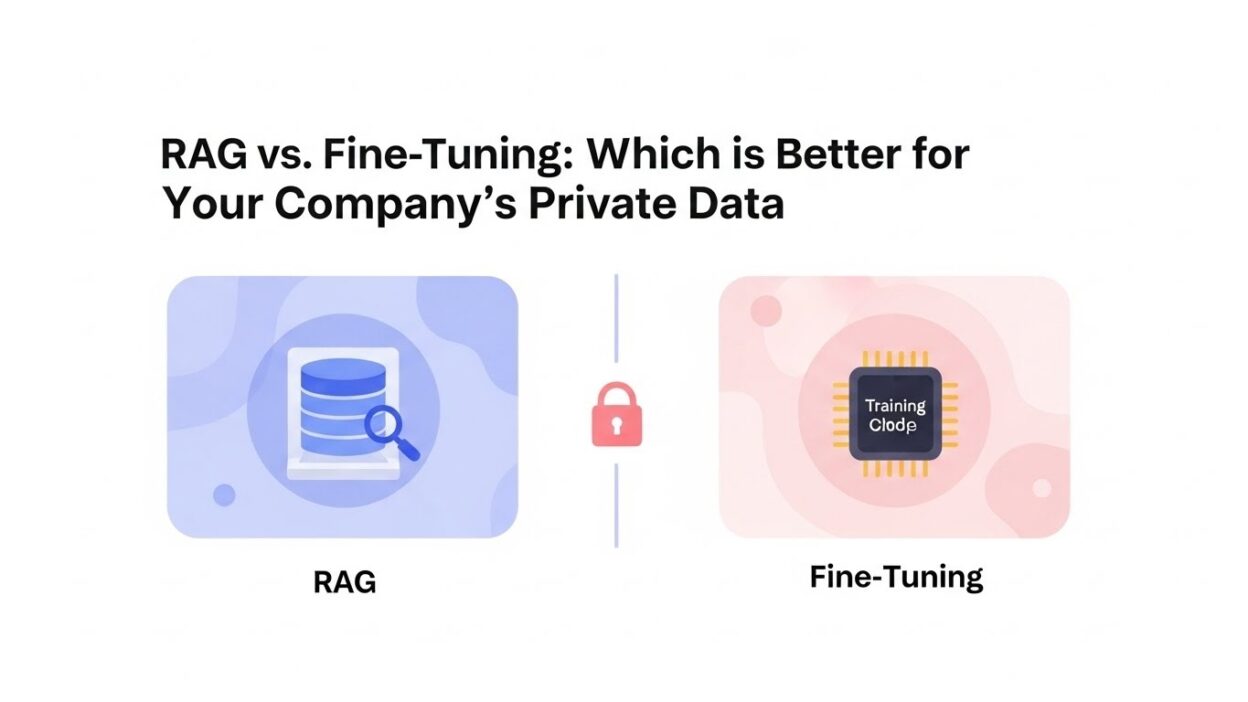
Two primary methods enable large language models to utilize your private data effectively. Retrieval-Augmented Generation pulls information from external sources dynamically. Fine-tuning bakes knowledge directly into model parameters through additional training. The choice between RAG vs fine-tuning for private data shapes your AI implementation success, costs, and security posture fundamentally.
This comprehensive guide examines both approaches in depth. You will understand exactly how each method works. You will discover which scenarios favor each technique. You will learn implementation costs, security implications, and performance characteristics. Most importantly, you will know which approach fits your specific business needs.
Table of Contents
Understanding Retrieval-Augmented Generation for Private Data
RAG transforms how AI systems access your company’s private information. The approach keeps your data external to the model itself. When someone asks a question, the system retrieves relevant documents from your data stores. It then feeds this context to the language model along with the query. The model generates responses grounded in your actual documentation rather than relying solely on training data.
Meta AI introduced RAG in a 2020 research paper titled “Retrieval-Augmented Generation for Knowledge-Intensive Tasks.” The framework revolutionized how organizations connect LLMs to proprietary information. RAG systems combine the general intelligence of foundation models with the specific knowledge contained in your databases, wikis, and document repositories.
The architecture operates through several interconnected components. Your documents get processed into embeddings using specialized models. These numerical representations capture semantic meaning. Vector databases store these embeddings enabling lightning-fast similarity searches. When users submit queries, the system converts questions into embeddings. It searches the vector database finding the most relevant documents. These retrieved documents get inserted into the prompt sent to the language model. The LLM generates responses using both its training and your retrieved information.
This approach offers tremendous flexibility for handling private data. Your sensitive information never gets incorporated into model weights. Documents remain in secured databases with full access controls. You can update information instantly without retraining models. Audit trails show exactly which documents informed each AI response. These characteristics make RAG exceptionally attractive for enterprises managing confidential data.
Leading companies deploy RAG for customer support, internal knowledge bases, and research assistance. A financial services firm uses RAG enabling analysts to query decades of investment reports instantly. A healthcare provider implements RAG allowing doctors to access latest treatment protocols. A legal firm deploys RAG helping attorneys search through millions of case documents. These real-world implementations prove RAG’s value for proprietary information.
Understanding Fine-Tuning for Private Data
Fine-tuning represents a fundamentally different approach to incorporating private data. The process involves continuing the training of a pretrained model using your specific dataset. The model adjusts its internal parameters learning patterns unique to your domain. Knowledge becomes embedded directly in the model weights rather than retrieved from external sources.
The fine-tuning process requires preparing labeled training data. You create input-output pairs demonstrating desired behavior. A customer support fine-tuning dataset might include thousands of real support tickets paired with ideal responses. The model trains on these examples adjusting its billions of parameters. This supervised learning process teaches the model domain-specific terminology, writing styles, and reasoning patterns.
Parameter-Efficient Fine-Tuning techniques like LoRA reduce computational requirements. Traditional fine-tuning updates all model parameters demanding massive GPU resources. PEFT methods update only the most relevant parameters. This approach achieves comparable performance improvements while requiring simpler hardware setups. The technique makes fine-tuning accessible to organizations lacking extensive AI infrastructure.
Fine-tuned models excel at specialized tasks requiring consistent behavior. A model fine-tuned on medical literature understands complex terminology automatically. It generates responses using appropriate clinical language. It follows medical reasoning patterns learned during training. This deep domain knowledge enables sophisticated applications impossible with general-purpose models.
Companies use fine-tuning when their private data defines unique communication styles or specialized knowledge. A law firm fine-tunes models on their contract templates creating consistent legal documents. A manufacturing company fine-tunes on maintenance records predicting equipment failures. A marketing agency fine-tunes on brand voice guidelines ensuring on-brand content. These specialized applications justify fine-tuning investments.
Understanding RAG vs fine-tuning for private data requires recognizing when each approach delivers superior value. The decision depends on your data characteristics, use case requirements, and organizational capabilities.
Data Security and Privacy Implications
Protecting private data represents the top concern for most enterprises considering AI implementations. The security posture differs dramatically between RAG and fine-tuning approaches. Understanding these differences guides appropriate method selection for sensitive information.
RAG keeps private data completely separate from the model itself. Your documents remain in secured databases with existing access controls. When the AI generates responses, it retrieves information dynamically but never incorporates it into model parameters. This separation provides several security advantages. Sensitive data never leaves your controlled environment. Access permissions determine which documents different users can query. Audit logs track exactly which information the system accessed for each response.
Financial services and healthcare organizations particularly value RAG’s security model. Regulatory requirements demand strict data protection. Patient records, financial transactions, and personally identifiable information cannot be exposed through model training. RAG enables AI capabilities while maintaining required data isolation. The approach satisfies compliance teams while delivering business value.
Fine-tuning incorporates private data directly into model weights raising different security considerations. Your training data influences model parameters permanently. This creates potential exposure risks if models get compromised or inadvertently shared. A fine-tuned model might inadvertently reveal training data through carefully crafted prompts. This concern particularly affects highly confidential information like trade secrets, customer data, or proprietary research.
Data residency requirements favor RAG implementations. Many industries and jurisdictions mandate that sensitive data remains within specific geographic boundaries. With RAG, your data stays in compliant storage locations. The model accesses it through secure retrieval without data movement. Fine-tuning typically requires consolidating training data in centralized locations complicating compliance.
The RAG vs fine-tuning for private data decision often hinges on security requirements. Organizations handling highly regulated data typically choose RAG. Companies with less sensitive information might accept fine-tuning risks for performance benefits. Your risk tolerance and compliance obligations determine the appropriate approach.
Cost Comparison: Implementation and Ongoing Expenses
Budget realities constrain every AI initiative. Understanding the true cost of RAG versus fine-tuning helps organizations make informed decisions about handling private data. The expense profiles differ dramatically across implementation and ongoing operation.
RAG requires building infrastructure for document storage, embedding generation, and vector search. Initial setup costs include vector database deployment, embedding model selection, and retrieval pipeline engineering. These components need configuration, testing, and optimization. A typical RAG implementation costs $10,000 to $100,000 depending on scale and complexity. Small organizations using managed services pay less. Large enterprises with complex requirements invest more.
Ongoing RAG costs center on storage and retrieval operations. Vector databases charge based on data volume and query frequency. Embedding generation consumes computational resources. Each user query triggers retrieval operations and LLM inference. These per-query costs scale with usage. Organizations might spend $500 to $10,000 monthly depending on query volume. The expenses remain predictable and scale gradually with adoption.
Fine-tuning demands significant upfront investment in training infrastructure. GPU resources for model training represent the largest expense. Training even with parameter-efficient methods requires powerful hardware running for hours or days. Cloud GPU costs range from $1 to $10 per hour. A typical fine-tuning job might cost $1,000 to $50,000 depending on model size, dataset volume, and training duration. Organizations lacking ML expertise need to hire specialists adding further costs.
Data preparation for fine-tuning consumes substantial resources. Creating high-quality training datasets requires domain experts labeling examples. This manual work costs thousands or tens of thousands of dollars for comprehensive datasets. Automated data labeling reduces costs but introduces quality concerns. The preparation investment often exceeds the actual training expenses.
Ongoing fine-tuning costs involve model retraining whenever data changes. New products launch requiring updated knowledge. Policies change demanding model refreshes. Regulations evolve necessitating retraining. Each retraining cycle incurs new GPU costs and data preparation expenses. Organizations in fast-changing domains face continuous retraining needs. These recurring costs add up quickly.
Most analyses conclude RAG offers better cost efficiency for private data applications. The approach leverages existing data without expensive retraining cycles. Updates happen instantly by refreshing document stores. Fine-tuning makes sense when performance requirements justify higher costs or when data remains relatively stable.
Performance Characteristics: Speed and Accuracy
Response quality and latency determine user satisfaction with AI systems. RAG and fine-tuning deliver different performance profiles affecting user experience and application suitability. Understanding these characteristics guides appropriate method selection.
Fine-tuned models generate responses quickly. Once deployed, they operate as pure inference engines requiring no external data retrieval. A user query goes directly to the model which generates answers immediately. Response latency stays consistently low under 100 milliseconds for most applications. This speed makes fine-tuning ideal for real-time chatbots, interactive applications, and high-volume scenarios demanding instant responses.
Fine-tuning achieves exceptional accuracy on domain-specific tasks when trained properly. The model internalizes domain knowledge learning specialized terminology and reasoning patterns. A fine-tuned legal model outperforms general models on legal question-answering benchmarks. A fine-tuned medical model excels at clinical decision support. This specialized expertise justifies fine-tuning for narrow, well-defined applications.
RAG introduces retrieval latency affecting overall response times. The system must search vector databases, retrieve relevant documents, and then generate responses. This multi-step process adds 200-500 milliseconds compared to direct inference. For many applications this delay remains acceptable. Users tolerate slightly slower responses when answers are accurate and well-grounded. Performance optimization techniques reduce latency significantly.
RAG improves factual accuracy by grounding responses in actual documents. The model cannot hallucinate facts not present in retrieved information. It cites specific sources providing transparency and verification. Users can trace answers back to original documents building trust. This explainability represents a major RAG advantage over fine-tuned models where knowledge sources remain opaque.
The RAG vs fine-tuning for private data performance decision depends on application requirements. Real-time conversational interfaces favor fine-tuning’s speed. Research tools prioritizing accuracy and source attribution favor RAG. Many organizations find RAG’s slight latency penalty acceptable given its other benefits.
Handling Dynamic and Evolving Information
Business information changes constantly. Product specifications update. Policies evolve. Market conditions shift. Competitor intelligence accumulates. Your AI systems must reflect current information to provide value. The two approaches handle dynamic data very differently.
RAG excels at incorporating fresh information instantly. New documents get added to the vector database immediately becoming available for retrieval. A company policy update happens today. RAG systems use that new policy in responses tonight. There is no training delay. No redeployment required. The latest information is always accessible. This real-time currency makes RAG indispensable for time-sensitive applications.
Companies handling breaking news, stock prices, or customer account updates depend on RAG. A financial chatbot needs current portfolio balances not yesterday’s numbers. A customer service agent needs the latest shipping status not outdated information. RAG delivers this immediacy naturally through dynamic retrieval.
Fine-tuned models remain frozen at their training data cutoff. If you fine-tune a model today, it knows only what existed in the training dataset. Tomorrow’s product launch remains unknown until retraining. Last week’s news stays invisible until the next fine-tuning cycle. This knowledge staleness creates serious limitations for dynamic domains.
Retraining fine-tuned models to incorporate new information takes days or weeks. You must collect new training examples. You must retrain the model consuming GPU resources. You must validate performance before deployment. This cycle cannot keep pace with rapidly changing information. Organizations in fast-evolving fields find themselves in constant retraining cycles. Models become outdated before the next version deploys.
The challenge intensifies for enterprises serving multiple clients or divisions. Fine-tuning might require separate models for each with distinct knowledge bases. Maintaining dozens of model versions becomes operationally impractical. RAG handles multiple knowledge domains by switching data sources while using the same model. This scalability advantage saves tremendous operational complexity.
The RAG vs fine-tuning for private data decision often hinges on information velocity. Static knowledge domains favor fine-tuning. Dynamic, frequently updated information demands RAG. Most enterprises find their data changes often enough to make RAG the practical choice.
Implementation Complexity and Required Expertise
Technical capabilities within your organization constrain AI implementation choices. RAG and fine-tuning demand different skill sets and expertise levels. Understanding these requirements helps assess feasibility realistically.
RAG implementation requires data engineering and system architecture skills. Teams must design document ingestion pipelines. They must configure vector databases and embedding models. They must engineer retrieval logic and prompt construction. These tasks demand programming ability and system design experience. Most data engineers possess these skills already. The work resembles traditional data pipeline development rather than specialized ML engineering.
Organizations can implement basic RAG systems without deep machine learning expertise. Managed services like Vertex AI Agent Builder, AWS Bedrock, and Azure AI Search provide ready-made RAG infrastructure. Teams configure rather than build from scratch. This accessibility democratizes RAG making it available to companies lacking extensive AI talent.
Fine-tuning demands specialized machine learning expertise. Data scientists must prepare training datasets with proper labeling and formatting. ML engineers must configure training parameters, learning rates, and optimization strategies. They must evaluate model performance using appropriate metrics. They must debug issues like overfitting, catastrophic forgetting, and training instability. These skills require formal ML education and practical experience.
The learning curve for fine-tuning is significantly steeper than RAG. A data engineer can learn RAG fundamentals in weeks. Fine-tuning expertise develops over months or years. Organizations lacking ML talent face hiring challenges as competition for these specialists remains fierce. Salaries for experienced ML engineers exceed $150,000 to $300,000 annually.
Troubleshooting and debugging differ substantially between approaches. RAG issues typically involve retrieval quality, document relevance, or prompt engineering. Engineers can inspect retrieved documents and adjust search parameters. The debugging process remains transparent and logical. Fine-tuning problems like model drift or degraded performance on edge cases require sophisticated analysis. Identifying why a fine-tuned model misbehaves on specific inputs demands deep expertise.
The RAG vs fine-tuning for private data decision must account for team capabilities honestly. Organizations with strong data engineering but limited ML expertise succeed with RAG. Companies with dedicated ML teams can pursue fine-tuning when use cases justify the complexity. Many enterprises start with RAG given its lower barrier to entry.
Hybrid Approaches: Combining RAG and Fine-Tuning
The RAG versus fine-tuning decision need not be binary. Many successful implementations combine both approaches capturing benefits of each. Understanding hybrid architectures reveals advanced optimization possibilities.
The most common hybrid pattern fine-tunes models for domain-specific language and reasoning, then deploys them in RAG architectures. A medical AI system might use a model fine-tuned on medical literature providing strong clinical terminology understanding. That specialized model then retrieves current patient information and recent research through RAG. The combination delivers both domain expertise and current information.
This approach even has its own acronym: RAFT for Retrieval-Augmented Fine-Tuning. Organizations in specialized domains like law, medicine, and finance increasingly adopt RAFT architectures. The fine-tuned model provides foundation knowledge. RAG adds specificity and currency. The result outperforms either approach alone.
Another hybrid pattern uses RAG for knowledge injection with fine-tuned models for output formatting. The RAG component retrieves relevant information from private data. A fine-tuned model then processes that information generating responses in specific formats or tones. This separation of concerns optimizes each component for its strength.
Some organizations fine-tune retrieval models improving document selection quality. Standard embedding models may not understand industry-specific terminology well. Fine-tuning the embedding model on domain examples improves retrieval relevance dramatically. This optimized retrieval feeds into standard LLMs for response generation.
Hybrid architectures introduce additional complexity requiring careful cost-benefit analysis. You pay both fine-tuning and RAG costs. You manage both model training and retrieval infrastructure. The technical expertise requirements increase substantially. However, applications demanding both specialized knowledge and current information justify this investment.
Financial services institutions commonly deploy hybrid systems. They fine-tune models on financial terminology and regulations. They use RAG to retrieve current market data and customer account information. The combination handles complex financial queries with accuracy impossible using either approach alone.
Understanding RAG vs fine-tuning for private data includes recognizing when combining approaches delivers superior value. Start simple with one method. Add complexity only when clear requirements justify the additional investment.
Use Case Decision Framework
Choosing between RAG and fine-tuning requires systematic evaluation of specific requirements. This framework guides appropriate method selection based on your unique circumstances.
Choose RAG when you need source attribution and explainability. Regulated industries often require AI systems to cite information sources. RAG provides this naturally by returning specific documents. Users can verify answers against original sources. Auditors can review which data informed decisions. This transparency builds trust and satisfies compliance requirements.
Select RAG when your data updates frequently. Product catalogs change daily. Policies evolve monthly. Market intelligence accumulates continuously. RAG handles these updates instantly without retraining. The system always uses current information. Fine-tuning cannot match this dynamism.
Pick RAG when data security and privacy are paramount. Highly confidential information should never be incorporated into model weights. RAG keeps sensitive data in controlled environments with full access controls. This isolation protects against data exposure through model compromise.
Choose RAG when you lack extensive ML expertise. Data engineering skills suffice for RAG implementation. Managed services lower barriers further. Organizations without specialized ML teams succeed with RAG where fine-tuning would be impractical.
Select fine-tuning when response speed is critical. Real-time applications demanding sub-100 millisecond latency favor fine-tuned models. The elimination of retrieval overhead delivers consistent, fast responses. High-volume scenarios benefit from this speed advantage.
Pick fine-tuning when your data is stable and well-curated. Static knowledge domains change infrequently. Historical information remains constant. Fine-tuning makes sense when retraining frequency stays low. The upfront investment pays off through superior domain-specific performance.
Choose fine-tuning when you need consistent style and tone. Brand voice requirements demand precise output formatting. Fine-tuning teaches models specific writing styles impossible to achieve through prompting alone. Marketing content, customer communications, and branded materials benefit from this consistency.
Select fine-tuning when you have sufficient training data and ML expertise. Building quality training datasets and managing model training requires specialized skills. Organizations with these capabilities can pursue fine-tuning when use cases justify the investment.
The RAG vs fine-tuning for private data decision ultimately depends on your specific circumstances. Evaluate each dimension systematically. Many organizations discover RAG addresses most needs with fine-tuning reserved for specialized applications.
Frequently Asked Questions
Can I use both RAG and fine-tuning together?
Yes and this hybrid approach is increasingly common. Organizations fine-tune models on domain-specific knowledge providing strong foundational understanding. They then deploy those specialized models in RAG architectures accessing current private data. This combination delivers both expertise and currency. The approach works particularly well in specialized fields like medicine, law, and finance where domain knowledge and current information are both essential.
How much does it cost to implement RAG vs fine-tuning for private data?
RAG implementations typically cost $10,000 to $100,000 initially with ongoing costs of $500 to $10,000 monthly based on query volume. Fine-tuning requires $1,000 to $50,000 per training cycle plus ongoing retraining costs whenever data changes. RAG generally proves more cost-effective for most private data applications. However, high-volume scenarios with stable data might favor fine-tuning’s lower per-query costs.
Which approach is better for highly confidential data?
RAG provides superior security for confidential private data. Your sensitive information never gets incorporated into model weights. Documents remain in secured databases with full access controls. Audit trails track which information the system accessed. Fine-tuning embeds data in model parameters creating potential exposure risks. Regulated industries handling healthcare records, financial data, or trade secrets typically choose RAG for its security advantages.
How quickly can I update information with each approach?
RAG updates instantly. Add new documents to your database and they become available immediately for retrieval. There is no retraining delay. Fine-tuning requires collecting new training examples, retraining the model, and redeploying which takes days or weeks. Organizations needing real-time information updates should choose RAG. Static knowledge domains can tolerate fine-tuning’s slower update cycle.
What technical expertise do I need for implementation?
RAG requires data engineering skills for building document pipelines, configuring databases, and managing retrieval systems. Most data engineers possess these capabilities. Fine-tuning demands specialized machine learning expertise including training configuration, performance evaluation, and debugging. The ML skills take months or years to develop. Organizations with strong data engineering but limited ML talent succeed with RAG. Companies with dedicated ML teams can pursue fine-tuning.
Which method delivers better accuracy?
Accuracy depends on the application. Fine-tuning achieves higher accuracy on narrow, well-defined tasks when trained on sufficient data. A legal model fine-tuned on case law outperforms general models on legal questions. RAG improves factual accuracy by grounding responses in retrieved documents rather than relying on internal model knowledge. RAG also provides source attribution enabling verification. For most private data applications, RAG’s grounded accuracy proves more valuable than fine-tuning’s specialized performance.
How do I measure ROI for these approaches?
Track implementation costs, ongoing operational expenses, and business value delivered. Measure response accuracy, user satisfaction, and time saved. Calculate cost per query or interaction. Monitor whether the system reduces support tickets, accelerates research, or improves decision-making. RAG typically shows faster time-to-value and clearer ROI. Fine-tuning requires longer evaluation periods but might deliver superior returns for specific high-value applications.
Can small companies implement these approaches successfully?
Yes especially with RAG. Managed services from major cloud providers democratize RAG making it accessible to small organizations. Initial implementations can start at under $10,000 with minimal ongoing costs. Fine-tuning remains more challenging for small companies lacking ML expertise. However, parameter-efficient methods and managed fine-tuning services are improving accessibility. Start with RAG proving value before considering fine-tuning investments.
Read More:-How to Implement Active vs Passive Listening in AI Assistants
Conclusion

The RAG vs fine-tuning for private data decision shapes your AI implementation success fundamentally. Both approaches enable AI systems to leverage your proprietary information. Both deliver measurable business value when applied appropriately. But they suit different scenarios with distinct tradeoffs.
RAG excels for most enterprise private data applications. It keeps sensitive information secure in controlled databases. It updates instantly as data changes. It provides source attribution building trust and enabling verification. It requires data engineering skills most organizations already possess. It costs less to implement and maintain than fine-tuning. These advantages explain why over 70% of enterprise AI implementations choose RAG architectures.
Fine-tuning delivers superior performance for specialized applications with stable data. It achieves lower latency for real-time interactions. It provides consistent style and tone impossible through prompting alone. It deeply embeds domain knowledge enabling sophisticated reasoning. Companies with ML expertise and narrow use cases benefit from fine-tuning investments.
Security requirements often determine the appropriate approach. Highly regulated industries handling confidential data typically choose RAG. The separation between model and data satisfies compliance requirements while enabling AI capabilities. Organizations with less sensitive information might accept fine-tuning’s embedding of data into model weights.
Cost considerations favor RAG for most scenarios. Lower implementation costs, predictable operational expenses, and instant updates without retraining deliver better ROI. Fine-tuning makes financial sense when performance requirements justify the investment or when data remains stable minimizing retraining frequency.
Technical capabilities within your organization constrain realistic options. RAG succeeds with data engineering skills. Fine-tuning demands specialized ML expertise. Assess your team honestly choosing approaches you can implement successfully.
Many leading organizations combine both methods through hybrid architectures. They fine-tune models for domain expertise then deploy them in RAG systems accessing current data. This combination captures benefits of each approach delivering superior results. However, the added complexity requires careful justification.
Start with a clear understanding of your requirements. Evaluate data sensitivity, update frequency, accuracy needs, and team capabilities systematically. Use the decision framework provided matching your circumstances to appropriate methods.
Most organizations should begin with RAG implementations. Prove value with manageable complexity and costs. Expand to fine-tuning only when specific use cases justify the additional investment and expertise. This pragmatic approach delivers results while building AI capabilities progressively.
The future of enterprise AI involves both RAG and fine-tuning working together. Understanding RAG vs fine-tuning for private data positions your organization to make informed decisions. Choose the right approach for each application. Implement systematically. Measure results rigorously. Your private data represents tremendous untapped value. The right AI approach unlocks that value driving competitive advantage and business growth.
Take action today. Assess your private data and use cases. Select the appropriate method matching your needs. Start implementation building on proven patterns. Your competitors are already leveraging AI for their proprietary information. Join them or watch them pull ahead. The technology is proven. The business case is clear. The only question is when you will start.