Introduction
TL;DR Retrieval-Augmented Generation transforms how AI systems handle knowledge. Traditional language models struggle with domain-specific information. RAG architectures bridge this gap elegantly.
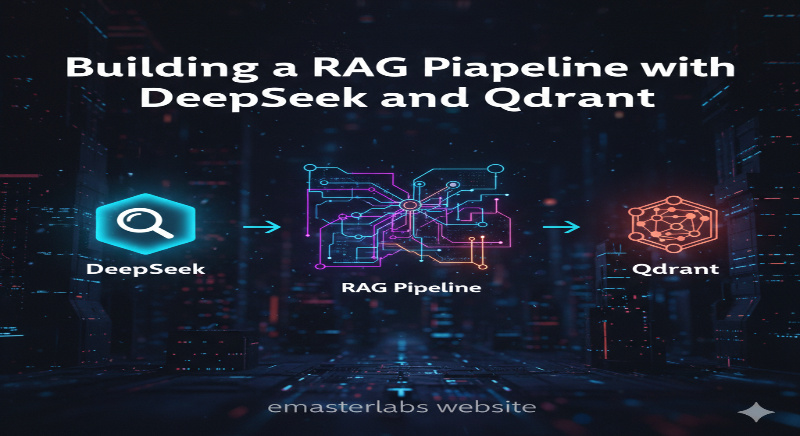
RAG Pipeline with DeepSeek and Qdrant combines cutting-edge technologies. DeepSeek provides powerful language understanding at lower costs. Qdrant delivers lightning-fast vector similarity search.
This comprehensive guide walks through building production-grade RAG systems. You’ll learn architecture decisions, implementation details, and optimization strategies. Real code examples demonstrate each concept practically.
DeepSeek emerged as a cost-effective alternative to GPT-4. The model delivers comparable performance at fraction of the price. Chinese researchers built this impressive system recently.
Qdrant stands out among vector databases significantly. Rust-based architecture ensures exceptional performance. Filtering capabilities exceed competing solutions substantially.
Together these technologies create powerful knowledge retrieval systems. Your applications gain access to custom data sources. Response accuracy improves while costs decrease.
We’ll cover everything from initial setup to production deployment. Data preparation, embedding generation, and query optimization all receive attention. By the end, you’ll build fully functional RAG applications.
Table of Contents
Understanding RAG Architecture Fundamentals
Retrieval-Augmented Generation operates through distinct phases. Document ingestion happens first during setup. Query processing occurs during runtime operations.
The ingestion phase chunks documents into manageable pieces. Each chunk converts into vector embeddings. Vector databases store these representations for retrieval.
Runtime queries also convert to vector embeddings. Similarity search identifies relevant document chunks. Retrieved context augments the language model prompt.
The language model generates responses using retrieved information. Grounding in specific documents prevents hallucinations. Answers cite actual source material accurately.
Why RAG Matters for Modern AI Applications
Language models possess impressive general knowledge. Specific organizational information remains inaccessible. Training custom models costs millions of dollars.
RAG provides a practical alternative approach. Connect existing models to proprietary knowledge bases. Implementation costs drop to thousands instead of millions.
Information updates happen without model retraining. Add new documents to the vector database. Knowledge freshness maintains automatically.
Source attribution builds user trust substantially. Citations link responses to original documents. Verification becomes possible for critical decisions.
Key Components of RAG Systems
Document loaders extract text from various formats. PDFs, Word documents, and web pages all convert. Structured extraction preserves formatting when needed.
Text splitters divide documents into optimal chunks. Chunk size balances context and retrieval precision. Overlapping sections maintain continuity across boundaries.
Embedding models convert text to numerical vectors. Semantic meaning encodes into high-dimensional spaces. Similar concepts cluster together geometrically.
Vector databases enable fast similarity searches. Millions of vectors query in milliseconds. Filtering narrows results by metadata attributes.
Language models generate final responses. Retrieved chunks provide factual grounding. Generation quality depends on retrieval accuracy.
Why Choose DeepSeek for RAG Applications
DeepSeek offers compelling advantages for RAG implementations. The model family includes chat and coder variants. Performance rivals leading commercial alternatives.
Cost efficiency distinguishes DeepSeek dramatically. API pricing undercuts OpenAI by 90% or more. Budget-conscious projects benefit enormously.
The models demonstrate strong reasoning capabilities. Chain-of-thought prompting works excellently. Complex queries decompose systematically.
Chinese and English both work natively. Multilingual applications deploy easily. Translation overhead disappears for Asian languages.
DeepSeek Model Capabilities
DeepSeek-V3 represents the latest generation. 671 billion parameters deliver impressive performance. Mixture-of-Experts architecture optimizes efficiency.
Context windows extend to 128,000 tokens. Entire books fit within single prompts. Long document analysis becomes practical.
Function calling enables tool integration. RAG pipelines chain multiple operations. Structured outputs extract cleanly.
Instruction following achieves high accuracy. Custom prompting strategies work reliably. Few-shot learning adapts to specific domains.
Performance Benchmarks and Comparisons
MMLU scores approach GPT-4 levels closely. General knowledge remains comprehensive. Academic subjects demonstrate strong coverage.
Coding benchmarks show particular strength. HumanEval scores exceed many competitors. Python and JavaScript generation works well.
Mathematical reasoning performs admirably. GSM8K results validate problem-solving abilities. Multi-step calculations complete accurately.
Multilingual capabilities outperform monolingual models. Chinese language understanding proves exceptional. Cross-lingual transfer happens effectively.
Cost and API Access
API pricing starts at $0.14 per million input tokens. Output costs $0.28 per million tokens. These rates beat competitors dramatically.
Self-hosting options exist for large deployments. Model weights release under permissive licenses. Infrastructure control remains possible.
Rate limits accommodate high-volume applications. Throughput scales with demand. Enterprise access provides dedicated capacity.
SDKs support Python, JavaScript, and Go. Integration takes minutes with existing code. OpenAI-compatible APIs ease migration.
Qdrant: The Vector Database Foundation
Qdrant provides the storage backbone for RAG Pipeline with DeepSeek and Qdrant. Written in Rust for maximum performance. Memory safety prevents common database bugs.
Vector similarity search happens in milliseconds. HNSW algorithm delivers excellent speed-accuracy tradeoffs. Scalability extends to billions of vectors.
Filtering combines with vector search powerfully. Metadata attributes narrow results precisely. Hybrid search improves relevance substantially.
Cloud-native architecture supports modern deployments. Kubernetes integration works seamlessly. Horizontal scaling happens transparently.
Qdrant Architecture and Design
Collections organize vectors by use case. Each collection stores embeddings with metadata. Schema flexibility accommodates evolving requirements.
Points represent individual vectors within collections. Unique IDs enable updates and deletions. Payloads attach arbitrary JSON data.
Indexes optimize search performance automatically. HNSW graphs build during ingestion. Query latency stays consistently low.
Sharding distributes data across nodes. Replication ensures high availability. Fault tolerance prevents data loss.
Key Features for RAG Workloads
Payload filtering narrows search scope effectively. Date ranges, categories, and tags all work. Complex boolean logic combines conditions.
Scroll API retrieves large result sets efficiently. Pagination handles millions of matches. Export operations complete quickly.
Snapshot capabilities enable backups. Point-in-time recovery protects data. Disaster recovery strategies implement easily.
Batch operations accelerate bulk ingestion. Thousands of vectors upload simultaneously. Initial indexing completes faster.
Qdrant Deployment Options
Docker containers simplify development setup. Single commands launch local instances. Testing happens without infrastructure complexity.
Qdrant Cloud offers managed hosting. Provisioning completes in minutes. Operations and maintenance vanish.
Self-hosted deployments provide maximum control. Kubernetes manifests deploy production clusters. Cost optimization reaches maximum levels.
Hybrid architectures mix deployment types. Development uses local instances. Production leverages managed services.
Setting Up Your Development Environment
Building a RAG Pipeline with DeepSeek and Qdrant requires proper tooling. Python serves as the primary programming language. Several libraries simplify implementation substantially.
Installing Required Dependencies
Python 3.9 or later provides necessary features. Virtual environments isolate project dependencies. Conda or venv both work excellently.
The Qdrant client library handles database operations. Installation happens through pip package manager. Version compatibility matters for stability.
LangChain orchestrates RAG workflows elegantly. Modular design enables component swapping. Community contributions expand capabilities continuously.
OpenAI SDK structure supports DeepSeek API. Code portability increases through compatibility. Migration between providers stays simple.
Sentence Transformers generate quality embeddings. Pre-trained models cover many languages. Fine-tuning adapts to specific domains.
Configuring API Access
DeepSeek API keys authenticate requests. Registration provides immediate access. Usage tracking happens through dashboards.
Environment variables store credentials securely. Hard-coded keys create security vulnerabilities. Configuration management best practices apply.
Qdrant Cloud requires separate authentication. API keys control collection access. Role-based permissions enhance security.
Local Qdrant instances skip authentication initially. Production deployments enable security features. Encryption protects data in transit.
Project Structure Best Practices
Separate configuration from application code. YAML or JSON files store settings. Environment-specific values override defaults.
Modular design isolates functionality logically. Data loading, embedding, and retrieval separate cleanly. Testing and maintenance simplify.
Version control tracks all code changes. Git repositories enable collaboration. Deployment automation builds from repositories.
Documentation explains architectural decisions. README files guide new developers. API documentation generates from code.
Implementing Document Ingestion Pipeline
Document ingestion transforms raw files into searchable vectors. The process involves loading, chunking, embedding, and storing. Each step requires careful optimization.
Loading and Processing Documents
PyPDF2 extracts text from PDF files. Page-by-page processing handles large documents. Metadata extraction captures titles and authors.
Beautiful Soup parses HTML content. Web scraping retrieves online documentation. Text cleaning removes navigation and ads.
Python docx handles Word documents. Formatting preservation maintains structure. Tables and lists extract properly.
CSV and JSON files load as structured data. Pandas DataFrames facilitate manipulation. Column selection focuses on relevant content.
Text Chunking Strategies
Fixed-size chunking divides text by character count. Simple implementation processes quickly. Context boundaries may split awkwardly.
Sentence-based chunking respects natural boundaries. NLTK tokenizes text intelligently. Coherence improves over fixed chunking.
Semantic chunking groups related sentences. Embedding similarity determines boundaries. Computational cost increases substantially.
Sliding window approaches add overlap. Context preservation improves across chunks. Retrieval quality benefits from redundancy.
Optimal chunk size balances competing factors. 256-512 tokens works well commonly. Domain-specific testing refines choices.
Generating Vector Embeddings
Sentence Transformers provide excellent embedding models. MiniLM variants offer speed advantages. MPNet models maximize quality.
all-MiniLM-L6-v2 balances performance and speed. 384-dimensional vectors reduce storage needs. Accuracy remains competitive.
Batch processing accelerates embedding generation. GPU utilization maximizes throughput. Progress tracking monitors long operations.
Embedding normalization improves search quality. L2 normalization standardizes vector magnitudes. Cosine similarity calculations simplify.
Storing Vectors in Qdrant
Collection creation specifies vector dimensions. Distance metrics configure similarity calculations. Cosine distance works best commonly.
Point upload attaches metadata to vectors. Document IDs enable result linking. Additional fields support filtering.
Batch uploads optimize network utilization. Thousands of points upload simultaneously. Progress monitoring tracks completion.
Index optimization happens automatically. HNSW parameters tune for workload. Memory usage balances speed.
Building the Query and Retrieval System
Query processing determines RAG system quality. Effective retrieval finds relevant information reliably. Multiple strategies improve results.
Query Understanding and Processing
User queries vary in clarity and specificity. Query expansion adds related terms. Synonym mapping improves recall.
Spelling correction handles typos automatically. Edit distance algorithms detect errors. Suggestions improve user experience.
Query classification routes to appropriate strategies. Factual questions need precise retrieval. Exploratory queries benefit from diversity.
Embedding queries maintains consistency. Same model as documents prevents drift. Semantic matching works optimally.
Vector Search Configuration
Top-k parameter controls result count. 5-10 results balance quality and context length. Domain requirements guide selection.
Score thresholds filter low-quality matches. Minimum relevance ensures usefulness. Empty results trigger fallback strategies.
HNSW search parameters tune accuracy-speed tradeoffs. ef parameter controls search depth. Higher values improve recall.
Exact search option guarantees optimal results. Computational cost increases substantially. Critical applications justify expense.
Metadata Filtering Techniques
Date range filters limit temporal scope. Recent documents often matter most. Historical context needs broader ranges.
Category filters narrow domain scope. Product documentation separates from marketing. Precision improves through specificity.
Access control filters enforce permissions. Users see authorized content only. Security requirements satisfy automatically.
Combined filters create powerful queries. Boolean logic expresses complex requirements. Performance remains excellent.
Reranking Retrieved Results
Cross-encoder models refine initial results. Bi-directional attention improves accuracy. Computational cost increases per query.
Diversity algorithms prevent redundant results. Maximal Marginal Relevance spreads topics. User experience improves through variety.
Metadata boosting adjusts relevance scores. Recent documents gain weight. Authoritative sources rank higher.
User feedback signals improve over time. Click-through rates indicate relevance. Machine learning optimizes ranking.
Integrating DeepSeek for Response Generation
The RAG Pipeline with DeepSeek and Qdrant culminates in response generation. Retrieved context augments language model prompts. Quality prompting determines output excellence.
Crafting Effective RAG Prompts
System prompts establish AI behavior. Instructing citation of sources improves accuracy. Admitting knowledge gaps builds trust.
Retrieved chunks insert into user messages. Context precedes the actual question. Clear delineation prevents confusion.
Prompt templates ensure consistency. Variables inject dynamic content. Maintainability improves through abstraction.
Few-shot examples demonstrate desired format. Response structure becomes clear. Quality improves through guidance.
Context Management Strategies
Token counting prevents context overflow. Tiktoken library estimates accurately. Truncation strategies preserve important content.
Chunk ordering affects response quality. Relevance-based sorting works best commonly. Temporal ordering suits chronological queries.
Metadata inclusion enriches responses. Source titles enable citation. Timestamps provide temporal context.
Redundancy elimination reduces token waste. Duplicate chunks remove automatically. Unique information maximizes value.
Streaming and Response Handling
Streaming responses improve perceived latency. Users see output immediately. Engagement increases through interactivity.
Token-by-token generation enables streaming. Buffers collect before display. Smooth rendering improves experience.
Error handling catches API failures. Retry logic handles transient issues. Graceful degradation maintains availability.
Response validation checks output quality. Length thresholds detect issues. Content filters prevent inappropriate responses.
Citation and Source Attribution
Retrieved chunk IDs track to sources. Document titles and URLs include. Users verify information easily.
Inline citations mark specific claims. Numbered references link to sources. Academic-style attribution builds credibility.
Confidence scores indicate reliability. Retrieval relevance guides assessment. Uncertainty acknowledgment prevents overconfidence.
Source snippets provide direct evidence. Quoted text supports generated claims. Verification becomes straightforward.
Optimizing RAG Pipeline Performance
Production systems demand optimization across dimensions. Latency, throughput, accuracy, and cost all matter. Systematic improvement requires measurement.
Measuring Retrieval Quality
Precision measures relevant result percentage. Retrieved documents match information needs. High precision reduces noise.
Recall measures coverage of relevant documents. Important information retrieves consistently. High recall prevents missing data.
Mean Reciprocal Rank evaluates result ordering. Relevant results appear early ideally. User experience correlates strongly.
NDCG accounts for graded relevance. Partial matches receive partial credit. Nuanced evaluation guides improvement.
Improving Embedding Quality
Fine-tuning embeddings on domain data helps. Contrastive learning improves discrimination. Task-specific models outperform generic ones.
Hard negative mining strengthens models. Similar but incorrect examples teach boundaries. Precision improves substantially.
Multi-task learning combines objectives. Classification and retrieval train together. Generalization improves across tasks.
Dimensionality reduction decreases storage costs. PCA or autoencoders compress vectors. Speed increases with smaller dimensions.
Caching and Performance Optimization
Query result caching prevents redundant computation. Popular queries serve from memory. Response times drop to milliseconds.
Embedding caches avoid recomputation. Previously processed queries retrieve instantly. Hit rates reach 30-50% commonly.
Connection pooling reduces overhead. Database connections reuse efficiently. Latency decreases through persistence.
Async processing enables concurrency. Multiple queries process simultaneously. Throughput scales with parallelization.
Cost Optimization Strategies
Smaller embedding models reduce API costs. Quality degradation may prove acceptable. Testing validates tradeoffs.
Batch processing amortizes overhead. Document ingestion groups operations. Per-operation costs decrease.
Reserved capacity pricing lowers costs. Committed usage earns discounts. Predictable workloads benefit most.
Open-source models eliminate API costs. Self-hosting trades infrastructure for usage fees. High-volume applications justify complexity.
Production Deployment Considerations
Moving RAG Pipeline with DeepSeek and Qdrant to production requires planning. Reliability, security, and scalability become critical. Professional operations prevent failures.
Monitoring and Observability
Latency tracking identifies performance regressions. P95 and P99 percentiles reveal outliers. User experience correlates with tail latency.
Error rate monitoring catches issues early. Alerts trigger before widespread impact. On-call teams respond quickly.
Cost tracking prevents budget surprises. Per-query expenses accumulate. Anomaly detection flags unusual spending.
Quality metrics guide improvements. User ratings indicate satisfaction. A/B testing validates changes.
Security Best Practices
API key rotation limits breach impact. Automated rotation prevents stale credentials. Compromise detection triggers immediate action.
Rate limiting prevents abuse. Per-user quotas enforce fairness. DDoS protection maintains availability.
Input validation sanitizes user queries. Injection attacks fail safely. Malicious prompts get blocked.
Data encryption protects sensitive information. TLS secures network transmission. At-rest encryption guards stored data.
Scaling Infrastructure
Horizontal scaling handles growth. Additional Qdrant nodes distribute load. Sharding strategies balance data.
Load balancing distributes queries. Health checks route to available instances. Fault tolerance maintains uptime.
Auto-scaling responds to demand. Kubernetes metrics drive decisions. Cost optimization happens automatically.
Database replication ensures availability. Read replicas distribute query load. Geographic distribution reduces latency.
Disaster Recovery Planning
Regular backups protect against data loss. Qdrant snapshots capture state. Restoration testing validates procedures.
Multi-region deployment survives outages. Failover happens automatically. User impact minimizes.
Incident response plans guide teams. Runbooks document procedures. Practice drills validate readiness.
Rollback capabilities enable quick recovery. Version control tracks changes. Problematic deployments revert instantly.
Advanced RAG Techniques and Patterns
Basic RAG Pipeline with DeepSeek and Qdrant implementations provide strong foundations. Advanced techniques unlock additional capabilities. Sophisticated applications demand these approaches.
Hybrid Search Strategies
Keyword search complements vector search. BM25 scoring finds exact matches. Precision improves for specific terms.
Result fusion combines both approaches. Reciprocal Rank Fusion merges rankings. Best of both worlds emerges.
Learned fusion weights optimize combinations. Machine learning determines blending. Performance exceeds manual tuning.
Query analysis selects appropriate strategy. Named entities trigger keyword search. Conceptual queries use embeddings.
Multi-Index Architecture
Separate indexes serve different content types. Product documentation splits from marketing. Retrieval precision improves dramatically.
Cross-index search aggregates results. Unified ranking presents coherent responses. User experience stays smooth.
Index routing optimizes resource usage. Metadata determines target collections. Efficiency increases through specialization.
Federated search queries multiple systems. External APIs supplement internal data. Comprehensive coverage emerges.
Conversational RAG Systems
Chat history informs subsequent queries. Context carries across turns. Understanding deepens through dialogue.
Query reformulation incorporates history. Pronouns resolve to previous entities. Ambiguity decreases substantially.
Multi-turn retrieval refines results. Initial queries broaden scope. Follow-ups narrow focus progressively.
Memory management prevents context overflow. Summarization condenses history. Relevance filtering drops old content.
Evaluation and Continuous Improvement
Human evaluation establishes ground truth. Expert annotations label quality. Automated metrics calibrate against judgments.
A/B testing validates improvements. User cohorts receive variants. Metrics determine winning approaches.
Feedback loops capture user signals. Thumbs up/down ratings guide tuning. Implicit signals complement explicit feedback.
Automated testing catches regressions. Test suites validate functionality. Continuous integration runs checks.
Real-World Use Cases and Examples
RAG Pipeline with DeepSeek and Qdrant powers diverse applications. Different domains demand unique optimizations. Learning from examples accelerates development.
Customer Support Knowledge Bases
Support tickets resolve faster with RAG. Agents retrieve answers instantly. Customer satisfaction improves measurably.
Article recommendations guide customers. Self-service deflects simple inquiries. Support costs decrease substantially.
Multilingual support leverages DeepSeek. Translation quality exceeds alternatives. Global deployment simplifies.
Analytics identify knowledge gaps. Frequently asked questions surface. Documentation improvements target needs.
Research and Document Analysis
Academic papers summarize automatically. Literature reviews compile quickly. Researcher productivity multiplies.
Citation networks visualize relationships. Knowledge graphs emerge from documents. Discovery accelerates through connections.
Comparative analysis contrasts sources. Conflicting claims highlight automatically. Critical thinking benefits.
Temporal analysis tracks evolution. Historical trends become visible. Predictive insights emerge.
Code Documentation and Developer Tools
API documentation retrieves contextually. Code examples match use cases. Developer onboarding accelerates.
Error message resolution guides debugging. Stack traces query solutions. Problem resolution speeds dramatically.
Architecture decision records inform design. Past choices and rationale retrieve. Consistency improves through institutional memory.
Migration guides generate automatically. Legacy code analysis extracts patterns. Modernization strategies develop.
Legal and Compliance Applications
Contract analysis identifies clauses. Risk assessment automates partially. Legal review accelerates.
Regulatory compliance checking validates policies. Requirements map to implementations. Gaps surface for remediation.
Case law research finds precedents. Argument construction benefits from examples. Legal strategy improves.
Due diligence reviews compress timelines. Document review automation saves thousands of hours. Deal velocity increases.
Troubleshooting Common Issues
Building RAG Pipeline with DeepSeek and Qdrant encounters predictable challenges. Understanding solutions accelerates development. Prevention beats debugging.
Poor Retrieval Quality
Irrelevant results indicate embedding mismatches. Document and query models must align. Reprocessing fixes inconsistencies.
Missing results suggest threshold issues. Score cutoffs filter too aggressively. Relaxing parameters improves recall.
Outdated information appears from stale indexes. Incremental updates maintain freshness. Automated pipelines prevent staleness.
Duplicate results waste context budget. Deduplication logic removes redundancy. Unique information maximizes value.
Performance Bottlenecks
Slow queries indicate index problems. HNSW parameters need tuning. Memory allocation affects speed.
High latency suggests network issues. Geographic distribution reduces distance. CDNs accelerate content delivery.
Resource exhaustion causes failures. Memory and CPU limits bind. Scaling addresses capacity constraints.
Cold start delays impact serverless deployments. Warmup strategies preload resources. User experience improves.
Integration Challenges
API compatibility issues arise occasionally. Version mismatches cause errors. Dependency management prevents problems.
Authentication failures block requests. Credential validation catches issues. Clear error messages guide resolution.
Data format inconsistencies create bugs. Schema validation enforces correctness. Testing catches problems early.
Rate limiting throttles applications. Backoff strategies handle limits gracefully. Queue systems smooth traffic.
Frequently Asked Questions
What makes DeepSeek suitable for RAG applications?
DeepSeek combines strong performance with exceptional cost efficiency. The model handles long contexts up to 128k tokens. Retrieved document chunks fit comfortably within prompts. Function calling enables structured retrieval workflows. Multilingual capabilities support global deployments. API compatibility eases integration with existing code.
How does Qdrant compare to other vector databases?
Qdrant delivers superior filtering capabilities compared to alternatives. Rust implementation ensures memory safety and performance. Payload filtering combines with vector search seamlessly. Cloud and self-hosted options provide flexibility. Active development adds features regularly. Community support helps troubleshoot issues.
What embedding model works best for RAG?
Choice depends on language and domain requirements. all-MiniLM-L6-v2 provides excellent general performance. Multilingual models support international content. Domain-specific fine-tuning improves accuracy further. Balance quality against speed and cost. Testing with actual data guides selection.
How many documents can a RAG system handle?
Qdrant scales to billions of vectors theoretically. Practical limits depend on infrastructure budget. Sharding distributes data across nodes. Filtering reduces search space effectively. Hundreds of thousands work well commonly. Millions require careful optimization.
What chunk size works best for documents?
Optimal size balances context and precision. 256-512 tokens proves effective commonly. Longer chunks provide more context. Shorter chunks improve retrieval precision. Domain testing reveals ideal settings. User query patterns influence decisions.
How do you prevent hallucinations in RAG systems?
Retrieved context grounds responses in facts. System prompts instruct citation requirements. Confidence thresholds filter uncertain responses. Source attribution enables verification. Adversarial testing identifies weaknesses. Continuous monitoring catches issues.
Can RAG work with real-time data?
Incremental index updates enable near real-time operation. Streaming ingestion processes new documents continuously. Cache invalidation maintains freshness. Latency depends on infrastructure complexity. Most applications tolerate slight delays. Critical systems optimize aggressively.
What costs should I expect for production RAG?
DeepSeek API costs stay remarkably low. Qdrant Cloud pricing starts around $25 monthly. Self-hosting trades infrastructure for API costs. Embedding generation adds minimal expense. High-volume applications benefit from optimization. Budget thousands monthly for serious systems.
How do you evaluate RAG system quality?
Human evaluation establishes ground truth initially. Automated metrics enable continuous monitoring. Retrieval quality and generation quality separate. User feedback provides real-world validation. A/B testing compares approaches rigorously. Multiple dimensions require attention.
Is it difficult to build a RAG pipeline?
Basic implementations complete in hours using frameworks. Production-grade systems demand weeks of work. LangChain and similar tools simplify development. Domain expertise proves more important than coding. Optimization requires iteration and testing. Community resources accelerate learning.
Read more:-v0.dev vs Bolt.new: The Best AI Tool for Instant Frontend Scaffolding
Conclusion
Building a RAG Pipeline with DeepSeek and Qdrant empowers applications with knowledge retrieval. The architecture combines proven components elegantly. Cost-effective implementation makes sophisticated AI accessible.
DeepSeek provides powerful language understanding affordably. Performance rivals expensive alternatives substantially. Long context windows accommodate extensive retrieval. Multilingual capabilities support global deployment.
Qdrant delivers exceptional vector search performance. Filtering capabilities exceed competing solutions. Flexible deployment options suit various requirements. Active development ensures continuous improvement.
The implementation journey follows clear steps. Document ingestion transforms content into searchable vectors. Query processing retrieves relevant information efficiently. Response generation grounds answers in facts.
Optimization techniques improve system performance. Retrieval quality metrics guide enhancement efforts. Caching strategies reduce latency substantially. Cost controls prevent budget overruns.
Production deployment requires careful planning. Monitoring catches issues before user impact. Security practices protect sensitive information. Scaling strategies accommodate growth.
Advanced techniques unlock additional capabilities. Hybrid search combines multiple strategies. Conversational systems maintain context across turns. Evaluation frameworks enable continuous improvement.
Real-world applications demonstrate value across domains. Customer support systems resolve tickets faster. Research tools accelerate literature review. Developer documentation retrieves contextually.
Common challenges have known solutions. Poor retrieval quality improves through tuning. Performance bottlenecks yield to optimization. Integration issues resolve through careful debugging.
The RAG Pipeline with DeepSeek and Qdrant represents modern AI architecture. Retrieval grounds generation in truth. Costs stay manageable through smart design. Capabilities rival enterprise solutions.
Start building your pipeline today. Begin with simple document collections. Iterate based on real usage patterns. Complexity adds gradually as needs evolve.
The technology stack matures rapidly. Community contributions expand capabilities. Documentation improves continuously. Best practices crystallize through shared experience.
Investment in RAG infrastructure pays dividends. Applications gain reliable knowledge access. Users trust cited responses more. Hallucinations decrease substantially.
Open-source foundations prevent vendor lock-in. Model flexibility enables optimization. Database portability protects investments. Future-proofing happens through standards.
Your journey toward intelligent applications begins now. The tools exist and work reliably. Implementation guidance removes barriers. Success requires action rather than perfection.
Deploy your first RAG Pipeline with DeepSeek and Qdrant this week. Learn through experimentation and iteration. Production readiness develops through practice. The future of AI applications awaits your creation.