Introduction
TL;DR Vector databases have become essential infrastructure for modern AI applications. Machine learning models generate embeddings that need efficient storage and retrieval. Developers face a critical decision when selecting the right vector database for their projects. The market offers several powerful options, each with distinct advantages.
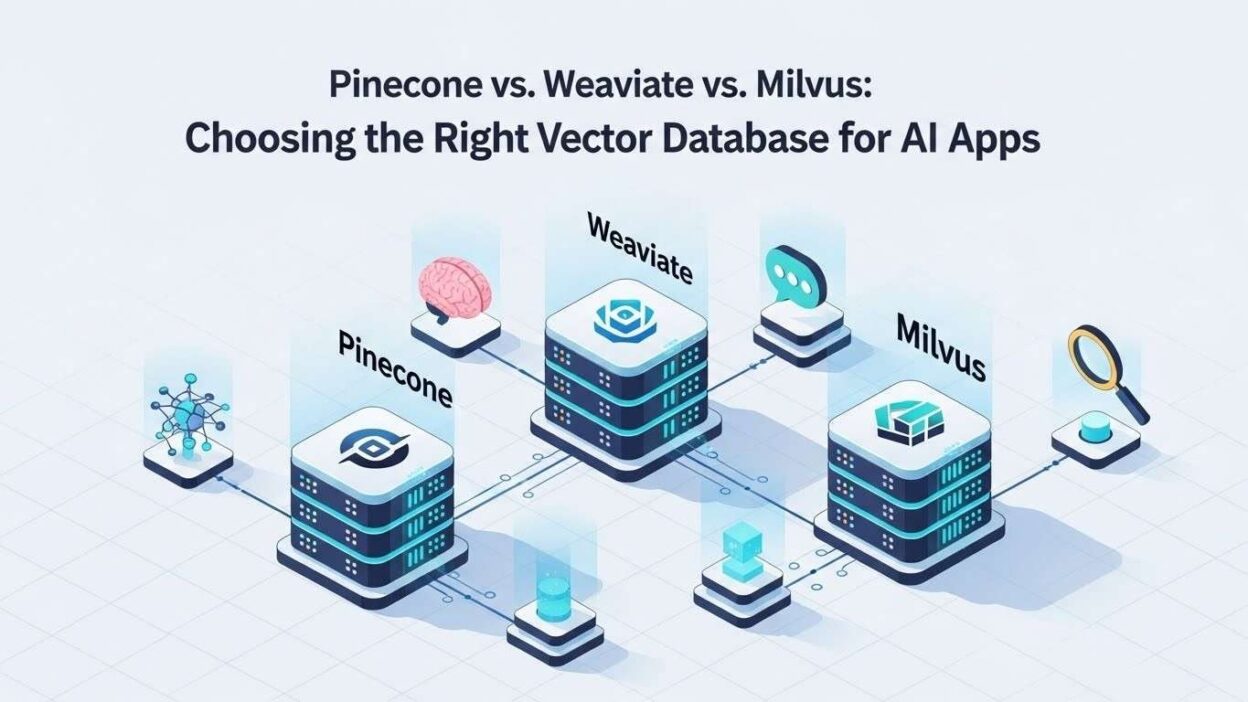
Pinecone vs Weaviate vs Milvus represents the most common comparison developers make today. These three platforms dominate the vector database landscape. Each solution brings unique capabilities to the table. Your choice impacts performance, scalability, and development speed. Understanding the differences helps you make an informed decision.
This comprehensive guide explores all three platforms in detail. We’ll examine their architectures, performance characteristics, and ideal use cases. You’ll discover which database aligns best with your specific requirements. Real-world scenarios and practical considerations will guide your selection process.
Table of Contents
Understanding Vector Databases and Their Importance
Vector databases store and retrieve high-dimensional vectors efficiently. Traditional databases struggle with similarity searches across millions of embeddings. A specialized vector database solves this challenge elegantly.
Machine learning models convert text, images, and audio into numerical representations. These embeddings capture semantic meaning in vector format. Finding similar vectors requires sophisticated indexing and search algorithms. Vector databases excel at this exact task.
AI applications rely heavily on similarity search functionality. Recommendation engines match user preferences with relevant content. Semantic search systems understand query intent beyond keyword matching. Chatbots retrieve contextually relevant information from knowledge bases. All these scenarios demand fast vector similarity searches.
The explosion of generative AI has accelerated vector database adoption. Large language models produce embeddings that need efficient storage. Retrieval-augmented generation systems query vector databases to enhance AI responses. The technology has moved from niche to mainstream.
Pinecone vs Weaviate vs Milvus emerges as the top comparison because these platforms lead the market. Each database offers production-ready features for enterprise applications. Developers evaluate them based on performance, ease of use, and deployment options.
Pinecone: The Fully Managed Vector Database
Pinecone pioneered the fully managed vector database category. The platform eliminates infrastructure management completely. Developers can focus on building applications rather than maintaining databases.
Architecture and Design Philosophy
Pinecone operates as a cloud-native service from the ground up. The architecture prioritizes simplicity and developer experience. You don’t configure servers, manage clusters, or tune performance parameters. The platform handles all operational complexity automatically.
The design separates storage from compute for elastic scaling. Pinecone can scale read and write operations independently. This architecture ensures consistent low latency under varying loads. The system automatically optimizes index structures based on your data patterns.
Pinecone uses proprietary indexing technology for fast similarity searches. The platform combines multiple algorithmic approaches for optimal performance. Graph-based indexes enable accurate nearest neighbor searches. Quantization techniques reduce memory footprint without sacrificing accuracy significantly.
Key Features and Capabilities
Pinecone offers serverless and pod-based deployment options. Serverless mode eliminates capacity planning entirely. You pay only for the operations you perform. Pod-based deployments provide dedicated resources for predictable performance.
The platform supports hybrid search combining vector and metadata filtering. You can filter results by attributes before similarity ranking. This capability proves valuable for applications with complex query requirements. Single-stage filtering maintains high performance even with restrictive conditions.
Pinecone includes built-in support for sparse-dense hybrid search. This feature enables keyword and semantic search in one query. Applications can leverage both exact matching and semantic understanding. The combination delivers more relevant results for many use cases.
Real-time updates allow immediate vector indexing after insertion. Your application can query newly added vectors within milliseconds. This capability supports dynamic applications with constantly changing data. No batch processing delays impact user experience.
Performance Characteristics
Pinecone delivers consistently low query latency across different dataset sizes. The platform maintains sub-100ms response times for most applications. Performance remains stable even as your vector count grows into billions. Automatic index optimization prevents degradation over time.
The service scales horizontally to handle increased query loads. Pinecone distributes requests across multiple nodes transparently. High availability is built into the platform architecture. The system replicates data across availability zones automatically.
Throughput scales linearly with the resources allocated to your index. Pod-based deployments offer predictable performance characteristics. You can provision capacity based on expected query volume. Serverless mode scales automatically to meet demand spikes.
Pricing Model and Cost Considerations
Pinecone uses a consumption-based pricing structure. Serverless mode charges per vector operation and storage. Pod-based plans charge for dedicated compute resources and storage separately. You select the pricing model matching your usage patterns.
The free tier includes 100,000 vectors for testing and prototyping. This allowance lets you explore the platform before committing financially. Production workloads typically require paid plans with higher capacity.
Costs scale with vector dimensionality and total vector count. Higher dimensional vectors consume more storage and memory. Query performance impacts compute costs in serverless mode. Careful optimization of embedding dimensions can reduce expenses.
Ideal Use Cases
Pinecone excels for teams prioritizing rapid development and deployment. Startups building AI applications benefit from minimal operational overhead. The platform eliminates the need for dedicated database administrators.
Production applications requiring high availability suit Pinecone well. The managed service provides enterprise-grade reliability out of the box. You gain automatic failover and disaster recovery capabilities.
Projects with variable or unpredictable traffic patterns fit serverless mode perfectly. The automatic scaling prevents over-provisioning and wasted resources. You pay only for actual usage rather than reserved capacity.
Weaviate: The Open-Source Semantic Search Engine
Weaviate combines vector database functionality with semantic search capabilities. The platform embraces open-source development principles. Developers gain transparency and flexibility alongside powerful features.
Architecture and Design Philosophy
Weaviate implements a modular architecture with pluggable components. The core database handles vector storage and retrieval efficiently. Modules extend functionality for specific use cases and integrations. This design allows customization without modifying core code.
The platform uses a graph-based data model natively. Objects connect through references forming a knowledge graph. This structure enables complex relationship queries alongside vector searches. Applications can traverse connections while performing similarity searches.
Weaviate includes vectorization modules for automatic embedding generation. You can configure the system to create vectors from text automatically. Popular models like OpenAI, Cohere, and Hugging Face integrate seamlessly. This feature eliminates manual embedding management in many scenarios.
Key Features and Capabilities
Weaviate supports multiple vector indexes per object class. Different properties can have different vector representations. This capability enables multi-modal search across various data types. Applications can search images, text, and audio simultaneously.
The platform offers GraphQL and RESTful APIs for flexible querying. GraphQL provides powerful filtering and relationship traversal. Complex queries combining vector search with graph navigation are straightforward. The query language feels natural for developers familiar with modern APIs.
Built-in CRUD operations simplify data management workflows. You can update vectors and metadata without rebuilding indexes. Batch operations enable efficient bulk data loading. The system handles consistency automatically during updates.
Weaviate provides horizontal scaling through sharding. Data distributes across multiple nodes for increased capacity. Replication ensures high availability and fault tolerance. You can configure replication factors based on reliability requirements.
Performance Characteristics
Weaviate delivers strong performance for semantic search applications. The platform handles millions of vectors efficiently on modest hardware. Query latency typically falls in the 50-200ms range for most deployments. Performance scales well with proper configuration and resource allocation.
The pluggable indexing system lets you choose algorithms matching your needs. HNSW provides fast approximate nearest neighbor searches. Flat indexes ensure 100% accuracy at the cost of speed. You select the tradeoff between speed and recall for each use case.
Memory usage scales with dataset size and index complexity. HNSW indexes require more memory than flat indexes. Careful capacity planning ensures adequate resources for your workload. The open-source nature allows benchmarking before deployment.
Deployment Options
Weaviate offers self-hosted and cloud-managed deployment paths. The open-source version runs on any infrastructure you control. Docker and Kubernetes deployments simplify operations. You maintain complete control over your data and configuration.
Weaviate Cloud Services provides fully managed hosting. The platform handles infrastructure, updates, and monitoring. You gain managed benefits while using familiar Weaviate features. Pricing follows a pay-as-you-go model based on resources consumed.
Hybrid deployments combine self-hosted and cloud components. You might run the database on-premises while using cloud vectorization modules. This flexibility accommodates various security and compliance requirements.
Ideal Use Cases
Weaviate shines for knowledge management applications. The native graph structure suits hierarchical and interconnected data. Organizations building internal search tools benefit from semantic capabilities.
Projects requiring on-premises deployment favor Weaviate’s self-hosted option. Healthcare and financial services with strict data residency rules appreciate this flexibility. Complete control over infrastructure ensures compliance with regulations.
Development teams valuing open-source transparency prefer Weaviate. The ability to inspect and modify source code provides confidence. Community-driven development means features emerge from real user needs.
Milvus: The Scalable Vector Database for Massive Datasets
Milvus targets applications with extreme scale requirements. The platform handles billions of vectors with impressive efficiency. Performance optimization and resource utilization receive primary focus.
Architecture and Design Philosophy
Milvus employs a disaggregated architecture separating different functions. Storage, computation, and coordination operate as independent services. This design enables fine-grained scaling of individual components. You can add compute capacity without expanding storage proportionally.
The platform supports multiple storage backends for flexibility. Object storage like S3 provides cost-effective persistence. Local SSDs deliver low-latency access for hot data. This tiered storage approach optimizes both performance and cost.
Milvus uses a distributed architecture from the ground up. The system partitions data across multiple nodes automatically. Load balancing ensures even resource utilization across the cluster. Coordination services maintain consistency across distributed components.
Key Features and Capabilities
Milvus supports numerous index types for different scenarios. HNSW, IVF, and DiskANN indexes offer various performance characteristics. Scalar indexes enable efficient metadata filtering. You select indexes matching your query patterns and accuracy requirements.
The platform provides GPU acceleration for computationally intensive operations. Index building and similarity searches run faster on GPU hardware. This capability significantly reduces query latency for large-scale deployments. Cost-sensitive applications can use CPU-only configurations.
Time travel functionality allows querying historical states. You can retrieve vectors as they existed at specific timestamps. This feature supports debugging and temporal analysis. Consistency across distributed operations becomes more manageable.
Milvus offers dynamic schema capabilities for flexible data modeling. Collections can accommodate vectors with varying dimensions. Metadata fields can be added without altering existing data. This flexibility simplifies schema evolution in production systems.
Performance Characteristics
Milvus excels at handling massive vector collections efficiently. The platform demonstrates linear scaling characteristics across cluster sizes. Billion-scale datasets become queryable with acceptable latency. Proper configuration and resource allocation unlock maximum performance.
Query processing distributes across multiple nodes for parallel execution. Complex queries break down into subtasks executed simultaneously. Result aggregation happens efficiently at the coordination layer. Throughput increases proportionally with cluster size.
Memory and disk utilization receive careful optimization. Data compression reduces storage footprint significantly. Memory mapping techniques balance speed and resource usage. The platform adapts to available hardware resources intelligently.
Deployment Options
Milvus supports both standalone and distributed deployment modes. Standalone mode suits development and small-scale production scenarios. A single process handles all database functions. Resource requirements remain modest for millions of vectors.
Distributed mode enables horizontal scaling for demanding workloads. Multiple coordinating, data, and query nodes work together. Kubernetes operators simplify cluster management and orchestration. The system handles node failures gracefully with built-in redundancy.
Zilliz Cloud offers fully managed Milvus hosting. The service eliminates infrastructure management while using familiar Milvus APIs. Automatic scaling and monitoring reduce operational burden. Pricing aligns with actual resource consumption.
Ideal Use Cases
Milvus suits applications processing billions of vectors. Large-scale recommendation systems benefit from horizontal scalability. The platform handles the massive embedding collections these systems generate.
Projects with on-premises infrastructure requirements appreciate Milvus’s flexibility. The open-source license allows deployment anywhere. Organizations can maintain complete control over their vector data.
Teams with strong engineering capabilities maximize Milvus’s potential. The platform offers extensive configuration options and tuning parameters. Dedicated database administrators can optimize performance precisely.
Direct Comparison: Pinecone vs Weaviate vs Milvus
Comparing these three platforms requires examining multiple dimensions. Performance, scalability, and operational complexity differ significantly. Your priorities determine which platform fits best.
Ease of Use and Developer Experience
Pinecone offers the smoothest onboarding experience among the three. The fully managed service requires minimal configuration. API documentation is clear and comprehensive. Developers can integrate Pinecone in hours rather than days.
Weaviate provides excellent documentation and intuitive APIs. The GraphQL interface feels modern and familiar. Self-hosting adds operational complexity but remains manageable. Community resources help troubleshoot common issues.
Milvus presents the steepest learning curve of the three. Extensive configuration options require careful study. Optimal performance demands understanding of indexing algorithms. The platform rewards investment with fine-grained control.
Performance and Scalability
All three platforms deliver strong performance for typical workloads. Differences emerge at scale and under specific conditions.
Pinecone maintains consistent low latency across dataset sizes. The managed infrastructure auto-optimizes continuously. Performance predictability is a key strength.
Weaviate performs well for moderate-scale semantic search applications. Single-node deployments handle millions of vectors efficiently. Multi-node clusters extend capacity for larger datasets.
Milvus demonstrates superior scalability for massive datasets. Billion-scale collections remain queryable with acceptable latency. The distributed architecture scales horizontally effectively.
Cost Structure and Total Ownership
Pinecone’s pricing simplicity appeals to many developers. Predictable costs emerge from usage-based pricing. The lack of infrastructure management reduces hidden expenses. Smaller projects might find costs escalate with growth.
Weaviate’s open-source nature eliminates licensing fees. Infrastructure costs depend on your deployment choices. Self-hosting requires staff time for maintenance and monitoring. Weaviate Cloud Services offers managed convenience at competitive prices.
Milvus provides maximum flexibility in cost optimization. Self-hosted deployments leverage existing infrastructure efficiently. Careful tuning minimizes resource waste. Zilliz Cloud pricing competes with other managed offerings.
Feature Completeness and Ecosystem
Pinecone focuses on core vector search functionality executed excellently. The platform prioritizes reliability and performance. Integration with popular ML frameworks is straightforward.
Weaviate offers the richest feature set including semantic search and knowledge graphs. Native GraphQL support enables complex queries. Extensive module ecosystem extends capabilities continuously.
Milvus provides comprehensive indexing options and GPU acceleration. The platform supports advanced features like time travel queries. Integration with analytics tools enhances its utility.
Deployment Flexibility
Pinecone operates exclusively as a managed cloud service. This approach suits teams preferring hands-off operations. On-premises deployment is not an option currently.
Weaviate supports self-hosted, cloud-managed, and hybrid deployments. Organizations with specific infrastructure requirements appreciate this flexibility. Data sovereignty concerns are addressable through self-hosting.
Milvus offers maximum deployment flexibility with open-source foundations. Any infrastructure supporting containers can run Milvus. Zilliz Cloud provides managed convenience when desired.
Pinecone vs Weaviate vs Milvus: Decision Framework
Selecting the right vector database requires evaluating your specific circumstances. Multiple factors influence the optimal choice.
Project Scale and Growth Trajectory
Early-stage projects with uncertain scale benefit from Pinecone’s serverless option. You avoid over-provisioning while maintaining performance. Growth doesn’t require architecture changes.
Medium-scale applications fit Weaviate’s sweet spot perfectly. The platform handles typical production loads without excessive complexity. Self-hosting controls costs as volume increases.
Massive-scale projects justify Milvus’s operational complexity. The platform’s scalability accommodates growth to billions of vectors. Investment in optimization pays dividends at scale.
Team Capabilities and Resources
Small teams without database expertise gravitate toward Pinecone. The managed service requires minimal specialized knowledge. Developers focus on application logic rather than infrastructure.
Teams with moderate infrastructure experience handle Weaviate well. The platform’s documentation and community support ease self-hosting. Weaviate Cloud Services provides an alternative requiring less expertise.
Organizations with strong engineering teams maximize Milvus’s capabilities. Database administrators can tune performance precisely. The flexibility rewards technical investment.
Budget and Cost Sensitivity
Startups with limited budgets often start with Weaviate’s open-source version. Initial costs remain low with self-hosting. Growth requires balancing infrastructure expenses against managed alternatives.
Companies prioritizing operational efficiency over raw costs choose Pinecone. The time savings and reliability justify higher per-vector costs. Total cost of ownership favors managed services for many organizations.
Large-scale deployments benefit from Milvus’s optimization potential. Careful resource management minimizes waste. The open-source model eliminates licensing fees entirely.
Feature Requirements
Applications needing only vector similarity search work well with Pinecone. The focused feature set covers most use cases. Simplicity accelerates development velocity.
Projects requiring knowledge graph capabilities alongside vector search favor Weaviate. The integrated approach simplifies complex applications. Native relationship modeling adds significant value.
Systems demanding advanced indexing options and GPU acceleration choose Milvus. The extensive configurability supports specialized requirements. Performance tuning unlocks maximum efficiency.
Data Residency and Compliance
Organizations with strict data sovereignty requirements consider Weaviate or Milvus. Self-hosted deployments maintain complete data control. Compliance becomes easier to demonstrate and verify.
Companies comfortable with cloud services can leverage Pinecone’s infrastructure. The platform meets standard compliance certifications. Regional deployment options address some residency concerns.
Hybrid requirements might combine approaches strategically. Sensitive data stays on-premises while less critical workloads use managed services. This balance optimizes both control and convenience.
Real-World Implementation Scenarios
Examining practical applications clarifies the decision process. These scenarios illustrate how different platforms suit various needs.
E-commerce Recommendation Engine
An online retailer needs product recommendations based on user behavior. The system processes millions of product embeddings. Users expect relevant suggestions in real-time.
Pinecone handles this use case excellently. The managed service scales automatically during traffic spikes. Low latency ensures recommendations appear instantly. The retailer focuses on algorithm improvement rather than infrastructure.
Weaviate works well if the retailer wants to combine recommendations with knowledge graphs. Product relationships and hierarchies integrate naturally. The richer data model enables more sophisticated recommendation strategies.
Milvus suits massive catalogs with billions of variants. A global marketplace with extensive inventory benefits from horizontal scalability. The platform’s efficiency reduces infrastructure costs at scale.
Enterprise Semantic Search
A large corporation wants employees to search internal documents semantically. The knowledge base includes millions of pages across various formats. Accuracy and data privacy are paramount.
Weaviate excels here with its semantic search focus. The platform’s graph capabilities organize documents hierarchically. Self-hosting addresses data sovereignty requirements completely. Automatic vectorization simplifies document ingestion.
Milvus provides another strong option for very large document collections. Advanced indexing maintains fast search across billions of paragraph embeddings. On-premises deployment keeps sensitive data internal.
Pinecone works if the company prefers managed infrastructure. The service delivers reliable performance without internal expertise. Document embeddings generated externally integrate easily.
AI-Powered Customer Support
A SaaS company builds an AI chatbot for customer support. The system retrieves relevant help articles based on user questions. Response time directly impacts customer satisfaction.
Pinecone’s low latency and reliability suit this real-time application. The managed service ensures consistent performance. Automatic scaling handles varying support request volumes.
Weaviate enables richer context understanding through knowledge graphs. Support articles connect to related topics and troubleshooting flows. The chatbot provides more comprehensive answers.
Milvus works if the support system processes massive conversation history. Historical interaction embeddings help personalize responses. The platform scales to accommodate growing conversation archives.
Healthcare Research Platform
Researchers need to find similar medical images from a vast database. The system contains millions of high-dimensional medical imaging embeddings. Accuracy is critical for clinical applications.
Milvus handles the massive imaging dataset efficiently. GPU acceleration speeds up similarity searches significantly. On-premises deployment satisfies healthcare data regulations.
Weaviate organizes medical images with detailed metadata and relationships. The graph structure links images to patient records and diagnoses. Complex queries combining multiple factors become straightforward.
Pinecone provides a simpler path if the research team lacks infrastructure expertise. The managed service delivers reliable performance. Researchers focus on analysis rather than database maintenance.
Migration Considerations and Future-Proofing
Vector database selection impacts your architecture long-term. Migration between platforms involves significant effort. Future-proofing your choice reduces risk.
Lock-in and Portability
Pinecone’s proprietary APIs create some vendor dependency. Migration to another platform requires application code changes. The simplified development experience often justifies this tradeoff.
Weaviate uses more standard APIs reducing lock-in. The open-source codebase enables self-hosting anywhere. Community support provides insurance against abandonment.
Milvus’s open-source foundation maximizes portability. You can deploy anywhere containers run. The standard interfaces simplify integration with various tools.
Technology Evolution and Roadmaps
All three platforms invest heavily in development. Feature velocity varies based on resources and focus.
Pinecone updates rapidly with new capabilities. The managed service delivers improvements transparently. Beta features preview upcoming functionality.
Weaviate’s community-driven development responds to user needs. The modular architecture accommodates new capabilities. Open governance ensures sustained development.
Milvus benefits from strong enterprise backing through Zilliz. The project roadmap emphasizes scalability and performance. Active development maintains competitive positioning.
Integration Ecosystem
Successful vector databases integrate with popular AI tools. Framework compatibility accelerates development.
Pinecone provides libraries for Python, JavaScript, and other languages. Integration with LangChain, LlamaIndex, and similar tools is seamless. The ecosystem continues expanding rapidly.
Weaviate offers extensive client libraries across languages. Modules integrate with numerous AI services directly. The open-source community contributes connectors continuously.
Milvus supports major programming languages and frameworks. SDK quality matches that of commercial products. Integration with analytics tools enhances its utility.
Frequently Asked Questions
Which vector database is fastest for similarity search?
Performance depends on specific use cases and configurations. Pinecone delivers consistently low latency across scenarios. Milvus can achieve faster searches at massive scale with proper tuning. Weaviate performs well for semantic search applications. All three platforms handle typical workloads efficiently.
Can I migrate between vector databases later?
Migration is possible but involves significant effort. Application code requires updates for different APIs. Vector data exports and imports take time for large datasets. Some platforms offer migration tools to simplify the process. Planning your choice carefully reduces migration needs.
Do these databases support hybrid search?
Pinecone supports hybrid search combining vector and metadata filtering. Weaviate includes built-in keyword and semantic search combination. Milvus enables hybrid search through scalar and vector indexes. Implementation details vary across platforms.
What’s the maximum number of vectors each platform handles?
Pinecone supports billions of vectors in production deployments. Weaviate scales to hundreds of millions efficiently on multi-node clusters. Milvus demonstrates proven scalability to tens of billions of vectors. Practical limits depend on hardware resources and configuration.
Are there open-source alternatives to Pinecone?
Weaviate and Milvus both offer open-source versions. These platforms provide similar functionality without licensing fees. Self-hosting requires managing infrastructure and maintenance. Open-source options suit teams with technical capabilities.
How do pricing models compare across platforms?
Pinecone uses consumption-based pricing per operation and storage. Weaviate Cloud Services charges for resources consumed. Milvus open-source version eliminates licensing costs but requires infrastructure. Zilliz Cloud follows usage-based pricing. Total cost depends on scale and deployment choices.
Which database is best for production applications?
All three platforms support production workloads effectively. Pinecone excels for teams wanting managed simplicity. Weaviate suits projects needing semantic search and knowledge graphs. Milvus handles massive scale with optimal resource efficiency. Your specific requirements determine the best fit.
Do I need machine learning expertise to use these databases?
Basic ML understanding helps but isn’t strictly required. Pinecone abstracts most complexity away. Weaviate includes automatic vectorization reducing ML burden. Milvus assumes you generate embeddings externally. All platforms provide documentation for developers learning AI.
Read More:-Claude 3.5 Sonnet vs GPT-4o: The Best Model for Coding Agents Reviewed
Conclusion

Choosing between Pinecone vs Weaviate vs Milvus requires careful consideration of your requirements. Each platform brings distinct advantages to different scenarios. No single database dominates every use case.
Pinecone delivers unmatched simplicity and reliability for most applications. The managed service eliminates infrastructure headaches completely. Teams prioritizing velocity and ease of use find Pinecone ideal. The platform handles growth automatically without architecture changes.
Weaviate combines vector search with knowledge graph capabilities uniquely. Semantic search applications benefit from its rich feature set. Deployment flexibility accommodates various infrastructure and compliance requirements. The open-source foundation provides transparency and control.
Milvus targets massive-scale deployments demanding maximum efficiency. The platform rewards technical investment with superior performance. Organizations with strong engineering capabilities maximize its potential. Cost optimization at billion-vector scale justifies the complexity.
Your decision should align with team capabilities and project constraints. Small teams benefit from Pinecone’s managed approach. Organizations with existing infrastructure might prefer Weaviate’s flexibility. Large-scale projects with dedicated resources leverage Milvus effectively.
Start with clear requirements for scale, features, and operational model. Prototype with your chosen platform before committing fully. Most vendors offer free tiers for evaluation. Real-world testing reveals performance characteristics your application actually experiences.
The vector database landscape continues evolving rapidly. New features and optimizations emerge regularly across all platforms. Stay informed about developments in the Pinecone vs Weaviate vs Milvus ecosystem. Your initial choice doesn’t lock you in permanently, though migration involves effort.
Remember that the best database is the one your team can operate effectively. Technical superiority matters less than practical usability. Choose the platform aligning with your strengths and constraints. Success comes from effective implementation rather than perfect selection.
Vector databases enable the AI applications transforming industries today. Your choice impacts development speed, operational costs, and application performance. Take time to evaluate options thoroughly. The investment in careful selection pays dividends throughout your project lifecycle.