Introduction
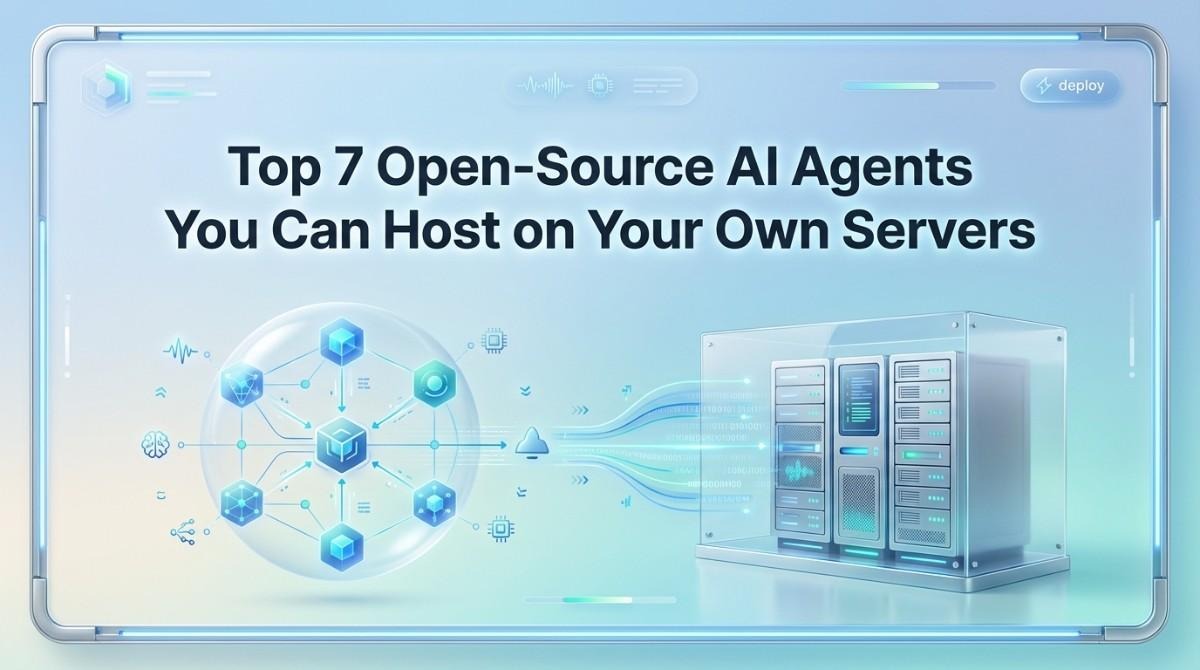
TL;DR Most companies rush into AI by signing up for cloud services and handing their data to third parties. That approach works until it does not. Compliance requirements tighten. Pricing spikes. Vendor lock-in becomes a strategic liability. The smarter path starts with open-source AI agents you can host on your own servers. You keep your data. You control the compute. You own the capability. This guide covers the top seven options available today, what each one does best, and exactly how to evaluate them for your infrastructure.
Table of Contents
Why Self-Hosting AI Agents Is the Right Move for Many Organizations
Every time an employee sends a query to a public AI service, that data travels to someone else’s infrastructure. For most consumer tasks, this is acceptable. For organizations handling customer PII, financial records, legal documents, or proprietary research, it is not. Open-source AI agents you can host on your own servers eliminate this external data exposure entirely. Your queries stay on your hardware. Your data never crosses an external boundary.
Cost control is the second major driver. Public AI API costs scale linearly with usage. At low volumes, the economics are fine. At production scale with thousands of daily agent interactions, API costs become a significant line item. Self-hosted open-source agents convert variable API spend into fixed infrastructure cost. The break-even point varies by usage volume but most mid-to-large organizations reach it faster than they expect.
Performance customization is the third driver. Self-hosted agents accept fine-tuning on your proprietary data. A customer support agent fine-tuned on your actual support history performs far better than a generic agent using your data only as context. A legal review agent fine-tuned on your contract library extracts clauses more accurately. Open-source AI agents you can host on your own servers become proprietary competitive assets when you invest in domain-specific fine-tuning.
Regulatory compliance closes the argument for regulated industries. HIPAA, GDPR, SOC 2, FedRAMP, and defense security frameworks all impose requirements on data handling that public cloud AI services struggle to satisfy fully. Self-hosting puts every compliance decision in your hands. You choose the encryption standard. You define the access controls. You determine the audit log retention policy. Compliance becomes something you manage rather than something you negotiate with a vendor.
What to Look for Before Choosing an Open-Source AI Agent
License Terms
Open-source does not always mean free for commercial use. License terms vary significantly across projects. Apache 2.0 licenses permit broad commercial use with minimal restrictions. MIT licenses are similarly permissive. GPL licenses require derivative works to carry the same license, which creates complications for proprietary commercial deployments. Some model licenses add non-commercial clauses or usage restrictions that limit enterprise deployment. Read every license carefully before committing to a stack.
Hardware Requirements
Self-hosting AI agents requires GPU compute. The hardware requirement scales with model size. A 7-billion parameter model runs on a single consumer GPU with 16GB VRAM. A 70-billion parameter model requires multiple high-end data center GPUs or a distributed inference setup. Assess your available hardware honestly against each framework’s requirements before selection. Running a model too large for your hardware produces unacceptable latency. Running a model too small for your task requirements produces unacceptable accuracy.
Community and Maintenance Activity
Open-source projects vary enormously in maintenance quality. A project with daily commits, active issue resolution, and a responsive maintainer community will keep pace with the fast-moving AI landscape. A project with infrequent updates and unanswered issues will fall behind quickly. Check GitHub commit frequency, issue response time, and release cadence before adopting any open-source AI agent framework. Community size matters. A larger contributor base means more bug fixes, more integrations, and more documentation.
Integration Ecosystem
An AI agent running in isolation adds limited value. Assess each framework’s integration ecosystem carefully. Does it support your preferred LLM backends? Does it connect to your existing databases, document stores, and APIs? Does it offer observability integrations for production monitoring? The best open-source AI agents you can host on your own servers fit naturally into your existing technology stack rather than requiring you to rebuild around them.
The Top 7 Open-Source AI Agents You Can Host on Your Own Servers
1. AutoGen by Microsoft Research
What AutoGen Does
AutoGen is one of the most capable open-source AI agents you can host on your own servers. Microsoft Research built it to model multi-agent interaction as conversation. Agents exchange messages. Each agent has a defined role and a set of capabilities. The AssistantAgent reasons and plans. The UserProxyAgent executes code, calls APIs, and interacts with external systems. This architecture handles complex, multi-step tasks that single-agent systems cannot.
AutoGen’s code execution loop is its signature capability. The AssistantAgent writes Python code to solve a problem. The UserProxyAgent executes that code in a sandboxed environment. The result feeds back into the conversation. The AssistantAgent reviews the output and decides what to do next. This loop handles data analysis, web research, file manipulation, and API integration tasks autonomously.
Self-Hosting AutoGen
AutoGen runs on any Python environment with standard ML dependencies. The framework connects to local LLM backends via OpenAI-compatible APIs. Run Ollama or vLLM on your GPU servers to serve local models. Point AutoGen at your local API endpoint instead of OpenAI’s servers. Your agent infrastructure operates entirely on your hardware with no external API calls.
AutoGen’s Docker support simplifies deployment. Container images encapsulate the full agent environment including code execution sandboxing. Deploy across multiple servers using Docker Compose or Kubernetes for scale. The framework’s active GitHub community means regular updates and strong documentation for self-hosted deployments.
2. CrewAI
What CrewAI Does
CrewAI organizes open-source AI agents you can host on your own servers into role-based teams called crews. Each agent in a crew has a specific role, a goal, and a set of tools. A crew for customer support might include a triage agent, a knowledge retrieval agent, and a response drafting agent. Each handles its specific job. The crew orchestrates their collaboration automatically.
CrewAI supports sequential and hierarchical execution processes. Sequential processes run agents in order. Hierarchical processes use a manager agent that delegates to workers and reviews their output before finalizing results. This hierarchical model suits complex tasks where a coordinator needs to assess intermediate results and redirect effort based on what workers produce.
Self-Hosting CrewAI
CrewAI installs via pip and runs on standard Python infrastructure. It integrates with LangChain’s tool ecosystem, which means access to hundreds of pre-built tools for web search, database queries, file operations, and API calls. Connect it to a locally served LLM using Ollama or LM Studio. The entire crew runs on your hardware with local tool execution and local model inference.
CrewAI’s low learning curve makes it one of the most accessible open-source AI agents you can host on your own servers for teams new to agentic AI. A working multi-agent crew deployable on your own infrastructure takes a developer with Python experience one to three days to build and deploy.
3. LangGraph
What LangGraph Does
LangGraph models agent workflows as directed graphs. Nodes represent processing steps. Edges define transitions between steps. Conditional edges let workflows branch based on agent output. Cycles let agents loop back to earlier steps for iterative refinement. This explicit graph architecture suits complex workflows where the agent needs to make branching decisions and maintain state across multiple reasoning steps.
State management is LangGraph’s defining feature. A typed state object flows through every node in the graph. Each node reads from and writes to this state. The graph always knows exactly what has happened, what the agent currently knows, and what steps remain. This explicit state tracking makes LangGraph uniquely reliable for long-running agentic tasks.
Self-Hosting LangGraph
LangGraph runs as a Python library with minimal external dependencies beyond LangChain. LangGraph Cloud offers a managed deployment option but self-hosting on your own servers is fully supported. Deploy the LangGraph server on your infrastructure. Connect it to locally served models via any OpenAI-compatible API endpoint. Use LangSmith self-hosted for observability that keeps trace data on your own servers.
LangGraph’s production-readiness makes it one of the strongest open-source AI agents you can host on your own servers for enterprise deployments. Built-in support for streaming, checkpointing, and human-in-the-loop interrupts reflects mature production engineering rather than research-grade prototyping.
4. OpenDevin (All-Hands AI)
What OpenDevin Does
OpenDevin, now developed under the All-Hands AI organization, is an open-source autonomous software development agent. It operates within a sandboxed environment that includes a code editor, a terminal, and a browser. The agent reads codebases, writes code, executes tests, debugs failures, and iterates until it completes the assigned development task. It handles software engineering tasks with a level of autonomy that exceeds most other open-source agents.
OpenDevin supports multiple backend LLMs. Claude, GPT-4o, and locally served open-source models all work as the reasoning engine. The agent’s effectiveness scales with the capability of its underlying model. For self-hosted deployments using open-source models, Llama 3.1 70B and CodeLlama variants deliver the best code generation results within a self-hosted constraint.
Self-Hosting OpenDevin
OpenDevin provides Docker-based deployment that encapsulates the full agent environment. The sandboxed execution environment runs inside Docker, isolating agent-generated code from your host infrastructure. This isolation is essential for safe autonomous code execution on your own servers. A configuration file points the agent at your local LLM API endpoint.
Development teams that want open-source AI agents you can host on your own servers for software engineering automation should evaluate OpenDevin carefully. The project has strong community momentum and represents the current state-of-the-art in open-source autonomous coding agents.
5. SuperAGI
What SuperAGI Does
SuperAGI is a developer-first open-source autonomous agent framework. It provides a graphical interface for building, deploying, and monitoring AI agents on your own infrastructure. The platform supports concurrent agent execution, agent memory management, and a marketplace of pre-built agent templates for common use cases. Scheduling capabilities let agents run automated tasks on defined intervals without manual triggers.
SuperAGI’s tool ecosystem covers web browsing, code execution, file management, email integration, calendar management, GitHub interaction, and database queries. Each tool connects to resources within your own infrastructure when self-hosted. The agent accesses your internal systems, not external cloud services.
Self-Hosting SuperAGI
SuperAGI deploys via Docker Compose on standard Linux server hardware. The deployment package includes the agent framework, a PostgreSQL database for agent memory, a Redis cache for performance, and a web interface for agent management. Point the framework at your locally served LLM. All agent activity stays within your server environment.
SuperAGI’s graphical interface makes it one of the most operationally accessible open-source AI agents you can host on your own servers for teams without deep AI engineering expertise. Non-developers can monitor agent activity, review outputs, and adjust agent configurations through the web interface without touching code.
6. Flowise
What Flowise Does
Flowise is a low-code open-source tool for building LLM-powered applications and agents through a drag-and-drop interface. It builds on LangChain’s component library and exposes those components as visual nodes that connect together to form agent workflows. Developers and technical non-developers both build functional AI agent workflows in Flowise faster than in any code-first framework.
Flowise supports RAG pipelines, multi-agent workflows, custom tool integration, and API deployment of agent flows. A Flowise agent workflow exports as a REST API endpoint. Other applications call that endpoint to trigger agent execution. This API-first design makes Flowise-built agents easy to integrate into existing applications and internal tools.
Self-Hosting Flowise
Flowise deploys via npm or Docker on standard server hardware. The self-hosted deployment stores all workflow configurations on your server. Connect Flowise to locally served LLMs through LangChain’s local LLM integrations. Ollama, LM Studio, and vLLM all work as Flowise LLM backends. Agent memory stores in your local database. No data leaves your infrastructure.
Teams evaluating open-source AI agents you can host on your own servers for internal tool development should prioritize Flowise. Its visual development interface dramatically accelerates the time from idea to deployed agent for teams that do not have dedicated AI engineering resources.
7. LocalAI with Agent Capabilities
What LocalAI Does
LocalAI is a free, open-source alternative to the OpenAI API that runs entirely on local hardware. It serves local models through an OpenAI-compatible REST API. Any application that works with OpenAI’s API works with LocalAI by changing the API endpoint URL. This compatibility makes LocalAI a foundational infrastructure layer for self-hosted AI deployments rather than an agent framework itself.
LocalAI supports text generation, image generation, audio transcription, and embeddings. Its agent capabilities come from combining the LocalAI model server with agent frameworks like LangChain, LangGraph, CrewAI, or AutoGen that connect to its OpenAI-compatible API. The result is a fully self-hosted stack where the model server and the agent orchestration layer both run on your hardware.
Self-Hosting LocalAI
LocalAI installs via Docker or direct binary installation on Linux, macOS, and Windows. It supports CPU-only inference for small models and GPU-accelerated inference for larger models via CUDA and Metal backends. Model files download from Hugging Face and store locally. The configuration file specifies which models to serve and their runtime parameters.
LocalAI serves as the infrastructure backbone for many self-hosted AI agent stacks. Organizations building open-source AI agents you can host on your own servers often deploy LocalAI as the model serving layer and choose a separate orchestration framework based on their workflow requirements. The OpenAI API compatibility means switching between model backends requires no application code changes.
Comparing All Seven for Self-Hosted Deployment
Ease of Deployment
Flowise and SuperAGI offer the easiest self-hosted deployment experiences. Both provide Docker Compose configurations that stand up a working environment with a single command. CrewAI and AutoGen require more manual configuration but offer more flexibility for custom deployments. LangGraph demands the most engineering investment to deploy properly but delivers the most production-ready architecture. OpenDevin’s Docker-based sandbox handles code execution safely but requires careful security review before deploying on production infrastructure. LocalAI runs anywhere but functions as infrastructure rather than a complete agent solution.
LLM Backend Flexibility
All seven frameworks support locally served models through OpenAI-compatible APIs. LocalAI and Ollama serve as the most common local model backends. Flowise, CrewAI, LangGraph, and AutoGen all integrate with these backends natively. OpenDevin has the strongest optimization for code-focused models. SuperAGI’s graphical interface makes model switching accessible without code changes. This flexibility is a core advantage of open-source AI agents you can host on your own servers compared to vendor-locked cloud alternatives.
Production Readiness
LangGraph leads on production readiness. Its explicit state management, streaming support, checkpointing, and observability integrations reflect mature engineering. AutoGen has strong Microsoft Research backing with consistent production improvements. CrewAI has grown rapidly and handles production workloads at significant scale. SuperAGI and Flowise suit internal tool use and moderate-scale production deployments. OpenDevin is advancing fast but remains most suited to development team use cases rather than customer-facing production deployments.
Frequently Asked Questions
What hardware do I need to self-host AI agents?
Hardware requirements depend on the model size you plan to serve. A 7B parameter model requires a GPU with at least 8 to 16 GB VRAM for comfortable inference. A 13B model needs 24 GB VRAM. A 70B model requires 80 GB VRAM minimum, which typically means multiple A100 or H100 GPUs. CPU-only inference works for small models but runs too slowly for production use. NVIDIA GPUs with CUDA support deliver the best performance across all major inference frameworks. AMD GPUs with ROCm support are an increasingly viable alternative for cost-sensitive deployments.
Are open-source AI agents you can host on your own servers as capable as GPT-4?
Modern open-source models close the capability gap with GPT-4 every quarter. Llama 3.1 70B and Mixtral 8x22B match or exceed GPT-3.5 Turbo on most benchmarks. They fall short of GPT-4o on complex multi-step reasoning and very long context tasks. For most business automation, document processing, and internal tool use cases, open-source models deliver results that satisfy operational requirements. Fine-tuning on domain-specific data narrows the remaining gap significantly for specialized applications.
How do I keep self-hosted AI agents secure?
Security for self-hosted AI agent infrastructure follows standard server security principles with AI-specific additions. Network isolation prevents the agent infrastructure from reaching external systems it should not access. Role-based access controls limit which users and applications can trigger agent execution. Input validation and sandboxed code execution prevent prompt injection attacks from executing malicious code on your servers. Audit logging captures every agent interaction for security review. Encrypt data at rest and in transit. Treat your AI infrastructure with the same security posture you apply to production databases.
Can I fine-tune models for my self-hosted agents?
Yes. Fine-tuning open-source models on your proprietary data is one of the most powerful capabilities that self-hosting enables. Frameworks like Hugging Face PEFT, Axolotl, and Unsloth support efficient fine-tuning techniques like LoRA and QLoRA that work on standard data center hardware. A fine-tuning run on a 7B model for a domain-specific task completes in hours on a single A100 GPU. The resulting fine-tuned model serves through LocalAI, Ollama, or vLLM just like any other local model.
What is the best open-source agent for a small team with limited infrastructure?
Flowise is the best starting point for small teams with limited infrastructure. Its visual interface reduces the engineering overhead of building and deploying agents. It runs on modest hardware for small model deployments. Ollama serves local models efficiently on a single GPU server. The combination of Flowise for agent orchestration and Ollama for model serving delivers a complete self-hosted AI agent stack that a small technical team manages without dedicated AI engineering resources.
How do open-source agents handle memory and context across sessions?
Memory handling varies across frameworks. LangGraph provides the most sophisticated memory architecture with explicit short-term and long-term memory management through its state system. CrewAI and AutoGen support conversation memory that persists within a session and optional long-term memory via vector database integrations. SuperAGI includes built-in memory management with a PostgreSQL backend. Flowise supports memory nodes that connect to local vector databases like ChromaDB or Weaviate. For all frameworks, the vector database stores in your own infrastructure when self-hosted, keeping conversation history and retrieved knowledge on your servers.
Read More:-Automating Legal Document Review with High-Accuracy AI Agents
Conclusion

The shift toward open-source AI agents you can host on your own servers reflects a broader maturation in the AI tooling landscape. The frameworks are production-ready. The models are capable. The infrastructure tooling to serve them is accessible. The barrier to self-hosted AI agents has never been lower.
AutoGen delivers flexible conversational multi-agent workflows. CrewAI provides fast role-based team automation. LangGraph offers explicit graph-based control for complex stateful workflows. OpenDevin handles autonomous software development. SuperAGI gives teams a graphical interface for agent management. Flowise accelerates development through visual workflow building. LocalAI provides the foundational model serving layer that ties any self-hosted stack together.
The right choice among these open-source AI agents you can host on your own servers depends on your use case, your team’s engineering capacity, and your infrastructure constraints. Start with the framework that matches your immediate need. Flowise for fast internal tool development. LangGraph for production-grade stateful workflows. AutoGen for dynamic multi-agent systems. Grow from there as your requirements expand.
Organizations that invest in self-hosted AI agent infrastructure today build a compound advantage. Every fine-tuning run improves their models. Every workflow built in their own infrastructure stays under their control. Every dollar spent on owned compute rather than per-token API fees goes further as usage scales. Open-source AI agents you can host on your own servers are not the harder path. At any meaningful scale, they are the smarter one.
Start with one use case. Deploy one agent. Measure the results. The infrastructure you build serves every agent you add after it. The investment compounds. The capability grows. The data stays yours.