Introduction
TL;DR Every business leader wants AI. The pressure is real. Competitors are shipping AI features. Boards are asking about AI strategy. The urgency pushes teams toward the fastest available option.
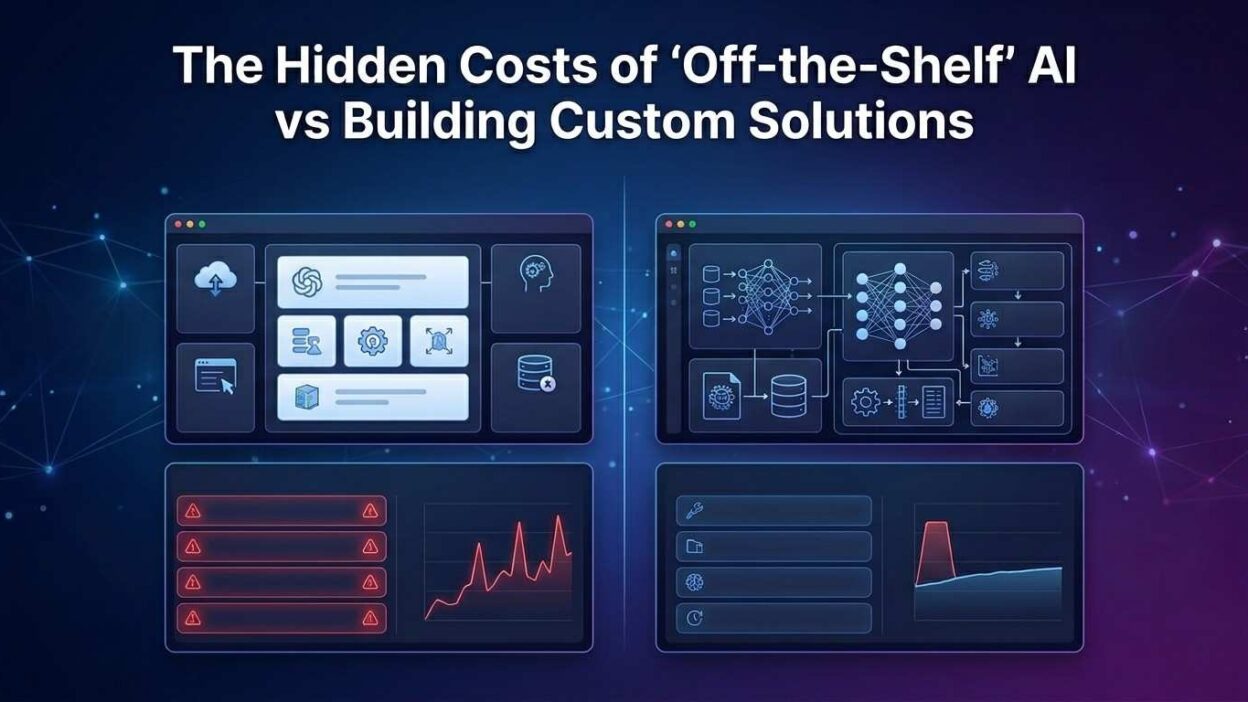
That fastest option is almost always a pre-built, vendor-packaged AI product. Click a button. Sign a contract. Start using it today. The appeal is obvious. The hidden costs, though, are not obvious at all.The debate around off-the-shelf AI vs custom AI solutions is not simply a technology discussion. It is a financial decision, a strategic decision, and a risk decision all wrapped into one. Companies that skip this analysis early end up paying for it later — in vendor lock-in, in integration costs, in performance gaps, and in missed competitive differentiation.
This blog breaks down the full picture. You will understand what both paths actually cost, where the hidden expenses live, which industries benefit from each approach, and how to make the right choice for your specific situation. By the end, you will have a clear framework for the off-the-shelf AI vs custom AI solutions decision that fits your business reality.
Table of Contents
Defining the Two Paths
What Is Off-the-Shelf AI?
Off-the-shelf AI refers to pre-built AI products and platforms sold by vendors on a subscription or usage-based model. These tools arrive ready to use. You configure them. You integrate them with existing systems. You start extracting value quickly.
Examples are everywhere. Salesforce Einstein adds AI to CRM workflows. HubSpot’s AI tools automate marketing tasks. ChatGPT Enterprise gives teams an AI assistant. Zendesk AI handles customer support queries. Grammarly Business improves writing across an organization. These are all off-the-shelf AI products built for broad market applicability.
The defining characteristic is that the vendor built the core AI capability for general use. You buy access to that capability. You customize it within the boundaries the vendor allows. You do not control the underlying model, the training data, or the roadmap.
What Is Custom AI?
Custom AI refers to AI systems built specifically for your organization’s unique requirements. A team of data scientists, ML engineers, and software developers designs and trains the system from scratch or fine-tunes existing open-source models on your proprietary data.
Custom AI looks completely different from off-the-shelf AI in practice. It might be a recommendation engine trained on your specific customer behavior data. It might be a document processing system trained on your industry’s specific document formats. It might be a demand forecasting model trained on fifteen years of your company’s sales history. The AI performs a specific function with deep domain knowledge that a general-purpose vendor product cannot replicate.
The defining characteristic is specificity. Custom AI exists to solve your problem. It does not serve a thousand other customers with different needs. That specificity is its greatest strength and the source of its upfront cost.
The True Cost of Off-the-Shelf AI
The Subscription Pricing Trap
Off-the-shelf AI products price themselves accessibly at first. A small monthly fee per user. A modest usage-based charge. A trial period that feels nearly free. That initial price anchors your perception of the total cost.
The reality of off-the-shelf AI vs custom AI solutions comparison begins when you see what subscription costs look like at scale. Ten users costs $500 per month. Five hundred users costs $25,000 per month. Five thousand users costs $250,000 per month. The cost scales linearly with your team and usage. There is no efficiency curve. You pay more as you grow without gaining leverage.
Many organizations sign multi-year contracts to get discounted rates. Those discounts lock in dependency. A competitor launches a better product during your contract period. You cannot switch. You wait. Your competitive position erodes while you honor a contract that made economic sense only at signing.
Integration Costs Nobody Budgets For
Off-the-shelf AI rarely plugs directly into your existing technology stack. Your CRM speaks one API language. Your ERP speaks another. Your data warehouse uses a schema the vendor never anticipated. Making these systems talk to each other requires custom integration work.
That integration work is expensive. Senior developers charge premium rates. Integration projects routinely take two to four times longer than initial estimates. A vendor that promises easy integration via “pre-built connectors” often delivers connectors that work for the simple case but require significant customization for the real-world case.
Integration costs in the off-the-shelf AI vs custom AI solutions comparison are consistently underestimated. Budget at least 30–50% of the software license cost for integration work. In complex enterprise environments with legacy systems, that figure is often much higher.
Customization Limits That Compound Over Time
Every off-the-shelf AI product has customization limits. The vendor designed the product for the average customer. Your business is not average. Your workflows differ from the standard template. Your industry has specific requirements the vendor did not anticipate.
You work around those limits. You adjust your workflows to fit the product rather than making the product fit your workflows. That adjustment has a cost. Employee productivity drops when people use tools that do not match how they actually work. Workarounds accumulate. What started as minor friction becomes significant operational drag over twelve months.
The off-the-shelf AI vs custom AI solutions question sharpens here. A custom solution builds to your workflow. Off-the-shelf forces your workflow toward it. That directional difference compounds over years into a substantial gap in operational efficiency.
Data Ownership and Privacy Risks
When you use an off-the-shelf AI product, your data flows through the vendor’s infrastructure. The vendor’s terms of service define what they can do with that data. Those terms are written by the vendor’s lawyers to protect the vendor’s interests.
Some vendors use customer data to improve their models. Some sell anonymized usage data to third parties. Some retain data indefinitely. For businesses in regulated industries like healthcare, finance, and legal services, those data practices create compliance exposure that carries real financial penalties.
The off-the-shelf AI vs custom AI solutions risk analysis must include data governance. A custom solution keeps your data on your infrastructure. You define the retention policies. You control access. You know exactly where your most sensitive business information lives at all times.
Vendor Lock-In Accumulates Quietly
Vendor lock-in in off-the-shelf AI is subtle at first. You train your team on the vendor’s interface. You build internal processes around the vendor’s workflow. You integrate other tools with the vendor’s API. You create documentation, training materials, and standard operating procedures that reference the vendor’s specific features.
Eighteen months later, switching vendors requires retraining your entire team, rebuilding your integrations, migrating your data, and revising your internal documentation. The switching cost is enormous. The vendor knows this. Renewal pricing reflects their leverage.
The off-the-shelf AI vs custom AI solutions calculus shifts dramatically when you factor in long-term vendor leverage. Off-the-shelf vendors gain pricing power as lock-in deepens. Custom solutions give you permanent control over your AI infrastructure and roadmap.
The True Cost of Custom AI
Upfront Development Investment
Custom AI requires significant upfront investment. Building a production-grade AI system involves data scientists who understand your domain, ML engineers who can train and deploy models, software engineers who integrate the AI into your product, and project managers who coordinate the effort.
That team costs money. A six-month custom AI project with a team of five specialists costs between $500,000 and $1,500,000 depending on seniority, location, and complexity. That number surprises many business leaders who expected to spend far less.
The off-the-shelf AI vs custom AI solutions comparison must be done on a multi-year timeframe. The custom AI’s high upfront cost spreads across years of use. The off-the-shelf product’s lower upfront cost accumulates into a much larger total cost of ownership over the same period.
Data Preparation and Infrastructure Requirements
Custom AI needs good data. Gathering that data, cleaning it, labeling it, and structuring it for training is often the most time-consuming part of a custom AI project. Organizations consistently underestimate this effort.
Infrastructure requirements add another cost dimension. Training large models requires GPU compute. Serving trained models at production scale requires reliable, low-latency inference infrastructure. Monitoring models in production requires observability tooling. These infrastructure costs are ongoing, not one-time.
Cloud infrastructure for custom AI typically runs $5,000 to $50,000 per month depending on model size and request volume. Budget carefully. Unplanned cloud bills from AI workloads create budget surprises that damage internal credibility for the project.
Talent Acquisition and Retention Challenges
Building custom AI requires rare talent. Machine learning engineers are among the most sought-after professionals in the technology industry. Competition for this talent is intense. Compensation is high. Retention is difficult.
A custom AI team that delivers a successful system becomes extremely valuable inside the organization. External competitors will recruit aggressively. Internal promotion paths need to exist. Compensation benchmarks need regular updates to reflect market rates.
Talent risk is real in the off-the-shelf AI vs custom AI solutions comparison. Off-the-shelf AI requires less specialized talent to operate. Custom AI requires ongoing specialized talent to maintain, improve, and expand. Factor talent strategy into your build decision before committing.
Time to Value Is Longer
Off-the-shelf AI delivers value within weeks of purchase. Custom AI delivers value after months of development. That gap matters for organizations under competitive pressure to show AI results quickly.
Executive patience for custom AI projects is finite. Long development timelines create organizational risk. Stakeholders lose confidence. Priorities shift. Projects get canceled before reaching production. The off-the-shelf AI vs custom AI solutions choice must account for your organization’s timeline tolerance and competitive urgency.
Where Off-the-Shelf AI Wins
General Productivity Use Cases
General productivity tools benefit from off-the-shelf AI. AI writing assistants, meeting transcription tools, email automation, and calendar scheduling tools are general enough that off-the-shelf solutions work well for most organizations.
These use cases do not require deep domain knowledge. The AI does not need to understand your specific industry. It helps employees work faster on universal tasks. The value is real. The customization requirements are minimal. Off-the-shelf AI wins in this category cleanly.
Speed-to-Market Pressure
When competitive pressure demands AI features immediately, off-the-shelf AI delivers. A startup needs an AI chatbot for customer service this quarter. A retailer needs AI product recommendations before the holiday season. A software company needs AI search before a major conference demo.
Speed requirements favor off-the-shelf AI. Accept the limitations. Ship the capability. Gather real user feedback. Decide later whether to build a custom replacement once you understand the actual requirements at scale.
Budget-Constrained Environments
Early-stage companies and budget-constrained divisions cannot afford a custom AI build. The off-the-shelf AI vs custom AI solutions question has a clear answer at low budgets. Use the off-the-shelf tool. Build custom when you have the revenue, data, and organizational maturity to justify the investment.
Where Custom AI Wins Proprietary Data Creates Unique Competitive Advantage
Some organizations hold data assets that are irreplaceable competitive advantages. A bank with forty years of transaction history can train fraud detection models that no vendor product matches. A manufacturer with sensor data from ten thousand machines can build predictive maintenance models beyond any off-the-shelf capability. A healthcare provider with fifteen years of clinical outcomes data can build diagnostic support tools at a level of specificity no general AI platform achieves.
Custom AI unlocks the value of proprietary data. Off-the-shelf AI ignores it. That gap in the off-the-shelf AI vs custom AI solutions comparison is the single strongest argument for building when you hold unique data.
Regulated Industries with Strict Compliance Requirements
Healthcare, financial services, defense, and legal industries face compliance requirements that off-the-shelf AI vendors often cannot satisfy. HIPAA requires specific data handling practices. GDPR imposes strict data residency rules. Financial regulators require model explainability and audit trails. Defense applications require air-gapped deployment on classified networks.
Off-the-shelf AI vendors build for the broadest market. They cannot customize their infrastructure to satisfy every regulated industry’s specific requirements. Custom AI built and deployed on your infrastructure gives you complete control over compliance architecture.
Core Differentiating Functionality
When AI is not a supporting tool but the core product, custom AI is the only viable choice. A fraud detection startup cannot rely on a vendor’s generic fraud model. An AI-powered legal research platform cannot use a general-purpose language model tuned for customer service. A predictive analytics company cannot build its value proposition on another company’s AI platform.
Core product AI must be proprietary. The off-the-shelf AI vs custom AI solutions comparison ends quickly when the AI is your product. Build it. Own it. Protect it.
High Volume Use Cases with Strong Unit Economics
At sufficient scale, custom AI’s economics become dramatically superior to off-the-shelf alternatives. A company processing ten million AI requests per day pays enormous per-request fees to an off-the-shelf provider. The same workload on custom infrastructure costs a fraction of that amount after amortizing development and compute costs.
Calculate your break-even point. Project your volume growth over three years. Map the cost curves for both options. In many high-volume scenarios, custom AI pays for its development cost within twelve to eighteen months. The off-the-shelf AI vs custom AI solutions math favors custom decisively at scale.
The Hybrid Approach: Best of Both Worlds
Starting with Off-the-Shelf and Migrating Strategically
Many organizations get the most value by starting with off-the-shelf AI and migrating strategically to custom solutions as they mature. Use an off-the-shelf tool to validate the use case. Prove that AI solves the problem before committing to a custom build. Gather data on real usage patterns. Understand the actual requirements at production scale.
After validation, build the custom replacement. You now know exactly what the system must do. You have real performance benchmarks from the off-the-shelf tool to beat. You have user feedback to incorporate. The custom build is faster and more targeted because the off-the-shelf pilot informed it.
Using Foundation Models as Custom AI Building Blocks
The off-the-shelf AI vs custom AI solutions binary is less sharp than it used to be. Open-source foundation models like Llama 3, Mistral, and Qwen give organizations powerful starting points for custom AI without building from scratch.
Fine-tuning a Llama model on your proprietary data costs far less than building a large language model from scratch. Retrieval-augmented generation lets you customize AI behavior using your knowledge base without any model training. These approaches deliver custom-feeling AI at a fraction of traditional custom build costs.
Vendor Products for Commodity Tasks, Custom for Core Differentiators
Smart organizations run both simultaneously. Off-the-shelf AI handles commodity tasks where differentiation does not matter. Custom AI powers the functions where differentiation defines competitive advantage.
Use Grammarly for company-wide writing assistance. Use Zoom AI for meeting notes. Use your custom-trained model for the customer-facing recommendation engine that directly affects revenue. This division of labor optimizes both cost and strategic impact across your entire AI portfolio.
Building a Decision Framework
Four Questions to Guide Your Choice
The off-the-shelf AI vs custom AI solutions decision simplifies to four core questions.
First, does the use case require proprietary data or domain knowledge? If yes, lean strongly toward custom. General vendor products cannot incorporate your specific institutional knowledge.
Second, is this AI function core to your competitive differentiation? If yes, build custom. Your differentiators should never depend on a vendor who serves your competitors with the same product.
Third, what is your actual budget and timeline for AI delivery? If both are tight, start with off-the-shelf. Deliver value now. Build custom when resources allow.
Fourth, what volume of AI requests do you expect within three years? Project your unit economics at that volume for both options. Let the math guide the final decision. High-volume scenarios almost always favor custom in the off-the-shelf AI vs custom AI solutions comparison.
Total Cost of Ownership Calculation
Do not compare upfront costs. Compare five-year total cost of ownership. Include software licensing, integration development, customization costs, support fees, price increases at renewal, and switching costs for off-the-shelf AI. Include development, infrastructure, talent, maintenance, and improvement costs for custom AI.
The five-year TCO comparison almost always tells a different story than the first-year cost comparison. Off-the-shelf AI that seems affordable in year one often costs more than custom AI by year three or four. That full-picture view is essential for good decision-making in the off-the-shelf AI vs custom AI solutions evaluation.
Common Mistakes in the Off-the-Shelf AI vs Custom AI Decision
Choosing Speed Over Strategic Fit
Urgency drives bad decisions. A team under pressure to show AI results selects the fastest available option. The off-the-shelf tool ships quickly. Eighteen months later, they hit the customization ceiling. They start a custom build from scratch. They paid twice for the same capability.
Slow down the decision enough to assess strategic fit. Two additional weeks of analysis at the start prevents two years of regret in a mismatched implementation.
Underestimating Integration Complexity
Every off-the-shelf AI vendor demonstrates their product in an ideal environment against a simple use case. Real enterprise environments are messy. Legacy systems have undocumented APIs. Data schemas do not match vendor assumptions. Internal security policies block vendor integration methods.
Get a realistic integration assessment from your engineering team before signing any vendor contract. The off-the-shelf AI vs custom AI solutions true cost comparison depends heavily on accurate integration cost estimation.
Ignoring the Data Strategy
Off-the-shelf AI choices today determine what data assets you build for tomorrow. A vendor that owns your data insights limits your future custom AI options. Organizations that start with off-the-shelf AI without a clear data strategy often find themselves locked out of the proprietary data advantages that would justify a future custom build.
Design your data strategy before selecting AI tools. Ensure that any off-the-shelf tool you deploy generates and stores data you own and can use to train custom models later.
Frequently Asked Questions
Is off-the-shelf AI always cheaper than custom AI?
No. Off-the-shelf AI costs less upfront. Custom AI costs more upfront. Over a three-to-five year horizon, the off-the-shelf AI vs custom AI solutions cost comparison often reverses. Subscription fees, integration costs, and vendor price increases make off-the-shelf more expensive at scale and over time.
How long does it take to build custom AI?
Simple custom AI systems take three to six months. Complex systems with large training datasets and sophisticated architectures take nine to eighteen months. The timeline depends on data readiness, team size, and system complexity. Off-the-shelf alternatives deliver value in weeks.
Can small businesses benefit from custom AI?
Small businesses with very specific domain expertise and proprietary data can benefit from targeted custom AI. General productivity tasks favor off-the-shelf AI for small businesses. The off-the-shelf AI vs custom AI solutions choice for small businesses usually favors off-the-shelf unless the AI directly drives the core product or service.
What industries should prioritize custom AI?
Healthcare, financial services, legal, manufacturing, and logistics industries hold proprietary data assets and face compliance requirements that favor custom AI for core functions. Any industry where the AI function is central to competitive differentiation should invest in custom AI.
How do I avoid vendor lock-in with off-the-shelf AI?
Negotiate data portability into your contract before signing. Ensure you can export your data in standard formats. Build abstraction layers in your integration code so switching vendors requires minimal application changes. Document vendor-specific workflows to ease migration if needed.
Can I combine off-the-shelf and custom AI in the same organization?
Yes. Many sophisticated organizations run both in parallel. Off-the-shelf AI handles commodity and productivity use cases. Custom AI powers differentiated, proprietary functions. The off-the-shelf AI vs custom AI solutions choice is not binary across an entire organization. Apply each approach where it fits best.
What is the biggest mistake companies make in this decision?
The biggest mistake is making the off-the-shelf AI vs custom AI solutions decision based only on first-year costs. Short-term cost focus ignores integration expenses, vendor price increases, customization limitations, data ownership risks, and long-term lock-in costs. Always evaluate on a multi-year total cost of ownership basis.
Read More:-Claude 3.5 Sonnet vs GPT-4o for Coding: Which LLM Writes Better Backends?
Conclusion
The off-the-shelf AI vs custom AI solutions debate has no single right answer. Both paths deliver real value. Both carry real costs. The hidden costs are what separate informed decisions from regretted ones.
Off-the-shelf AI gets you moving fast. Its subscription model feels affordable until scale and lock-in reveal the true price. Integration complexity, customization limits, data governance risks, and vendor leverage accumulate quietly over months and years into costs that dwarf the original purchase price.
Custom AI costs more upfront. It demands time, talent, and organizational patience. It delivers a differentiated capability that competitors cannot simply license from the same vendor. It puts you in control of your data, your roadmap, and your infrastructure.
The smartest path for most organizations is strategic sequencing. Use off-the-shelf AI to validate use cases fast and capture near-term productivity gains. Build custom AI for the functions where your proprietary data, industry expertise, and competitive differentiation demand something that no vendor product can deliver.
The off-the-shelf AI vs custom AI solutions decision deserves the same rigor as any major strategic investment. Run the full total cost of ownership analysis. Assess your data assets honestly. Define which AI functions differentiate you competitively. Make the decision that serves your three-to-five year business position, not just your next quarter’s budget.