Introduction
TL;DR Your customers expect speed, accuracy, and empathy. A generic bot can give them none of that. Off-the-shelf AI chatbots hurting customer experience is not a fringe problem. It is a widespread business crisis that costs brands revenue, trust, and loyalty every single day.
Table of Contents
The Rise of AI Chatbots in Customer Service
Businesses adopted AI chatbots at a record pace over the last five years. The appeal was obvious. They promised 24/7 availability, reduced support costs, and instant responses. Every company, large and small, rushed to deploy one.
The market flooded with ready-made solutions. Vendors made bold claims. Brands believed the hype. Many plugged in a generic chatbot and called it digital transformation.
That decision came with a hidden cost. Customers started noticing something was wrong. Responses felt robotic. Answers missed the point. Conversations looped without resolution. Frustration levels rose sharply.
The data tells a hard story. Studies reveal that over 60% of customers prefer human agents after a poor chatbot experience. Many simply abandon the brand entirely. Customer satisfaction scores dropped at companies relying on one-size-fits-all solutions.
The problem is not AI itself. AI, when built right, genuinely helps customers and businesses alike. The problem is the shortcut. Buying a prebuilt solution and calling it “done” is where things go wrong.
Off-the-shelf AI chatbots hurting customer experience is the direct result of treating a complex, brand-specific challenge as a commodity purchase. Customer service is deeply human. A generic product cannot replicate that depth.
This blog breaks down exactly why these bots fail, what the real damage looks like, and what smart businesses are doing instead. Read every section carefully. Your customer experience strategy depends on it.
What “Off-the-Shelf” Really Means
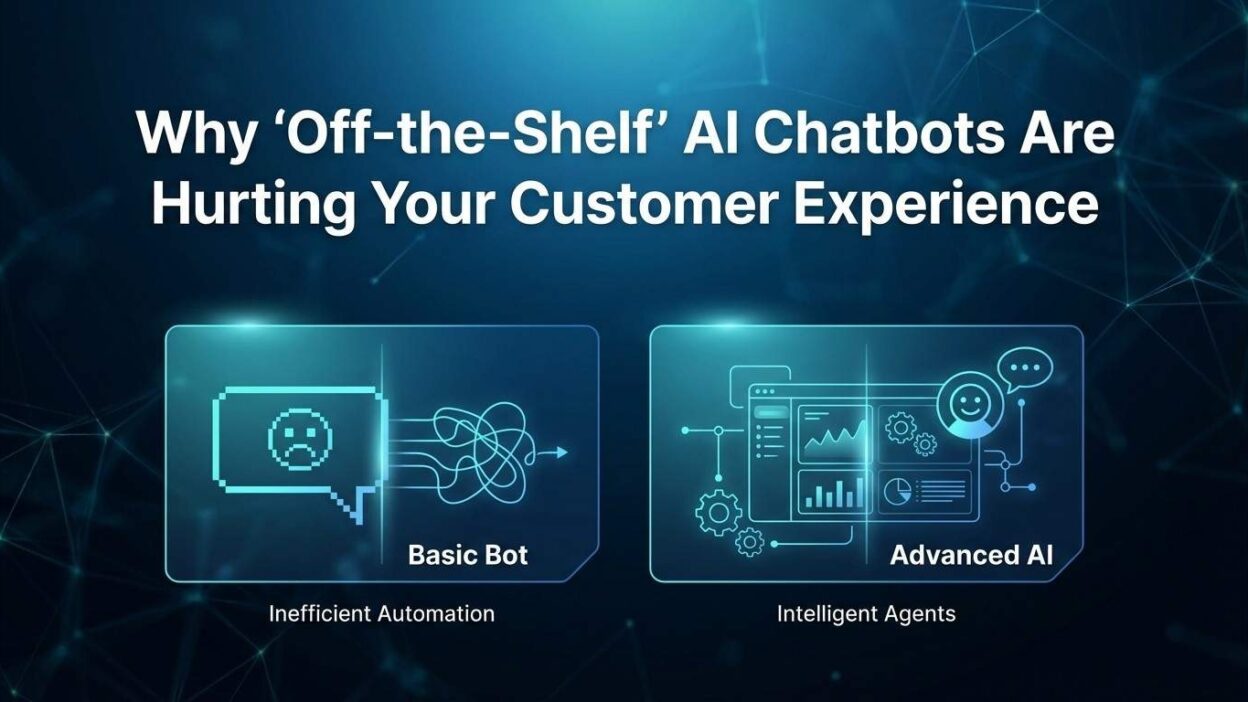
An off-the-shelf AI chatbot is a pre-packaged software product. Vendors build it for generic use. They design it to work across industries, use cases, and audiences without specific customization.
You buy it, plug it into your website, and it starts answering questions. It sounds efficient. It looks modern. It gives the impression of innovation.
But here is the core issue. That chatbot knows nothing about your brand. It does not understand your tone. It has no knowledge of your products beyond what you manually feed it. It cannot sense when a customer is frustrated. It does not know your business rules.
It is built to be “good enough” for everyone. That means it is actually perfect for no one.
These tools pull from generic training data. Their language models are not fine-tuned for your industry. Their conversation flows are templated. Their escalation logic is rigid. Their personality is blank.
Customers interact with your chatbot expecting your brand experience. They get a faceless, templated script instead. That disconnect creates friction. Friction creates dissatisfaction. Dissatisfaction creates churn.
This is precisely why off-the-shelf AI chatbots hurting customer experience has become such a critical topic in 2024 and beyond. What once seemed like a smart shortcut is now a clear competitive disadvantage.
How Off-the-Shelf AI Chatbots Fail Your Customers
They Cannot Understand Context
Real customer conversations are layered. A customer might start a chat complaining about a delayed order. Midway through, they shift to asking about a return policy. Then they mention a billing issue.
A generic chatbot loses track. It treats each message as a new interaction. It misses context. It gives answers that do not match the actual situation. Customers have to repeat themselves constantly.
Repetition is one of the biggest drivers of frustration in customer service. When a chatbot forces customers to re-explain their problem three times, trust collapses fast.
They Give Irrelevant or Wrong Answers
Off-the-shelf bots pull from general knowledge bases. They are not trained on your specific products, policies, or processes. A customer asking about your specific refund window might get a generic answer about “standard industry practices.”
That answer is useless. Worse, it can be completely wrong for your context. A customer acting on incorrect information becomes an angry customer. An angry customer tells others.
The damage from one wrong answer compounds quickly. Off-the-shelf AI chatbots hurting customer experience through misinformation is a documented and growing problem across retail, finance, and healthcare sectors.
They Lack Brand Voice and Personality
Your brand has a voice. It took years to build. Every piece of copy, every email, every ad reflects a personality that your customers recognize and trust.
A generic chatbot ignores all of that. It speaks in a neutral, lifeless tone. It sounds nothing like your brand. Customers notice the dissonance immediately, even if they cannot articulate it.
Brand consistency builds emotional connection. A chatbot that breaks that consistency weakens the relationship. Customers feel they are talking to a stranger, not the brand they chose.
They Cannot Handle Emotional Nuance
Customer service is emotional work. A customer who just lost a package is upset. A customer facing a billing error is anxious. A customer who received a damaged product is angry.
These emotions require sensitivity. Generic bots cannot read emotional tone. They respond the same way to a calm inquiry and a furious complaint. That sameness feels dismissive to someone who is already upset.
Empathy is not a luxury in customer service. It is a requirement. No off-the-shelf product can deliver genuine empathy at scale without deep customization and training.
They Escalate Poorly and Slowly
Every chatbot needs to know when to hand off a conversation to a human agent. That moment matters enormously. Getting it wrong — escalating too late or not at all — destroys the experience.
Generic bots follow rigid escalation rules. They wait for specific trigger words or a set number of failed attempts. By then, the customer is already furious. The human agent inherits a situation that has fully broken down.
Smart escalation requires judgment. Judgment requires context-aware AI trained on real customer data. Off-the-shelf products do not have that foundation.
“A bot that cannot tell the difference between a curious customer and a frustrated one is not a support tool. It is a liability.”
The Real Business Cost of Getting This Wrong
The financial damage of poor chatbot experiences goes far beyond one lost conversation. It compounds across every touchpoint, every channel, and every quarter.
Customer Churn Accelerates
Customers do not wait around for a brand to fix its chatbot. They leave. Research consistently shows that one bad digital experience is enough to push a customer to a competitor. When off-the-shelf AI chatbots keep hurting customer experience, churn becomes a silent revenue drain.
Acquiring a new customer costs five to seven times more than retaining an existing one. Every customer lost to a poor bot interaction is a compounding financial loss.
Support Costs Actually Rise
A common selling point for generic chatbots is cost reduction. The reality often flips. When bots fail to resolve issues, customers call or email instead. Ticket volumes go up. Human agents spend more time fixing bot-created confusion. The overall support cost increases.
The supposed efficiency gain disappears. What remains is the cost of a tool that created more problems than it solved.
Brand Reputation Takes Hits
Unhappy customers talk. They post reviews. They share screenshots. They warn friends. Social media amplifies every bad experience at scale.
A string of negative reviews mentioning your chatbot signals to potential customers that your brand does not care. Reputation damage is slow to appear and even slower to repair. Off-the-shelf AI chatbots hurting customer experience can silently erode years of brand equity.
Employee Morale Drops
Human support agents bear the brunt of bot failures. They receive escalated chats from customers who are already exhausted and angry. They spend their time apologizing for the bot’s errors instead of doing meaningful work.
Morale suffers. Turnover increases. The cost of recruiting, hiring, and training new agents adds yet another financial burden.
Industries Feeling the Pain Most
E-Commerce and Retail
Retail customers need precise, real-time answers. Order status, return windows, product specs, and delivery timelines must be accurate and instant. Generic bots lack access to live inventory and order systems. They give vague answers that frustrate shoppers at the exact moment they are ready to buy or resolve an issue.
Cart abandonment and return disputes often trace directly back to chatbot failures. Off-the-shelf AI chatbots hurting customer experience in retail is costing brands millions in lost conversions each year.
Banking and Financial Services
Financial questions are sensitive. Customers asking about loan terms, fraud alerts, or account access need precise answers. A wrong answer in finance is not just frustrating — it can be legally and financially damaging.
Generic bots are not equipped to handle regulatory nuance, regional compliance differences, or emotionally charged financial conversations. The stakes here are simply too high for a template solution.
Healthcare
Healthcare interactions demand accuracy, empathy, and confidentiality. A patient asking about medication side effects or appointment rescheduling deserves careful, accurate responses. Off-the-shelf bots in healthcare often fail at all three requirements. The consequences range from mild frustration to genuine patient safety risks.
Travel and Hospitality
Travel customers face high-stress situations. Missed flights, booking errors, and last-minute changes require rapid, accurate resolutions. A bot that loops through generic FAQ answers during a travel emergency is worse than having no bot at all.
Why Businesses Still Buy Off-the-Shelf Despite the Risks
Understanding why companies make this mistake matters. It is not stupidity. It is a combination of budget pressure, time pressure, and vendor promises that sound compelling on paper.
Speed to Market Pressure
Leadership wants results fast. A plug-and-play bot can go live in days. A custom-built AI solution takes months of planning, development, and testing. In a fast-moving market, speed wins the argument even when it should not.
Lower Upfront Cost Looks Attractive
Generic chatbots are cheaper upfront. The subscription fee fits neatly into a quarterly budget. Custom AI development requires a higher initial investment. Finance teams approve what is cheaper on the surface. They rarely model the downstream cost of poor customer experience.
Vendor Promises Are Misleading
Vendors pitch generic solutions with impressive demo videos and polished case studies. The demos always work perfectly. The case studies feature handpicked success stories. The reality of deployment, with real customers and real complexity, looks very different.
Off-the-shelf AI chatbots hurting customer experience often starts the moment the demo ends and the real world begins.
What a Better AI Chatbot Actually Looks Like
The answer is not to abandon AI chatbots entirely. The answer is to build or implement them correctly. A well-designed, brand-specific AI assistant can genuinely transform customer experience for the better.
It Is Trained on Your Data
A strong chatbot learns from your actual customer conversations, your product catalog, your support tickets, and your brand guidelines. It does not rely on generic internet data. It speaks your language because it was trained on it.
This specificity makes every response relevant. Customers feel heard because the bot actually understands their context.
It Reflects Your Brand Voice
A custom-built assistant has a personality that matches your brand. If your brand is warm and casual, the bot sounds warm and casual. If your brand is precise and professional, the bot reflects that too.
Brand voice in a chatbot is not cosmetic. It builds trust. It creates continuity. It tells the customer they are still talking to the same brand they chose.
It Integrates With Your Systems
A capable AI assistant connects with your CRM, your order management system, your inventory database, and your ticketing platform. It pulls real data in real time. It gives answers that are actually accurate for that specific customer at that specific moment.
This integration is what separates a genuinely helpful tool from a frustrating guessing machine.
It Escalates With Intelligence
Smart escalation is a feature, not an afterthought. A well-built chatbot detects frustration signals early. It knows when a conversation needs a human touch. It hands off with full context so the agent can pick up seamlessly.
The customer never has to repeat themselves. The agent is prepared. The handoff feels like a natural continuation, not a failure.
It Learns and Improves Continuously
A good AI system gets better over time. It analyzes resolution rates, customer satisfaction scores, and conversation patterns. It flags gaps in its knowledge. It adapts as your products, policies, and customers evolve.
Static, generic tools do not do this. They stay frozen at the moment of deployment. Your business changes. Your generic bot does not. That gap widens every month.
Signs Your Current Chatbot Is Failing Your Customers
Many businesses do not realize their chatbot is causing damage until the metrics reveal it clearly. Here are the warning signs worth watching closely.
High Escalation Rate to Human Agents
If a large percentage of chatbot conversations end with a human transfer, the bot is not doing its job. Occasional escalation is healthy. Constant escalation means the bot is failing to resolve what it should handle independently.
Low Customer Satisfaction Scores After Bot Interactions
Track CSAT scores specifically for bot-handled conversations. If they score consistently lower than human-handled ones, your bot is actively damaging the customer relationship. Off-the-shelf AI chatbots hurting customer experience will show up clearly in this data.
Customers Repeatedly Asking the Same Questions
If the same questions keep triggering failed responses, the bot lacks the knowledge depth it needs. This signals a training gap that no generic product can fix without serious customization.
Negative Mentions in Reviews
Search your brand reviews for the word “bot” or “chatbot.” If the sentiment is negative, customers are telling you something important. Ignoring that signal is a strategic mistake.
Rising Support Ticket Volumes Despite Bot Deployment
A chatbot should reduce ticket volume. If tickets are climbing after deployment, the bot is pushing customers to other channels rather than resolving their issues. That is the opposite of its intended purpose.
Frequently Asked Questions (FAQs)
Are all AI chatbots bad for customer experience?
No. AI chatbots built specifically for your brand, trained on your data, and integrated with your systems can deliver excellent customer experiences. The problem is not AI itself. The problem is generic, off-the-shelf AI chatbots hurting customer experience by treating every brand as identical. Well-designed bots solve real problems with speed and accuracy.
How do I know if my chatbot is hurting my customer experience?
Check your CSAT scores for bot interactions. Monitor your escalation rate. Review your support ticket volume trends. Read your customer reviews for chatbot mentions. If any of these signals are negative, your current solution is failing. Off-the-shelf AI chatbots hurting customer experience usually shows up clearly in these metrics within weeks of deployment.
What is the difference between a generic chatbot and a custom AI assistant?
A generic chatbot uses prebuilt conversation flows and general training data. It is designed to work everywhere, which means it works perfectly nowhere. A custom AI assistant is trained on your brand’s specific data, voice, policies, and systems. It speaks your language. It understands your customers. It delivers responses that actually match your business reality.
Is building a custom AI chatbot too expensive for smaller businesses?
The cost of a custom solution has dropped significantly. Many platforms now offer configurable AI tools that go far beyond generic templates without requiring a massive engineering investment. More importantly, the cost of off-the-shelf AI chatbots hurting customer experience — through churn, rising tickets, and reputation damage — almost always exceeds the investment in a better solution.
How long does it take to build a proper AI chatbot?
A well-planned custom AI chatbot implementation typically takes between four and twelve weeks depending on complexity, integration requirements, and training data availability. That timeline is longer than plugging in a generic product. The results, measured in customer retention and satisfaction, justify every extra week.
Can I fix my existing chatbot instead of replacing it?
Sometimes yes. If your current platform supports deep customization, fine-tuning the training data and conversation flows can improve performance. Other times, the platform itself is too rigid. A thorough audit of your current bot’s architecture will reveal whether improvement or replacement is the right path forward.
The Competitive Advantage of Getting This Right
Most brands are still running generic chatbots. That is a fact. It is also an opportunity.
When you build a customer-facing AI assistant that genuinely helps people, you stand out immediately. Customers notice. They remember. They come back. They tell others.
Great customer experience is the most powerful differentiator in today’s market. Price competition is brutal. Product features get copied. But a brand that makes customers feel genuinely understood and supported builds loyalty that competitors cannot steal.
Companies that solve the off-the-shelf AI chatbots hurting customer experience problem before their competitors do will gain a measurable edge. That edge shows up in retention rates, lifetime customer value, and net promoter scores.
The window to act is now. Customers’ expectations are rising every year. Their patience for bad bot experiences is shrinking. The brands that invest in intelligent, brand-specific AI tools today will define the standard for everyone else tomorrow.
This is not about technology for its own sake. It is about building relationships at scale. It is about respecting the customer’s time. It is about delivering on your brand promise at every touchpoint.
A smart AI assistant does all of that. A generic, off-the-shelf product does the opposite.
Read More:-Automated Customer Support: Moving Beyond Simple Chatbots to Agents
Conclusion
The promise of AI in customer service is real. The execution, however, matters enormously. Generic tools built for everyone fail everyone equally. Off-the-shelf AI chatbots hurting customer experience is not a temporary glitch. It is a structural problem rooted in the wrong approach to a deeply human challenge.
Your customers deserve more than a templated script. They deserve responses that reflect your brand, your values, and your genuine understanding of their needs. A chatbot that delivers that level of experience is not a luxury. It is a business necessity.
The businesses winning in customer experience right now are those that rejected the generic shortcut. They invested in AI tools built specifically for their customers, their brand, and their growth goals. The results speak clearly — higher retention, lower churn, better reviews, and stronger brand loyalty.
Stop letting off-the-shelf AI chatbots hurt your customer experience. Audit your current solution honestly. Understand where it fails. Build something better. Your customers will notice the difference within days. Your business metrics will confirm it within months.
The future of customer service belongs to brands that take AI seriously enough to do it right. Make that choice now — before your competitors do.